
Nerve compression causes muscle weakness because pressure on the nerve interrupts both the electrical signal traveling to the muscle and the blood flow and nutrient transport the nerve fiber needs to keep functioning. Cut off either one long enough, and the muscle simply stops getting the message to contract.
Two mechanisms drive this. The first is a conduction and metabolic block: the nerve is starved of blood flow and oxygen, so signals slow or stop, but the fiber itself is intact. The second, seen with prolonged or severe pressure, is structural damage to the nerve’s insulation (myelin) and eventually the axon itself. Compression from nearby bone, cartilage, muscle, or tendon is the usual trigger for both.
Watch for these red flags:
- Sudden, severe weakness that comes on fast rather than gradually
- New loss of bladder or bowel control
- Weakness paired with numbness spreading up a limb, not just in one spot
If you notice any of those, skip the wait-and-see approach and get evaluated the same day.
Key Takeaways
Nerve compression causes weakness because sustained pressure cuts off the nerve’s blood supply and internal transport system before it damages the fiber structurally.
| Point | Details |
|---|---|
| Pressure thresholds are low | Around 2.7 kilopascals of pressure can impair blood flow and axonal transport in nerve tissue. |
| Two-stage mechanism | Early reversible metabolic block can progress to demyelination and axon loss if compression continues. |
| Six-week window matters | Compression lasting beyond six weeks raises the risk of permanent nerve and muscle changes. |
| Distribution reveals the cause | Weakness following a specific nerve path, not a whole limb, points to compression rather than general fatigue. |
| Axon regrowth is slow | Structural nerve injury heals at roughly 1 millimeter per day, so recovery can take months. |
This article is general information, not a substitute for advice from a qualified doctor. Consult a qualified healthcare professional about your own circumstances before acting on anything here.
Table of Contents
- Why Nerve Compression Causes Weakness at the Cellular Level
- What Weakness and Related Symptoms Actually Look Like
- How Long Does Weakness From Nerve Compression Last?
- How Clinicians Diagnose Nerve Compression
- Treatment Options and When to Seek Urgent Care
- How to Reduce Nerve Pressure Before It Becomes a Problem
- Everton Chiropractic’s Approach to Nerve Compression
- What the Research Actually Tells Us About Nerve Weakness
- Sources
- FAQ
Why Nerve Compression Causes Weakness at the Cellular Level
The short version: pressure squeezes the blood vessels feeding the nerve before it damages the nerve fiber itself. Nerves run on a constant supply of oxygen and glucose delivered through tiny intraneural blood vessels. Compress those vessels even slightly, and the fuel supply drops before the wiring itself breaks.
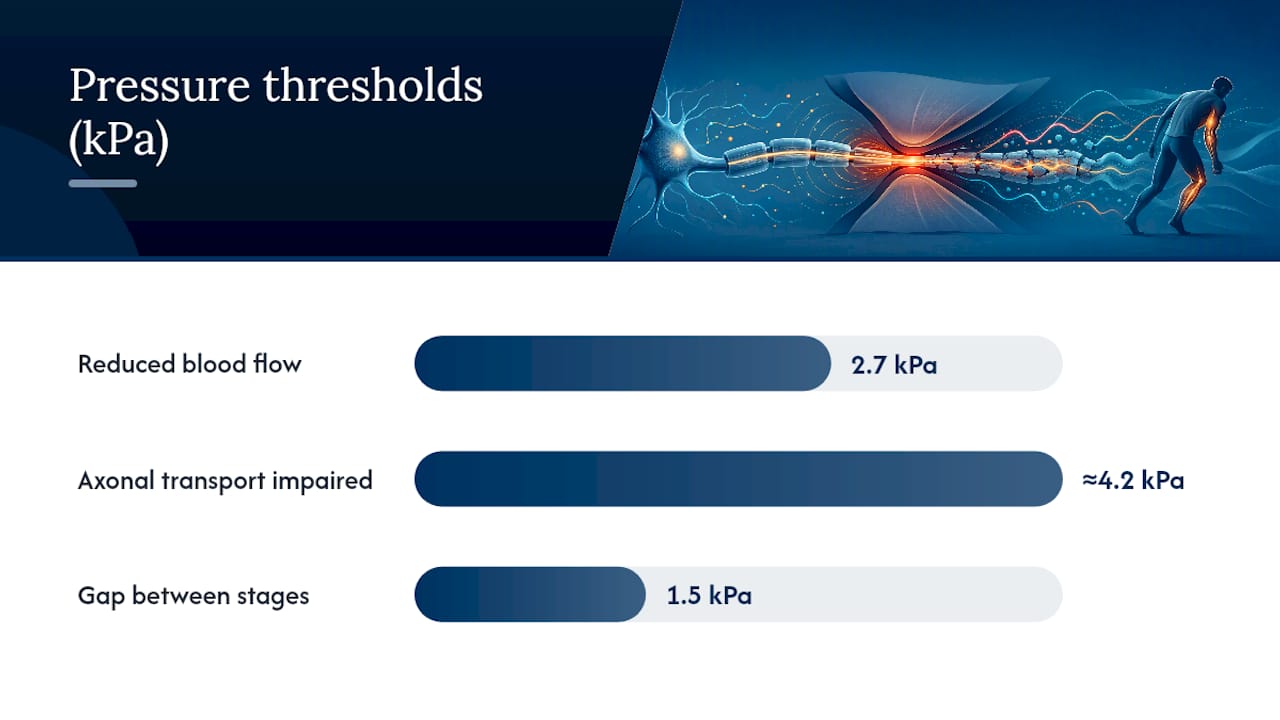
Research on peripheral nerve loading found that pressures as low as 2.7 kilopascals reduce blood flow in the small epineurial veins surrounding the nerve. That is a remarkably small amount of force, roughly what a snug watch band or a crossed leg can generate against soft tissue. Higher pressure levels can impair axonal transport, the internal system that shuttles proteins and nutrients along the nerve fiber. Without that transport, the nerve cell body loses contact with its own signaling machinery.
Statistic to remember: a pressure difference of less than 1.5 kilopascals separates “blood flow reduced” from “internal transport disrupted.” That is a narrow window, which is part of why nerve compression symptoms can escalate faster than people expect.
If compression persists, the endoneurial fluid pressure inside the nerve rises within hours, producing swelling that can trigger connective tissue changes and scarring that make recovery harder even after the pressure is removed. From there, sustained pressure pushes the nerve into demyelination, where the insulating sheath breaks down, and eventually axon loss, where the fiber itself degenerates. Demyelination alone often recovers well. Axon loss is a different problem, because the fiber has to regrow rather than just re-insulate.
Pro Tip: If a limb “falls asleep” and recovers within minutes once you move it, that is almost always a reversible metabolic block, not damage. Frequent recurrence in the same spot, though, is a signal the tissue around that nerve is chronically tight and worth having assessed.
The duration matters as much as the pressure. Compression sustained beyond roughly six weeks substantially raises the risk of permanent changes, including muscle atrophy and irreversible fiber damage. That six-week mark is not a hard deadline, but it is the point where clinicians start treating the situation with more urgency.

What Weakness and Related Symptoms Actually Look Like
Motor symptoms and sensory symptoms tell you different things, and separating them helps you describe what is happening to a clinician more precisely.
- Motor signs show up as reduced grip strength, dropping objects, a foot that catches on the ground when you walk, or one arm tiring faster than the other during the same task.
- Sensory signs include numbness, tingling, or a pins-and-needles sensation, usually in a pattern that follows the nerve’s specific territory rather than the whole limb.
- Distribution matters. Weakness from nerve compression tends to track a nerve’s path (a dermatome for sensation, a myotom for motor function), not spread evenly across a limb the way general fatigue or muscle strain does.
- Triggers and progression. Certain positions, like sitting with legs crossed or sleeping with an arm overhead, provoke symptoms, and repeated exposure without relief tends to make episodes longer and more frequent.
- Red flags include weakness that keeps worsening over days, weakness affecting more than one limb, or any change in bladder or bowel function alongside limb symptoms.
Nerve compression symptoms typically build gradually, which is exactly why people tend to dismiss early weakness as “just being tired.”
How Long Does Weakness From Nerve Compression Last?
Recovery timing depends almost entirely on which of the two mechanisms is at play. A transient metabolic block, the kind behind a limb falling asleep, resolves in minutes to days once pressure lifts and blood flow returns. Structural axon injury is a much longer process.
- Metabolic block: minutes to a few days once pressure is removed
- Demyelination without axon loss: weeks to a few months, often with good recovery
- Axon loss: months, following the nerve’s regrowth rate of roughly 1 millimeter per day
- Compression sustained past six weeks carries a meaningfully higher risk of incomplete recovery
Certain factors stack the odds against faster healing: diabetes (which independently slows nerve repair), delayed evaluation, and severe or high-pressure compression from the start. A nerve injured at the wrist, for instance, might need several months to regrow enough distance to restore hand function, and full strength doesn’t always come back even then.
How Clinicians Diagnose Nerve Compression
Diagnosis usually starts with a conversation and a physical exam before any scan gets ordered. Your clinician will ask when the weakness started, what positions make it worse, and whether numbness travels in a specific pattern.
- Physical exam typically includes provocative tests (movements that reproduce the nerve compression symptoms), reflex testing, and manual muscle strength grading.
- Imaging (MRI or ultrasound) gets prioritized when a structural cause is suspected, such as a herniated disc, bone spur, or cyst pressing on the nerve.
- Nerve conduction studies and electromyography (EMG) measure how well electrical signals travel along the nerve and whether muscle fibers are receiving normal input, which helps distinguish a conduction block from actual axon loss.
These tests matter because general muscle weakness has many possible causes, and separating a nerve-compression cause from a muscular or systemic one changes the entire treatment plan.
Treatment Options and When to Seek Urgent Care
Most cases of nerve compression respond to conservative treatment, and surgery is the exception rather than the default.
- Activity modification removes the specific position or repetitive motion causing the pressure in the first place.
- Splints or braces hold a joint in a neutral position, especially overnight, when unconscious positioning often makes symptoms worse.
- Targeted physiotherapy builds strength and mobility around the compressed area without aggravating it.
- Short-term analgesics or anti-inflammatories manage pain while the underlying issue resolves.
- Steroid injections can reduce inflammation around a nerve when conservative measures alone aren’t enough.
- Surgical decompression becomes the right conversation when motor deficits keep progressing or conservative care fails after a reasonable trial period.
Pro Tip: Don’t wait for pain to disappear before returning to normal activity. Waiting for zero symptoms often means waiting past the point where conservative care works best. Talk to a clinician about a graded return instead.
Seek urgent care immediately if weakness is progressing day over day, or if you notice any new bowel or bladder dysfunction. Those are signs the nerve or spinal cord is under a degree of pressure that needs same-day evaluation, not a wait-and-see approach.
How to Reduce Nerve Pressure Before It Becomes a Problem
Small daily habits account for a surprising amount of chronic nerve compression, especially at the wrist, elbow, and neck.
- Adjust your workstation so wrists stay neutral and elbows aren’t resting on hard edges for hours at a time.
- Change sleep position if you wake up with a numb or tingling arm; a pillow between the knees or a different arm position at night often breaks the cycle.
- Use a splint at night for wrist-related symptoms, since most compression during sleep happens from unconscious bent-wrist positioning.
- Pace repetitive tasks with short breaks rather than pushing through discomfort.
Posture plays a bigger role than most people assume; a rounded upper back or forward head position can narrow the space nerves travel through at the neck and shoulder. If symptoms persist beyond a week or two of these changes, that’s the point to stop self-managing and get a professional assessment of how to relieve the compression safely.
Pro Tip: If tingling wakes you up at the same time every night, note the position you were in. That detail alone often points a clinician straight to the compressed structure.
Everton Chiropractic’s Approach to Nerve Compression
Everton Chiropractic, led by Dr. Richard, an experienced Australian chiropractor, focuses on the mechanical side of nerve compression: posture, spinal alignment, and the confined spaces nerves travel through.
- Assessments look at how spinal alignment issues contribute to nerve pressure across the neck, shoulders, and lower back.
- Treatment plans address forward head posture and related spinal changes that narrow the tunnels nerves pass through.
- Chiropractic evaluation works alongside medical diagnosis, not instead of it. A clear understanding of what chiropractic treatment actually involves helps patients see where it fits alongside imaging and nerve conduction testing ordered by a physician.
What the Research Actually Tells Us About Nerve Weakness
Most patient advice on nerve compression treats it as a mystery symptom rather than a mechanical problem with a fairly well-mapped timeline. That’s the gap worth closing. The pressure thresholds from peripheral nerve research for blood flow reduction and axonal transport impairment are key to understanding symptom progression. They explain why a nerve can recover fully from one weekend of bad sleeping position but not from six months of an unaddressed structural pinch.
Conventional advice tends to underplay the six-week window. People wait far longer than that before getting evaluated, often because early weakness feels minor compared to pain, and pain is what usually drives people to seek help. Weakness deserves equal urgency, arguably more, because it is the symptom most tied to structural nerve damage rather than simple irritation.
If there’s one thing to prioritize, it’s this: treat new or spreading weakness as a timing problem, not just a symptom to monitor. The nerve doesn’t care how busy your week is. It responds to how long the pressure has been there.
— Aman
Sources
- Pinched nerve – Symptoms and causes – Mayo Clinic
- Biological Response of Peripheral Nerves to Loading: Pathophysiology of Nerve Compression Syndromes – NCBI Bookshelf
- Nerve Compression Syndromes: Causes, Types & Treatment – Cleveland Clinic
FAQ
Why does nerve compression cause muscle weakness?
Pressure on a nerve reduces blood flow to it and disrupts the internal transport system nerve fibers rely on, so the electrical signal telling a muscle to contract weakens or stops entirely.
How can I stop nerve weakness from getting worse?
Remove the source of pressure through activity modification and positioning changes as early as possible, since compression sustained past six weeks carries a higher risk of permanent damage.
How long does it take to regain strength after a pinched nerve?
A metabolic block can resolve within days once pressure lifts, but recovery from structural axon damage follows the nerve’s regrowth rate of about 1 millimeter per day and can take months.
How is nerve compression treated?
Most cases respond to conservative care like activity changes, splints, and physiotherapy, with steroid injections or surgery reserved for progressive weakness or failed conservative treatment.