Movement quality matters more than raw volume or weight because it determines whether training builds usable, durable capacity or entrenches dysfunction. The American College of Sports Medicine and clinical research both confirm that training to improve movement quality makes resistance training safer, more effective, and more likely to produce real-world performance gains. The Functional Movement Screen (FMS) and similar tools do not reliably predict injury on their own, according to a systematic review of 17 studies, but they give coaches and clinicians a valuable baseline to guide individualized exercise prescription and track movement capability over time. That distinction matters in practice.
- Injury context: Poor movement patterns under load increase tissue stress at the wrong joints. Fixing the pattern first reduces that risk before you add weight.
- Performance transfer: Quality movement produces strength that works outside the gym. Sloppy reps produce strength that only works in the exact conditions you trained them.
- Quick next step: Before adding load or volume, assess the pattern. Can you perform the movement with control, full range, and stable alignment using bodyweight alone? If not, that’s your starting point.
Key Takeaways
Movement quality matters more than volume or weight because it determines whether training builds durable, transferable capacity or deepens dysfunction that compounds over time.
| Point | Details |
|---|---|
| Pattern before power | Master control and range at bodyweight before adding load; early correction prevents neurological hardwiring of poor mechanics. |
| Assessments guide programming | FMS and similar screens are valuable for baselines and programming, not reliable standalone injury predictors per systematic review evidence. |
| Functional gains come first | A randomized trial found movement-quality training improved balance, posture, and breathing more than conventional training, with similar strength gains. |
| Red flags need clinical input | Persistent pain, neurological signs, or a mechanical block warrant professional assessment before continuing self-guided training. |
| Evertonchiropractic next step | Evertonchiropractic offers personalized clinical assessment and care plans for adults seeking to resolve movement-quality deficits and long-term pain. |
This article is general information, not a substitute for advice from a qualified doctor. Consult a qualified healthcare professional about your own circumstances before acting on anything here.
Table of Contents
- What does “movement quality” actually mean?
- Why movement quality matters more for your long-term health
- Why steps, reps, and heavy weights alone can mislead you
- How is movement quality assessed, and what can those tools actually tell you?
- How to actually improve movement quality: a practical protocol
- What does the research actually show?
- When should you see a clinician or movement coach?
- The practitioner case for prioritizing movement quality
- Evertonchiropractic: movement-quality care that goes beyond the session
- Sources
- FAQ
What does “movement quality” actually mean?
Movement quality is the degree to which a person executes a physical task with appropriate control, range of motion, timing, joint alignment, and variability. It’s not about looking graceful. It’s about whether the right muscles fire in the right sequence, whether joints move through the range the task demands, and whether the body can maintain that standard when fatigued.
A high-quality squat, for example, shows the hips hinging back and down with the knees tracking over the toes, the spine neutral, and the weight distributed through the full foot. A low-quality squat might hit the same depth but with the knees caving inward, the heels rising, and the lower back rounding under load. Both look like squats. Only one builds durable capacity.
The same contrast shows up in a deadlift. A quality hinge loads the posterior chain with a braced spine and controlled hip drive. A poor one rounds the lumbar spine and shifts load to passive structures like discs and ligaments, which aren’t designed to carry it repeatedly.
The components coaches and clinicians assess:
- Stability and motor control: Can the body hold position against gravity and load without compensating?
- Mobility and range of motion: Do joints move through the range the task requires?
- Sequencing and timing: Do the right muscles activate in the right order?
- Balance and proprioception: Does the body know where it is in space and adjust in real time?
- Breathing and diaphragmatic control: Is intra-abdominal pressure managed to support the spine during effort?
Each component can be trained. None of them improves automatically just by doing more reps.
Why movement quality matters more for your long-term health
The benefits of quality movement aren’t abstract. They show up in specific, measurable ways that compound over years.
Injury resilience. Joints and tissues tolerate load better when force is distributed correctly. When movement patterns are off, certain structures absorb stress they weren’t designed for. Over time, that accumulation produces overuse injuries, joint degeneration, and chronic pain. Correcting the pattern before adding load is the most direct way to reduce that risk. Research on movement-focused training shows fewer negative post-training changes compared with conditioning-only approaches.
Transferable strength. Strength built through quality movement transfers to real tasks: lifting a heavy box, catching yourself from a fall, carrying groceries up stairs. Strength built through compensated patterns tends to stay locked in those patterns. Guidance from expert organizations on resistance training emphasizes that technique must be acceptable before progressive overload is applied, precisely because the quality of the adaptation depends on the quality of the input.
Joint and tissue longevity. Cartilage, tendons, and ligaments adapt slowly. They respond well to appropriate, well-distributed load and poorly to repetitive stress at the wrong angles. Prioritizing movement quality is one of the most direct ways to keep joints functional into your 50s, 60s, and beyond. For adults concerned about age-related stiffness, this is where the work starts.
Movement economy and recovery. Efficient movement uses less energy to produce the same output. Practitioners report that prioritizing movement quality reduces markers of tissue damage and often lowers perceived recovery time compared with purely high-volume approaches. Less systemic stress per session means more capacity to train consistently over time.
Psychological benefits. Body awareness improves when you train with attention to quality. People who understand how their body moves tend to feel more confident in physical tasks, more motivated to train, and less anxious about re-injury. The relationship between chronic pain and mental health is well-documented, and movement quality work addresses both sides of that equation.
The practical illustrations are simple. A person who spends two years squatting with knee valgus and a forward lean builds the muscles that reinforce that pattern. When they try to squat heavier, the compensation amplifies. A person who spends the same two years building a quality squat pattern first can load it progressively without the structural cost.
Why steps, reps, and heavy weights alone can mislead you
Volume metrics feel satisfying. Ten thousand steps, five sets of ten, a new one-rep max. They’re trackable, shareable, and easy to chase. The problem is that none of them tell you anything about how the movement was executed.
-
“More reps equals better training.” Repetition reinforces whatever pattern you’re practicing. If that pattern is efficient and well-controlled, more reps build capacity. If it’s compensated, more reps deepen the compensation. The nervous system doesn’t distinguish between good reps and bad ones. It just encodes what it receives. Repeated sloppy mechanics program inefficient motor patterns into the nervous system, making dysfunction the default under fatigue or stress.
-
“Lifting heavier always means getting stronger in a useful way.” Load amplifies whatever movement pattern is already present. A well-patterned lift gets stronger under load. A poorly patterned one gets more entrenched and more likely to produce injury. Usable strength requires that the pattern can hold under the load, not just that the weight moved.
-
“Moving more always reduces pain.” General movement is beneficial, but undirected volume can reinforce the exact patterns causing pain. A person with chronic lower back pain who walks ten thousand steps daily with a persistent anterior pelvic tilt is loading the lumbar spine in extension with every stride. More steps don’t fix the tilt.
A quick self-check for movement quality:
- Can you perform the movement pattern (squat, hinge, push, pull) with bodyweight only, maintaining alignment from start to finish?
- Can you maintain that alignment through moderate fatigue, say, the last two reps of a set?
- Can you identify and self-correct a breakdown in form without a mirror or coach?
- Does the movement feel smooth and controlled, or do you notice grinding, clicking, or compensatory shifts?
If the answer to any of these is no, that’s where quality work begins, not with more load.
The neurological point is worth sitting with. The nervous system encodes movement patterns through repetition. Early correction of poor mechanics matters more than chasing load because the longer a dysfunctional pattern runs, the more automatic it becomes. Under fatigue, stress, or high speed, the body defaults to its most practiced pattern. Make sure that pattern is the right one.
How is movement quality assessed, and what can those tools actually tell you?
Several tools exist for assessing movement quality, each with genuine utility and documented limits.
The Functional Movement Screen (FMS)
The FMS is a seven-test battery that scores fundamental movement patterns on a 0–3 scale. Coaches use it to identify asymmetries, mobility restrictions, and stability deficits that might not be obvious during regular training. Its practical value is in programming: it gives a structured baseline and flags which patterns need regression before loading.
What it doesn’t do reliably is predict injury. A systematic review of 17 studies found inconsistent evidence linking FMS scores directly to lower-extremity injury risk. The correct interpretation is that a low FMS score tells you something needs work, not that injury is inevitable. A high score doesn’t mean you’re protected. Use it as a programming guide, not a clearance test.
Clinician appraisal
A physiotherapist or chiropractor brings something a standardized screen can’t: contextual, hands-on assessment of how your specific history, anatomy, and compensations interact. They look at joint mobility, tissue quality, neurological function, and how patterns change under load or fatigue. That layered view is why personalized chiropractic assessment often catches things a self-administered screen misses.
Wearable technology
Wearables can measure aspects of movement quality at scale, which makes them appealing for ongoing monitoring. Multi-sensor setups provide more comprehensive metrics than single-sensor devices, but user-feedback design remains a key limitation. Raw data without contextualized interpretation can overwhelm rather than guide. A wearable that tells you your hip drop is 12 degrees is only useful if you know what to do with that number.
Pro Tip: Use wearables to track trends over time, not to make single-session judgments. A consistent pattern across multiple sessions is meaningful. One data point is noise.
A broader review of movement-quality assessment tools found that composite scores tend to be reliable, but movement-level scoring varies across tools. The practical guidance: choose an assessment that matches your actual purpose. If you want to track programming progress, a repeatable composite score works. If you want to understand a specific joint’s behavior under load, a clinician’s hands-on appraisal is more informative.
The consistent finding across the literature is that movement assessments are most valuable for guiding exercise prescription and tracking capability changes over time, not for standalone injury prediction. That’s a useful reframe. The goal of assessment isn’t to pass or fail. It’s to know where you are so you can program intelligently from there.
How to actually improve movement quality: a practical protocol
The organizing principle is pattern before power: master mechanics, control, and range before adding load. Adding load too early embeds dysfunctional patterns that become progressively harder to unwind.
The sequence: assess the pattern, regress to where quality is achievable, build skill at that level, then progress load or complexity only when the pattern holds.
Regressions and progressions by movement pattern
- Squat: Start with a box squat or goblet squat to groove depth and alignment. Mid-stage: tempo squats (3-second descent) to build control. Progression: barbell back squat once bodyweight squat is clean through full range under fatigue.
- Hinge: Start with a hip hinge drill using a dowel rod along the spine to feel neutral position. Mid-stage: Romanian deadlift with light load. Progression: conventional deadlift once the hinge pattern is automatic.
- Push: Start with an elevated push-up to build scapular control. Mid-stage: floor push-up with strict alignment. Progression: loaded pressing only when scapular rhythm is consistent.
- Pull: Start with a band-assisted row focusing on scapular retraction. Mid-stage: bodyweight inverted row. Progression: loaded pull-up or row when the pattern is stable.
- Single-leg: Start with a split stance balance hold. Mid-stage: reverse lunge with controlled descent. Progression: Bulgarian split squat or single-leg deadlift once alignment holds under fatigue.
A sample weekly micro-plan
- Session 1 (30–40 minutes): Movement-quality focus. Mobility work for the week’s target patterns (10 minutes), skill practice at regression level (15 minutes), light loaded work at current quality threshold (10 minutes).
- Session 2 (30–40 minutes): Strength with quality emphasis. Compound lifts at working weight, with a coach cue or self-check at the start of each set. Stop a set if form breaks, not after the rep count.
- Session 3 (20–30 minutes): Active recovery plus daily micro-practices. Breathing drills, single-leg balance, hip 90/90 mobility, thoracic rotation. These take minutes and compound over weeks.
- Daily micro-practice (5–10 minutes): One mobility drill and one stability drill tied to your current weak pattern. Consistency here matters more than duration.
Movement-quality checklist for session readiness
- Breathing is diaphragmatic and controlled before loading.
- Target joints move through full range without pain or restriction.
- The pattern holds for 5 clean reps at bodyweight before adding load.
- No compensatory shifts appear in the first working set.
Self-coaching cues that work: “Screw your feet into the floor” (activates hip external rotators in a squat), “Long spine” (cues neutral alignment in a hinge), “Proud chest” (cues thoracic extension in a push), “Pull the bar apart” (cues lat engagement in a pull).
What does the research actually show?
The evidence on movement quality is consistent in its practical direction, even where specific claims need nuance.
| Study | Population | Primary Outcome | Practical Implication |
|---|---|---|---|
| BJSM systematic review (51:7:580) | 17 studies, mixed athletic | Inconsistent injury-prediction from movement screens | Use screens for programming baselines, not injury clearance |
| MDPI randomized trial | 64 outpatients with obesity | Movement-quality group improved FMS, balance, and breathing more than conventional training; strength gains were similar | Movement-quality protocols produce faster functional gains than volume-only approaches |
| PMC wearables review (PMC11437222) | Mixed populations | Multi-sensor wearables provide better holistic assessment; feedback design is a key limitation | Use wearables for trend tracking; pair with expert interpretation |
| Springer assessment review (2025) | Athletic populations | —; composite scores reliable, movement-level scoring varies | Match the assessment tool to the specific purpose |
The MDPI randomized trial is particularly instructive. In 64 participants, the movement-quality group improved postural control, FMS scores, and breathing-pattern measures significantly more than the conventional training group, while both groups made similar strength and body-composition gains. That result suggests movement-quality work doesn’t trade off against strength development. It adds functional capacity on top of it.
The practical takeaway from the body of evidence: don’t over-interpret a single screening score, and don’t dismiss movement quality because screens can’t predict injury with precision. The value of movement-quality work sits in the training itself, not in the predictive power of the assessment that precedes it.
When should you see a clinician or movement coach?
Self-guided movement-quality work is appropriate for most healthy adults with no acute pain or structural history. There are clear signals, though, that professional assessment is the better starting point.
Red flags that warrant a clinician visit:
- Pain that persists beyond 2–3 weeks despite modifying training
- Pain that worsens during or after movement, rather than improving
- Neurological signs: numbness, tingling, or weakness in a limb
- A mechanical block, meaning a joint that simply won’t move through its range regardless of effort
- Consistent failure to progress despite months of quality-focused practice
- A sudden, unexplained decline in movement capacity or coordination
What a good clinical or coaching appointment provides:
- A structured movement assessment that goes beyond what a self-administered screen captures
- Identification of the root cause of a pattern deficit (mobility restriction, motor control gap, structural issue, or pain-driven compensation)
- A targeted intervention plan with measurable goals and a reassessment timeline
- Guidance on what to train, what to avoid temporarily, and how to progress safely
Evertonchiropractic offers personalized chiropractic care that addresses movement-quality deficits alongside pain management, postural correction, and spinal alignment. For adults dealing with persistent pain, chronic stiffness, or a history of injury, that clinical layer makes the difference between guessing at a regression and knowing exactly where to start.
The practitioner case for prioritizing movement quality
Movement quality sits at the center of clinical decision-making for a straightforward reason: it determines what training is safe to prescribe and what it will actually produce.
When a patient presents with lower back pain and a history of high-volume training, the first question isn’t “how much were they doing?” It’s “how were they moving?” Almost always, the answer reveals a pattern deficit that load amplified over time. Correcting that pattern, before returning to load, is what produces lasting relief rather than a temporary reduction in symptoms.
Movement-quality work integrates naturally with chiropractic care. Spinal adjustments restore joint mobility and reduce pain, which creates the neurological window to re-pattern movement. But the re-patterning has to happen, or the same loads and habits reload the same structures. The combination of hands-on clinical care and deliberate movement-quality training is what produces durable outcomes, not either one alone.
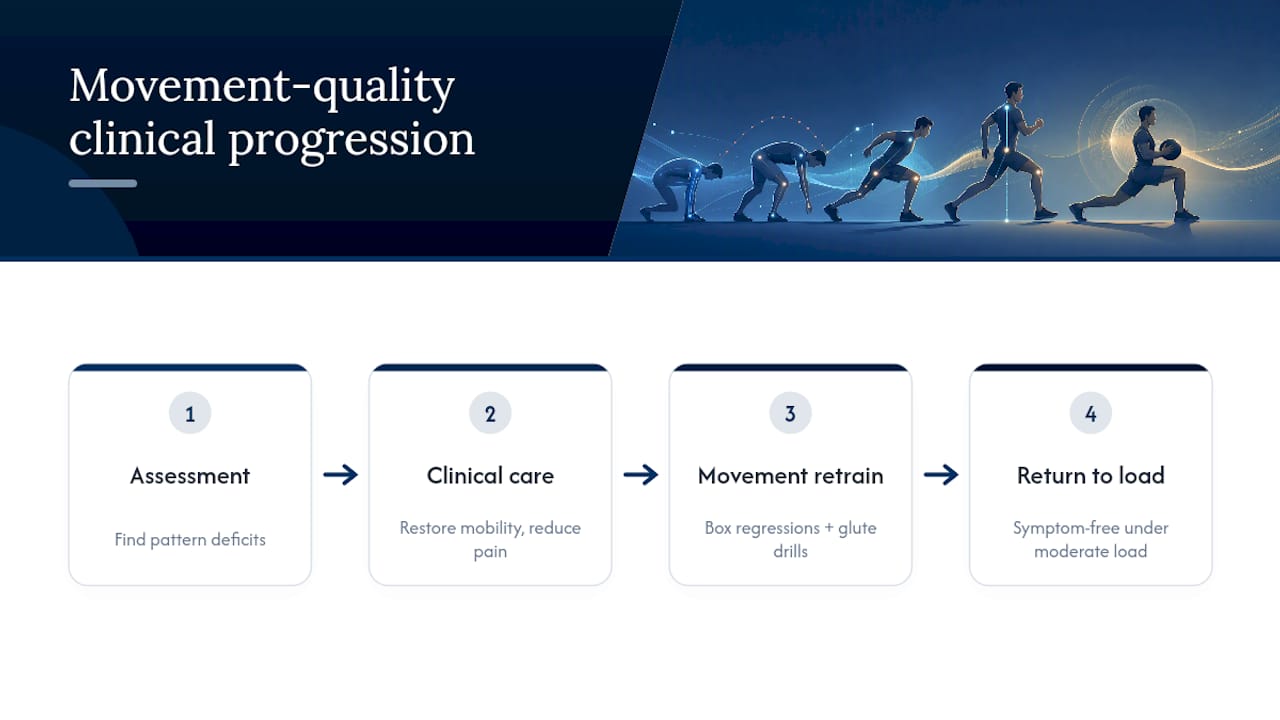
A typical progression looks like this: a patient arrives with chronic knee pain that flares during squatting. Assessment reveals limited hip mobility and weak glute activation, so the knee is compensating for both. The clinical work addresses the hip restriction and the neurological inhibition. The movement work rebuilds the squat pattern from a box squat regression, with daily glute-activation drills. Within six to eight weeks, the squat pattern holds under moderate load with no knee symptoms. That’s not a dramatic story. It’s just what happens when the sequence is right.
Evertonchiropractic: movement-quality care that goes beyond the session
Most people who struggle with persistent pain or stalled training progress aren’t lacking effort. They’re lacking the right starting point. Evertonchiropractic provides exactly that: a clinical assessment that identifies the specific movement-quality deficits driving your pain or limiting your performance, followed by a personalized care plan that addresses the root cause rather than the symptom.
Led by Dr. Richard, the clinic works with active adults, seniors, athletes, and office workers who want to move better and stay active long-term. The approach combines spinal care, postural correction, and mobility work into a plan built around your body and your goals, not a generic protocol.
If you’ve been managing pain, working around a restriction, or hitting the same performance ceiling despite consistent training, a structured clinical assessment is the fastest way to find out why. Book a consultation with Evertonchiropractic and get a clear picture of where your movement quality stands and what to do about it.
Sources
- Exercising to Improve Movement Quality: Why and How — ACSM / clinical review (PMC7749228)
- British Journal of Sports Medicine 51(7):580 — systematic review on movement assessment and injury prediction
- Systematic review on wearable technology for movement quality assessment (PMC11437222)
- Effects of a Randomized Home-Based Quality of Movement Protocol on Function, Posture and Strength in Outpatients with Obesity — MDPI
- Systematic review of movement-quality assessments in athletic populations — Springer (2025)
- Exercising to improve movement quality: ACSM Health & Fitness article
- Pattern Before Power: Movement Quality Basics — Breaking Muscle
- Fitness vs Movement: Science Shows Quality Training Matters — MovNat
FAQ
What does “movement quality” mean?
Movement quality refers to how well a person executes a physical task, specifically the control, range of motion, joint alignment, timing, and stability involved. High movement quality means the right muscles fire in the right sequence through the full range the task demands.
Why is movement quality more important than the quantity of weight lifted?
Load amplifies whatever pattern is already present. A well-patterned movement gets stronger under load; a compensated one gets more entrenched and more likely to cause injury. The ACSM’s resistance-training guidance specifies that technique must be acceptable before progressive overload is applied.
What is the difference between movement quantity and movement quality?
Quantity measures how much you do: steps, reps, sets, weight. Quality measures how well you do it: control, alignment, range, and sequencing. A systematic review found that movement-quality training produced greater improvements in balance, posture, and breathing than conventional volume-based training, with similar strength gains.
Why is good movement quality important for injury prevention?
Poor movement patterns distribute force unevenly across joints and passive structures. Over time, that accumulation produces overuse injuries and degeneration. Correcting the pattern before adding load reduces that structural stress at the source, which is why clinicians and coaches prioritize movement quality before volume or intensity.
When should you see a professional about movement quality?
Seek clinical assessment if you have pain lasting more than 2–3 weeks, neurological symptoms such as numbness or tingling, a joint that won’t move through its range, or consistent failure to progress despite quality-focused training. Evertonchiropractic provides structured movement assessment and personalized care plans for exactly these situations.
Recommended
- How to Improve Posture and Alignment – Everton Chiropractic
- Why Resting Might Actually Be Making Your Chronic Joint Pain Worse: Target Movement Therapy for Chronic Pain – Everton Chiropractic
- How to Prevent Age Related Stiffness Daily – Everton Chiropractic
- Prevent Injury Through Better Posture: a Practical Guide – Everton Chiropractic