
Sports chiropractic care is a movement-focused branch of chiropractic that combines spinal and joint adjustments, soft-tissue therapy, and targeted rehabilitation to address pain, posture, and mobility. It goes well beyond a standard back-cracking appointment. The specialty draws on movement analysis, kinetic chain assessment, and exercise-based rehab to treat the root cause of a problem, not just the symptom.
Who does it help? More people than the name suggests:
- Active adults managing recurring back, neck, or joint pain tied to daily movement
- Seniors dealing with postural decline, stiffness, or mobility loss
- Weekend athletes recovering from strains, sprains, or overuse injuries
- Anyone whose pain worsens with specific movements or physical loading
The primary goals are pain relief, improved posture and joint mobility, and injury recovery or prevention — all through non-invasive, drug-free methods.
Table of Contents
- How does sports chiropractic differ from general chiropractic care?
- What treatments and techniques do sports chiropractors use?
- Who benefits most from sports chiropractic care?
- What should you expect at the first visit?
- What does the research actually say?
- Is sports chiropractic safe, and when should you see a doctor instead?
- How do you choose a sports chiropractor in the United States?
- What do sports chiropractic sessions cost in the United States?
- Key Takeaways
- Why movement-focused care matters more than most people realize
- Useful sources and further reading
- Evertonchiropractic: movement-focused care for adults and seniors
- FAQ
How does sports chiropractic differ from general chiropractic care?
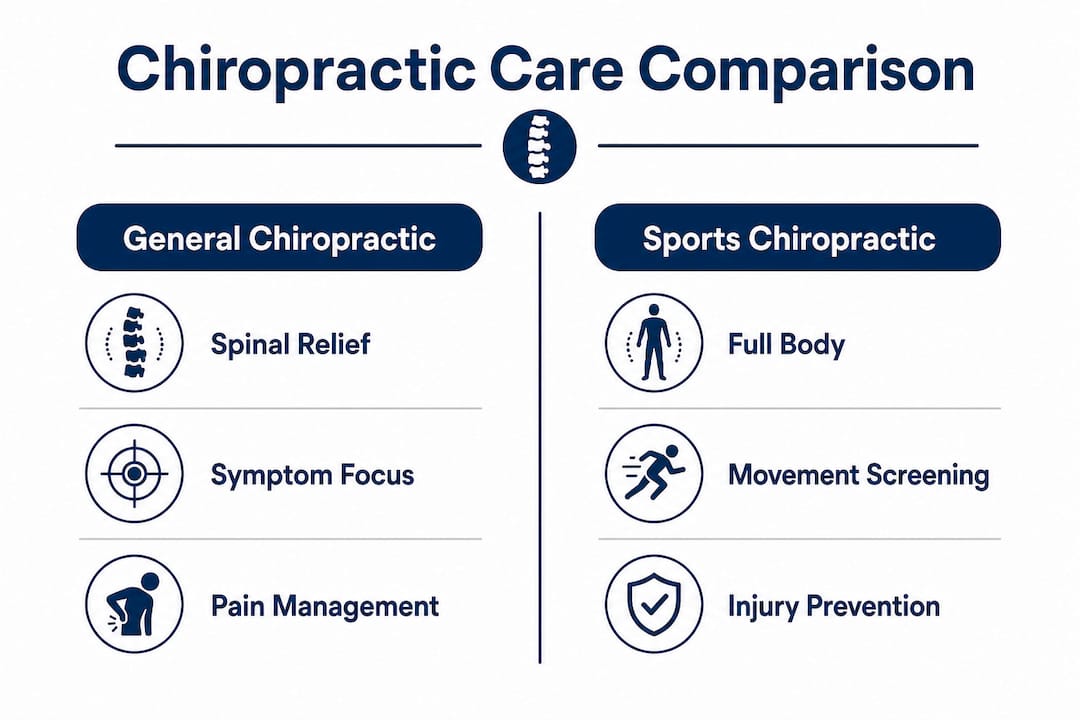
General chiropractic focuses mainly on spinal symptom management: a patient reports back pain, the chiropractor adjusts the spine, and relief is the goal. Sports chiropractic expands that model considerably. According to Wikipedia’s overview of the specialty, it combines movement analysis, soft-tissue therapy, and rehabilitation that goes well beyond spinal adjustment alone.

The practical differences show up immediately in how a clinician thinks about your problem. A sports chiropractor looks at the entire kinetic chain — how your ankle mechanics affect your knee, which loads your hip, which stresses your lumbar spine. General chiropractic rarely goes that far.
Key scope differences at a glance:
- Movement screening: Functional movement tests (not just range-of-motion checks) to find where the chain breaks down
- Biomechanical focus: Sport-relevant and activity-relevant loading patterns, not just spinal symptom relief
- Soft-tissue integration: Myofascial release, trigger-point work, and instrument-assisted techniques alongside adjustments
- Exercise prescription: Structured home programs and in-clinic rehab, not just passive treatment
- Coordinated care: Active collaboration with physical therapists, sports medicine physicians, or orthopedists when needed
| Feature | General chiropractic | Sports chiropractic |
|---|---|---|
| Primary focus | Spinal symptom relief | Full kinetic chain and movement function |
| Assessment tools | Orthopedic tests, X-ray | Movement screens, functional tests, orthopedic tests |
| Soft-tissue work | Limited or basic | Myofascial release, trigger-point, IASTM |
| Rehab component | Minimal | Structured exercise prescription |
| Coordination with other clinicians | Occasional | Routine for complex cases |
For adults and seniors targeting posture correction or mobility improvement, that expanded scope is exactly what makes the difference.
What treatments and techniques do sports chiropractors use?
The toolkit is broader than most patients expect. Henry Ford Health’s sports chiropractic program describes it as a full-body approach combining manual therapy with exercise-based treatment for mobility, muscle balance, and faster recovery.
Manual therapies:
- Spinal manipulation restores joint motion, reduces nerve irritation, and relieves localized pain
- Joint mobilization uses slower, controlled movements to improve range of motion in stiff joints — gentler than high-velocity manipulation and often preferred for older adults
Soft-tissue techniques:
- Myofascial release targets restricted connective tissue to reduce tension and improve movement
- Trigger-point therapy addresses localized muscle knots that refer pain to other areas
- Instrument-assisted soft tissue mobilization (IASTM) uses handheld tools to break down scar tissue and adhesions
Rehabilitation and exercise:
- Mobility drills targeting specific joint restrictions
- Strengthening programs for stabilizer muscles around the spine, hips, and shoulders
- Balance and proprioception training, particularly valuable for seniors at fall risk
- Gait and movement pattern correction for runners or walkers with recurrent lower-limb issues
Some clinics also use shockwave therapy to accelerate healing in chronic tendon problems, and kinesiology taping to support joints during the rehab phase. These are adjuncts, not replacements, for the core manual and exercise work. You can explore specific sports chiropractic techniques in more detail to understand how each one fits into a care plan.
Pro Tip: The research consistently shows that manual therapy paired with structured exercise outperforms either approach alone. If your chiropractor only adjusts you and sends you home with no rehab component, ask about adding one.
Who benefits most from sports chiropractic care?
The patient list is wider than competitive athletes. Research published in PMC confirms that sports chiropractic commonly addresses conditions central to adult and senior health: low back pain, postural dysfunction, joint stiffness, and functional decline.
Common patient profiles:
- Seniors with postural kyphosis or mobility loss — forward head posture and thoracic rounding respond well to a combination of joint mobilization, soft-tissue work, and targeted strengthening
- Adults with chronic low back or neck pain — especially when pain is mechanical (worse with certain movements or positions)
- Weekend athletes with recurrent hamstring, knee, or shoulder problems
- Office workers whose sedentary posture has created hip flexor tightness and upper-back stiffness
- Post-injury patients who have cleared the acute phase but still have movement deficits
Conditions frequently treated:
- Low back pain and sciatica
- Neck pain and cervicogenic headaches
- Shoulder impingement and rotator cuff irritation
- Knee pain (patellofemoral syndrome, IT band issues)
- Plantar fasciitis
- Postural kyphosis and forward head posture
The treatment approach shifts based on the patient. A 68-year-old with postural kyphosis will spend more time on thoracic mobility work and balance training. A 45-year-old weekend runner with recurrent knee pain gets a biomechanical gait analysis and hip strengthening. Same specialty, very different programs.
What should you expect at the first visit?
The first appointment is an assessment, not just a treatment. Palmer College’s clinical curriculum outlines what a thorough initial exam includes: movement screening, orthopedic tests, posture analysis, a review of your activity history, and imaging when clinically indicated.
Practical preparation:
- Bring a written summary of your activity history, including sports, exercise habits, and past injuries
- Wear comfortable, athletic clothing — you will perform functional movements during the exam
- Expect the chiropractor to observe how you squat, hinge, walk, or reach, not just ask where it hurts
- Be ready to describe which movements provoke or relieve your symptoms
- Ask whether X-ray or MRI is needed before treatment begins
A typical short-term care plan moves through two phases. The acute phase (roughly weeks 1–3) focuses on pain reduction and restoring basic joint motion, often with two to three visits per week. The rehab phase (weeks 3–8 or longer) shifts toward strengthening, movement retraining, and reducing visit frequency. Maintenance care after that is optional and patient-driven.
Pro Tip: Track your progress with functional measures, not just pain scores. Can you reach further? Walk longer without discomfort? Those numbers tell you more than a 0–10 pain rating.
What does the research actually say?
The evidence base is solid for some outcomes and genuinely mixed for others. A randomized controlled trial published in BMC Musculoskeletal Disorders found that multimodal sports chiropractic interventions — combining manipulation, mobilization, and soft-tissue work — trended toward fewer lower-limb strains and reduced time missed from injury when added to standard care.
Injury prevention and rehabilitation? Well-supported. Chiropractic Economics’ systematic review confirms that integrating chiropractic into sports medicine can reduce injury rates and support faster recovery as part of multidisciplinary care.
Direct performance enhancement is a different story. A systematic review on spinal manipulation and performance outcomes found mixed evidence: some immediate small effects appear in certain subgroups, but long-term raw performance gains remain unclear. The honest framing is this: sports chiropractic is foundational movement and injury-management care, not a performance shortcut.
| Outcome | Evidence strength | Notes |
|---|---|---|
| Low back pain relief | Strong | Supported by multiple RCTs |
| Injury prevention | Moderate | RCT data trends positive; more research needed |
| Mobility and posture improvement | Moderate | Consistent in clinical programs |
| Immediate performance boost | Weak to mixed | Small acute effects; long-term unclear |
For adults and seniors, the practical takeaway is straightforward: the evidence supports using sports chiropractic for pain relief, posture correction, and mobility improvement. Expecting it to add yards to your golf drive is a different claim entirely.
Is sports chiropractic safe, and when should you see a doctor instead?
For most adults and seniors, the risk profile of manual and soft-tissue techniques performed by a licensed chiropractor is low. Mild soreness after an adjustment or soft-tissue session is common and typically resolves within 24–48 hours.
Red flags that require medical evaluation before or instead of chiropractic care:
- Progressive neurological deficits (worsening weakness, numbness, or loss of bladder/bowel control)
- Unexplained weight loss alongside spinal pain
- Fever with back or neck pain
- Severe, constant pain that does not change with position or movement
- Night pain that wakes you from sleep consistently
- History of cancer, osteoporosis with fracture risk, or recent spinal surgery
When any of these are present, a medical doctor should evaluate you first. A good sports chiropractor will refer you out when the situation calls for it, and will coordinate with your physician or specialist when co-management makes sense.
How do you choose a sports chiropractor in the United States?
Credentials to verify:
- Active state chiropractic license (check your state board’s public registry)
- Post-graduate training in sports chiropractic (look for CCSP, DACBSP, or ICSC credentials)
- Continuing education in geriatric care or rehabilitation if you are a senior or have complex mobility issues
Questions to ask when booking:
- Do you have experience treating seniors or adults with postural problems?
- What does a typical care plan look like, and how do you measure progress?
- Do you collaborate with physical therapists or physicians when needed?
- What outcome measures do you use beyond pain scores?
Logistics checklist:
- Confirm your insurance covers chiropractic and ask whether the clinic bills directly
- Ask about session length — a thorough first visit should run 45–60 minutes
- Check that the clinic has space for functional movement testing, not just a treatment table
- Ask whether telehealth follow-ups are available for progress reviews
For spinal alignment and neck pain concerns specifically, confirm the chiropractor performs a cervical orthopedic screen before any neck manipulation.
What do sports chiropractic sessions cost in the United States?
Costs vary by region, clinician experience, and the services included. A first visit with a full movement assessment typically runs higher than follow-up sessions. Clinics in major metro areas generally charge more than those in smaller markets. Adding services like shockwave therapy or extended rehab sessions increases the per-visit cost.
Factors that affect what you pay:
- Geographic region (urban vs. rural)
- Whether the clinic accepts your insurance plan
- Session length and complexity (assessment-only vs. treatment + rehab)
- Added modalities (shockwave, taping, dry needling)
Insurance coverage for chiropractic varies widely. Medicare covers a limited number of spinal manipulation visits per year for medically necessary care. Many private plans cover chiropractic with a copay, though coverage for rehab exercises or soft-tissue work may be separate. Always call your insurer before the first visit.
Timeline expectations: Most adults with mechanical back or neck pain report meaningful pain relief within 4–6 visits. Measurable posture or mobility improvements typically take 6–12 weeks of consistent care combined with a home exercise program. Seniors with longer-standing postural changes should expect the longer end of that range.
Key Takeaways
Sports chiropractic care combines spinal adjustments, soft-tissue therapy, and structured rehabilitation to address pain, posture, and mobility in adults and seniors through evidence-informed, non-invasive methods.
| Point | Details |
|---|---|
| Broader than general chiropractic | Sports chiropractic adds movement screening, kinetic chain analysis, and exercise rehab to standard adjustments. |
| Best evidence for pain and prevention | RCT data supports injury prevention and pain relief; direct performance gains have weaker, mixed evidence. |
| First visit is an assessment | Expect movement screens, orthopedic tests, and posture analysis before any hands-on treatment begins. |
| Timeline: 4–12 weeks | Pain relief often comes within 4–6 visits; posture and mobility gains typically take 6–12 weeks of consistent care. |
| Evertonchiropractic | Offers personalized, evidence-informed care plans for posture correction, pain relief, and mobility improvement. |
Why movement-focused care matters more than most people realize
The conventional view of chiropractic care — you come in with back pain, you get adjusted, you leave feeling better — misses the most important part of the work. The adjustment is a tool, not the treatment. What actually drives durable results is identifying where movement has broken down and building it back up systematically.
Seniors especially tend to underestimate how much “silent” movement loss has accumulated before pain ever shows up. By the time someone books an appointment for knee pain or a hunched posture, they have often been compensating for hip stiffness or thoracic restriction for years. Addressing the symptom without the underlying movement deficit is why so many people get temporary relief and then cycle back to the same problem.
The research backs this up. Henry Ford Health’s integrative sports program frames high-quality movement screening and targeted rehab as the drivers of the best outcomes. That framing matches what the clinical evidence shows: multimodal care that pairs manual therapy with structured exercise consistently outperforms passive treatment alone.
For older adults, the goal should never be just “less pain.” It should be moving better, falling less, and staying active longer. Pacing matters too. Functional goals — walking a mile without stopping, getting up from the floor without assistance — are more meaningful progress markers than a pain score dropping from a 6 to a 4. Set those goals at the first visit and track them.
Useful sources and further reading
- Unlocking Athletic Potential: Chiropractic in Sports Medicine (PMC) — peer-reviewed overview of injury prevention, recovery, and multidisciplinary integration
- BMC Musculoskeletal Disorders RCT on sports chiropractic — randomized trial on multimodal intervention and lower-limb injury outcomes
- Systematic review: spinal manipulation and performance (Springer) — honest look at where evidence is strong and where it is not
- Chiropractic Economics systematic review — broad survey of chiropractic’s role in sports medicine
- Palmer College: chiropractic care for athletes — clinical training context and assessment overview
- Henry Ford Health sports chiropractic program — real-world program description and treatment philosophy
- Evertonchiropractic: personalized chiropractic treatment — how tailored care plans work for posture, pain, and mobility
- Evertonchiropractic: chronic pain and movement — long-form guide for adults and seniors managing persistent pain
Evertonchiropractic: movement-focused care for adults and seniors

Evertonchiropractic, led by Dr. Richard, takes the approach this article describes: thorough movement assessment first, then a personalized care plan built around your specific posture, pain, and mobility goals. The clinic works with active adults, seniors, and anyone whose pain is linked to how they move, not just where it hurts. Rather than defaulting to passive treatment, the focus is on identifying what is actually limiting your movement and building a plan that addresses it long-term.
If you are dealing with low back pain, sciatica, postural decline, or joint stiffness, the evidence behind spinal adjustments and targeted rehab is on your side. Book a first appointment with Evertonchiropractic to get a proper movement assessment and a care plan that fits your life.
FAQ
What is sports chiropractic care in simple terms?
Sports chiropractic care is a specialized branch of chiropractic that combines joint adjustments, soft-tissue therapy, and rehabilitation exercises to treat pain, improve posture, and restore movement. It is suitable for active adults and seniors, not just competitive athletes.
How many visits does it typically take to see results?
Most adults with mechanical back or neck pain report meaningful pain relief within 4–6 visits. Posture and mobility improvements generally take 6–12 weeks of consistent care combined with a home exercise program.
Is sports chiropractic safe for seniors?
Yes, when performed by a licensed chiropractor who screens for contraindications first. Techniques are routinely modified for older adults, with gentler joint mobilization replacing high-velocity manipulation when bone density or other factors warrant it.
Does insurance cover sports chiropractic in the United States?
Coverage varies by plan. Medicare covers spinal manipulation for medically necessary care, and many private plans include chiropractic with a copay. Rehab exercises or soft-tissue work may be billed separately, so calling your insurer before the first visit is worth the time.
How is a sports chiropractor different from a physical therapist?
A sports chiropractor uses manual joint adjustments and soft-tissue techniques alongside exercise rehab, while a physical therapist focuses primarily on exercise-based rehabilitation and functional training. The two disciplines overlap significantly and often work best together for complex cases.