
Myofascial pain syndrome (MPS) is a musculoskeletal condition marked by regional pain arising from hyperirritable knots, called trigger points, embedded in taut bands of skeletal muscle or its surrounding fascia. Trigger points come in two forms: active points that fire off pain on their own, and latent points that only hurt when someone presses on them, though both can still limit how a muscle moves. Acute cases often settle quickly with basic care; chronic MPS is defined as pain lasting six months or longer, and it usually needs a more sustained approach. There’s no blood test or scan that confirms MPS on its own. Diagnosis rests almost entirely on a clinician’s hands and a careful physical exam.
- Regional, not widespread: pain stays confined to one muscle group or a connected referral zone, unlike full-body pain conditions.
- Two trigger point types: active (spontaneous pain) and latent (pain only on pressure).
- Chronicity threshold: symptoms persisting beyond a typical half-year period shift the case into chronic management territory.
- No single diagnostic test: clinicians rely on palpation, history, and exclusion of other causes.
Key Takeaways
Myofascial pain syndrome resolves fastest when clinicians treat the mechanical driver behind the trigger point, not just the sore spot itself.
| Point | Details |
|---|---|
| MPS is regional | Pain and trigger points stay localized, unlike fibromyalgia’s widespread pattern. |
| Palpation drives diagnosis | Clinicians press perpendicular to muscle fibers to find taut bands and twitch responses. |
| Six months marks chronic | Symptoms lasting six months or longer generally need sustained, layered treatment. |
| Multimodal care wins | Manual therapy, movement correction, and procedural options work best combined. |
| Red flags need prompt care | Numbness, fever, or rapid worsening should prompt evaluation, not more waiting. |
Table of Contents
- What Are the Symptoms and Signs of Myofascial Pain?
- What Causes Myofascial Pain Syndrome?
- How Do Clinicians Diagnose Myofascial Pain?
- What Are the Best Therapies for Myofascial Pain Relief?
- How Long Does Myofascial Pain Last?
- When Should You See a Clinician for Myofascial Pain?
- How Everton Chiropractic Approaches Myofascial Pain
- Ready to Address the Root Cause of Your Pain?
- What the Evidence Actually Tells Us About Myofascial Pain
- Sources
- FAQ
What Are the Symptoms and Signs of Myofascial Pain?
The hallmark complaint is a deep, dull ache that sits in one region of the body and just won’t quit. Patients often describe stiffness, a tight band of muscle that feels almost rope-like under the skin, and a noticeable drop in range of motion. Pressing on the sore spot frequently reproduces pain the patient recognizes as their usual complaint, which is one of the more telling clues clinicians look for during an exam.
Trigger points themselves fall into two behavioral categories: active points that ache even at rest, and latent points that stay quiet until touched. Both types can still throw off how surrounding muscles fire, which is part of why the pain sometimes shows up somewhere other than where the actual problem lives.
Common exam findings include:
- A palpable taut band running through the affected muscle.
- A focal nodule that feels distinctly firmer than the tissue around it.
- Reproduction of the patient’s familiar pain pattern when the spot is compressed.
- A local twitch response, a brief involuntary flicker of the muscle fiber when the trigger point is snapped or needled.
Referral patterns worth knowing: a trigger point in the upper trapezius commonly refers pain up into the neck and temple, mimicking a tension-type headache. Trigger points in the levator scapulae or rhomboids often show up as a nagging ache between the shoulder blades. If you’ve ever had a “knot” in your shoulder that somehow gave you a headache, that’s the referral mechanism at work, not a coincidence. Understanding how trigger point therapy targets these exact nodules helps explain why treatment sometimes focuses on a spot nowhere near where the pain is actually felt.
What Causes Myofascial Pain Syndrome?
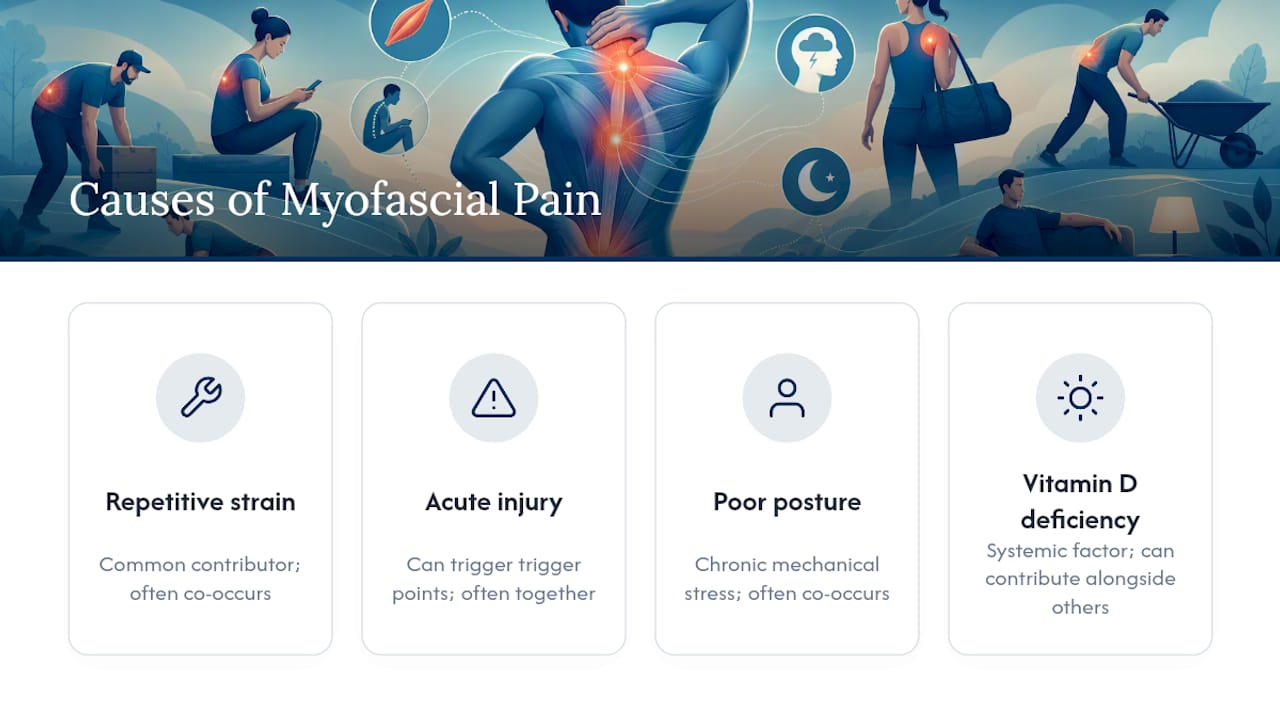
Most cases trace back to something mechanical. Repetitive motion, the kind of daily strain a warehouse worker or a violinist accumulates over years, overloads specific muscle fibers until they develop persistent knots. Acute injury does the same thing faster: a whiplash event or a pulled muscle can seed a trigger point that outlives the original injury by months.
Posture plays a bigger role than most people assume. Hours spent hunched over a laptop shortens some muscles and overstretches others, creating the muscle imbalance that primes tissue for trigger point formation. Poor sitting posture and prolonged desk work are among the most common mechanical drivers clinicians see in office workers.
- Overuse and repetitive strain: assembly line work, certain sports, and repetitive lifting.
- Acute trauma: whiplash, sprains, or a sudden awkward movement.
- Postural imbalance: forward head posture, rounded shoulders, prolonged sitting.
- Systemic contributors: vitamin D deficiency, hypothyroidism, and iron deficiency have all been linked to trigger point formation, likely through their effect on muscle metabolism.
- Behavioral factors: chronic stress, jaw clenching, and a sedentary lifestyle can aggravate existing trigger points or help new ones form.
One leading theory holds that trigger points develop from a localized “energy crisis” in muscle fibers, where sustained contraction cuts off local blood flow and creates a small pocket of tissue hypoxia. It’s a plausible explanation for why these spots feel so much tighter and more tender than the muscle around them, though researchers are still working out the full mechanism.
How Do Clinicians Diagnose Myofascial Pain?
There’s no lab panel or imaging study that lights up and says “myofascial pain syndrome.” Diagnosis is built entirely on a hands-on exam and a detailed history, which is exactly why seeing a clinician experienced in musculoskeletal assessment matters.
The core technique is palpation performed perpendicular to the direction of the muscle fibers. Pressing across the fibers rather than along them makes it far easier to feel the taut band and trigger the response clinicians are looking for.
Signs clinicians check for during palpation:
- A taut, rope-like band within the muscle.
- A hypersensitive nodule that’s noticeably more tender than surrounding tissue.
- A local twitch response, an involuntary muscle flicker triggered by a quick snap or needle insertion.
- Reproduction of the patient’s own familiar pain, not just generic tenderness.
Because MPS shares symptoms with other conditions, ruling those out matters as much as confirming trigger points. Fibromyalgia causes widespread pain across the body rather than the regional pattern typical of MPS, and that distinction changes the entire management plan. Radicular pain from a compressed nerve root and arthritis-related joint pain also get ruled out through targeted tests such as imaging or nerve conduction studies when red flags or an unclear picture warrant them.
Pro Tip: Ask your clinician to show you the palpation finding during the exam. Feeling the taut band yourself, and seeing your own pain reproduced, makes it far easier to trust and follow through on the treatment plan.
What Are the Best Therapies for Myofascial Pain Relief?
There’s no single fix for myofascial pain, and any clinician who promises one is oversimplifying. The strongest results come from multimodal plans that combine mechanical correction, manual therapy, and, when needed, procedural intervention.
- Start with mechanical drivers. Fixing the posture or ergonomic setup that created the trigger point in the first place, whether that’s a desk chair, a repetitive work task, or a sleeping position, prevents the same knot from reforming after treatment.
- Manual therapy. Trigger-point release techniques, deep tissue massage, and joint mobilization work directly on the taut band to reduce tenderness and restore normal muscle length. A chiropractic assessment can identify which muscles are compensating for others, which matters because treating the symptomatic muscle alone often misses the actual mechanical culprit.
- Dry needling or trigger-point injections. Inserting a needle directly into the nodule to provoke a local twitch response can shut down a stubborn trigger point that hasn’t responded to manual work. Benefits are often fast, though they tend to fade without follow-up rehab addressing the underlying driver.
- Medication and topical adjuncts. NSAIDs and muscle relaxants can take the edge off acute flare-ups; topical agents offer localized relief with fewer systemic effects. Neither resolves the trigger point itself.
- Psychological support when relevant. Chronic pain and chronic stress feed each other. When clenching, anxiety, or sleep disruption are part of the picture, addressing that side of things improves how well the physical treatments hold.
- Correct nutritional or systemic deficits. If bloodwork turns up low vitamin D, iron deficiency, or an underactive thyroid, correcting it removes an ongoing driver that manual therapy alone can’t fix.
Individualized planning is the throughline here. There’s no universally accepted protocol, and that’s not a gap in the research so much as a reflection that everyone’s mechanical and systemic contributors look a little different.
Pro Tip: If a trigger point keeps coming back after treatment, the issue usually isn’t the treatment itself. It’s an untreated driver, like a desk setup or a movement pattern, that keeps recreating the same knot.
How Long Does Myofascial Pain Last?
Acute MPS, when caught and treated early, often clears up within weeks. Chronic cases, defined as pain persisting six months or longer, generally need sustained, multi-pronged management and carry a less favorable prognosis than acute flare-ups.
What tips a case from acute into chronic? Untreated mechanical drivers, unaddressed systemic issues like thyroid dysfunction, and simple delays in seeking care all raise the odds. Left unmanaged, complications creep in beyond the pain itself: reduced function in the affected region, referral pain that keeps recurring, and downstream effects on sleep and mood that make the whole condition harder to shake.
When Should You See a Clinician for Myofascial Pain?
Most regional muscle pain isn’t an emergency, but a few warning signs mean it’s time to stop self-treating and get evaluated.
- Neurological symptoms: numbness, tingling, or weakness that spreads down an arm or leg.
- Systemic signs: fever, unexplained weight loss, or night sweats accompanying the pain.
- Rapidly worsening pain that doesn’t fit the usual pattern of a muscle strain.
- Pain that persists or limits daily function despite a few weeks of basic self-care.
Short of those red flags, sensible first steps at home include gentle stretching of the affected muscle, adjusting your workstation or sleep posture, avoiding the specific movement that aggravates the spot, and alternating heat or ice depending on what feels better. If pain hangs around past a couple of weeks or keeps interfering with sleep or work, that’s the point to book an evaluation rather than keep waiting it out.
How Everton Chiropractic Approaches Myofascial Pain
A proper evaluation starts with a functional movement and posture assessment, not just pressing on the sore spot. Identifying which mechanical habits, a slumped desk posture, an uneven gait, a compensating shoulder, are feeding the trigger point is what separates lasting relief from a treatment that wears off in a week.
Dr. Richard builds care plans that combine manual trigger-point techniques with targeted exercise prescription, addressing both the knot itself and the movement pattern that created it. At an initial appointment, expect a hands-on assessment, a clear explanation of what’s found, and a realistic plan, not a one-size-fits-all adjustment. Anyone exploring long-term pain relief approaches will find the same principle applies to myofascial pain: correcting the driver matters as much as easing the ache.
- Functional movement screening to pinpoint mechanical contributors.
- Manual therapy paired with a structured exercise plan.
- Clear communication about expected timelines and realistic outcomes.
| Point | Details |
|---|---|
| Definition | MPS is regional muscle pain from hyperirritable trigger points, not a whole-body pain disorder. |
| Diagnosis is clinical | No lab test confirms MPS; clinicians rely on palpation, taut bands, and twitch responses. |
| Chronicity matters | Pain past six months typically needs sustained, multimodal management rather than a single fix. |
| Treatment is layered | Combining mechanical correction, manual therapy, and procedural options outperforms any single approach. |
| Watch for red flags | Numbness, fever, or rapidly worsening pain warrants prompt evaluation, not more self-care. |
Ready to Address the Root Cause of Your Pain?
Guessing at which muscle is actually driving your pain, and hoping a foam roller sorts it out, tends to waste months. A proper functional movement assessment identifies the actual mechanical driver behind your trigger points, whether that’s a desk setup, an old injury, or a compensating muscle group elsewhere in the chain. Everton Chiropractic builds treatment plans around what your specific body is doing wrong, not a generic protocol, so relief holds up past the first few sessions.
What the Evidence Actually Tells Us About Myofascial Pain
Most explainers on this topic treat trigger points as the whole story, poke the knot, feel better, done. That’s the part conventional advice gets wrong. The research points somewhere else: trigger points are usually a symptom of a mechanical or systemic problem, not the problem itself. Needling a knot without fixing the desk posture or the thyroid deficiency behind it just buys time before the same knot reappears.
What gets underrated is how often a systemic contributor, low vitamin D, an underactive thyroid, sits quietly behind pain that looks purely mechanical. Skipping that possibility means treating the same trigger point over and over without asking why it kept forming.
If you take one thing from this, prioritize the assessment over the quick fix. A clinician who spends time on movement patterns and posture before reaching for a needle is doing the harder, more useful work. Symptom relief matters, but it’s the second step, not the first.
This article is general information, not a substitute for advice from a qualified doctor. Consult a qualified healthcare professional about your own circumstances before acting on anything here.
Sources
- Myofascial Pain Syndrome – StatPearls – NCBI Bookshelf
- PMC review on multimodal treatment approaches
- PMC clinical review on myofascial pain
FAQ
Why Is Myofascial Pain So Painful?
Trigger points sit in taut, contracted bands of muscle fiber that compress local blood flow, creating a sensitized area that fires pain signals more easily and often refers that pain to nearby regions.
What Causes Myofascial Pain Syndrome?
Repetitive strain, acute injury, poor posture, and systemic issues like vitamin D deficiency or hypothyroidism are the most common contributors, often working together rather than alone.
How Do You Treat Myofascial Pain Syndrome?
Treatment typically combines correcting mechanical drivers like posture, manual therapy such as trigger-point release, and, when needed, dry needling or injections, all guided by an individualized plan since no single universal protocol exists.

Is Myofascial Pain Syndrome the Same as Fibromyalgia?
No. MPS causes regional pain tied to specific trigger points, while fibromyalgia produces widespread pain across the body and requires a different management approach.
How Long Does Myofascial Pain Typically Last?
Acute cases often resolve within weeks with early treatment, while chronic cases, defined as pain lasting six months or longer, usually need sustained, multimodal management.
Recommended
- Trigger Point Therapy: What It Is and How It Works – Everton Chiropractic
- Facet Joint Syndrome: Unlocking Stiff Painful Back Joints Naturally – Everton Chiropractic
- Shoulder Pain Treatment That Lasts – Everton Chiropractic
- Conditions Treated by Spinal Realignment: 10 Key Issues – Everton Chiropractic