
A functional movement assessment, most commonly performed as the Functional Movement Screen (FMS), is a standardized seven-test movement checkup that scores your mobility, stability, and motor control patterns to flag injury risk and guide corrective training. Developed by Gray Cook and colleagues, the FMS assigns each test a score of 0–3, for a maximum composite of 21. A composite score at or below a commonly cited threshold is referenced in research as a marker of elevated injury risk in active populations, though that number is a starting point for conversation, not a verdict. The Selective Functional Movement Assessment (SFMA) is the related clinical pathway for people who already have pain.
Here is what a functional movement assessment gives you in practice:
- A movement baseline you can track over time
- Asymmetry flags showing which side of the body is compensating
- Corrective priorities so training targets the right problem first
- A clear signal when pain during testing means you need clinical evaluation rather than a corrective program
Table of Contents
- What does a functional movement assessment actually measure?
- The seven FMS tests and what each one reveals
- How FMS scoring works and what your score means
- Who should get a functional movement assessment?
- FMS vs. SFMA: which assessment pathway fits your situation?
- What to expect during a functional movement assessment
- How practitioners turn your FMS results into a corrective plan
- What the research says about FMS reliability and limitations
- Key Takeaways
- The part most people miss about movement screening
- Evertonchiropractic offers movement screening as part of personalized care
- Useful sources
- FAQ
What does a functional movement assessment actually measure?
The FMS is not a joint-by-joint range-of-motion test. It evaluates how your body moves as a system under specific positional demands, which is a meaningfully different question.
Four concepts sit at the core of what it measures:
- Mobility: the available range of motion at a joint, including tissue extensibility
- Stability: the ability to control a joint or segment under load, not just hold it still
- Motor control and proprioception: how accurately the nervous system sequences movement across the kinetic chain
- Asymmetry: a meaningful difference between the left and right sides of the same pattern
The FMS places the body in positions where compensations become visible. A person with tight hip flexors and weak glutes, for example, will show that pattern clearly in a deep squat or hurdle step, even if they feel fine walking around. Peer-reviewed commentary describes this as filling the gap between a routine pre-participation medical screen and a sport-specific performance test, by treating the body as an integrated kinetic chain rather than a collection of isolated parts.
The screen is explicitly not a diagnostic tool. It will not tell you which structure is injured or why a joint is stiff. What it does tell you is where the movement system is breaking down, and that is often the more useful question for someone who is training, returning from rest, or trying to stay active long-term.
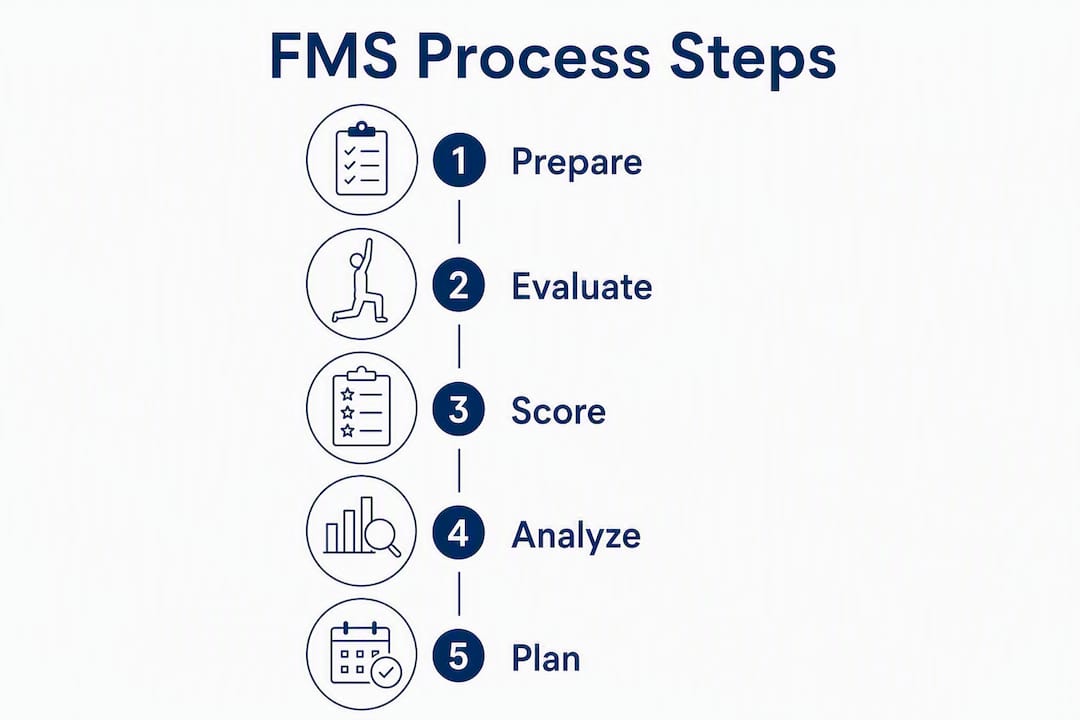
Pro Tip: Don’t fixate on hitting a specific composite score. The FMS developers themselves stress that the real value is in creating a reliable baseline to guide training decisions, not in chasing a perfect number.
The seven FMS tests and what each one reveals
The seven fundamental movement patterns cover the full range of human locomotion and load-bearing demands. Each one is designed to expose a specific category of dysfunction.
-
Deep squat: Tests bilateral symmetry of hip, knee, and ankle mobility, plus thoracic and shoulder mobility. A low score typically points to limited ankle dorsiflexion, restricted hip mobility, or poor thoracic extension.
-
Hurdle step: Assesses single-leg stance stability and hip flexor mobility while the opposite leg clears a hurdle. Compensations here often reflect hip mobility limits or weak stance-side hip stabilizers.
-
In-line lunge: Challenges hip mobility, knee stability, and thoracic rotation in a split stance. This test is particularly sensitive to hip tightness and poor frontal-plane control.
-
Shoulder mobility: Evaluates bilateral shoulder range of motion and scapular mobility by having both hands reach toward each other behind the back. Asymmetry here is common and clinically meaningful.
-
Active straight leg raise (ASLR): Tests hamstring and calf flexibility while the opposite leg stays flat and stable. A low score usually reflects hamstring tightness combined with poor core stability.
-
Trunk stability push-up: Assesses the ability to stabilize the spine under a symmetrical upper-body load. Sagging hips or a segmented push-up pattern indicate core stability deficits.
-
Rotary stability: The most demanding pattern, requiring coordinated ipsilateral or contralateral limb movement while the spine stays neutral. Failure here often signals poor neuromuscular coordination across the trunk.
Three of these patterns include clearing tests: shoulder rotation (paired with shoulder mobility), trunk extension (paired with trunk stability push-up), and trunk flexion (paired with rotary stability). If any clearing test produces pain, the score for that pattern is automatically 0, and the person should be referred for a diagnostic assessment rather than continuing the screen.
Pro Tip: For the hurdle step and in-line lunge, a lateral-view observation is more informative than a front-on view. Ask your practitioner to observe from the side to catch spinal compensation that is invisible from the front.
How FMS scoring works and what your score means
Each of the seven tests is scored on a 0–3 scale:
| Score | Meaning |
|---|---|
| 3 | Movement completed correctly with no compensation |
| 2 | Movement completed but with visible compensation |
| 1 | Unable to complete the movement pattern |
| 0 | Pain during the movement (hard stop — clinical referral required) |

Bilateral tests (hurdle step, shoulder mobility, ASLR, in-line lunge, rotary stability) are scored on both sides. The lower of the two sides is recorded as the test score. This means a person who scores 3 on the right and 1 on the left records a 1 for that test, preserving the asymmetry signal in the composite total.
The composite score runs from 0–21. The commonly discussed threshold score, referenced in research in active populations, is associated with a higher likelihood of injury. It is worth being clear about what that means: this threshold is a risk indicator, not a diagnosis, and not a guarantee of injury. Plenty of people score 15 and get hurt; others score 12 and train for years without incident. The threshold is a flag, not a finish line.
Asymmetry is often a more actionable finding than the composite total. A person who scores 14 with no asymmetries is in a different position than someone who scores 16 with a consistent left-right difference across three tests.
A score of 0 is a hard stop. Clinical guidance is unambiguous: pain during any FMS test or clearing test means the screen should stop, and the person needs a clinical evaluation, not a corrective exercise program.
Pro Tip: Always record both sides of bilateral tests, even when the composite score looks fine. A 3/1 asymmetry buried in a composite of 16 is a more pressing clinical concern than the total suggests.
Who should get a functional movement assessment?
The FMS is built for people who are currently pain-free. That is not a minor caveat; it is the defining boundary of the tool.
Good candidates for an FMS:
- Active adults establishing a movement baseline before starting a new training program
- Athletes preparing for a pre-season or returning from a rest period
- Fitness beginners who want to train without compounding existing movement habits
- Tactical workers (firefighters, military, law enforcement) undergoing occupational screening
- Office workers or seniors who want to understand where their movement quality stands
Who should skip the FMS and seek a diagnostic assessment instead:
- Anyone with current pain, even mild or intermittent
- People recovering from a recent injury or surgery
- Individuals with acute musculoskeletal complaints (new-onset back pain, joint swelling, nerve symptoms)
For these individuals, the SFMA is the appropriate pathway. It uses a similar movement-based framework but is designed specifically for clinical populations with pain, and it leads to a diagnostic classification rather than a corrective exercise priority.
The FMS is typically administered by certified movement specialists, physical therapists, strength and conditioning coaches with FMS certification, or clinicians trained in movement-based intake. Certification through the FMS organization involves standardized training to maintain the inter-rater reliability the screen depends on.

At Evertonchiropractic, movement screening is integrated into the intake process for patients presenting with movement-based complaints, giving the clinical team a structured baseline before treatment begins.
Pro Tip: If you are unsure whether you qualify as “pain-free” for an FMS, err on the side of a clinical evaluation first. A practitioner can determine which pathway fits your situation in a single session.
FMS vs. SFMA: which assessment pathway fits your situation?
Both systems come from the same developers, Gray Cook and colleagues, but they answer different questions for different people.
| Dimension | FMS | SFMA |
|---|---|---|
| Purpose | Screening for movement dysfunction | Diagnostic classification of movement dysfunction |
| Intended population | Pain-free individuals | Individuals with current pain or musculoskeletal dysfunction |
| Scoring | 0–3 per test, composite 0–21 | Breakout system: Functional/Dysfunctional, Non-Painful/Painful |
| Reliability / predictive validity | Moderate; improves with trained testers | Designed for clinical diagnostic use; less studied for injury prediction |
| Who administers | Certified coaches, PTs, movement specialists | Licensed clinicians (PTs, chiropractors, physicians) |
The practical decision is straightforward:
- Recreational athlete, pre-season, no current pain → FMS for a movement baseline and corrective priorities
- Patient with new-onset lower back pain → SFMA or clinical exam to classify the dysfunction before any exercise is prescribed
- Post-rehabilitation return to sport → FMS to confirm movement quality has been restored before full training resumes
The FMS developer materials are explicit: using the FMS on someone with pain produces unreliable data and risks missing a clinical problem that needs treatment, not corrective training.
What to expect during a functional movement assessment
The FMS is a short appointment. Practitioner resources consistently describe the screen as taking 10–15 minutes from start to finish, though a full clinical intake that includes the FMS may run 45–60 minutes when history-taking and result discussion are included.
Equipment used:
- A dowel rod (for overhead positioning)
- Tape marks on the floor
- A measuring board for the hurdle step height
- A measuring stick for shoulder mobility
How to prepare:
- Wear athletic shorts and a fitted top so the practitioner can observe your movement clearly
- Avoid heavy training in the 24 hours before the screen, since fatigue alters movement patterns
- Bring any relevant medical history, including past injuries or surgeries
- Do a light warm-up (5–10 minutes of walking or gentle mobility) before the session
In private U.S. clinics, a standalone FMS screen typically runs in the range of $50–$150 depending on the provider and whether it is bundled with a consultation. When integrated into a full chiropractic or physical therapy intake, the screen is often included as part of the session fee rather than billed separately.
Scores are recorded bilaterally and kept as a baseline record. That baseline is what makes re-testing meaningful: without it, you have no way to know whether a corrective program is working.
How practitioners turn your FMS results into a corrective plan
The screen itself is the starting point, not the product. Here is how a trained practitioner typically moves from scores to action:
-
Identify the priority deficit. Asymmetries take precedence over low composite scores. A bilateral 1 on the deep squat and a 3/1 asymmetry on the hurdle step are two different problems requiring different interventions.
-
Select targeted corrective exercises. Common examples:
- Low deep squat score → ankle dorsiflexion mobility work (wall ankle stretches, heel-elevated squats) plus hip mobility drills
- Low ASLR score → hamstring flexibility combined with core coordination work (dead bugs, supine leg lowering)
- Low trunk stability push-up → anti-extension core training (plank progressions, Pallof press)
-
Integrate corrections into the training program. Corrective work is not a separate warm-up ritual; it gets woven into the session structure so it transfers to loaded movement.
-
Schedule a re-test. Targeted corrective training can improve FMS composite scores within several weeks, which is a useful planning horizon. Most practitioners schedule a formal re-test after about one to two months.
Where manual therapy is part of the picture, chiropractic care can address spinal mobility restrictions that limit scores on tests like the deep squat, hurdle step, and trunk stability push-up. The combination of hands-on spinal work and targeted corrective exercise tends to produce faster and more durable score improvements than either approach alone. For patients recovering from injury, restoring post-injury movement through a structured clinical pathway is often the prerequisite before an FMS baseline even makes sense.
What the research says about FMS reliability and limitations
The FMS has a substantial body of peer-reviewed literature behind it, and that literature is honest about both its strengths and its limits.
“The FMS can reliably produce consistent inter-rater scores when testers adhere to standard procedures and are trained; reliability drops without standardization.”
PMC reliability review
The ≤14 injury-risk threshold has been studied across multiple populations, with the strongest evidence in military and athletic cohorts. The predictive validity is moderate, meaning the screen identifies elevated risk at a group level better than it predicts individual outcomes. A score of 13 does not mean you will get injured; a score of 17 does not mean you will not.
Key limitations to understand:
- Inter-rater variability is real without standardized training. Two untrained observers can score the same movement differently.
- Context sensitivity: the screen was validated primarily in athletic and military populations; its predictive value in general fitness or occupational populations is less established.
- No diagnostic capacity: the FMS identifies where movement breaks down but cannot tell you why, which structure is involved, or what the pathology is.
- Single-tool limitation: Physio-pedia and clinical reviews consistently recommend combining FMS results with balance tests, strength assessments, and clinical history for a fuller injury-risk profile.
Clinical studies indicate that many people can substantially improve composite FMS scores with targeted corrective exercise within several weeks, which is the most practically useful finding in the literature. Movement quality is trainable, and the FMS gives you a structured way to measure that progress.
For athletes, pairing the FMS with a mobility restoration checklist gives a more complete picture of where corrective training should focus across the training cycle.
Key Takeaways
The Functional Movement Screen is a seven-test, 0–21 composite scoring tool that identifies mobility, stability, and asymmetry deficits in pain-free individuals so practitioners can prioritize corrective training before injury occurs.
| Point | Details |
|---|---|
| Seven tests, scored 0–3 | Each test scores mobility, stability, and motor control; the composite maximum is 21. |
| Score ≤14 signals elevated risk | A composite at or below 14 is a research-cited risk indicator, not a diagnosis. |
| Pain = score 0, stop immediately | Any pain during testing means clinical referral is needed before corrective exercise begins. |
| FMS is for pain-free individuals only | People with current pain should pursue the SFMA or a clinical diagnostic exam instead. |
| Evertonchiropractic integrates FMS into intake | Movement screening at Evertonchiropractic provides a structured baseline for personalized corrective and chiropractic care plans. |
The part most people miss about movement screening
Most articles about the FMS spend their energy explaining the scoring system. That is useful, but it misses the more important point: the screen’s value is almost entirely in what happens after the scores are recorded.
A composite score of 13 sitting in a file somewhere does nothing. The same score, reviewed by a clinician who uses it to prioritize hip mobility work over generic core training, changes how someone moves in six weeks. That is the gap between a movement screen as a checkbox and a movement screen as a clinical tool.
The controversy around the ≤14 threshold is real, and the critics are not wrong that the predictive validity is moderate. But those critiques often miss the point of the tool. The FMS was never designed to predict injury with statistical certainty. It was designed to give practitioners a standardized, reproducible way to observe movement quality and make better training decisions. Used that way, the evidence supports it.
The other thing worth saying plainly: if you have pain, the FMS is the wrong tool. Not because it is a bad screen, but because it was built for a different question. Pain changes movement patterns in ways that make the screen’s results uninterpretable. The SFMA exists precisely for that situation, and using the right tool for the right population is what separates a useful clinical assessment from a wasted appointment.
Evertonchiropractic offers movement screening as part of personalized care
If your FMS results point to spinal mobility restrictions, asymmetries, or movement patterns that corrective exercise alone is not resolving, Evertonchiropractic provides a structured clinical pathway that combines movement-based intake with hands-on chiropractic care. Rather than a generic corrective program, the clinic builds a plan around your specific deficits, whether that means addressing nerve pain that is limiting your movement or working through the benefits of personalized chiropractic treatment to restore function over time. Book a consultation to get a movement baseline and a corrective plan built around what your body actually needs.

This article is for general informational purposes only and does not constitute medical or clinical advice. Consult a qualified healthcare professional for assessment and treatment decisions specific to your situation.
Useful sources
- Functional Movement Screen (FMS) and related evidence (PMC): Primary peer-reviewed source for FMS scoring methodology, the ≤14 threshold, and injury-risk evidence in active populations.
- Functional movement screening: the use of fundamental movements as an assessment of function (PMC): Explains the conceptual framework of the FMS as a kinetic-chain assessment bridging medical screening and performance testing.
- Reliability and application notes from FMS developers (PMC): Covers inter-rater reliability conditions and the importance of standardized training for valid results.
- FMS and SFMA: When should I use what? (FunctionalMovement.com): Developer-authored guidance on selecting the correct assessment pathway based on pain status.
- Functional Movement Screen (FMS) (Physio-pedia)): Clinical encyclopedia entry summarizing the FMS, its limitations, and recommendations for combined assessment approaches.
- Functional Movement Screening: What It Is and How It Works (HTK Training Blog): Practitioner-focused overview of how FMS identifies injury risk in healthy individuals; useful as a complementary training resource.
FAQ
What is a functional movement assessment in simple terms?
It is a short, standardized movement checkup, most commonly the Functional Movement Screen (FMS), that scores seven fundamental movement patterns to identify mobility, stability, and asymmetry problems before they lead to injury.
What does a score of ≤14 on the FMS mean?
A composite score at or below 14 is a research-cited indicator of elevated injury risk in active populations. It is a flag for clinical attention, not a diagnosis, and should prompt corrective exercise prioritization or clinical review.
Can I do a functional movement assessment if I have pain?
No. The FMS is designed for pain-free individuals. If you have current pain, the appropriate pathway is the SFMA or a clinical diagnostic evaluation, which Evertonchiropractic can guide you through.
How long does a functional movement assessment take?
The screen itself takes 10–15 minutes. When combined with a full clinical intake and results discussion, the appointment typically runs 45–60 minutes.
How soon can FMS scores improve with corrective training?
Research shows that targeted corrective training can improve composite FMS scores within roughly 6 weeks, supporting a standard re-test interval of 6–8 weeks after beginning a corrective program.
Recommended
- Movement Breaks and Spine Health: Your 2026 Guide – Everton Chiropractic
- How to Prevent Age Related Stiffness Daily – Everton Chiropractic
- How Chronic Pain Affects Mental Health and Why Movement is Medicine Target Psychological Impact of Pain – Everton Chiropractic
- Why Does My Knee Ache? Causes and Next Steps – Everton Chiropractic