
Computer vision-related neck strain is musculoskeletal strain in the neck caused by prolonged screen use, driven by forward head posture, static muscle load, and repetitive postural strain rather than any problem with your eyes. It’s a mechanical overuse injury, not a vision disorder.
If your neck aches after hours at a monitor, three things help right now:
- Raise your screen so the top third sits at eye level, cutting the forward head tilt that overworks your neck muscles.
- Take a 30 to 60 second movement break every 20 to 40 minutes.
- Do a slow, gentle neck rotation and chin tuck, never forcing the stretch.
A prospective study of VDU users found that perceived muscular tension alone raised the risk of developing neck pain by roughly 60% (adjusted IRR of about 1.6). If self-care doesn’t resolve things within a week or two, a clinic visit with a provider like Everton Chiropractic can pinpoint what’s driving your specific pattern of strain.
Key Takeaways
Computer vision-related neck strain is a mechanical, posture-driven problem that responds best to combined ergonomic and exercise-based care rather than equipment changes alone.
| Point | Details |
|---|---|
| Definition matters | This is musculoskeletal strain from posture and load, not a vision or eye-related disorder. |
| Perceived tension is a risk factor | Feeling muscularly tense raises neck pain risk by about 60%, and higher still when combined with job strain. |
| Ergonomics alone falls short | Workstation fixes help comfort but need active exercise and microbreaks to reduce pain long term. |
| Know your red flags | Seek urgent care for new weakness, spreading numbness, bladder or bowel changes, or fever with neck pain. |
| Everton Chiropractic offers assessment-led care | The clinic pairs soft-tissue therapy, mobility exercises, and ergonomic coaching around your specific workday. |
Table of Contents
- What Causes Neck Strain From Screen Time?
- What Does Computer-Related Neck Strain Feel Like?
- When Does Neck Strain Need Medical Evaluation?
- Do Ergonomics and Exercise Actually Fix Neck Strain?
- What Can You Do Today to Relieve Neck Strain?
- How Do You Build a Weekly Routine That Prevents Recurrence?
- What Happens During a Chiropractic Assessment for Neck Strain?
- How Everton Chiropractic Approaches Desk-Related Neck Strain
- Sources
- FAQ
What Causes Neck Strain From Screen Time?
Your head weighs roughly 10 to 12 pounds, and your neck is built to carry that load in a stacked, neutral position. Tilt your head forward, and the physics change fast. Forward head posture past roughly 30 degrees of flexion forces the small muscles at the back of your neck to work far harder just to keep your skull from dropping, since the spine loses its natural load-bearing alignment. That’s why a slouched, chin-forward posture during hours of typing leaves you stiff by 3 p.m. even if you never lifted anything heavy.
Picture a fishing rod bent at the tip: the further the bend, the more strain concentrates at that one point. Your cervical spine works the same way when your head juts forward toward a laptop screen.
Mechanical factors compound the problem:
- Sitting still for long stretches reduces blood flow to neck muscles, accelerating fatigue.
- Poor monitor height and distance force repeated small corrective movements throughout the day.
- Limited thoracic (mid-back) mobility pushes more compensatory load onto the neck and shoulders.
- Unsupported forearms while typing add tension through the upper trapezius.
A systematic review of computer users found the prevalence of work-related musculoskeletal disorders was widely varied across studies, with neck pain consistently among the most affected regions.
Perceived tension is a real risk factor, not just a symptom. The same VDU cohort study found that combining high perceived muscular tension with high job strain pushed the adjusted incidence rate ratio to about 4.0, meaning workers who feel both stressed and physically tense face a substantially higher chance of developing neck pain than either factor alone. Older age, being female, and low physical activity also showed up as contributing risk factors in that research.
What Does Computer-Related Neck Strain Feel Like?
Most office workers describe a dull, localized ache across the back and sides of the neck, often worse by mid-afternoon. The upper trapezius, that thick muscle running from your neck to your shoulder, frequently feels tight or knotted to the touch.
Common patterns include:
- Stiffness that makes turning your head to check a blind spot or glance at a colleague feel restricted.
- A noticeably smaller range of motion compared with mornings or weekends.
- Cervicogenic headaches starting at the base of the skull and radiating toward the temple or behind the eye.
- Occasional tension or aching that spreads into the upper back or shoulder blade, and sometimes a brief tingling down one arm.
That last symptom is common with muscular strain, but it should stay mild and temporary. Progressive weakness or lasting numbness is a different issue entirely, covered in the red-flag section below.
Pro Tip: Sit up, relax your shoulders, and slowly turn your head as far as comfortable to each side, then tip your ear toward each shoulder. Note where it feels tight versus where it feels sharp or electric. Tightness is normal muscular guarding. Sharp, shooting, or electric sensations mean stop and get it checked rather than pushing through.
When Does Neck Strain Need Medical Evaluation?
For straightforward desk-related neck strain, a clinician typically starts with your history, focusing on work setup, hours at a screen, and how the pain behaves throughout the day. That’s followed by a physical exam checking range of motion, muscle tenderness, and basic neurological screening. In garden-variety cases, conservative care comes before any imaging.
Certain symptoms change that plan immediately. Seek urgent medical care if you notice:
- New weakness or loss of coordination in an arm or hand.
- Numbness or tingling that is spreading or getting progressively worse.
- Changes in bladder or bowel control.
- Fever alongside neck pain, or a recent fall or trauma to the neck.
- Severe, unremitting pain that doesn’t ease with rest or position changes.
None of those fit the typical desk-strain picture. For everything else, book a clinic visit if self-care hasn’t helped after about a week or if symptoms are clearly worsening rather than settling.
Do Ergonomics and Exercise Actually Fix Neck Strain?
Ergonomic fixes alone tend to disappoint. A public health review of computer-related neck pain found that workstation adjustments improved comfort but didn’t consistently reduce long-term neck pain on their own. What moved the needle further was pairing ergonomics with active exercise and structured microbreaks, an approach borne out across multiple prevention studies.
Manual therapy has a real, if measured, role. A small randomized study of 26 office workers with chronic neck pain compared thoracic spine mobility exercises against thoracic spine manipulation. Both groups saw improved cervical range of motion and reduced pain, with similar results between the active exercise group and the manual therapy group. That’s a meaningful finding for anyone weighing self-directed exercise against a clinic visit: neither approach clearly beat the other, and both worked.
Spinal manipulation itself is generally well tolerated. Mayo Clinic’s clinical guidance notes it can relieve some neck pain and headaches, though it carries small, usually transient risks like temporary soreness, which is why proper screening and informed consent matter before any adjustment.
Here’s a realistic timeline for combined ergonomic and exercise-based care:
- 2 weeks: Reduced frequency of flare-ups, modest improvement in stiffness, especially in the morning.
- 6 weeks: Noticeably better range of motion and fewer headaches if you’ve stuck with microbreaks and exercises.
- 12 weeks: Durable improvement for most people, assuming workstation habits and exercise routines have become consistent rather than occasional.
Pro Tip: Don’t choose between ergonomics training and exercise. Combine a corrected workstation with a short, progressive neck and thoracic mobility program. That pairing consistently outperforms either approach used alone.
What Can You Do Today to Relieve Neck Strain?
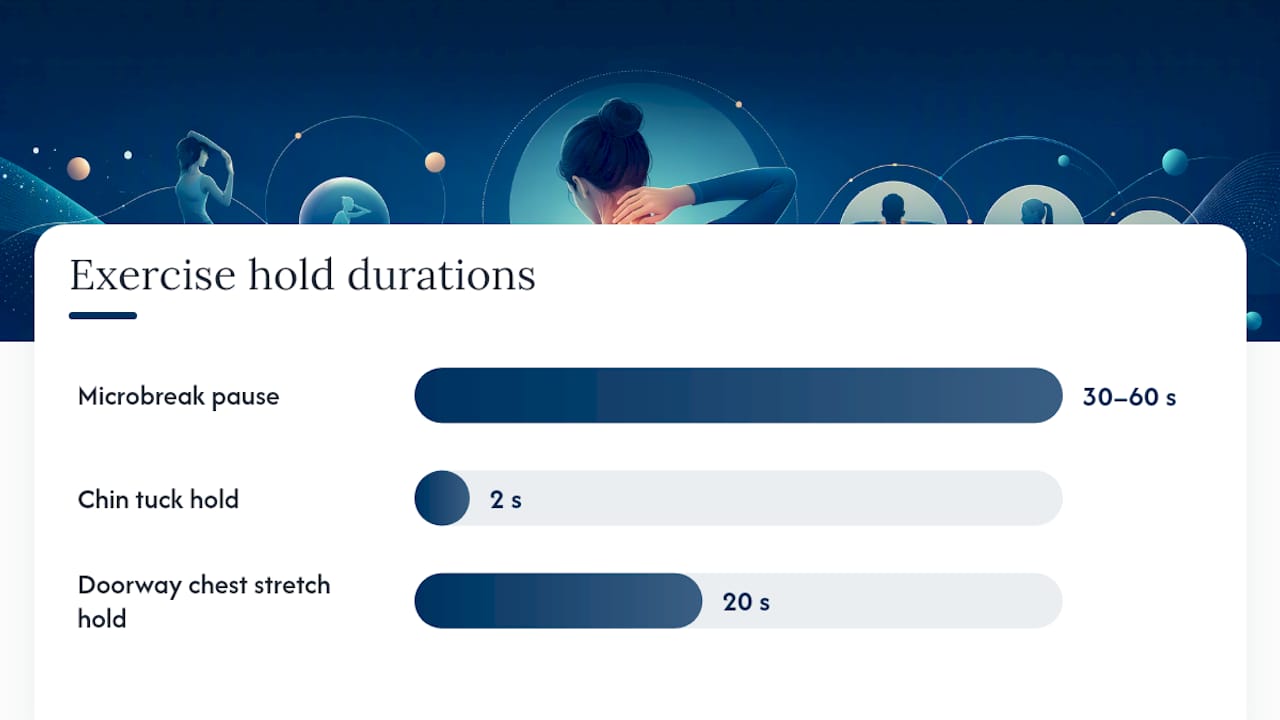
Break the static-posture cycle with a simple microbreak rhythm: pause for 30 to 60 seconds every 20 to 40 minutes. Stand, roll your shoulders back, and squeeze your shoulder blades together for a count of five, repeated three times.
Three desk exercises worth doing daily:
- Chin tucks: Gently draw your chin straight back, like making a double chin, hold two seconds, repeat 10 times.
- Doorway chest stretch: Place forearms on a doorframe, step forward gently until you feel a stretch across the chest, hold 20 seconds.
- Seated thoracic rotation: Cross arms over chest, rotate your torso slowly side to side, 10 reps each direction.
Stop any exercise that causes sharp or radiating pain rather than mild stretching sensation.
Quick workstation fixes that take under 10 minutes: raise your monitor so your eyes meet the top third of the screen, position it an arm’s length away, support your forearms while typing, and adjust your keyboard height so your elbows sit near a 90 degree angle. Our detailed neck pain relief guide walks through additional adjustments if your setup still feels off after these changes.
How Do You Build a Weekly Routine That Prevents Recurrence?
A sustainable plan doesn’t need to be complicated. Structure your week around three elements: daily microbreaks, two short strength or mobility sessions, and one workstation check.
- Monday through Friday: Microbreaks every 20 to 40 minutes, plus one set of chin tucks and shoulder blade squeezes at your desk.
- Tuesday and Thursday: A 10 minute mobility session covering thoracic rotation, doorway stretches, and gentle neck range-of-motion work.
- Sunday: A five minute workstation audit, checking monitor height, chair support, and keyboard position.
Team-level habits help too. Supervisors who actively encourage microbreaks, rotate tasks to avoid hours of uninterrupted typing, and support basic ergonomics training tend to see fewer repeat complaints across their teams, consistent with the prevention literature on computer-related neck pain.
Quick self-audit checklist:
- Monitor top third at eye level, roughly an arm’s length away.
- Forearms supported while typing, elbows near 90 degrees.
- Feet flat, lower back supported by your chair.
- No twisting to face a second monitor for extended periods.
Our best exercises for neck pain guide has extended routines if you want more variety than the basics above.
What Happens During a Chiropractic Assessment for Neck Strain?
A first visit typically starts with a focused history covering your job, hours at a screen, and how your symptoms behave through the day, followed by red-flag screening to rule out anything beyond mechanical strain. The physical exam usually checks cervical range of motion, palpates for tender or tight muscle bands, and runs basic neurological tests. From there, your clinician reviews your workstation setup and builds a short-term plan specific to what they find.
Over the first one to three visits, care commonly includes soft-tissue work to release tight upper trapezius and levator scapulae muscles, targeted exercises, thoracic and cervical mobility drills, and practical ergonomic coaching. A case study combining ergonomics with chiropractic care reported meaningful reductions in pain and improved productivity, though the same report noted results depended heavily on whether the patient kept up with the recommended changes.

Good questions to ask at your first visit: what’s driving my specific pattern, what should I expect week to week, and what happens if I don’t keep up with the home program?
| What Happens | Typical Focus |
|---|---|
| First visit | History, red-flag screening, posture and workstation review |
| Visits 1 to 3 | Soft-tissue therapy, mobility work, exercise coaching |
| Ongoing | Ergonomic reinforcement, progress reassessment |
A clinic-first view on what actually moves the needle
Equipment upgrades get too much credit and follow-through gets too little. A standing desk or a new chair rarely fixes neck strain by itself. What consistently works in practice is pairing hands-on care with exercises the patient actually keeps doing after the pain eases. Case reports on combined ergonomic and chiropractic interventions show clear early gains, but those gains tend to fade when someone quietly drops the home exercises once they feel better. The uncomfortable truth is that adherence, not the specific technique, decides whether relief lasts three weeks or three years.
How Everton Chiropractic Approaches Desk-Related Neck Strain
If your neck pain traces back to hours at a screen, Everton Chiropractic builds a plan around the same combination the research supports: posture correction, targeted exercises, soft-tissue therapy, and practical ergonomic coaching, tailored to your actual workday rather than a generic handout.

Dr. Richard’s clinic assesses your posture and movement patterns first, then designs a short-term plan around what’s actually driving your specific strain pattern, whether that’s monitor height, thoracic stiffness, or a stress-heavy work schedule that keeps your shoulders locked near your ears. You can review the clinic’s long-term pain relief approach to see how assessment leads into a personalized care plan. If your symptoms have persisted beyond a couple of weeks of self-care or seem to be getting worse, a clinical assessment is worth booking rather than waiting it out. Ready to find out what’s actually causing your neck strain? Book an assessment with Everton Chiropractic to get a plan built around your specific workday and posture patterns.
Sources
- A systematic review of work-related musculoskeletal disorders and risk factors among computer users – PMC
- Chiropractic adjustment: what to expect – Mayo Clinic
This article is general information, not a substitute for advice from a qualified doctor. Consult a qualified healthcare professional about your own circumstances before acting on anything here.
FAQ
Is Computer Vision-Related Neck Strain the Same as Eye Strain?
No. It refers to musculoskeletal strain in the neck from posture and static muscle load during screen use, not a visual or ocular condition.
How Long Does Desk-Related Neck Strain Take to Improve?
With consistent ergonomic changes and exercise, many people notice reduced flare-ups within 2 weeks and more durable improvement by 6 to 12 weeks.
Can a Chiropractor Help With Screen-Related Neck Pain?
Yes. Clinics like Everton Chiropractic combine soft-tissue therapy, mobility exercises, and workstation coaching, an approach supported by research on multimodal care for desk workers.
Should I See a Doctor or Try Self-Care First?
Try self-care measures like microbreaks and posture adjustments for about a week; seek medical evaluation sooner if you notice weakness, spreading numbness, or symptoms that worsen rather than improve.
Does Stress Make Neck Strain Worse?
Yes. Prospective research on VDU users found that high job strain combined with perceived muscular tension raised neck pain risk far more than either factor alone.