
Evidence-informed care means blending the best available research evidence with a clinician’s professional judgment and each patient’s own preferences and circumstances to shape a treatment decision. It differs from strict evidence-based practice by giving more weight to context: the patient sitting in front of the clinician, not just the population studied in a trial. The Australian Institute of Family Studies frames this as a deliberate integration of three inputs, while StatPearls describes the classic evidence-based model this approach builds on.
The three components that define evidence-informed practice are:
- Research evidence — findings from clinical trials, observational studies, and systematic reviews.
- Clinical expertise — a practitioner’s accumulated skill in applying and interpreting that research.
- Patient preferences — the values, goals, and lived circumstances of the person receiving care.
Key Takeaways
Evidence-informed care works because it combines research evidence, clinical expertise, and patient preferences instead of relying on any single input alone.
| Point | Details |
|---|---|
| Three components define it | Research evidence, clinical expertise, and patient preferences must all factor into a genuinely evidence-informed decision. |
| EIP is broader than EBP | Evidence-informed practice adds context, systems, and flexibility on top of the classical evidence-based model. |
| Quality of evidence varies | Systematic reviews and RCTs generally outrank observational studies and expert opinion on the evidence pyramid. |
| Documentation matters | Writing down the reasoning behind a decision supports both patient understanding and clinician accountability. |
| Everton Chiropractic applies this model | Treatment plans combine research on posture and spinal health with Dr. Richard’s clinical judgment and each patient’s stated goals. |
This article is general information, not a substitute for advice from a qualified doctor. Consult a qualified healthcare professional about your own circumstances before acting on anything here.
Table of Contents
- What Does Evidence-Informed Care Mean in Practice?
- Evidence-Based Care vs Evidence-Informed Care: What’s the Difference?
- Why Evidence-Informed Care Matters for Patients and Practitioners
- How Clinicians Apply Evidence-Informed Care Step by Step
- How Do You Know if Evidence Is High Quality?
- What Does Evidence-Informed Care Look Like in the Clinic?
- Common Misconceptions About Evidence-Informed Care
- Questions to Ask Your Clinician About the Evidence Behind Your Care
- Where Evidence-Informed Care Came From
- Why Interdisciplinary Collaboration Strengthens Evidence-Informed Care
- Ethical Considerations When Applying Evidence-Informed Care
- What Stands in the Way of Evidence-Informed Care, and What Helps
- Why This Approach Guides How We Practice at Everton Chiropractic
- Book a Chiropractic Plan Built Around the Evidence and Your Goals
- Sources
- FAQ
What Does Evidence-Informed Care Mean in Practice?
Research evidence, clinical expertise, and patient preferences each pull in a slightly different direction, and evidence-informed care is the discipline of reconciling them rather than picking one and ignoring the rest.
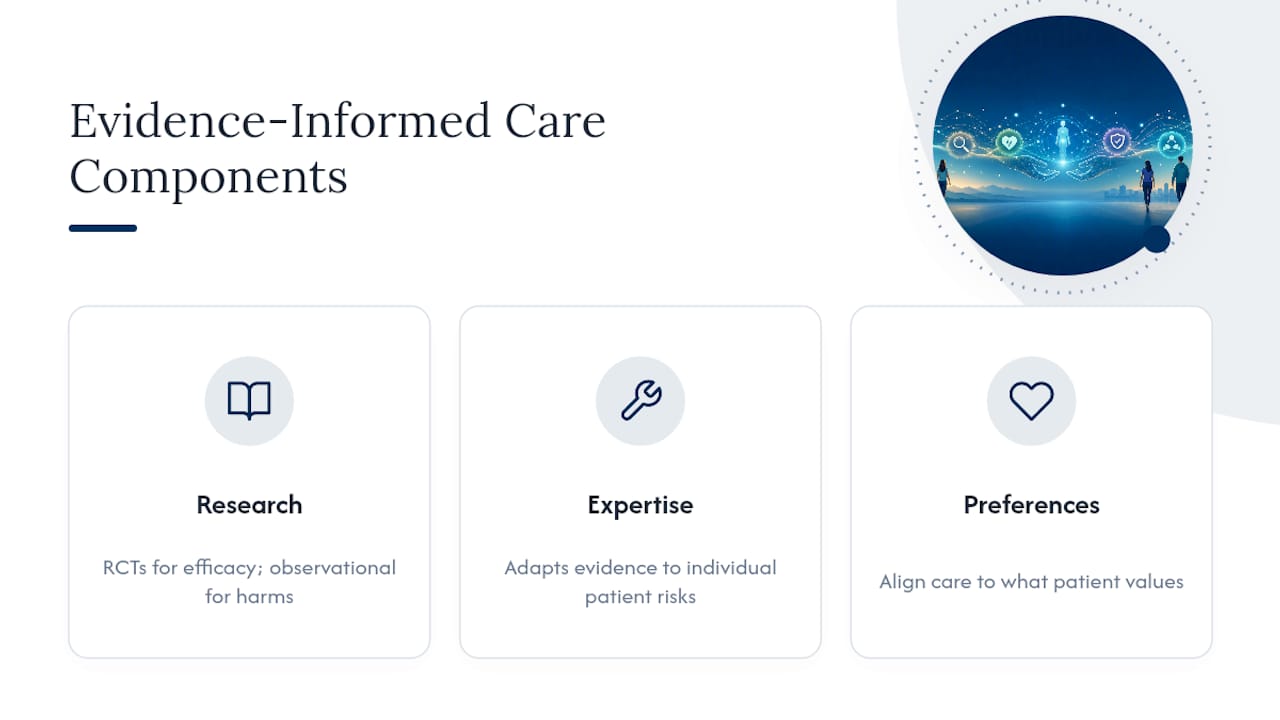
Research evidence is the foundation, but not all research answers the same question. A randomized controlled trial (RCT) is the strongest design for measuring whether a treatment works better than a placebo or alternative. Observational studies, which track real-world patients over time without controlling who gets which treatment, are often better suited to spotting rare harms or long-term patterns that a short trial would miss. A clinician using research evidence well knows which type of study to trust for which question, rather than treating every published paper as equally authoritative.
Clinical expertise is the second component, and it’s what keeps evidence from becoming a rigid script. A trial might show a stretching program reduces lower back pain in adults aged 30 to 55 with no prior surgery. A patient in front of a clinician might be 68, have had a previous spinal fusion, and take blood thinners. Clinical judgment is what translates the trial’s finding into something safe and workable for that specific person.

Patient preferences round out the model. Two patients with an identical MRI finding might want completely different things: one wants to keep training for a half marathon, the other just wants to stop waking up in pain. Verve College’s comparison of the two models makes the point directly: even a statistically favorable treatment can be the wrong choice if it ignores what the patient actually values.
Statistic in focus: the AIFS explainer notes that drawing on multiple sources of evidence, not just one study or one clinician’s instinct, reduces cognitive and confirmation bias in decision making. That’s the practical argument for insisting on all three components instead of leaning on just one.
Skip any one of the three and you get a predictable failure mode: research without judgment produces cookie-cutter protocols; judgment without research drifts into habit and guesswork; and preferences without evidence can validate a treatment that simply doesn’t work.
Evidence-Based Care vs Evidence-Informed Care: What’s the Difference?
Evidence-based practice (EBP) is the classical model: it names the same three ingredients (research, expertise, patient values) but tends to apply them in a fairly linear, protocol-driven way. Evidence-informed practice (EIP) keeps those ingredients but treats the surrounding system, context, and available resources as part of the decision, not an afterthought.
The distinction matters more in practice than it sounds on paper. A PMC review comparing the two frameworks describes EIP as systems-based and integrative: it explicitly builds in facilitation, organizational context, and practitioner judgment as inputs that shape how research gets applied, not just whether it gets applied.
Consider a clinical guideline that recommends a specific exercise dosage for chronic neck pain based on trial averages. A strict EBP reading might apply that dosage uniformly. An EIP approach asks more questions first:
- Does this patient have the equipment, time, or physical capacity to follow the guideline as written?
- Does a comorbidity (arthritis, a prior injury, deconditioning) change what “the same benefit” would require?
- Does the patient’s goal (returning to competitive sport versus simply sitting through a workday without pain) change which outcome matters most?
That flexibility is why Verve College describes EIP as the broader, more adaptable model. It doesn’t reject evidence-based methods. It absorbs them and adds room for context. Nursing literature and the British Journal of Nursing’s coverage of EIP models trace this framing back to systems-oriented models like McSherry’s, which map how evidence actually moves from research into a practitioner’s hands and, from there, into a changed outcome for the patient.
Why Evidence-Informed Care Matters for Patients and Practitioners
Evidence-informed care earns its place because it’s defensible, patient-centered, and better suited to systems that serve diverse populations than a one-size-fits-all protocol.
Defensibility comes first. A clinician who can point to the research behind a decision, explain the clinical reasoning that shaped it, and document how the patient’s preferences factored in has a record that holds up to scrutiny. A nursing academic blog on evidence-based practice makes this point plainly: documenting the rationale behind a choice supports professional accountability, both to patients and to regulators.
Patient-centeredness is the second benefit, and it’s the one patients feel directly. Matching a treatment plan to what someone actually wants, rather than what a guideline assumes everyone wants, tends to produce better follow-through. A plan built around a patient’s real goals is a plan people are more likely to stick with.
Statistic in focus: the WHO’s guidance on evidence-informed decision-making treats consulting multiple information sources, not a single study or opinion, as central to sound policy and program decisions. That principle scales down cleanly to the individual clinical encounter.
The system-level payoff shows up in three places:
- Fewer blind spots. Combining research, expertise, and patient input catches errors that any single source would miss.
- Better resource allocation. Programs designed with living evidence stay current instead of ossifying around outdated studies.
- More equitable outcomes. Decisions that account for context serve populations that don’t match the “average” trial participant.
How Clinicians Apply Evidence-Informed Care Step by Step
Evidence-informed decisions don’t happen by instinct. They follow a sequence that starts with a specific question and ends with a plan to revisit that question later.
-
Formulate an answerable question. Clinicians often use a PICO framework (Population, Intervention, Comparison, Outcome) to turn a vague clinical dilemma into something searchable. “Does manual therapy help back pain?” becomes something closer to: “In an adult with mechanical lower back pain, does spinal manipulation versus general exercise reduce pain scores over six weeks?”
-
Appraise the evidence. Not every study that answers that question deserves equal trust. A clinician checks for study validity (was the design sound), the actual magnitude of effect (a statistically significant result can still be clinically tiny), and applicability (does the study population resemble this patient). The StatPearls entry on evidence-based medicine frames this appraisal step as part of a repeating cycle: ask, acquire, appraise, apply, assess.
-
Integrate evidence with judgment and preference, then document it. This is where the “informed” in evidence-informed care actually happens. The clinician weighs what the research shows against what they know clinically and what the patient wants, then writes down the reasoning. That documentation matters later if the plan needs to be revisited or explained.
-
Implement, monitor, and reassess. Evidence isn’t static. New studies update what’s known, and a patient’s response to treatment updates what’s relevant to them specifically. A responsible plan includes a checkpoint, not just a start date.
Pro Tip: Ask your clinician what the plan would look like if the first approach doesn’t work as expected. A good evidence-informed plan already has a next step in mind, not just a starting point.
When the evidence on a given question is sparse or low-certainty, the right move isn’t to guess confidently. It’s to say so, consider a more conservative option, and schedule a specific point to reassess. That kind of honesty is itself part of evidence-informed practice, not a failure of it.
How Do You Know if Evidence Is High Quality?
Not all evidence carries the same weight, and knowing the difference is what keeps evidence-informed care from becoming evidence-cited care, where a single study gets quoted regardless of how strong it actually is.
The evidence pyramid ranks study designs roughly by how much bias they control for. Systematic reviews and meta-analyses sit at the top because they pool multiple studies. RCTs come next, well suited to measuring whether a treatment works. Observational studies and case series sit lower, useful for spotting patterns or rare harms but more vulnerable to confounding factors. Expert opinion sits at the bottom: useful when nothing else exists, but the weakest form of evidence on its own.
Appraisal goes beyond just checking a study’s spot on the pyramid. Clinicians look at:
- Whether bias or confounding could explain the result instead of the treatment itself.
- Whether the study population resembles the patient in front of them (external validity).
- Whether the reported effect is an absolute difference or just a relative percentage, since the two can tell very different stories about real-world benefit.
The GRADE framework, referenced in the StatPearls overview of evidence-based medicine, separates two questions that often get conflated: how certain is the evidence, and how strongly should that evidence drive a recommendation. A treatment can have solid evidence behind it and still not be strongly recommended for everyone, once harms, costs, and patient values are factored in.
What Does Evidence-Informed Care Look Like in the Clinic?
Abstract definitions are easier to grasp with a concrete picture. Two brief, de-identified scenarios illustrate how the three components interact when they actually meet a patient.
The first involves an adult with chronic lower back pain and a history of osteoporosis. Trial evidence generally supports manual therapy for mechanical back pain, but a clinician applying that evidence to this patient adjusts force and technique to account for reduced bone density. Judgment modifies the intervention without abandoning the research.
The second involves a patient recovering from a minor disc injury whose primary goal is returning to recreational tennis, not simply reducing pain scores at rest. A plan built purely around average trial outcomes might emphasize general activity. A plan shaped by that patient’s stated goal instead prioritizes the specific rotational movements tennis requires, progressing toward function the patient actually cares about.
When a clinician’s plan departs from a standard guideline, whether to accommodate a comorbidity or a patient’s specific goal, the reasoning behind that departure should be written down. That documentation is what separates informed adaptation from improvisation.
Everton Chiropractic’s own explanation of what evidence-informed chiropractic care means walks through how this looks at the clinic level, pairing research on posture and spinal mechanics with individualized assessment before any treatment plan is built.
Common Misconceptions About Evidence-Informed Care
The phrase “evidence-informed” gets misunderstood in two opposite directions, and both misreadings cause real problems.
One misconception treats it as “only research counts,” which strips out clinical judgment and patient input entirely. The other treats it as “anything goes as long as I call it evidence-informed,” which uses the term as cover for whatever a practitioner already wanted to do.
Real pitfalls to watch for:
- Confirmation bias. A practitioner selectively cites studies that support a treatment they already prefer, while ignoring evidence that complicates the picture. The AIFS explainer names this directly as a risk that multi-source evidence use is meant to counter.
- Overgeneralization. Applying a trial’s average result to a patient who looks nothing like the study population.
- Publication bias. Positive results get published more often than null results, which can make a treatment look more effective in the literature than it is in practice.
The safeguards are straightforward: peer-reviewed sourcing, transparent documentation of clinical reasoning, and genuine shared decision making with the patient, not just a signature on a consent form.
Questions to Ask Your Clinician About the Evidence Behind Your Care
You don’t need a research background to check whether your care is being handled in an evidence-informed way. A short conversation reveals a lot.
- Ask what evidence supports the recommended option. A specific answer (“trials on manual therapy for this type of pain show…”) is a good sign. A vague “it just works” is not.
- Ask about alternatives, including their likely benefits and harms. Good shared decision making means being shown options, not steered toward one without comparison.
- Ask how your own goals and health history factored into the plan. If the answer sounds identical to what every other patient would hear, that’s worth questioning.
Where Evidence-Informed Care Came From
The term “evidence-based medicine” entered clinical vocabulary in the early 1990s, largely through work at McMaster University, as a formal push to base clinical decisions on systematically reviewed research rather than tradition or authority alone. That movement built the appraisal tools and hierarchies, like the evidence pyramid, still used today.
Evidence-informed practice emerged later as a response to a real limitation clinicians noticed: strict EBP protocols, built from trial averages, didn’t always translate cleanly into messy, individual clinical situations. Fields like nursing and social policy adopted the “informed” framing to signal that context, practitioner judgment, and the realities of a given health system deserved formal standing alongside the research itself, not just an afterthought bolted onto a protocol.
The shift wasn’t a rejection of evidence-based methods. It was an acknowledgment that the original model, built for population-level questions, needed more flexibility when applied one patient at a time. WHO’s own framing of evidence-informed decision-making reflects this evolution at the policy level: a process built to consult multiple sources and adapt as new evidence emerges, rather than freeze around a single landmark study.
This history explains why you’ll see both terms used, sometimes interchangeably, in modern clinical settings. EBP laid the groundwork. EIP is what practitioners built on top of it once they saw where the original model needed more give.
Why Interdisciplinary Collaboration Strengthens Evidence-Informed Care
No single clinician holds every piece of evidence, expertise, or context a complex case needs, which is why evidence-informed care tends to work better as a team exercise than a solo judgment call.
A patient with chronic pain, for instance, might benefit from a chiropractor’s assessment of movement and spinal mechanics, a physical therapist’s rehabilitation expertise, and a physician’s read on any underlying medical conditions complicating the picture. Each professional brings a different slice of research literacy and hands-on judgment. Collaboration surfaces evidence one discipline might miss and catches assumptions that don’t hold up outside a single field’s frame of reference.
The systems-based view of evidence-informed practice, the same framing the PMC review uses to distinguish EIP from EBP, treats this kind of coordination as a structural feature, not an optional extra. Facilitation and organizational context are part of how evidence actually moves from a study into a changed outcome for a patient, and that facilitation often depends on more than one professional talking to each other.
Practically, this shows up in shared documentation, referral conversations, and a willingness to say “this is outside what I can evaluate, let’s bring in someone who can.” Clinicians who treat their own expertise as the entire picture tend to miss exactly the kind of context that interdisciplinary input catches. Patients benefit most when their care team communicates, not when each provider works in isolation with the same evidence base interpreted differently.
Ethical Considerations When Applying Evidence-Informed Care
Evidence-informed care raises ethical questions that a strict protocol doesn’t, precisely because it gives clinicians more room to adapt. That flexibility needs guardrails.
The central obligation is informed consent that actually informs. Telling a patient “we’ll do evidence-based treatment” without explaining what the evidence shows, what the alternatives are, and how their own preferences shaped the plan falls short of genuine shared decision making. Patients deserve to know when a clinician has deviated from a standard guideline and why.
A second consideration is honesty about uncertainty. When evidence is thin or conflicting, an ethical clinician says so rather than presenting a confident-sounding recommendation that overstates what’s actually known. Overselling certainty to reassure a patient, or to close a sale, undermines the entire point of grounding care in evidence.
Equity matters too. Evidence-informed flexibility should expand access to appropriate care for patients who don’t match a “typical” trial population (older adults, people with multiple conditions, those with limited resources), not become an excuse to give some patients less rigorous care than others. The AIFS piece on evidence-informed approaches frames multi-source evidence use as a bias-reduction tool precisely because it protects against uneven treatment across different patients.
Finally, documentation is itself an ethical practice, not just a defensive one. Writing down the reasoning behind a decision protects the patient’s ability to understand their own care history and protects the clinician’s ability to explain that history later.
What Stands in the Way of Evidence-Informed Care, and What Helps
Adopting evidence-informed care sounds straightforward in principle. In practice, clinics and health systems run into predictable friction.
Time pressure is the most common barrier. Appraising research, documenting reasoning, and having a genuine conversation about patient goals all take longer than following a fixed protocol. Clinics under volume pressure often default to the fastest path, not the most tailored one.
Access to quality evidence is another obstacle. Not every practitioner has easy access to current systematic reviews or the training to appraise them critically, which is part of why frameworks like GRADE exist: to translate raw research into something a busy clinician can apply without redoing the appraisal from scratch.
Organizational culture matters as much as individual willingness. A clinic that rewards speed and volume over documented, individualized reasoning will struggle to sustain evidence-informed habits, no matter how committed any single practitioner is.
What helps: living evidence tools that update automatically rather than requiring manual literature searches, organizational time built in for case review and documentation, and leadership that treats “let’s slow down and check the reasoning” as a strength rather than an inefficiency. The WHO’s evidence-to-policy framework makes a similar point at the system level: sustained evidence use requires infrastructure, not just individual good intentions.
Why This Approach Guides How We Practice at Everton Chiropractic
Grounding treatment decisions in research, clinical judgment, and each patient’s actual goals is the standard we hold ourselves to at Everton Chiropractic. Musculoskeletal pain rarely follows a textbook pattern, and a plan that ignores a patient’s history, comorbidities, or personal priorities risks solving the wrong problem. Dr. Richard’s approach to posture correction and long-term mobility reflects the same principle running through this entire explainer: research sets the direction, clinical experience shapes the path, and the patient’s own goals decide what “better” actually means.
Book a Chiropractic Plan Built Around the Evidence and Your Goals
There are other routes to managing chronic pain, from over-the-counter medication to generic exercise programs you find online, but neither adapts to your specific history or goals the way a personalized clinical assessment does.
Everton Chiropractic builds every treatment plan around the same three-part model covered in this article: current research on spinal health and posture, Dr. Richard’s clinical judgment as an experienced chiropractor, and a conversation about what you actually want your body to do again, whether that’s playing with grandchildren, returning to sport, or just getting through a workday without pain. Instead of a one-size-fits-all adjustment schedule, you get an assessment that accounts for your specific history before any treatment begins. If chronic pain, sciatica, or postural decline has been limiting how you move, explore Everton Chiropractic’s long-term pain relief approach and book an assessment to see how an evidence-informed plan would look for your specific situation.
Sources
- What is an evidence-informed approach to practice and why is it important? (AIFS)
- Evidence-Based Medicine (StatPearls/NCBI Bookshelf)
- WHO guide and tool repository for evidence-to-policy processes
- Evidence‐informed practice versus evidence‐based practice (PMC article)
FAQ
What is evidence-informed nursing?
Evidence-informed nursing applies the same three-part model (research, clinical expertise, patient preference) within a systems-based framework that accounts for a unit’s resources, staffing, and patient population, rather than following a fixed protocol regardless of context.
What is meant by evidence-based care?
Evidence-based care means clinical decisions are guided by the best available research evidence, combined with clinical expertise and patient values, typically following a structured cycle of asking a question, finding evidence, appraising it, and applying it.
What is the difference between evidence-based and evidence-informed practice?
Evidence-based practice follows the classical, more linear three-element model, while evidence-informed practice is broader and systems-oriented, explicitly building in context, organizational facilitation, and practitioner judgment as factors that shape how evidence gets applied.
What are the three main components of evidence-informed practice?
The three components are the best available research evidence, the clinician’s professional expertise and judgment, and the patient’s preferences, values, and personal circumstances.
How does a chiropractic clinic apply evidence-informed care?
A clinic applies it by grounding assessments in current research on posture and spinal mechanics, then adjusting the plan based on clinical judgment and the patient’s specific goals, an approach Everton Chiropractic documents on its own evidence-informed care page.