
For U.S. patients searching for vitality chiropractic alternatives, the strongest options are evidence-informed private practices and multidisciplinary wellness clinics that build personalized treatment plans around your specific condition, not a one-size-fits-all adjustment routine. Evertonchiropractic stands out as the recommended pick for patients who want posture correction, pain relief, and a long-term movement strategy backed by evidence-informed techniques.
Quick shortlist:
- Evertonchiropractic — personalized, evidence-informed plans; best for posture correction, sciatica, and long-term function
- Specialist private practices (e.g., CBP-certified clinics) — best for structural rehab and chronic spinal conditions
- Multidisciplinary wellness centers — best for patients who need chiropractic plus PT, acupuncture, or nutrition under one roof
- Rehab-focused chiropractic clinics — best for post-injury recovery and mobility restoration
- Direct-access community clinics — best for straightforward acute pain with quick scheduling and insurance acceptance
Table of Contents
- How do vitality chiropractic alternatives compare side by side?
- What do alternative clinic models actually offer?
- How do you choose the best chiropractic clinic for your needs?
- What does a quality first visit look like in the U.S.?
- Which certifications and treatment modalities are worth prioritizing?
- What should U.S. patients expect for insurance and pricing?
- Why Evertonchiropractic fits what many U.S. patients are looking for
- Key Takeaways
- The case for demanding more from your chiropractic care
- Selected sources and further reading
- Evertonchiropractic: personalized care for patients who want real results
- FAQ
How do vitality chiropractic alternatives compare side by side?
| Best for | Care model | Typical techniques | Insurance & pricing | Availability | When to choose |
|---|---|---|---|---|---|
| Posture correction, sciatica, long-term function | Personalized 1-on-1 | CBP, spinal adjustments, rehab exercises | Varies; self-pay and insurance options | Local specialist | You want a tailored plan with clear goals |
| Structural spinal rehab | Specialist private practice | CBP, decompression, postural retraining | Insurance accepted at many; self-pay packages | Regional | Chronic disc or curvature issues |
| Complex or chronic cases | Multidisciplinary wellness center | Chiropractic + PT + acupuncture | Major plans accepted; flexible self-pay | Urban/suburban | You need referrals or co-managed care |
| Post-injury recovery | Rehab-focused clinic | Manual therapy, corrective exercise, soft tissue | Insurance common; bundled rehab packages | Widespread | Recent injury, mobility deficit |
| Acute pain, fast access | High-volume community clinic | Standard adjustments | Insurance-friendly; low per-visit cost | National chains | Short-term symptom relief only |
Use-case guidance:
- Choose a specialist private practice or Evertonchiropractic when your goal is structural correction, not just temporary relief. Personalized treatment plans consistently outperform generic adjustment routines for long-term outcomes.
- Choose a multidisciplinary center when your case involves nerve symptoms, failed prior treatment, or a condition that needs imaging and medical co-management.
- High-volume retail clinics work for isolated, uncomplicated acute pain, but they rarely provide the detailed initial consultation or written treatment timeline that evidence-informed care requires.
What do alternative clinic models actually offer?
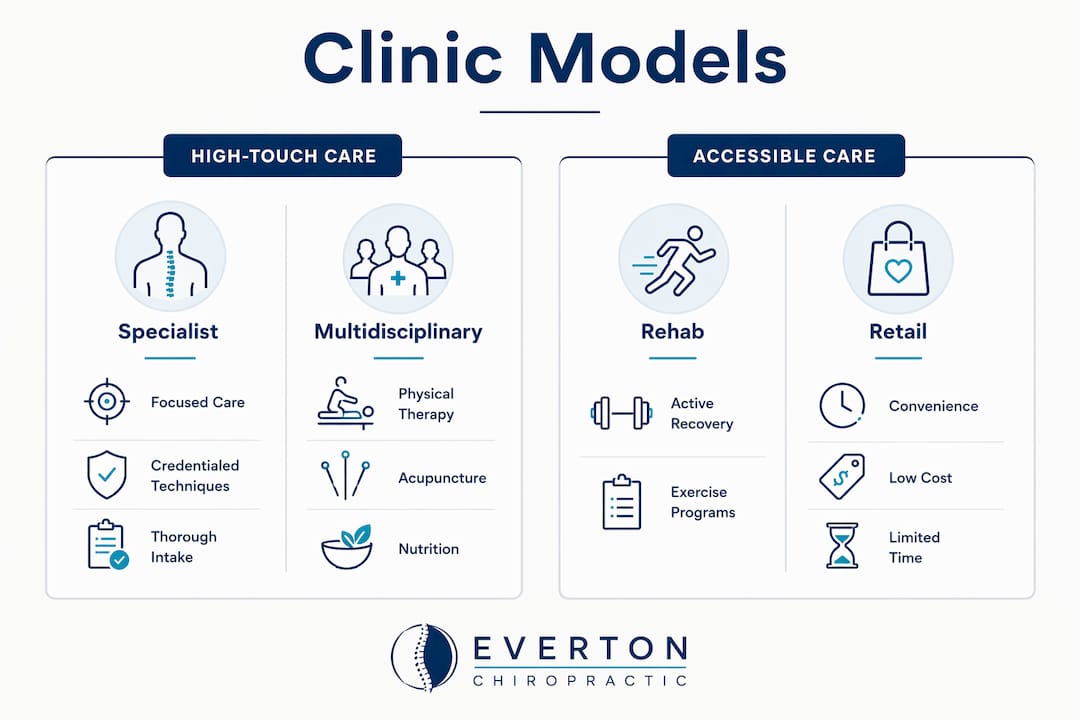
Specialist private practices deliver focused spinal care with credentialed techniques. Expect a thorough intake, postural analysis, and a written care plan with measurable goals.
Multidisciplinary wellness centers combine chiropractic with physical therapy, acupuncture, and sometimes clinical nutrition. They typically maintain referral networks for imaging and medical specialists, which matters when a case is complex or chronic.
Rehab-focused clinics prioritize active recovery. You get manual adjustments plus corrective exercise programming and soft-tissue work, with home-exercise plans assigned from the first visit.

High-volume retail models offer convenience and low per-visit cost. The tradeoff is less doctor time, minimal individualization, and treatment plans that rarely extend beyond symptom management.
Pro Tip: Three signs a clinic is genuinely personalized: the doctor stays with you for the full initial visit (no hand-off to an assistant mid-exam), you leave with a written home-exercise plan, and the clinic gives you a clear timeline with specific goals before your second appointment.
How do you choose the best chiropractic clinic for your needs?
Decision criteria checklist:
- Personalized care model: does the doctor conduct and stay through the full initial exam?
- Technique certifications: does the clinic hold CBP, spinal decompression, or equivalent credentials?
- Rehab integration: are corrective exercises and postural retraining part of every care plan?
- Insurance handling: does the front desk verify benefits and file claims on your behalf?
- Outcome-focused timelines: does the clinic give you written goals and a projected visit schedule?
Questions to ask before booking:
- “Do you accept my insurance, and will you verify my benefits before my first visit?”
- “What does the first appointment include, and how long does it run?”
- “How many visits should I expect before we reassess my progress?”
- “Who designs and supervises my home-exercise program?”
Red flags to watch for:
- The doctor leaves the room during your treatment and an assistant takes over
- No timeline or written goals offered after the initial exam
- Surprise billing for imaging or therapies not mentioned at intake
- Pressure to sign a long-term package before you’ve completed your first visit
Most established U.S. chiropractic clinics operate as direct-access providers, so you can book an initial consultation without a primary care referral. That removes a common delay, but it also means the quality screening falls entirely on you.
What does a quality first visit look like in the U.S.?
A quality first visit at any of the best chiropractic clinics includes a detailed consultation, a 1-on-1 physical assessment, and a clear next-step plan before you leave. Many clinics offer a free initial consultation to discuss your case before you commit to a care plan.
First-visit checklist:
- Complete medical history and symptom timeline
- Focused physical and orthopedic exam
- Postural screen and range-of-motion assessment
- Neurologic testing where nerve symptoms are present
- Imaging referral when clinically indicated
- A brief demonstration treatment if appropriate
- Written summary of findings and recommended next steps
Sample first-visit flow: Arrival and intake forms (10–15 minutes) → 30–60 minute consultation and physical exam with the doctor → initial treatment if appropriate → summary of findings and next-steps discussion before you leave.
Which certifications and treatment modalities are worth prioritizing?
Evidence-informed, multimodal approaches consistently outperform single-technique, high-volume models for complex spinal conditions. Here is what to look for:
Priority credentials and techniques:
- Chiropractic Biophysics (CBP): the most research-supported structural correction method; prioritize for posture problems, spinal curvature, and long-term postural rehab
- Certified spinal decompression: non-surgical option for herniated or bulging discs; look for clinics with dedicated decompression tables and documented protocols
- Credentialed rehab or PT collaboration: essential for persistent mobility deficits or post-surgical cases
- Shockwave therapy: evidence supports it for chronic tendinopathies and soft-tissue conditions; a useful adjunct, not a standalone treatment
Condition-to-technique matching:
- Postural correction and structural rehab: CBP or equivalent postural retraining programs
- Herniated or bulging discs: non-surgical spinal decompression combined with corrective exercise
- Persistent mobility deficits: integrated rehab with credentialed PT collaboration
- Chronic tendinopathy or soft-tissue pain: shockwave therapy as an adjunct to manual care
Clinics that maintain a referral network connecting patients to imaging centers and medical specialists are a strong trust signal, particularly for cases that have not responded to prior treatment.
What should U.S. patients expect for insurance and pricing?
Reputable chiropractic clinics typically accept major insurance plans and offer self-pay options; many also provide military and veteran discounts to improve access.
What to expect from front-desk support:
- Insurance benefit verification before your first visit
- Claims filing handled by the clinic, not left to you
- Assistance transferring records from prior providers
- Free or low-cost initial consultations at many established practices
Pricing tips:
- Ask whether a bundled program fee covers all visits in a care phase or bills per session.
- Confirm whether initial imaging is included in the new-patient fee or billed separately.
- Ask about the cancellation and no-show policy before you sign anything.
- Self-pay package models often cost less per visit than billing insurance for each appointment, depending on your deductible.
Pro Tip: Before your first appointment, call the front desk and ask: “Can you run a benefits check and tell me my estimated out-of-pocket cost per visit?” Any clinic worth your time will do this without hesitation.
Why Evertonchiropractic fits what many U.S. patients are looking for
Evertonchiropractic, led by Dr. Richard, is built around the exact criteria this article uses to evaluate chiropractic center options:
- Personalized plans: every patient receives a treatment plan tailored to their condition, lifestyle, and goals, not a standard adjustment protocol
- Evidence-informed techniques: the clinic uses techniques grounded in current clinical evidence, including postural correction and active movement-based recovery
- Long-term focus: the approach targets root causes to prevent chronic recurrence, not just short-term symptom relief
- Integrated rehab: active recovery programs and corrective exercises are built into care plans from the start
For patients dealing with nerve pain, sciatica, or lower back issues, Evertonchiropractic’s nerve pain relief and spinal adjustment pages explain the clinical approach in plain language. Bring your insurance card, a list of current medications, and a written symptom timeline to your first visit.
Key Takeaways
Personalized, evidence-informed chiropractic care, with a 1-on-1 initial assessment, written treatment goals, and integrated rehab, consistently produces better long-term outcomes than high-volume adjustment models.
| Point | Details |
|---|---|
| Lead with the first visit | A quality clinic delivers a full 1-on-1 exam, written findings, and a clear timeline at visit one. |
| Certifications signal depth | CBP and certified spinal decompression indicate a clinic can handle structural and chronic cases. |
| Verify insurance upfront | Ask for a benefits check before booking; reputable clinics handle this at the front desk. |
| Active rehab matters | Clinics that assign home exercises alongside adjustments produce stronger, longer-lasting results. |
| Evertonchiropractic | Offers personalized, evidence-informed plans targeting root causes for posture, pain, and long-term function. |
The case for demanding more from your chiropractic care
Most patients settle for a clinic that is simply convenient and takes their insurance. That is understandable, but it is also why so many people cycle through chiropractic care for years without a lasting result. The real differentiator is not the equipment or the number of Google reviews. It is whether the doctor treats your first visit as a diagnostic event or a sales pitch.
The clinics worth your time share one habit: they tell you something specific about your body that you did not already know, and they connect that finding to a plan with a measurable endpoint. If you leave a first visit with nothing but a follow-up appointment and a vague sense that “adjustments will help,” the clinic is not practicing evidence-informed care. It is practicing habit.
Evertonchiropractic’s model, built around Dr. Richard’s emphasis on long-term function over short-term relief, reflects what the clinical evidence actually supports: combining manual correction with active rehab and clear goals. That combination is not the norm in high-volume clinics, which is precisely why it is worth seeking out.
Selected sources and further reading
Independent evidence and clinical guidance:
- Comparative evidence on chiropractic care models (PMC) — peer-reviewed summary supporting multimodal, evidence-informed approaches
- The science behind Chiropractic Biophysics (Ideal Spine) — practitioner resource on CBP and active rehab outcomes
- Northeast Chiropractic Center — example of a U.S. clinic with transparent first-visit and insurance practices
Evertonchiropractic pages (for booking and deeper reading):
- Nerve pain relief that targets the cause
- Spinal adjustments for pain relief
- Benefits of personalized chiropractic treatment
- How chiropractic addresses chronic pain
Evertonchiropractic: personalized care for patients who want real results
Patients who have tried generic chiropractic care and walked away with temporary relief but no lasting change are exactly who Evertonchiropractic is built for. Where high-volume clinics prioritize throughput, Evertonchiropractic prioritizes the diagnostic work that makes a treatment plan actually stick: a thorough initial assessment, a written care timeline, and active rehab built in from day one.
Dr. Richard’s evidence-informed approach targets the root cause of pain rather than managing symptoms visit by visit. Whether you are dealing with lower back pain, sciatica, or posture-related dysfunction, the starting point is a consultation that treats your case as individual. Book your initial consultation at Evertonchiropractic and come prepared with your insurance details, medication list, and a clear description of when your symptoms started.
FAQ
What makes a chiropractic clinic evidence-informed?
An evidence-informed clinic uses techniques supported by current clinical research, conducts a thorough initial assessment, and builds a personalized plan with measurable goals rather than applying the same adjustment to every patient.
Do I need a referral to see a chiropractor in the U.S.?
Most U.S. chiropractic clinics are direct-access providers, meaning you can book an initial consultation without a referral from a primary care physician.
How long does a typical chiropractic care plan last?
Duration depends on your goal: acute pain relief may require a few weeks of visits, while structural correction programs for posture or disc conditions typically run several months with a home-exercise component.
Does Evertonchiropractic accept insurance?
Insurance acceptance and pricing details are best confirmed directly with the clinic; contact Evertonchiropractic before your first visit to verify your benefits and understand your out-of-pocket costs.
What is Chiropractic Biophysics (CBP)?
CBP is a research-supported chiropractic technique focused on structural spinal correction and postural retraining; it is particularly suited for chronic posture problems and spinal curvature cases.
Recommended
- Top 4 Effective Chiropractic Providers 2026 – Everton Chiropractic
- Top 5 Croydonchiro.com.au Alternatives for Pain Relief 2026 – Everton Chiropractic
- Best Posturawellness.com Alternatives for Posture Care – Everton Chiropractic
- Chiropractic Care Active Lifestyle Checklist: 2026 Guide – Everton Chiropractic