
Referred pain comes from muscles, joints, or organs and gets felt somewhere else entirely, while nerve pain (also called radicular or neuropathic pain) comes from direct irritation or compression of a nerve itself. The clearest tell is the pattern: nerve pain usually tracks a narrow band roughly several centimeters wide, along a specific dermatome, while referred pain spreads broadly and vaguely. If you have numbness, weakness, bladder or bowel changes, or chest pain radiating to the jaw or arm, treat that as urgent and see a clinician now.
TL;DR:
- Nerve pain typically follows a narrow dermatome pattern and feels like burning, shooting, or electric sensations, often with numbness or weakness.
- Referred pain spreads broadly, often describes a dull ache or deep pressure, and changes with movement or posture.
- Differentiating factors include pain pattern, sensory changes, reflexes, and response to nerve tension tests, with urgent symptoms like weakness or bowel control loss requiring immediate care.
- Most musculoskeletal referred pain responds to targeted therapy at the source, while nerve pain often requires nerve-specific treatment and careful monitoring.
- An assessment including history, physical exam, and possibly imaging is essential to determine the true pain mechanism and inform appropriate treatment.
Table of Contents
- Referred Pain vs Nerve Pain: Where Each One Actually Starts
- What Referred Pain and Nerve Pain Actually Feel Like
- Common Causes and Where Pain Shows Up Instead of Its Source
- How Clinicians Actually Tell the Difference
- Treatment Differences That Actually Matter
- How Everton Chiropractic Assesses Overlapping Pain Patterns
- What the Research Actually Tells Us About This Distinction
- If You Want a Clear Answer, Get an Assessment
- Sources
- FAQ
Referred Pain vs Nerve Pain: Where Each One Actually Starts
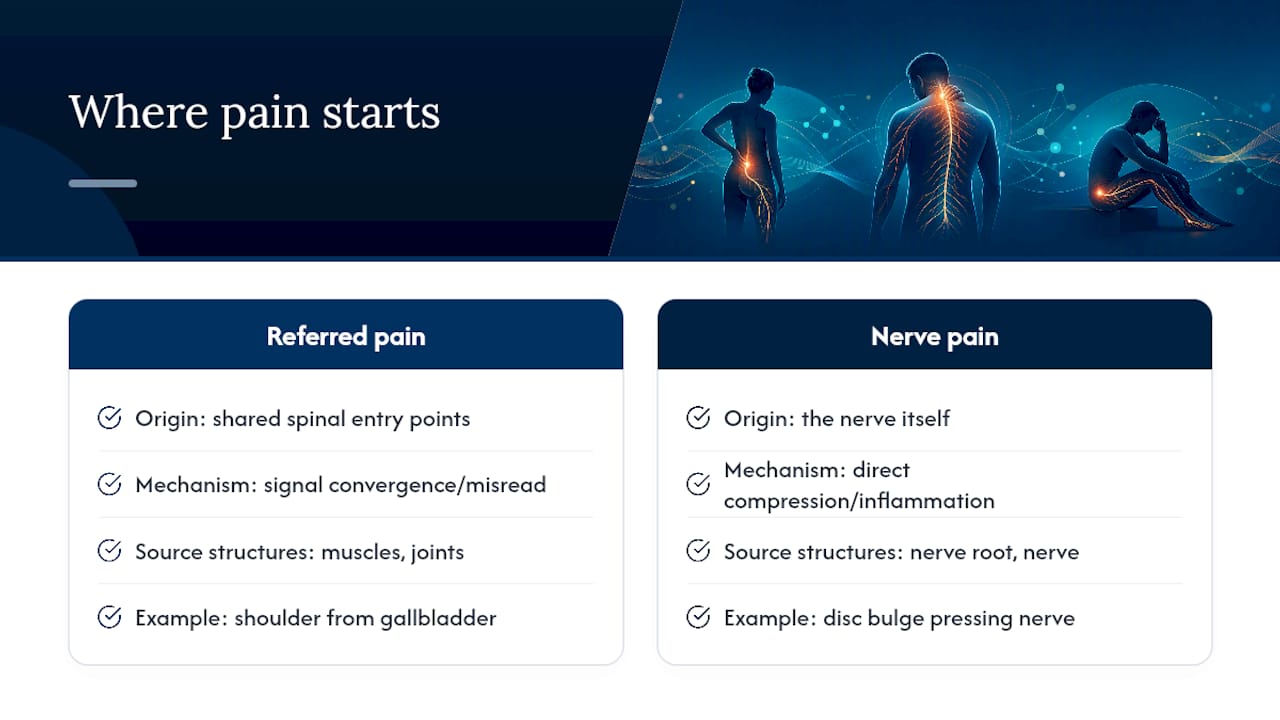
The difference comes down to where the signal originates and how it travels. Referred pain happens because sensory nerves from muscles and joints share the same entry points into the spinal cord as nerves from other body regions. When those signals converge, the brain sometimes misreads which structure sent them, so you feel pain in your shoulder when the real problem sits in your gallbladder, or in your jaw when the trouble is in your heart.
Nerve pain, sometimes called radicular pain when a spinal nerve root is involved, works differently. A nerve gets compressed, stretched, or inflamed directly, most often by a disc bulge, bone spur, or swollen tissue pressing on it. The pain you feel is coming from the nerve itself, not from a misread signal.
Terminology gets messy here. “Sciatica” technically describes true nerve root irritation, but people (and some clinicians) use it loosely for pseudoradicular pain that mimics a nerve pattern without actual nerve compression. The two mechanisms also overlap constantly in real patients, which is exactly why differentiation matters clinically, not just academically.
What Referred Pain and Nerve Pain Actually Feel Like
Descriptors matter more than most people realize when you’re trying to sort one from the other.
Nerve pain tends to announce itself with a specific vocabulary: burning, shooting, electric shocks, or tingling, often paired with numbness or a patch of skin that feels wrong to the touch. Weakness can show up too, particularly in a foot, hand, or specific muscle group tied to the affected nerve. Clinicians rely heavily on these descriptors, since burning and electric-shock sensations are considered classic markers of neuropathic involvement.
Referred pain reads differently. It’s usually described as a dull ache, a deep pressure, or a diffuse soreness that’s hard to pinpoint with a single finger. It often shifts with movement or posture rather than staying fixed to one exact spot.
The distribution pattern is the most useful clue of all:
- Nerve/radicular pain tends to follow a dermatome, a narrow strip of skin serviced by one nerve root, and that strip is often only a narrow band roughly several centimeters wide.
- Referred pain spreads across a broader, less defined area that doesn’t respect dermatomal borders.
- Sensory loss, reflex changes, or measurable weakness point toward nerve involvement rather than referred pain from soft tissue.
- Pain that worsens with specific nerve-tension positions (bending forward, straight-leg raise) suggests a nerve root is being stretched or compressed.
If you’re trying to work out whether leg pain is coming from your back or from a hip or piriformis issue, the sitting test and straight-leg raise are two of the simplest checks clinicians use to narrow it down.
Common Causes and Where Pain Shows Up Instead of Its Source
Musculoskeletal referred pain usually comes from joints, discs, or muscle trigger points sending signals that get misrouted. A facet joint problem in the neck can produce a headache. A hip joint issue can present as groin or thigh pain rather than hip pain itself.
Radicular pain has a shorter, more predictable list of usual suspects: a herniated disc pressing on a nerve root, spinal stenosis narrowing the space nerves travel through, or bone spurs encroaching on that space over time.
Visceral referred pain is where things get genuinely dangerous to overlook. The heart, gallbladder, and pancreas all refer pain to surface locations far from the organ itself. Cardiac ischemia commonly shows up as jaw, shoulder, or left-arm pain rather than classic chest pain. Gallbladder disease frequently refers to the right shoulder blade. This is why shoulder pain isn’t automatically a rotator cuff problem. One version comes from a joint or tendon; the other might be your gallbladder or your heart trying to get your attention through the wrong channel.
How Clinicians Actually Tell the Difference
A good clinical history does most of the diagnostic heavy lifting before any imaging happens. Clinicians ask about onset (sudden versus gradual), what makes it worse or better, whether it’s worse at night, and whether symptoms are progressing or stable.
- History first. Nocturnal pain that disrupts sleep, progressive numbness, or pain that’s worsened rather than improved over weeks all point toward nerve involvement rather than a straightforward muscular issue. Patterns like worsening sciatica pain at night often reflect nerve root irritation that shifts with position.
- Physical exam clues. Dermatomal sensory changes, measurable strength deficits, altered reflexes, and positive nerve-tension tests all shift suspicion toward a radicular source.
- Imaging and electrodiagnostics when warranted. MRI helps confirm disc or stenosis findings when neurological deficits are present or conservative care isn’t working. Electrodiagnostic testing can localize nerve damage. Quantitative sensory testing exists, but it remains largely a research tool rather than routine first-line practice because it’s time consuming and lacks standardized clinical protocols.
- Red flags that mean urgent care, not a wait-and-see approach: sudden or progressively worsening weakness, loss of bladder or bowel control, or chest pain radiating to the arm or jaw.
Treatment Differences That Actually Matter
Referred pain generally responds well to addressing the actual source rather than the spot where you feel it. That usually means targeted rehab or physiotherapy, manual therapy, load management for the aggravated joint or muscle, and analgesics as needed. Treating only the felt location, ignoring where the pain is truly coming from, is a common trap; local treatment at the symptomatic site often fails when the real problem sits elsewhere in the spine.
Nerve pain calls for a different toolkit. Nerve-focused rehab, medications specifically aimed at neuropathic pain, and in some cases targeted injections come into play. Surgery stays reserved for cases where conservative care fails or neurological deficits progress, not as a first move. Muscle and referred pain typically respond to physical therapy and activity changes, while nerve pain often needs a more nerve-specific approach, and mixed presentations need a staged plan that addresses both mechanisms rather than picking one.
- Referred pain: source-focused rehab, manual therapy, gradual load changes.
- Nerve pain: nerve-directed rehab, neuropathic medication when indicated, imaging-guided referral if deficits progress.
- Combined presentations: staged care, reassessing as one mechanism resolves and the other becomes clearer.
Pro Tip: Give a conservative approach two to four weeks of consistent effort before deciding it isn’t working. Nerve tissue calms down slower than muscle tissue, so a plan that looks stalled at week one can still be the right plan at week three.
How Everton Chiropractic Assesses Overlapping Pain Patterns
A first visit starts with a detailed history and a movement-based physical assessment, checking dermatomal sensation, reflexes, strength, and how specific positions change your symptoms. That combination usually reveals whether nociceptive, neuropathic, or mixed mechanisms are driving the pain.
Care stays conservative when nerve tension tests are negative and strength and sensation are intact. When deficits show up or fail to improve on schedule, the plan shifts to add nerve-directed treatment or a referral for imaging. One recurring pattern: a patient with both muscle guarding and mild nerve irritation improves in stages, first through movement-based care that settles the muscular component, then through nerve-focused work that resolves the lingering tingling.
What the Research Actually Tells Us About This Distinction
Most articles on this topic pretend referred pain and nerve pain are two clean, separate boxes. They aren’t. Clinicians who work with this daily know that pure nociceptive or pure neuropathic presentations are actually the exception. Most patients walk in with mixed features, and which mechanism dominates can shift over the course of days or weeks as tissue heals or inflammation changes.
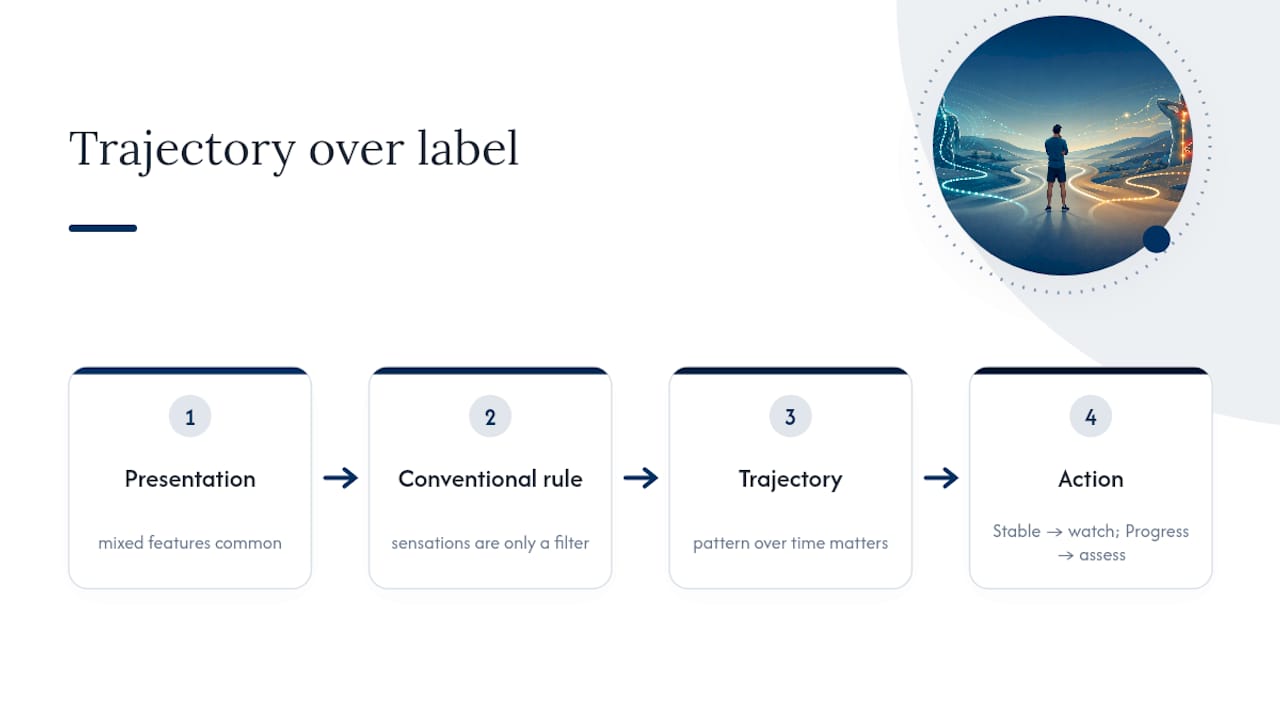
The conventional advice, “if it burns and tingles, it’s nerve pain; if it aches, it’s muscular,” is a reasonable starting filter but a poor final answer. It skips the harder truth: a herniated disc can produce both nerve irritation and a protective muscle spasm at the same time, so you get burning down the leg and a deep ache in the back simultaneously, coming from two different tissues.
What should actually change your behavior is the trajectory, not the label. Pain that’s stable or improving with basic movement and time tolerates a wait-and-watch approach. Pain that’s progressing, especially with new weakness or numbness, needs assessment regardless of what adjective you’d use to describe it. Chase the pattern over time, not just the sensation on any single day.
— Aman
If You Want a Clear Answer, Get an Assessment
Reading about dermatomes and convergent pathways only gets you so far when you’re the one lying awake with a burning leg or an ache that won’t sit still. A chiropractic clinic evaluates overlapping pain mechanisms to figure out whether pain is coming from a nerve root, a joint, or both, and builds a plan around what’s actually driving it rather than guessing based on symptoms alone.

A first appointment typically includes a full movement-based assessment, an explanation of likely symptom causes, and a staged treatment plan with follow-up to track progress. If deficits need imaging or specialist referral, those can be flagged early rather than after weeks of guesswork. If your pain has a burning or shooting quality that hasn’t budged, start with a focused nerve pain assessment and get a straight answer about what’s actually going on.
Sources
This article draws on peer-reviewed clinical reviews covering nerve mechanism differentiation, visceral referred pain patterns, and general chronic pain education resources for readers wanting further background.
This article is general information, not a substitute for advice from a qualified doctor. Consult a qualified healthcare professional about your own circumstances before acting on anything here.
- Low-back related leg pain: is the nerve guilty? How to differentiate the underlying pain mechanism
- Low back-related leg pain: mechanism differentiation
- Referred Pain: What It Is, Causes, Treatment & Common Areas
- Is it nerve pain or muscle pain? How to tell the difference | Hartford Hospital
FAQ
What does nerve pain feel like?
Nerve pain most often feels like burning, shooting, or electric sensations, sometimes with numbness, tingling, or noticeable weakness in the affected area.
Can nerve pain be constant?
Yes. Nerve pain can be constant or intermittent, and unlike muscle soreness, it often doesn’t improve much with rest and may worsen at night.
What are the different types of nerve pain?
The main categories are radicular pain (from a compressed nerve root, as in sciatica), peripheral neuropathic pain (from damage to a specific nerve), and central neuropathic pain (from spinal cord or brain involvement).
How do you reverse nerve pain?
Outcomes depend on the cause and how long compression or irritation has been present; early conservative care, including nerve-focused rehab and movement-based treatment, gives nerves the best chance to recover, while long-standing severe compression may need imaging-guided referral.
Is referred pain dangerous?
Most referred pain comes from musculoskeletal sources and isn’t an emergency, but referred pain from the heart, gallbladder, or other organs can signal a serious problem and needs prompt evaluation, especially with chest pain radiating to the jaw or arm.