A focused alignment program of daily posture checks, three progressive alignment drills, and weekly balance practice can meaningfully reduce fall risk by improving how your body controls its center of mass over its base of support. Start this week: spend two minutes each morning checking your standing posture against a wall, add chin tucks and pelvic tilts to your daily routine, and practice a 10-second single-leg stand three times per week. Research published in the Acta Medica journal found that each one-point improvement in Berg Balance Scale score is associated with an estimated 20% lower fall probability in older adults with chronic pain, which means small, consistent alignment gains add up fast.
Start here this week:
- Quick self-check: Stand with your back against a wall. Your heels, buttocks, shoulder blades, and the back of your head should all touch. A gap larger than two fingers at your low back or neck signals a misalignment worth addressing.
- Three starter exercises: chin tucks (10 reps), pelvic tilts (10 reps), and single-leg stands (10 seconds each side). Details and progressions are in Section 5.
- Safety step: Clear a space near a sturdy chair or wall before any balance exercise. If you feel sudden dizziness, sharp pain, or leg weakness, stop immediately and contact a clinician.
Red flags that need professional review before you start: new or worsening dizziness, sudden leg weakness, recurrent near-falls in the past month, or unexplained changes in your gait. These are not reasons to avoid exercise permanently, but they are reasons to get assessed first.
Pro Tip: Keep a simple log of your single-leg stand time each week. Even a two-second improvement over a month is a measurable signal that your alignment and balance work is producing results.
Key Takeaways
Improving body alignment through progressive, consistent exercise is one of the most evidence-supported ways to reduce fall risk, and small measurable gains in posture and balance scores translate directly to lower fall probability.
| Point | Details |
|---|---|
| Start with daily alignment checks | A 2-minute wall posture check each morning identifies misalignment before it compounds into fall risk. |
| Target 150–180+ minutes per week | Clinical guidelines recommend this volume of multicomponent exercise, with 3+ hours per week of progressive balance training over 6–12 months. |
| Small score gains matter | Each 1-point BBS improvement is associated with ~20% lower fall probability; each 1-point posture score gain with ~10% lower probability. |
| Seek clinical assessment after any fall | A TUG over 12 seconds, failed single-leg stand, or any fall in the past 12 months warrants a professional evaluation. |
| Evertonchiropractic | Provides alignment assessments, spinal care, and personalized balance programs for adults seeking to reduce fall risk. |
Table of Contents
- How poor alignment shifts your center of mass and raises fall risk
- Signs of poor alignment and simple at-home checks for fall risk
- The four core exercise categories that reduce fall risk through alignment
- Six alignment exercises you can safely start at home
- What clinicians do to accelerate alignment gains and reduce falls
- What the research says about dosage and alignment-focused fall prevention
- When to see a clinician and what a fall-risk assessment involves
- The part of alignment training most programs get wrong
- Evertonchiropractic offers a clear path from alignment assessment to fall prevention
- Sources
- FAQ
How poor alignment shifts your center of mass and raises fall risk
Balance comes down to one mechanical fact: your center of mass must stay over your base of support. When it drifts outside that zone, you fall. Poor alignment accelerates that drift in ways most people never notice until a stumble happens.
Forward head posture is the clearest example. For every inch your head moves forward of your shoulders, the effective load on your cervical spine roughly doubles. That shift pulls your thoracic spine into increased kyphosis, which tilts your entire trunk forward. Your center of mass moves anteriorly, your hip flexors shorten, and your glutes disengage. The result is a posture that is perpetually leaning toward a fall.
Pelvic tilt compounds the problem. An anterior pelvic tilt (pelvis tipped forward) overloads the lumbar extensors, weakens the deep abdominals, and reduces the hip extension needed for a normal, stable stride. A posterior tilt does the opposite: it flattens the lumbar curve, limits hip flexion, and shortens your step length. Either pattern narrows the margin between controlled movement and a stumble.
Three systems take the hit when alignment is off:
- Musculoskeletal: Misaligned joints load muscles asymmetrically, creating weakness on one side and tightness on the other. Core and hip strength, which Harvard Health identifies as key anchors for postural stability, deteriorates faster when those muscles are chronically shortened or inhibited.
- Proprioceptive: Spinal misalignment alters the sensory signals from joint mechanoreceptors. The nervous system gets inaccurate position data, so anticipatory postural adjustments, the micro-corrections that fire before you take a step, are mistimed.
- Visual/vestibular: Pain-driven postural adaptations cause the nervous system to over-rely on visual input for balance. Remove that visual anchor (dim lighting, looking down at a phone) and stability drops sharply.
Improving alignment does not just make you stand straighter. It recalibrates all three systems simultaneously, which is why alignment-focused programs show measurable balance gains beyond what strength training alone produces.
Signs of poor alignment and simple at-home checks for fall risk
The quickest signs that alignment may be increasing your fall risk are visible in a mirror and testable in your living room. You do not need clinical equipment to get a useful read.
Visible alignment signs to check:
- Forward head position: ears sitting in front of your shoulders when viewed from the side
- Rounded shoulders: shoulder blades winging away from the spine, arms rotating inward
- Increased thoracic kyphosis: an exaggerated upper-back curve, sometimes called a “dowager’s hump”
- Forward pelvic tilt: lower belly pushing forward, lower back arching excessively
- Functional cues: shorter stride length, reaching for walls or furniture when turning, early fatigue on stairs
Three validated at-home screening tests:
The CDC STEADI program provides printable versions of these tests, and they are the same tools clinicians use for community screening.
- 10-second single-leg stand: Stand near a counter. Lift one foot slightly off the floor and hold for 10 seconds without touching down or grabbing support. Inability to hold 10 seconds on either side is a clinically recognized fall-risk signal.
- Heel-to-toe (tandem) walk: Walk 10 steps in a straight line placing the heel of your front foot directly against the toes of your back foot. Stepping out of line or needing arm support suggests reduced dynamic balance.
- Timed Up and Go (TUG): Sit in a standard chair, stand up without using your arms if possible, walk 10 feet, turn, walk back, and sit down. A time over 12 seconds is associated with elevated fall risk in community-dwelling older adults.
Statistic to know: In older adults with chronic neck, low back, or knee pain, each one-point increase in Berg Balance Scale score is linked to an estimated 20% lower fall probability, and each one-point improvement in total posture score is linked to an estimated 10% lower fall probability. Small, measurable gains matter.
Stop and seek clinician evaluation if you notice: new or sudden dizziness, unexplained leg weakness, a recent fall with or without injury, recurrent near-falls, or pain that changes your gait. These are red flags, not just inconveniences.
The four core exercise categories that reduce fall risk through alignment
Preventing falls with alignment work requires more than one type of exercise. Four categories each address a different piece of the puzzle, and the research is clear that combining them outperforms any single approach.
| Category | Primary Goal | Beginner Example | Intermediate Example | Advanced Example |
|---|---|---|---|---|
| Postural corrective drills | Restore neutral spine and head position | Chin tucks, wall angels | Thoracic extension over foam roller | Standing wall slides with resistance band |
| Core and hip strengthening | Stabilize pelvis and lumbar spine | Supine pelvic tilts, glute bridges | Dead bugs, clamshells | Single-leg deadlifts, side-lying hip abduction with band |
| Progressive balance training | Challenge center-of-mass control | Two-leg stance on firm surface | Tandem stance, single-leg stand | Single-leg stand on foam pad, eyes closed |
| Gait and step training | Improve stride mechanics and reactive stepping | Heel-to-toe walking, marching in place | Lateral step-overs, obstacle courses | Volitional step training, direction-change drills |
How to combine them: Postural drills and core work form the foundation. Balance training builds on that foundation by progressively reducing your base of support. Gait training applies the gains to real-world movement. Clinical guidelines recommend including volitional step training and gait adaptability as a core component, not an optional add-on.
Who benefits most from each:
- Postural drills: anyone with forward head posture, kyphosis, or desk-related stiffness
- Core and hip work: adults with low back pain, pelvic instability, or post-surgical deconditioning
- Progressive balance training: all adults over 50, especially those who have had a near-fall
- Gait training: adults with shortened stride, shuffling gait, or Parkinson’s disease
Common contraindications to note: acute disc herniation (avoid loaded flexion), severe osteoporosis (avoid high-impact or spinal flexion under load), recent lower-limb surgery (modify weight-bearing as directed by your surgeon).
Pro Tip: Progressive balance training must progressively reduce your base of support and remove upper-limb support across sessions to stay effective. Standing with feet together is harder than shoulder-width; standing on one leg is harder still. If the exercise feels easy, it probably isn’t challenging your balance system enough.
Six alignment exercises you can safely start at home
These six exercises form a balanced home starter routine. Together they address posture, core stability, and balance, and each one can be done in a small space with no equipment beyond a sturdy chair and a wall.
1. Chin tucks
Purpose: Retract the head over the shoulders to correct forward head posture and reduce cervical load.
Setup: Sit or stand with your back straight.
Cues: Gently draw your chin straight back, as if making a “double chin.” Hold 3–5 seconds. Do not tilt your head down.
Sets/reps: 2 sets of 10 reps.
Modification: Lie on your back for a gravity-assisted version if neck stiffness limits the seated range.
Progression: Add a resistance band looped around the back of your head for gentle forward resistance.
2. Wall angels
Purpose: Open the chest, retract the shoulder blades, and reinforce thoracic extension.
Setup: Stand with your back flat against a wall, feet 2–3 inches from the baseboard, arms raised to 90 degrees (goalpost position).
Cues: Slide your arms up the wall toward overhead, keeping your wrists and elbows in contact with the wall. Return slowly.
Sets/reps: 2 sets of 10 reps.
Modification: Reduce the range of motion if your arms cannot stay flat against the wall.
Progression: Hold a light resistance band between your hands.
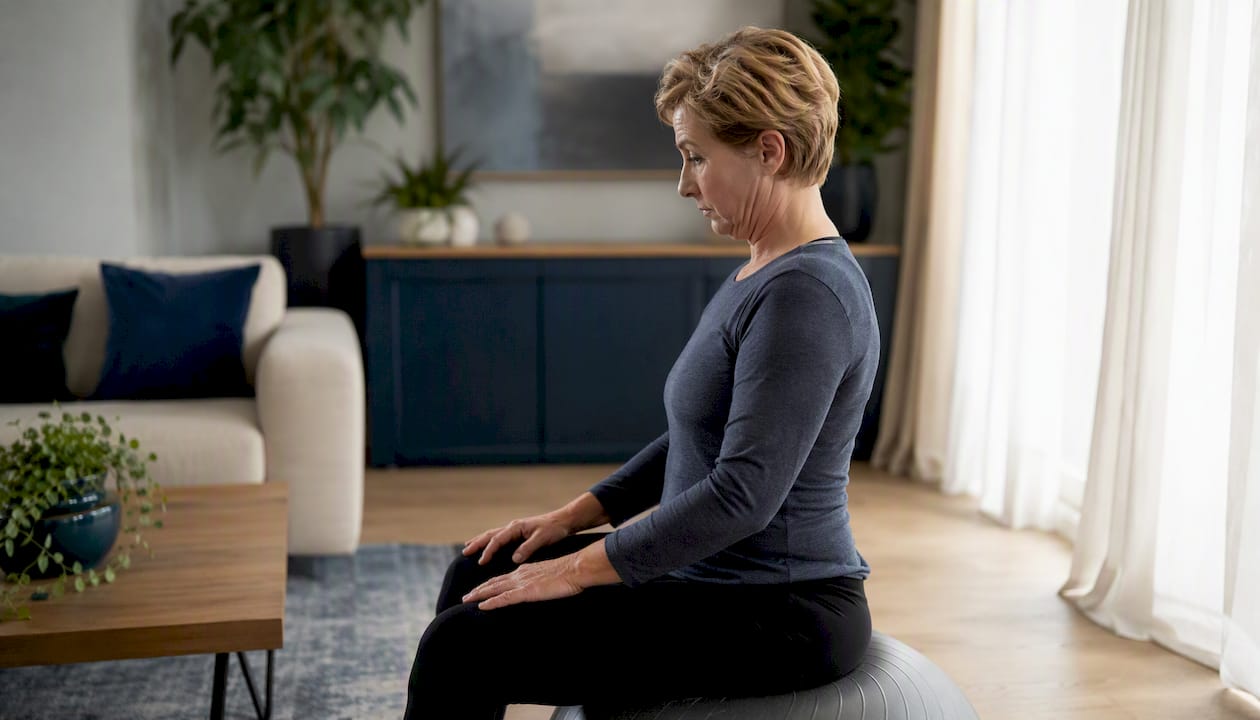
3. Pelvic tilts
Purpose: Activate the deep abdominals and restore neutral lumbar position.
Setup: Lie on your back, knees bent, feet flat on the floor.
Cues: Gently flatten your low back against the floor by tightening your lower abdominals. Hold 5 seconds, then release.
Sets/reps: 2 sets of 10 reps.
Modification: Perform seated in a firm chair if getting to the floor is difficult.
Progression: Add a glute bridge at the top of each tilt.
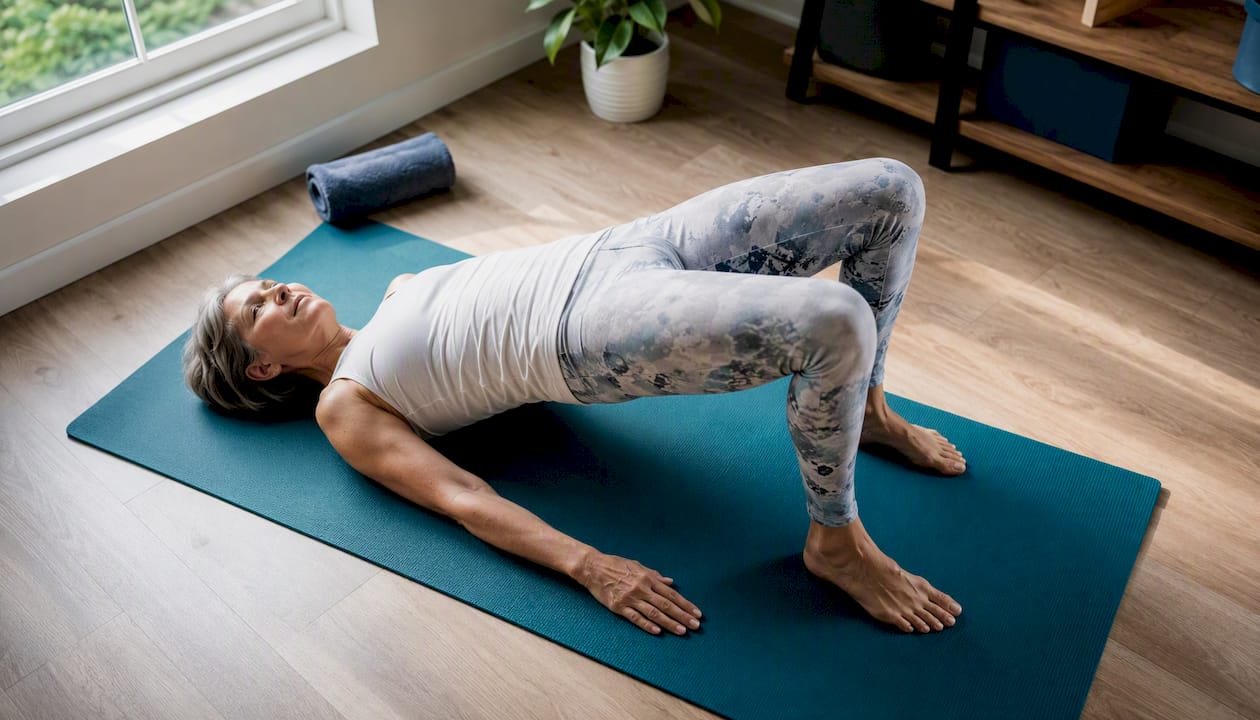
4. Glute bridges
Purpose: Strengthen the glutes and posterior chain to support pelvic stability and hip extension during walking.
Setup: Lie on your back, knees bent, feet hip-width apart.
Cues: Press through your heels, squeeze your glutes, and lift your hips until your body forms a straight line from knees to shoulders. Hold 3 seconds.
Sets/reps: 2 sets of 12 reps.
Modification: Reduce the height of the lift if you have knee or hip pain.
Progression: Single-leg bridge (one foot lifted).
5. Single-leg stand
Purpose: Directly train the balance system and proprioceptive feedback under a reduced base of support.
Setup: Stand beside a sturdy chair or counter with one hand lightly resting on it for safety.
Cues: Shift your weight onto one foot, lift the other foot slightly, and hold. Keep your standing knee soft, not locked.
Sets/reps: 3 holds of 10 seconds each side.
Modification: Keep fingertip contact with the chair rather than gripping it.
Progression: Remove hand support, then close your eyes briefly (only when you can hold 30 seconds safely with eyes open).
6. Heel-to-toe walking
Purpose: Train dynamic balance and gait coordination in a controlled, linear pattern.
Setup: Walk along a hallway wall or use a countertop alongside you.
Cues: Place the heel of your front foot directly against the toes of your back foot with each step. Look straight ahead, not at your feet.
Sets/reps: 2 passes of 10 steps.
Modification: Allow a small gap between heel and toe if full tandem is unstable.
Progression: Walk without the wall nearby; add a slight head turn while walking.
Sample weekly micro-program (20–40 minutes, 3–5 days per week):
- Days 1, 3, 5: Chin tucks + wall angels + pelvic tilts + glute bridges (15–20 minutes)
- Days 2, 4: Single-leg stand + heel-to-toe walking + one additional balance challenge (15–20 minutes)
- All days: 2-minute wall posture check on waking
Safety notes: Always have a chair or wall within arm’s reach during balance exercises. Adults with arthritis should avoid locking joints at end range. Those with Parkinson’s disease benefit from exaggerated cues (big steps, high knees) and should work with a physical therapist on cueing strategies. If you have had recent lower-limb surgery, confirm weight-bearing status with your surgeon before starting.
Pro Tip: Posture-correction programs produce the most durable results when you carry the alignment cues into daily tasks, not just exercise sessions. Practice your chin tuck while waiting for coffee to brew. Check your pelvic position while sitting at a desk. Research confirms that functional balance gains outlast spinal alignment changes when practice stops, so integrating these habits into real life is what keeps the gains.
What clinicians do to accelerate alignment gains and reduce falls
A clinician, whether a physical therapist or a chiropractor, adds two things a home program cannot: objective measurement and individualized progression. The combination safely accelerates alignment gains and catches problems before they become falls.
Common clinic assessments:
- Berg Balance Scale (BBS): A 14-item scored test of static and dynamic balance tasks. Scores below 45/56 indicate elevated fall risk.
- Timed Up and Go (TUG): Timed in clinic with standardized instructions; scores over 12 seconds flag elevated risk.
- Gait analysis: Observation or instrumented measurement of stride length, cadence, step symmetry, and trunk sway.
- Posture photography: Lateral and posterior photos to quantify forward head angle, kyphosis, and pelvic tilt at baseline and follow-up.
- Computerized dynamic posturography (CDP): Used in specialist settings to identify which sensory system (visual, vestibular, or proprioceptive) a patient over-relies on, then guide targeted retraining. Research on spine patients shows CDP reveals sensory drivers of balance deficits that standard clinical observation misses.
What to expect at a first visit:
- Full history: falls in the past 12 months, medications, pain locations, activity level
- Postural assessment: standing alignment, range of motion, muscle length testing
- Functional balance tests: BBS or TUG, single-leg stand, functional reach
- Hands-on intervention: spinal mobilization or manipulation, soft-tissue work, or neuromuscular retraining depending on findings
- Exercise prescription: a personalized home program with specific sets, reps, and progression criteria
- Home safety review: a brief discussion of environmental modifications such as lighting, grab bars, and trip-hazard removal
Referral signals that mean the home program is not enough:
- Any neurologic sign: new numbness, tingling, or weakness in the limbs
- Progressive gait deterioration over weeks
- Orthostatic hypotension (dizziness on standing) that is unmanaged
- A fall resulting in injury
- Fear of falling so severe it is causing activity avoidance
For a deeper look at how chiropractic assessment and care fit into fall-prevention strategies, the clinical rationale for spinal alignment work extends well beyond posture aesthetics.
| Takeaway | Detail |
|---|---|
| BBS score below 45/56 | Flags elevated fall risk; each 1-point gain is associated with ~20% lower fall probability |
| TUG over 12 seconds | Standard clinical threshold for elevated fall risk in community-dwelling adults |
| CDP testing | Identifies sensory system over-reliance to guide targeted vestibular or proprioceptive retraining |
| Home safety review | Environmental modifications are recommended alongside exercise, not instead of it |
What the research says about dosage and alignment-focused fall prevention
Multicomponent exercise programs that include progressive balance training have the strongest evidence base for reducing falls in older adults. This is not a close call in the literature.
Clinical practice guidelines published in the Journal of Physical Therapy recommend progressive balance training at a minimum of three hours per week, with total program volume exceeding 50 hours over a 6–12 month period. The evidence quality for this recommendation is graded at Level I with a strong recommendation strength. That means the evidence is not preliminary or suggestive; it is the kind of finding that shapes clinical protocols.
Dosage target: Aim for 150–180+ minutes per week of multicomponent exercise (postural drills, strength, balance, gait), with balance-specific training making up at least three hours per week. Sustain this over 6–12 months for the strongest fall-risk reduction.
The alignment component specifically matters for people with pain. In older adults with chronic neck, low back, or knee pain, each one-point increase in total posture score is associated with an estimated 10% lower fall probability, alongside the 20% reduction per BBS point. Pain management and alignment correction are not separate tracks; they work together.
One important durability finding: corrective exercise programs improve forward head posture, kyphosis, and fear of falling measurably, but spinal alignment angles tend to regress after about three months without continued practice. Functional balance gains are more durable. The practical implication is that alignment work needs to be ongoing, not a six-week course you complete and abandon.
Evidence-supported program features:
- Progressive reduction in base of support across sessions (feet together, tandem, single-leg)
- Removal of upper-limb support as balance improves
- Volitional step training and gait adaptability drills included, not just static balance holds
- Tai Chi: one of the most studied single-modality interventions, with consistent evidence for fall-risk reduction in older adults
- Multicomponent design (strength + balance + gait + posture) outperforms any single modality
When to see a clinician and what a fall-risk assessment involves
The clearest trigger for a clinical visit is any fall, regardless of whether you were injured. Beyond that, several objective and subjective signals indicate that self-management alone is not sufficient.
Decision checklist:
- You have fallen once or more in the past 12 months.
- You failed the 10-second single-leg stand on either side.
- Your TUG time exceeds 12 seconds.
- You have noticed a progressive change in your gait over weeks (shorter steps, more shuffling, increased trunk sway).
- You are avoiding activities because you fear falling.
- You have new neurologic symptoms: numbness, tingling, or weakness in your arms or legs.
- You experience dizziness when standing up from a seated or lying position.
- You have a medical condition (Parkinson’s disease, peripheral neuropathy, recent stroke) that directly affects balance.
What to bring to your appointment:
- A complete list of your current medications (some medications, including sedatives, antihypertensives, and certain antidepressants, are independent fall-risk factors)
- A description of any recent falls: what you were doing, what surface you were on, whether you lost consciousness
- Photos or a short video of your standing posture if you can take them
- Notes on which activities you have been avoiding
What a clinical fall-risk assessment typically includes:
- Detailed history covering falls, medications, vision, and activity level
- Standardized balance tests: BBS, TUG, functional reach, and the CDC STEADI 4-stage balance test
- Gait analysis: stride length, cadence, symmetry, and trunk control
- Medication review for fall-risk contributors
- Referral options: ophthalmology (vision), cardiology (orthostatic hypotension), neurology (progressive neurologic signs), or vestibular rehabilitation
For readers wanting to understand the full scope of postural correction protocols used in clinical settings, the structured assessment process is where individualized programs begin.
The part of alignment training most programs get wrong
Most fall-prevention programs focus on what you do during exercise. The ones that produce lasting results focus on what you do the other 23 hours of the day.
Alignment angles, specifically forward head posture and thoracic kyphosis, tend to regress within months when practice stops. The research is clear on this. What persists longer is functional balance confidence and the neuromuscular patterns built through progressive training. That gap tells you something important: the exercises are the training stimulus, but daily postural habits are the maintenance dose.
The programs that work long-term treat alignment correction as a movement re-education project, not a rehabilitation course with a discharge date. Patients who carry their chin tuck into a grocery store, check their pelvic position while driving, and choose stairs over escalators are not doing more exercise. They are accumulating hundreds of low-load alignment repetitions that keep the nervous system calibrated.
There is also a tendency to underestimate the role of pain in this picture. Chronic spinal pain does not just hurt; it reorganizes how your nervous system manages balance. It shifts sensory weighting toward vision and away from proprioception, which means your balance becomes fragile the moment lighting is poor or your attention is divided. Addressing the pain alongside the alignment work, rather than treating them as separate problems, is what closes that gap. That is exactly where a clinician adds value that a home program cannot replicate on its own.
Evertonchiropractic offers a clear path from alignment assessment to fall prevention
If the home exercises in this guide are a starting point, a professional assessment is where a real, individualized program begins. Evertonchiropractic provides alignment-focused assessments and personalized programs built specifically to reduce fall risk, with care led by Dr. Richard, an experienced chiropractor who treats the whole picture: posture, pain, spinal alignment, and functional movement.
Relevant services include postural assessment and photography, progressive balance retraining, spinal alignment care, and personalized exercise plans tailored to your current limitations and goals. For readers managing chronic spinal pain alongside balance concerns, evidence-informed spinal adjustments address the pain component that home exercise alone often cannot resolve. The clinic’s approach challenges the assumption that balance decline is simply part of aging; it is often a correctable alignment and movement problem.
To book an initial assessment or learn what your first visit involves, contact Evertonchiropractic directly through the website at Evertonchiropractic.
Sources
- Does the coronal and sagittal posture affect the risk of falling in older adults with pain?
- Clinical practice guideline: multicomponent exercise and balance training recommendations (JPT 2025)
- Alignment in motion: Fall risk in spine patients and the effect of vision, support surface, and adaptation on the cone of economy
- Preventing falls: Home safety — National Institute on Aging
FAQ
What is the best way to reduce fall risk?
The strongest evidence supports multicomponent exercise programs combining progressive balance training, strength work, and gait training, sustained over 6–12 months at 150–180+ minutes per week. Addressing alignment and pain alongside exercise produces the most durable results.
Can improving posture actually lower your chance of falling?
Yes.
What are the main fall-risk factors related to alignment?
Forward head posture, increased thoracic kyphosis, anterior pelvic tilt, and weak core and hip muscles are the primary alignment-related contributors. Each shifts the center of mass forward and reduces the margin for safe balance recovery.
Can vitamin D help prevent falls?
Pooled trial data suggests high-dose vitamin D supplementation (700 IU or more) is associated with a modest reduction in fall risk compared with placebo (relative risk approximately 0.87), while lower doses showed no significant effect. Vitamin D is a supplement to, not a substitute for, exercise and alignment work.
When should I see a clinician instead of managing fall risk at home?
See a clinician after any fall, if your Timed Up and Go exceeds 12 seconds, if you cannot hold a 10-second single-leg stand, or if you notice new neurologic symptoms such as numbness or leg weakness. Evertonchiropractic offers alignment-focused assessments that identify the specific drivers of your fall risk and build a program around them.
Recommended
- How to Improve Posture and Alignment – Everton Chiropractic
- Preventing Slips and Falls in Seniors The Role of Chiropractic Balance Target Balance Improvement – Everton Chiropractic
- Chiropractic Care’s Role in Fall Prevention for Seniors – Everton Chiropractic
- Avoiding Knee Surgery: How Proper Hip and Knee Alignment Eases Joint Stress – Everton Chiropractic