Muscle imbalances affecting athletic performance are not a minor training detail — they measurably reduce sprint speed, change-of-direction ability, and injury resilience. Bilateral strength asymmetries exceeding roughly 10–15% are consistently associated with elevated musculoskeletal injury risk across athletic populations, and Lower Y-Balance Test composite scores correlate with elevated injury markers in athletic cohorts. If you have not screened for asymmetry recently, start with a single-leg squat or Y-Balance Test today. If you notice a visible side-to-side difference or have recurring pain on one side, that is your cue to see a clinician.
Key signals to watch for right now:
- A bilateral strength gap greater than 10–15% between limbs (measured by comparing single-leg strength output or hop distance)
- A Y-Balance Test composite score below 85% of limb length on either side
- Recurring pain or strain on the same side of the body across training cycles
Key Takeaways
| Point | Details |
|---|---|
| Asymmetry thresholds matter | Bilateral gaps above 10–15% consistently flag elevated injury risk; YBT composite below 85% is the key field-test cutoff. |
| Sprint and COD are most affected | Inter-limb asymmetry hurts sprint and change-of-direction performance more than vertical jump, per meta-analysis findings. |
| Six to eight weeks drives change | A 6-week individualized resistance program produced significant H/Q ratio improvements (p < 0.05) in a controlled trial. |
| Function beats perfect symmetry | Correct deficits that limit performance or cause pain; not every asymmetry warrants intervention. |
| Evertonchiropractic offers assessment | A functional movement assessment at Evertonchiropractic identifies specific deficits and builds an individualized corrective plan. |
Table of Contents
- How muscle imbalances affect athletic performance and alter joint mechanics
- Why imbalances develop and what sport-specific patterns look like
- How to screen yourself and what the thresholds mean
- What the research actually says about imbalances and performance
- Evidence-based strategies to correct muscle imbalances
- A practical 6–8 week program for lower-limb imbalances
- Who treats muscle imbalances and when to seek help
- How to monitor progress and prevent recurrence
- The case for function over perfect symmetry
- Evertonchiropractic can help you screen and correct imbalances
- Sources
- FAQ
How muscle imbalances affect athletic performance and alter joint mechanics
The core problem is a disrupted force vector. When one muscle group is significantly weaker or tighter than its antagonist, the joint it crosses no longer tracks along its optimal path. The result is altered movement timing, reduced peak force output, and disproportionate tissue loading on the side that compensates.
Force output and sprint mechanics. A meta-analysis of inter-limb asymmetries found weak but significant negative associations with change-of-direction (r ≈ 0.24) and sprint performance (r ≈ 0.20), while vertical jump showed no consistent effect. That distinction matters practically: if your sport involves cutting or accelerating, asymmetry costs you more than if it involves pure jumping.
Shoulder: the upper-crossed pattern. Overhead athletes — swimmers, baseball pitchers, volleyball players — frequently develop what clinicians call Upper Crossed Syndrome: weak lower and mid-trapezius, weak serratus anterior, and weak infraspinatus paired with tight upper trapezius and pectorals. The scapula tips forward and upward, narrowing the subacromial space. Every overhead rep now loads the rotator cuff at a mechanically disadvantaged angle, raising impingement risk and bleeding power out of every throw or stroke.
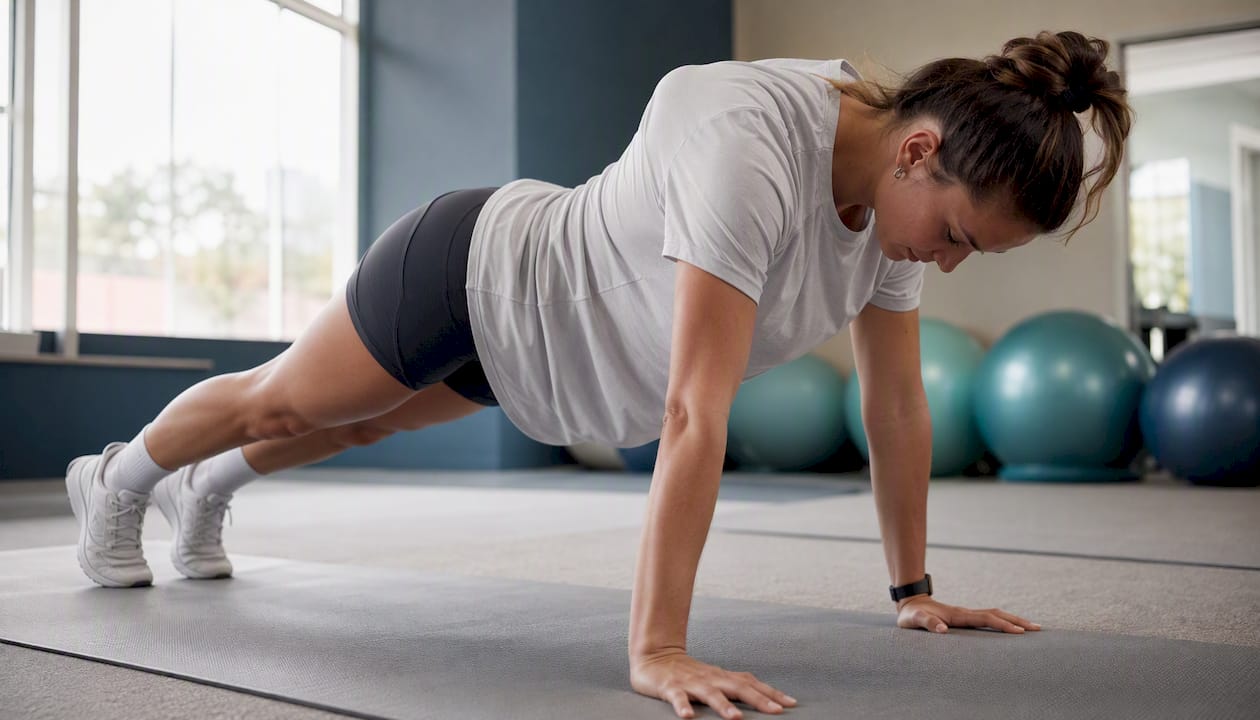
Hip and knee: quad dominance and ACL risk. Quadriceps dominance relative to hamstring strength is one of the most studied imbalances in sport. During deceleration and cutting, the hamstrings act as the primary dynamic stabilizer of the anterior cruciate ligament. A weak or slow hamstring fails to decelerate tibial translation fast enough, placing the ACL under abnormal load. The hamstring-to-quadriceps ratio (H/Q ratio) is the standard clinical measure here, with conventional isokinetic norms typically cited in the 0.6–0.8 range depending on contraction speed and the population tested.
Tendon mismatch: the overlooked risk. Strength training can increase muscle force capacity faster than tendons adapt. Research warns that building muscle strength without matching tendon adaptation raises tendon overload risk, and recommends personalized tendon-loading protocols to keep muscle and tendon adaptation in sync. Patellar and Achilles tendons are the most common sites where this mismatch shows up clinically.
Why imbalances develop and what sport-specific patterns look like
Imbalances rarely appear overnight. They accumulate through repeated movement patterns, training choices, and the body’s own compensatory responses to pain or fatigue.
Common causes:
- Limb dominance. Every athlete has a dominant side. Without deliberate unilateral training, the dominant limb gets stronger and more coordinated over time.
- Repetitive unilateral skill practice. A soccer player kicking thousands of balls with the right foot, a tennis player serving with the right arm — these patterns build asymmetry into the neuromuscular system.
- Post-injury compensation. After an ankle sprain or hamstring strain, athletes offload the injured side. Even after tissue healing, the altered motor pattern often persists.
- Training bias. Programs heavy on bilateral lifts (squats, deadlifts) without matching unilateral volume miss the side-to-side differences those lifts mask.
- Mobility restrictions. A stiff hip on one side forces the lumbar spine or contralateral hip to compensate, creating a chain of secondary imbalances.
- Fatigue. As muscles tire, weaker stabilizers drop out first, and the dominant movers take over. Repeated exposure to this pattern reinforces the imbalance.
Sport-specific signatures worth knowing:
Runners tend toward quad dominance with relative hamstring deficits, particularly in the late swing phase where hamstrings decelerate the leg. Overhead athletes (pitchers, swimmers, volleyball players) commonly show the scapular stabilizer weakness described above. Unilateral sport athletes — tennis players, soccer players, fencers — build measurable side-to-side differences in both strength and bone density over a career.
Pro Tip: Not every asymmetry needs correcting. Sport-specific adaptations and limb dominance create functional asymmetries that are normal. Focus corrective work on deficits that degrade performance or cause pain, not on achieving perfect bilateral symmetry.
How to screen yourself and what the thresholds mean
You do not need a lab to get useful data. A few field tests give you enough signal to decide whether to self-manage or escalate.
Field-friendly screens:
- Y-Balance Test (YBT). Stand on one leg and reach as far as possible in three directions (anterior, posteromedial, posterolateral) with the free foot. Composite score is calculated as a percentage of limb length. A composite below 85% on either side flags elevated injury risk. The YBT is practical for teams and clinics and requires no equipment beyond a tape measure and a marked floor.
- Single-leg hop tests. Single-leg hop for distance, triple hop, and crossover hop are all validated tools. Compare the distance between limbs; a side-to-side difference greater than 10–15% is a flag worth investigating.
- Single-leg RDL and step-down. These movement-quality screens reveal hip stability, knee tracking, and ankle control. A visible Trendelenburg drop, knee valgus, or trunk lean indicates hip abductor or glute weakness.
- Timed strength endurance tests. Single-leg wall sits or single-leg calf raises to fatigue reveal endurance asymmetries that peak-strength tests miss.
Lab-based measures:
Isokinetic dynamometry is the gold standard for quantifying H/Q ratios and bilateral strength differences. A Biodex or similar dynamometer measures peak torque at controlled angular velocities (commonly 60°/s and 180°/s). The conventional H/Q ratio at 60°/s is typically cited in the 0.6–0.8 range; values below 0.6 in the hamstring relative to the quadriceps are a consistent flag for hamstring strain risk. Practitioners calculate bilateral asymmetry using the formula: ((stronger side − weaker side) / stronger side) × 100%.
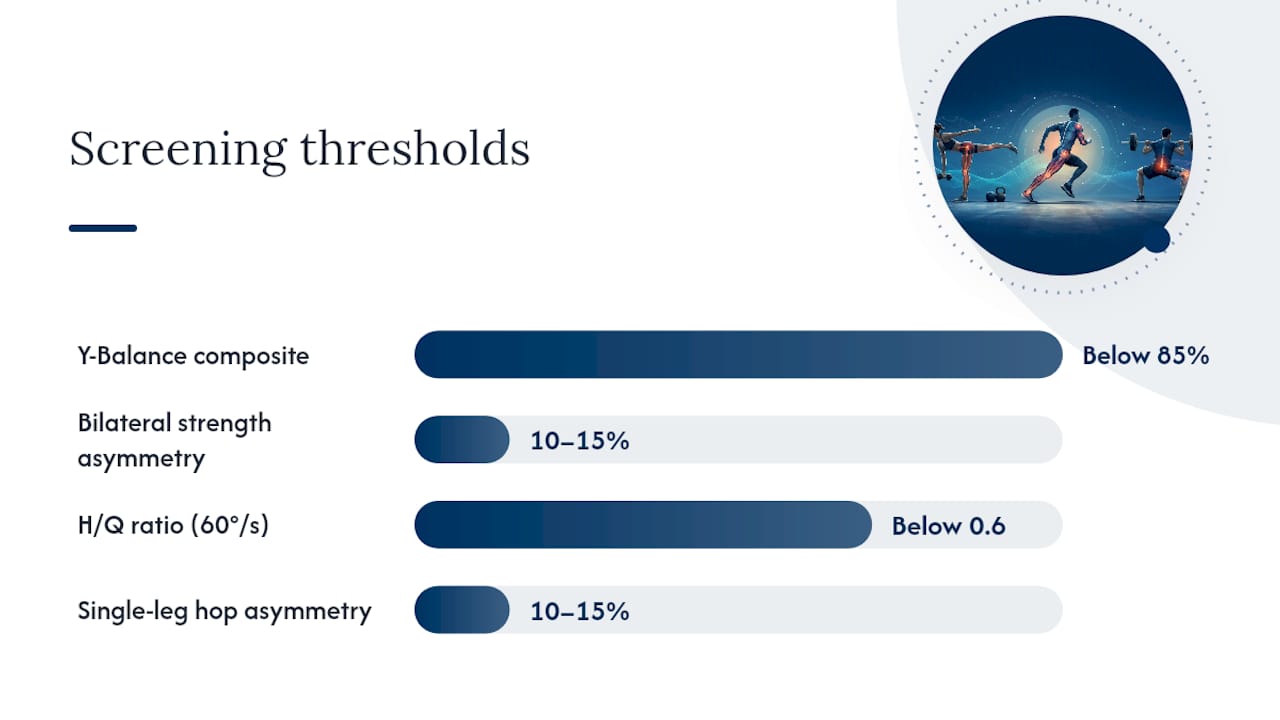
Screening thresholds at a glance:
| Test | Risk Threshold | What It Flags |
|---|---|---|
| Y-Balance Test composite | Below 85% of limb length | Elevated lower-limb injury risk |
| Bilateral strength asymmetry | Greater than 10–15% | Musculoskeletal injury risk (muscle-group dependent) |
| Conventional H/Q ratio (60°/s) | Below 0.6 | Hamstring strain and ACL risk |
| Single-leg hop asymmetry | Greater than 10–15% difference | Functional limb deficit |
When to refer. If a field screen flags a threshold, add isokinetic or countermovement-jump testing for a clearer picture. Persistent asymmetry despite 6–8 weeks of targeted training, worsening pain, or a failed return-to-play test all warrant referral to a physical therapist, sports physician, or chiropractor for diagnostic assessment.
What the research actually says about imbalances and performance
The evidence base is real but uneven. Here is what holds up and what to treat with caution.
The sprint and COD finding is the most consistent signal in the literature. The absence of a vertical jump effect suggests that bilateral explosive tasks can mask asymmetry that unilateral tasks expose. For team-sport athletes whose performance depends on cutting and accelerating, this is the most practically relevant finding.
On intervention timelines, a 6-week individualized supplemental resistance program for junior elite soccer players produced statistically significant improvements in hamstring peak torque and H/Q ratios (p < 0.05) compared with controls. Six to eight weeks is a realistic window to expect measurable strength changes from a targeted program, though neuromuscular adaptations often appear earlier.
Practical takeaways from the evidence:
- Sprint and change-of-direction performance are the tasks most sensitive to inter-limb asymmetry.
- Strength asymmetries above 10–15% consistently flag injury risk, but exact cutoffs depend on the muscle group and assessment method.
- Six to eight weeks of individualized supplemental work can produce measurable H/Q improvements.
- The research is heterogeneous. No single threshold applies universally. Use monitoring and retesting rather than a one-time screen.
Evidence-based strategies to correct muscle imbalances
Correction works best when it layers multiple approaches rather than relying on any single method.
Ranked toolbox:
- Targeted unilateral resistance training. Single-leg squats, Bulgarian split squats, single-leg Romanian deadlifts, and single-arm pressing directly address side-to-side strength gaps. Start the weaker limb first in each set and match the stronger side’s volume rather than exceeding it.
- Eccentric exercises, especially Nordic hamstring curls. Eccentric-focused hamstring work, including Nordic hamstring exercises, reduces hamstring deficits and is linked to lower hamstring strain rates across trials and cohort studies. The Nordic hamstring curl is the most studied single exercise for this purpose.
- Neuromuscular and proprioceptive drills. Balance board work, single-leg landing mechanics, and reactive agility drills retrain the motor patterns that strength training alone does not address. These are particularly important after injury, when altered motor patterns persist beyond tissue healing.
- Mobility and soft-tissue work. Hip flexor stretching, thoracic rotation drills, and targeted foam rolling address the mobility restrictions that force compensatory patterns. Improving range of motion at one joint often reduces the load on adjacent joints. Chiropractic care can improve athletic range of motion as part of this process.
- Manual and chiropractic input. When biomechanical restrictions limit the effectiveness of exercise-based correction, manual therapy addresses joint mobility and movement quality directly. Clinical evidence links pain-site treatment failure to upstream biomechanical faults such as muscle imbalance, supporting an integrated approach.
Progression guidelines:
- Weeks 1–2: Low load, high control. Focus on movement quality and activating the weaker side. Two to three sessions per week.
- Weeks 3–4: Add load progressively (5–10% per week) once movement quality is consistent.
- Weeks 5–8: Integrate corrective exercises into sport-specific patterns. Reduce isolated corrective volume as asymmetry narrows.
Contraindications: Pause corrective loading with acute pain, significant tendon pain (above a 4/10 on a pain scale during exercise), or uncontrolled swelling. These require clinical assessment before resuming.
Pro Tip: If you have a history of tendon pain, progress strength loads more slowly than the numbers suggest. Increasing muscle strength without matching tendon adaptation raises overload risk. When tendon symptoms are present, prioritize tendon-targeted loading protocols and get a clinician’s input on progression rate.
A practical 6–8 week program for lower-limb imbalances
This template is based on the intervention structure that produced measurable H/Q improvements in the 6-week soccer trial. Adapt load and volume to your training level and sport demands.
Phase structure:
- Weeks 1–2 (Assess and activate). Establish baseline YBT scores and single-leg hop distances. Introduce unilateral activation work at low load.
- Weeks 3–4 (Targeted correction). Increase load on the weaker limb. Add Nordic hamstring curls and single-leg RDL progressions.
- Weeks 5–6 (Integrate). Embed corrective exercises within sport-specific movement patterns. Reduce isolated corrective volume.
- Weeks 7–8 (Return-to-sport load). Retest YBT and single-leg hop. Progress to full sport loads if asymmetry has narrowed below the 10–15% threshold and movement quality is consistent.
Sample session template (Weeks 3–4):
- Warm-up (10 min): Hip 90/90 mobility, lateral band walks, single-leg glute bridges (2 × 10 each side)
- Corrective block (15 min): Nordic hamstring curls (3 × 6), single-leg RDL with light load (3 × 8 weaker side first), Copenhagen adductor holds (3 × 20 sec)
- Main lift (20 min): Bulgarian split squat (3 × 8 each side), single-leg press (3 × 10 each side)
- Conditioning (10 min): Sport-specific agility or sprint work at 70–80% intensity
- Cool-down and mobility (5 min): Hip flexor stretch, hamstring stretch, thoracic rotation
Progression checklist:
- Movement quality consistent before adding load (no Trendelenburg, no knee valgus)
- Bilateral strength gap narrowing toward less than 10% by Week 6
- No tendon pain above 4/10 during or after sessions
- YBT composite at or above 85% on both sides before return to full sport
Retest schedule: Baseline (Week 0), mid-program (Week 3), end of program (Week 6–8), and maintenance check every 3 months.
Who treats muscle imbalances and when to seek help
Self-managed programs work well for mild asymmetries identified early. Persistent or worsening asymmetry, pain, or a failed return-to-play test signals that a professional assessment will get you further faster.
Professional roles:
- Physical therapist (PT). Diagnostic testing, movement analysis, and structured rehabilitation. The primary referral for significant asymmetry or post-injury compensation patterns.
- Sports physician. Imaging and medical management when structural pathology (tendon tear, stress fracture) needs to be ruled out before loading.
- Chiropractor. Biomechanical assessment, joint mobility, and movement re-education. Particularly useful when joint restrictions are limiting the effectiveness of exercise-based correction. Chiropractic care for injury prevention addresses the movement faults that drive recurring injury.
- Strength and conditioning coach. Program design, load management, and sport-specific integration. Works best in combination with clinical assessment rather than in isolation.
Red flags that warrant referral:
- Asymmetry persisting despite 6–8 weeks of targeted training
- Pain worsening during or after corrective exercise
- Recurring injury to the same structure across multiple seasons
- Failed return-to-play test (asymmetry above threshold or pain on sport-specific tasks)
What to expect at a first clinical visit: A movement screen (YBT, single-leg squat, or equivalent), a strength assessment (manual muscle testing or dynamometry if available), a working diagnosis, and a short corrective plan with a retest date. Imaging is ordered only when structural pathology is suspected, not as a routine first step.
How to monitor progress and prevent recurrence
Correcting an imbalance is the first half of the job. Keeping it corrected requires a maintenance plan and objective retesting.
Retest cadence:
- Baseline before starting any corrective program
- Mid-program check at 3–4 weeks to confirm the weaker side is responding
- End-of-program retest at 6–8 weeks against the original baseline
- Periodic maintenance screen every 3 months during the competitive season
Maintenance checklist:
- At least one dedicated unilateral strength session per week, even in-season
- Neuromuscular drills (single-leg landing, balance work) twice per week
- Load management flags: reduce training volume by 10–15% if bilateral asymmetry starts climbing back above 10% on retesting
- Track subjective side-to-side fatigue differences as an early warning signal
Return-to-play criteria. The goal is not perfect symmetry. Return to full sport when the bilateral asymmetry has dropped below the sport-specific threshold (typically less than 10–15%), movement quality is consistent under fatigue, and the athlete is pain-free on sport-specific tasks. Chasing a perfectly equal limb-to-limb score at the expense of sport readiness is counterproductive.
The case for function over perfect symmetry
Most athletes who come in with a “muscle imbalance problem” are actually dealing with a performance or pain problem that asymmetry is contributing to. That framing matters because it changes what you prioritize.
Chasing bilateral symmetry as an end in itself can lead to overcorrecting functional adaptations that are actually serving the athlete. A dominant kicking leg in soccer, a stronger throwing shoulder in baseball — these are adaptations, not pathologies. The intervention target should always be the deficit that limits performance or causes pain, not the number on a symmetry index.
Two practical principles that hold up across the evidence:
- Prioritize asymmetries that show up on performance-relevant tests (sprint, COD, single-leg hop) over those that appear only on isolated strength measures.
- Use objective retesting to guide decisions about when to progress, when to refer, and when to return to full sport. Clinical judgment without retesting is how athletes stay in corrective programs longer than they need to.
Evertonchiropractic can help you screen and correct imbalances
Persistent asymmetry that does not respond to self-managed training is exactly the situation where a clinical assessment changes the outcome. Evertonchiropractic offers functional movement assessments that identify the specific movement faults and strength deficits driving your imbalance, rather than treating the pain site in isolation.
An initial assessment at Evertonchiropractic typically includes a movement screen, bilateral strength comparison, and a short individualized care plan with a retest schedule built in. Dr. Richard’s approach integrates chiropractic biomechanical correction with exercise-based corrective strategies, so the plan addresses both joint mobility restrictions and the strength deficits that keep patterns locked in. For athletes who want to stay in their sport and train at full capacity, that combination is more effective than either approach alone. Book your long-term performance assessment today and get a clear picture of where your asymmetries stand.
Sources
- The effect of lower inter-limb asymmetries on athletic performance: A systematic review and meta-analysis
- The Effects of Individualized Resistance Strength Programs on Knee Muscular Imbalances in Junior Elite Soccer Players | PLOS One
- Muscle imbalances and their role in musculoskeletal injury risk
- Frontiers | Isokinetic muscle function, dynamic balance, and injury risk in dominant and non-dominant lower extremities of adolescent taekwondo athletes
- Link
This article is general information, not a substitute for advice from a qualified doctor. Consult a qualified healthcare professional about your own circumstances before acting on anything here.
FAQ
How do you fix unbalanced muscles?
Fix muscle imbalances by combining targeted unilateral resistance training (to close the strength gap), eccentric exercises such as Nordic hamstring curls (to address length-tension deficits), and neuromuscular drills (to retrain altered motor patterns). Isolated strength work alone is less reliable for long-term correction than this blended approach.
How long does it take to correct muscle imbalances?
Measurable improvements in hamstring strength and H/Q ratios are achievable within 6 weeks of individualized supplemental resistance training, based on a controlled trial in junior elite soccer players. Neuromuscular adaptations often appear earlier, but full correction of significant asymmetry typically takes 6–8 weeks of consistent targeted work.
Who fixes muscle imbalances?
Physical therapists handle diagnostic testing and structured rehabilitation; sports physicians rule out structural pathology; chiropractors address joint mobility and biomechanical restrictions; and strength and conditioning coaches manage programming and sport-specific integration. For persistent asymmetry that does not respond to self-managed training, Evertonchiropractic offers functional movement assessments that identify the specific deficits driving the imbalance.
What muscle imbalances do runners have?
Runners commonly develop quad dominance relative to hamstring strength, particularly a deficit in the hamstrings’ eccentric deceleration capacity during late swing phase. Hip abductor weakness (leading to Trendelenburg gait and knee valgus) and calf-to-anterior-tibialis imbalances are also frequently identified in distance runners.
Recommended
- Spinal Alignment Benefits for Athletes: 9 Key Gains – Everton Chiropractic
- Chiropractic Benefits for Performance: Athletes’ Guide – Everton Chiropractic
- Chiropractic Care Explained for Fitness Enthusiasts – Everton Chiropractic
- How Chiropractic Improves Athletic Range of Motion – Everton Chiropractic