
Chiropractic care is defined as a hands-on clinical discipline that restores spinal alignment, joint mobility, and neuromuscular coordination to support functional independence. For adults over 65, the stakes are high. Falls cause over 41,400 deaths and nearly 3.9 million emergency department visits annually among older Americans. That number reflects how directly mobility loss translates into life-threatening risk. Clinics like Evertonchiropractic, led by Dr. Richard, are built around the principle that physical decline is not inevitable. You can maintain independence with chiropractic care when treatment combines safe manual therapy, targeted exercise, and consistent self-management.
How does chiropractic care improve mobility and reduce fall risk?
Spinal manipulation, the core technique in chiropractic practice, restores joint mobility by reducing fixation in vertebral segments. When joints move freely, the nervous system receives cleaner positional signals from muscles and tendons. That process is called proprioception, and it directly controls your balance and reaction speed.
The evidence is specific. An RCT in adults aged 65 and older shows chiropractic care improves fall-risk measures like ankle joint position sense and stepping reaction time over 12 weeks. Faster reaction time means you catch yourself before a fall becomes a fracture.
The benefits of chiropractic therapy extend beyond the spine itself. Here is what a well-structured care plan addresses:
- Spinal alignment: Correcting vertebral fixations reduces nerve interference and restores upright posture, which shifts your center of gravity back over your base of support.
- Soft-tissue therapy: Massage and myofascial release reduce muscle tension that pulls joints out of alignment and limits stride length.
- Neuromuscular coordination: Chiropractic adjustments stimulate mechanoreceptors in spinal joints, improving the brain’s real-time map of body position.
- Rehabilitative exercise: Targeted movements prescribed alongside manual therapy build the strength and stability that adjustments alone cannot provide.
The VA/DoD 2022 guideline recommends spinal mobilization and manipulation as a nonpharmacologic treatment for chronic low back pain. That recommendation from a federal clinical body signals that chiropractic is no longer a fringe option. It is a recognized tool in mainstream pain and mobility management.
Pro Tip: Ask your chiropractor to include a balance assessment at your first visit. Baseline scores for ankle proprioception and single-leg stance give you a concrete starting point to measure real progress.
What safety considerations are essential for senior chiropractic patients?
Chiropractic care for seniors is safe when the intake process is thorough. The two most critical screening factors are bone density and medication status. Both directly determine which techniques a chiropractor can safely use.
“Screening and technique adaptation according to bone and medication status can make chiropractic care safe and effective for older adults.” — Chiropractic Authority
Patients with osteoporosis require low-force mobilization rather than high-velocity thrust techniques. A DEXA scan result gives your chiropractor the data needed to select the right method. Patients on anticoagulants like warfarin or apixaban face elevated bruising and soft-tissue risk, so technique pressure must be adjusted accordingly.
Key safety checkpoints before beginning care:
- Medical history review: Disclose all medications, recent fractures, surgeries, and diagnosed conditions including osteoporosis, rheumatoid arthritis, and cardiovascular disease.
- Imaging when indicated: X-rays or DEXA scans clarify bone integrity before any spinal work begins.
- Technique matching: High-velocity manipulation is not appropriate for every patient. Gentle mobilization, instrument-assisted adjusting, and drop-table techniques are common alternatives.
- Provider coordination: Complex cases benefit from communication between your chiropractor, primary care physician, and any specialists managing chronic conditions.
A 2026 systematic review of adults 55 and older found that severe adverse events in chiropractic care are rare in clinical studies. That finding does not mean risk is zero. It means that with proper screening, the risk profile is manageable and comparable to other physical therapies. You can review chiropractic safety data in detail before committing to a care plan.
How can seniors combine chiropractic with exercise for lasting independence?

Manual therapy alone does not build the strength and endurance needed for long-term independence through spinal health. The most effective programs pair chiropractic adjustments with structured physical activity. The VA/DoD guideline is explicit: patients should receive advice to remain active alongside manual therapy. That combination produces better outcomes than either approach alone.
Here is a practical framework for integrating movement into your care plan:
- Walking: Aim for 20–30 minutes of brisk walking most days. Walking reinforces the postural corrections made during adjustments and maintains cardiovascular health that supports tissue recovery.
- Balance training: Single-leg stands, heel-to-toe walking, and standing on a foam pad train the same proprioceptive pathways that chiropractic adjustments stimulate. Practices like walking qigong combine mindful movement with balance work in a low-impact format.
- Gentle stretching: Hip flexor, hamstring, and thoracic spine stretches maintain the range of motion gained from adjustments between sessions.
- Self-management coaching: Clinician-supported education on posture, lifting mechanics, and activity pacing reduces the behaviors that cause pain to return.
The long-term data supports this integrated approach. Clinician-supported biopsychosocial self-management combined with spinal manipulation reduces lower back pain impact over 10–12 months. That is not a short-term fix. It is a documented pathway to sustained functional capacity.
Sleep is an underappreciated outcome. Adding chiropractic care improves sleep disturbance at 52 weeks among adults with low back pain. Better sleep accelerates tissue repair, reduces pain sensitivity, and supports the mental clarity needed to stay active and engaged in daily life.
Pro Tip: Keep a simple weekly log of your walking distance, sleep quality, and any pain flare-ups. Bring it to each chiropractic visit. Patterns in that data help your provider adjust your plan before small setbacks become major ones.
Supporting joint health through nutrition also matters. Resources on natural joint health support can complement what your chiropractor does in the clinic.
What are realistic expectations for independence-focused chiropractic care?
Spinal manipulation is not more effective than other established treatments for acute neck and low back pain, according to a Cochrane review cited by VA HSR&D. That finding matters. It means chiropractic works best as part of a coordinated plan, not as a standalone cure. Patients who understand this commit more consistently to multi-month programs and see better functional results.
Tracking progress requires metrics beyond a pain scale. The table below outlines the outcome measures most relevant to seniors focused on staying active with chiropractic care.
| Outcome Measure | What It Tracks | Typical Timeline |
|---|---|---|
| Ankle joint position sense | Proprioception and fall risk | 6–12 weeks |
| Stepping reaction time | Neuromuscular response speed | 6–12 weeks |
| Single-leg stance duration | Static balance capacity | 4–8 weeks |
| Daily activity capacity | Functional independence level | 8–16 weeks |
| Sleep quality score | Recovery and pain sensitivity | 12–52 weeks |
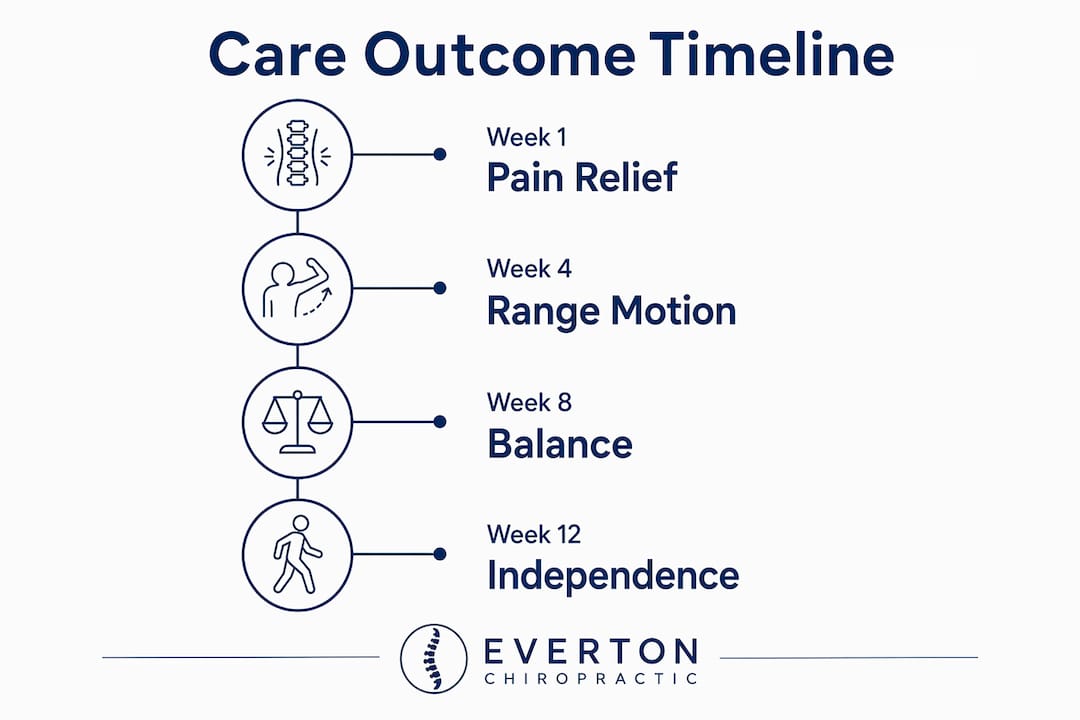
Short-term results, typically within the first 4–8 weeks, usually include reduced pain intensity and improved range of motion. These early wins matter because they build confidence and motivation to continue. Long-term results, from 3 months onward, show up in balance scores, reduced fall frequency, and the ability to perform daily tasks without assistance.
About 1 in 4 U.S. adults over 65 report at least one fall annually. That statistic frames why functional metrics matter more than pain scores alone. A patient whose pain dropped from a 7 to a 4 but whose reaction time did not improve is still at high fall risk. Tracking both dimensions gives you and your provider a complete picture.
Modify your care plan when progress stalls for more than 4 consecutive weeks. Options include adding physical therapy, adjusting exercise intensity, or consulting your physician about contributing medical factors. Staying in communication with your provider is the single most effective way to keep your plan working.
Key takeaways
Chiropractic care supports independence in seniors most effectively when manual therapy, targeted exercise, and safety screening work together as a coordinated plan.
| Point | Details |
|---|---|
| Fall risk is measurable | Track ankle proprioception and reaction time, not just pain scores, to assess real progress. |
| Safety screening is non-negotiable | Disclose osteoporosis status and all medications before any spinal technique is applied. |
| Exercise multiplies results | Walking, balance training, and stretching extend the gains from each chiropractic adjustment. |
| Long-term benefits include sleep | Chiropractic care improves sleep quality at 52 weeks, supporting recovery and daily function. |
| Realistic expectations drive commitment | Spinal manipulation works best as part of a multi-month coordinated plan, not a single-visit fix. |
Why functional goals changed how i think about senior chiropractic care
Most conversations about chiropractic care start and end with pain. I understand why. Pain is what drives people through the door. But after working with older adults, the most meaningful shift I have seen is when the goal moves from “less pain” to “I want to carry my groceries without help” or “I want to walk my grandchild to school.”
That reframe changes everything. When a patient tracks their single-leg stance time instead of just their pain level, they see progress that a pain scale would miss. A patient whose pain is a 5 but who can now stand on one leg for 12 seconds instead of 4 is genuinely safer and more capable than they were six weeks ago.
Safety screening is not a bureaucratic step. It is the foundation that makes the whole plan work. I have seen well-intentioned care go sideways because a provider did not know about a patient’s osteoporosis or blood thinner use. That information changes the technique, the pressure, and the expected timeline.
The patients who do best are the ones who treat chiropractic as one part of a broader commitment to staying active. They walk. They do their balance exercises. They show up consistently. The gentle spinal care approach that combines manual therapy with movement coaching is not a luxury. For older adults, it is the most direct path to staying in their own homes, on their own terms.
Physical decline is not a foregone conclusion. It is a trajectory that can be changed with the right tools and the right team.
— Aman
How Evertonchiropractic helps you stay mobile and independent
Evertonchiropractic, led by Dr. Richard, specializes in evidence-informed care designed for adults who want to stay active and independent as they age. Every treatment plan is tailored to your specific health history, mobility goals, and daily routine. That means no generic protocols and no guesswork about technique safety.

Whether you are managing chronic lower back pain, recovering from a fall, or simply want to move better, Evertonchiropractic builds a plan that addresses the root cause. For those dealing with persistent back pain, the clinic’s lower back pain relief guide outlines exactly how chiropractic treatment can reduce pain and restore function without medication. Schedule a consultation with Dr. Richard to take the first step toward lasting mobility.
FAQ
What does chiropractic care do for seniors specifically?
Chiropractic care for seniors restores joint mobility, improves proprioception, and reduces fall risk through spinal adjustments and rehabilitative exercise. An RCT in adults 65 and older found measurable improvements in ankle position sense and stepping reaction time after 12 weeks of care.
Is chiropractic care safe for people with osteoporosis?
Yes, with proper screening and technique modification. Chiropractors use low-force mobilization instead of high-velocity thrusts for patients with reduced bone density, making care both safe and effective.
How long does it take to see results from chiropractic care?
Short-term improvements in pain and range of motion typically appear within 4–8 weeks. Functional gains like better balance and reduced fall frequency develop over 3–6 months of consistent care combined with exercise.
Can chiropractic care replace exercise for maintaining independence?
No. The VA/DoD 2022 guideline recommends combining spinal manipulation with advice to remain active. Exercise builds the strength and endurance that manual therapy alone cannot provide.
Does chiropractic care help with sleep problems related to back pain?
Yes. A pragmatic trial found that adding chiropractic care improves sleep disturbance at 52 weeks among adults with low back pain, making it a meaningful long-term benefit beyond pain relief.