
Most cases of a perceived leg length discrepancy trace back to pelvic tilt or muscle imbalance, not a bone that’s actually shorter, and chiropractic assessment plus manual therapy often reduces the difference within weeks of consistent care. This article covers functional (apparent) leg length discrepancy only. True structural differences in bone length need imaging and an orthopaedic workup, not the guidance below.
TL;DR:
- Correcting pelvic tilt and muscle imbalance typically reduces functional leg length discrepancy by 1 to 3 centimeters over several weeks, not instantly.
- Assessments involve multiple tests, including standing postural checks, unloaded leg comparisons, and block testing, with imaging only if structural issues are suspected.
- Manual therapies like muscle energy technique and gluteal exercises are proven effective, while pelvic mobilization results are less consistent.
- A shoe lift should only be used after addressing pelvic torsion and confirming a true structural discrepancy through proper evaluation.
- Patients with persistent or traumatic leg length issues should seek imaging and orthopaedic consultation, as chiropractic care primarily targets biomechanical causes.
Table of Contents
- What Is Functional Leg Length Discrepancy?
- What Causes an Apparent Leg-Length Difference?
- How Do Chiropractors Measure Leg Length Discrepancy?
- What Treatments Reduce Functional Leg Length Discrepancy?
- What Results and Timeline Should You Expect?
- What Should You Bring to a Chiropractic Assessment?
- The Clinical Case for Treating the Pelvis First
- How Everton Chiropractic Approaches Your First Visit
- Sources
- FAQ
What Is Functional Leg Length Discrepancy?
Functional leg length discrepancy (FLLD) is an apparent difference in leg length caused by pelvic tilt, innominate rotation, or muscle imbalance rather than an actual difference in bone length. The bones measure the same. What changes is how the pelvis sits and how tension in surrounding muscle groups pulls one hip higher than the other.
This matters because the treatment paths diverge completely. Structural (true) leg length discrepancy, where the femur or tibia is genuinely shorter, belongs to orthopaedics, imaging, and sometimes surgical management. Functional leg length discrepancy is a biomechanical problem, and it shows up constantly in adults dealing with chronic low back pain, one leg longer back pain, or a posture that looks subtly off in the mirror. Clinicians see it often enough that ruling it out first, before assuming a structural cause, is standard practice.
What Causes an Apparent Leg-Length Difference?
Pelvic torsion is the most common driver. When one side of the pelvis rotates forward relative to the other, the hip socket shifts position and one leg appears shorter even though nothing in the bone has changed. Tight muscles crossing the pelvis often cause or maintain that rotation.
The usual suspects include:
- Quadratus lumborum: hypertonicity here tilts the pelvis upward on one side.
- Iliopsoas: a shortened psoas can rotate the pelvis anteriorly and pull the leg into apparent shortening.
- Adductors: tight inner-thigh muscles restrict hip abduction and skew standing alignment.
- Foot mechanics: over-pronation on one side changes leg alignment up the entire kinetic chain.
- Joint contractures: limited range in the hip or knee changes how the leg sits in space, even at rest.
The scale of this effect surprises most people. Clinical orthopaedic guidance estimates roughly 3 centimeters of apparent leg-length change for every 10 degrees of hip adduction or abduction. A modest joint restriction, in other words, can produce a leg-length difference big enough to worry a patient who has never had an actual bone-length problem in their life.
How Do Chiropractors Measure Leg Length Discrepancy?
Assessment starts standing and ends with confirmation, because posture changes with load and a single snapshot rarely tells the full story. A thorough exam usually runs through this sequence:
- Weight-bearing postural screen. The chiropractor palpates the ASIS and PSIS (the bony landmarks at the front and back of the pelvis) while you stand normally, checking for asymmetry and observing your gait for compensations.
- Unloaded comparison. With you lying prone or supine, tests like the Derifield method compare leg length without gravity’s influence, which helps separate a true pelvic rotation from a positional artifact.
- Block testing. Small blocks are placed under the shorter-appearing side while standing to see whether the apparent difference resolves, confirming a functional rather than structural pattern.
- Imaging, when warranted. X-ray or a long-limb scan gets ordered only if findings suggest a structural component or don’t resolve with positional testing.
None of these steps work in isolation, and that’s the point. Professional literature on treating leg-length inequality notes that bedside checks, especially supine visual comparisons, carry real reliability problems without a level surface and repeated measurement. A single test rarely settles anything on its own.
Pro Tip: Ask your chiropractor which specific test confirmed a functional (not structural) pattern before starting treatment. If they can’t point to a block test or a positional comparison that ruled out a structural cause, ask why.
What Treatments Reduce Functional Leg Length Discrepancy?
Manual therapy and targeted exercise make up the core of non-surgical correction, and the research backing this approach has grown more specific in recent years.
Muscle Energy Technique (MET) is the most studied intervention here. A randomized trial found that MET produced significant improvements in pelvic alignment, functional leg length, pain, and fatigue in chronic low back pain patients, with results reaching statistical significance across a 42-participant group. MET works by having the patient actively contract a muscle against gentle resistance, then relaxing into a new range, which resets tone in the tissues holding the pelvis rotated.

Gluteal control training delivers some of the most concrete numbers in the field. One study measured a reduction in functional leg-length inequality from an average of 0.9 centimeters down to 0.3 centimeters, alongside a pelvic index angle improvement indicating better pelvic alignment. That’s a genuine shift in a measurable clinical marker, not a subjective “feels better” outcome.
Sacroiliac and pelvic manipulative therapy rounds out the toolkit, though the evidence here stays more cautious. A pilot study of bilateral SI joint manipulation found no statistically significant change in primary gait parameters across a small sample, which underscores how much measurement variability affects this kind of research.
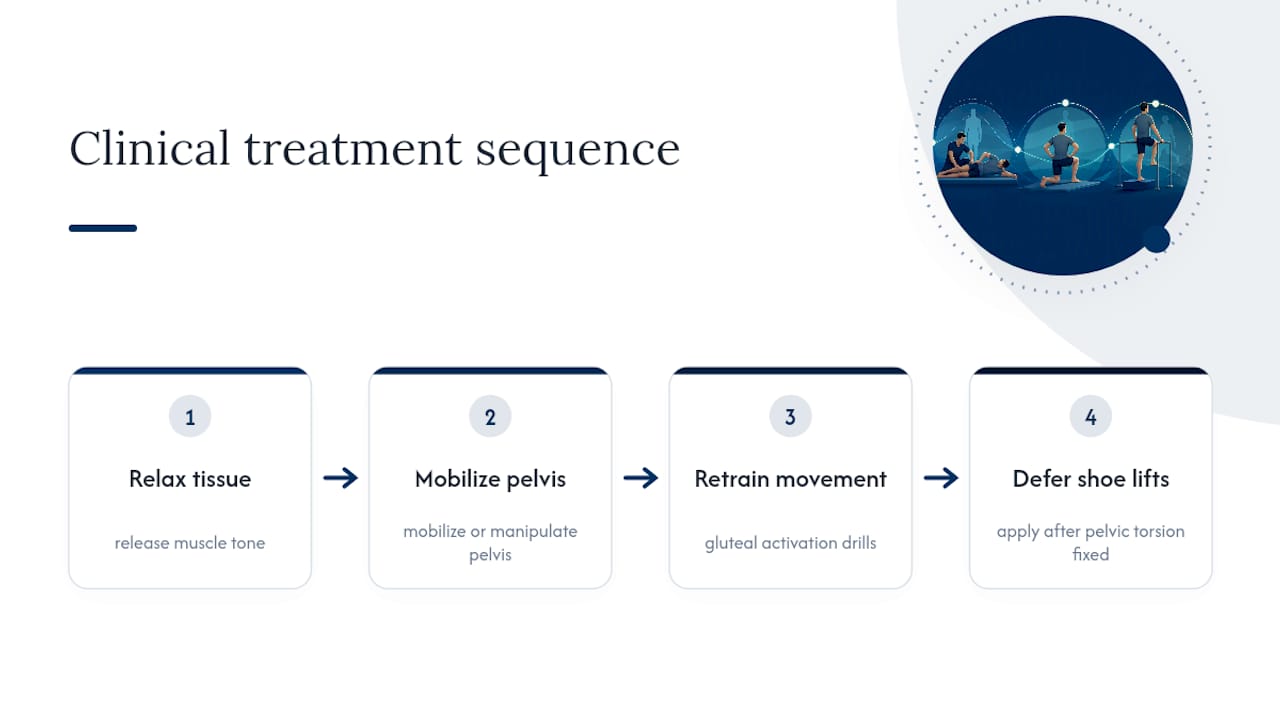
The sequencing matters as much as the techniques themselves. Clinicians typically relax hypertonic tissue first, mobilize or manipulate the pelvis second, then retrain movement patterns with exercises like gluteal activation drills. Unilateral shoe lifts get held off until pelvic torsion is actually addressed, since applying a lift too early can lock in the very asymmetry the rest of the plan is trying to fix.
What Results and Timeline Should You Expect?
Expect measurable change, not instant resolution. The gluteal training study above took its 0.9 to 0.3 centimeter improvement over a structured rehabilitation period, not a single visit, and the MET trial’s pain and fatigue improvements followed a defined treatment course rather than one session.
A few realistic markers for readers to hold onto:
- Early sessions typically target pelvic mobility and muscle tension, with postural changes noticeable within a few weeks for many patients.
- Individual variability is real. Foot mechanics, existing joint contractures, and how long the imbalance has been present all affect how fast things shift.
- Refer out for imaging or orthopaedic evaluation if there’s a history of trauma, prior hip or leg surgery, or a discrepancy that stays large despite weeks of consistent conservative care.
What Should You Bring to a Chiropractic Assessment?
Preparation shortens the path to an accurate diagnosis. Walk in with a short written history: any prior imaging, when the leg-length difference or back pain started, and what activities seem to trigger or worsen it.
- Bring your history. Prior X-rays, a symptom timeline, and a note on which activities aggravate the discomfort.
- Ask about method. Which specific tests will confirm functional versus structural involvement, and how many visits the clinician expects before reassessing.
- Ask what gets measured. Objective markers like pelvic angle or block-test results give you something concrete to track over time, similar to how a functional movement assessment tracks progress.
- Start gentle self-care. Light activity modification and gentle gluteal activation exercises are reasonable while you wait for your first visit.
Pro Tip: Skip unilateral shoe lifts on your own before assessment. If the discrepancy is functional and pelvic torsion hasn’t been addressed, a DIY lift can reinforce the very imbalance you’re trying to correct.
The Clinical Case for Treating the Pelvis First
The approach to functional leg length discrepancy starts with a simple bias: fix the muscle imbalance and pelvic rotation before reaching for a shoe insert. The assessment process combines standing and unloaded positional testing with evidence-informed manual therapy, MET and sacroiliac mobilization among them, paired with rehabilitation exercises that retrain how the hips and pelvis move under load.
A typical care pathway might run a patient through an initial postural and gait screen, several sessions of manual correction alongside gluteal activation work, then a reassessment to check whether the apparent discrepancy has narrowed. No plan promises a guaranteed outcome. What it offers is measurable goals, patient education on what’s actually happening in the pelvis, and a rehabilitation focus that outlasts the initial relief.
— Aman
How Everton Chiropractic Approaches Your First Visit
Everton Chiropractic gives you a structured alternative to guessing whether your back pain and uneven stance come from a real bone-length issue or a fixable pelvic imbalance. Rather than jumping straight to a shoe lift or living with the discomfort, Dr. Richard’s clinic runs the same kind of layered assessment described above: standing posture checks, unloaded comparisons, and objective measures you can actually track between visits.

Your first visit typically covers a full postural and gait screen, palpation of pelvic landmarks, and a conversation about what’s triggering your symptoms, followed by a tailored plan that might include MET, pelvic mobilization, and corrective exercise. The clinic’s broader approach to lasting relief is outlined in its long-term pain relief strategies, which covers how these techniques fit into ongoing care rather than a one-off fix. If a pelvic imbalance has been driving your back pain or uneven stance, book an assessment and get an objective read on what’s actually happening before assuming the worst.
Sources
- Gluteal training study (2024)
- Effect of MET on pelvic alignment and LLD (Healthcare, 2023)
- Leg-length discrepancy (Musculoskeletal Key, 2021)
- Pilot study of bilateral SI joint manipulation (PMC)
FAQ
What is the difference between functional and structural leg length discrepancy?
Functional (apparent) leg length discrepancy comes from pelvic tilt or muscle imbalance with no actual difference in bone length, while structural discrepancy involves a real difference in femur or tibia length that requires orthopaedic evaluation.
Can chiropractic care fix an uneven leg length?
Chiropractic care can reduce the apparent difference caused by pelvic torsion and muscle imbalance through techniques like Muscle Energy Technique, pelvic mobilization, and gluteal control training, though results vary by individual and typically develop over several weeks.
How do chiropractors measure leg length discrepancy?
Chiropractors combine standing postural palpation, unloaded prone or supine comparisons, and block testing, since a single bedside check is prone to error without repeated, standardized measurement.
Is a shoe lift a good fix for uneven leg lengths?
A shoe lift can help once a true structural difference remains after functional causes are addressed, but applying one before correcting pelvic torsion risks reinforcing the underlying imbalance.
When should leg length discrepancy be checked with imaging?
Imaging becomes appropriate when there’s a history of trauma or prior surgery, or when a leg-length difference persists despite weeks of conservative chiropractic care aimed at the pelvis and surrounding muscles.