
You can breathe diaphragmatically when your lower rib cage and pelvis are positioned to let the diaphragm descend fully. Relaxed shoulders and a neutral pelvis are the immediate cues that make it possible. To check yourself right now, put one hand on your chest and one on your belly and inhale slowly through your nose. If the belly hand moves more than the chest hand, your posture is already working with you.
TL;DR:
- Diaphragmatic breathing requires correct posture, including a neutral pelvis and relaxed shoulders, to allow full diaphragm descent and proper abdominal movement.
- Practice lying down first, then sitting and standing, to gradually build automatic diaphragmatic patterns across different positions.
- Common errors include breathing too quickly, tension in the neck and shoulders, and forcing the belly outward, all of which slow progress.
- Structural issues like thoracic rigidity from severe kyphosis may prevent effective diaphragmatic movement, requiring a postural assessment and possible manual treatment.
- Consistent, short daily sessions focusing on slow, controlled breaths develop a more natural diaphragm-first breathing pattern over time.
Table of Contents
- What Diaphragmatic Breathing Posture Actually Means
- Which Position Should You Practice In First?
- How Do You Practice Diaphragmatic Breathing Step by Step?
- How Often Should You Practice Diaphragmatic Breathing?
- Why Isn’t My Diaphragmatic Breathing Working?
- When Does Breathing Practice Need Backup From Posture Treatment?
- A Practitioner’s Honest Take on the Learning Curve
- When Posture Won’t Budge, Try a Hands-On Assessment
- Sources
- FAQ
What Diaphragmatic Breathing Posture Actually Means
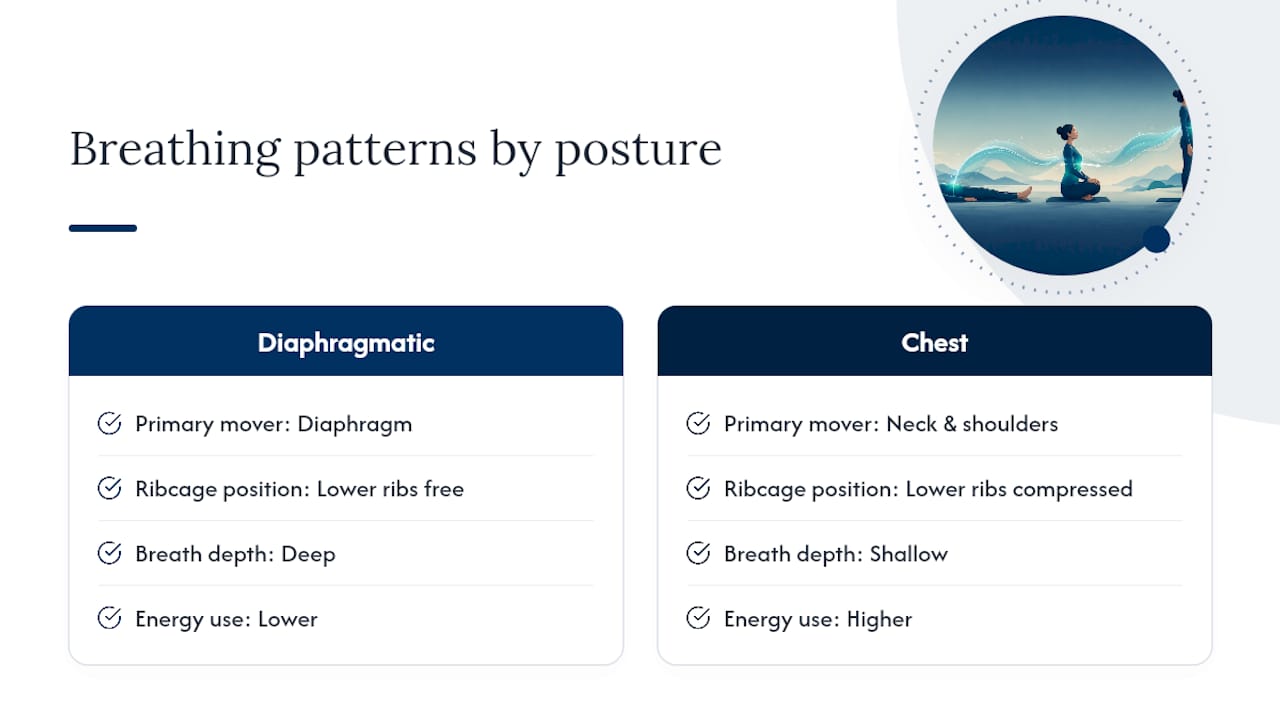
Diaphragmatic breathing, sometimes called belly breathing, relies on the diaphragm dropping down and flattening as you inhale, pushing the abdominal contents forward. Chest breathing, by contrast, uses the neck and shoulder muscles to lift the rib cage instead, which is shallower and burns more energy for less oxygen exchange. Your rib cage position determines which pattern you default to. When the lower ribs sit in a slightly flared, compressed position from slouching, there is less room for the diaphragm’s dome to move, a space physiologists call the zone of apposition. Slumped shoulders and a forward head shrink that zone further. This isn’t just theory: a randomized controlled trial on postmenopausal women with thoracic kyphosis found that adding diaphragmatic breathing to corrective posture exercises produced significantly greater gains in diaphragmatic excursion than corrective exercises alone, with the difference reaching statistical significance (p<0.05) over 12 weeks. Posture and breath train together, not separately.
Which Position Should You Practice In First?
Start lying down, which helps gravity assist the diaphragm’s movement and provides stable spinal support. Once the movement feels automatic lying down, progress to sitting, then standing, since Harvard Health’s own guidance on learning diaphragmatic breathing treats position progression as the path to making the pattern stick in daily life, not just on a mat.
A few posture cues matter in every position:
- Keep your pelvis neutral, neither tucked under nor tilted forward, so the abdominal wall can expand without resistance.
- Let your shoulders drop away from your ears instead of hiking up on the inhale.
- Stack your head over your spine rather than jutting your chin forward.
- Aim for soft, sideways rib expansion rather than lifting your chest upward.
Each cue does a specific job. A neutral pelvis keeps your core canister aligned so the belly has somewhere to go. Relaxed shoulders and a stacked head quiet the neck muscles that otherwise hijack the breath, a pattern Johns Hopkins Medicine specifically flags as something diaphragmatic breathing is meant to minimize. Lateral rib expansion, instead of chest lifting, tells you the diaphragm is doing the work.
How Do You Practice Diaphragmatic Breathing Step by Step?
Lying down
- Lie on your back with knees bent, feet flat, and one small pillow under your head if needed.
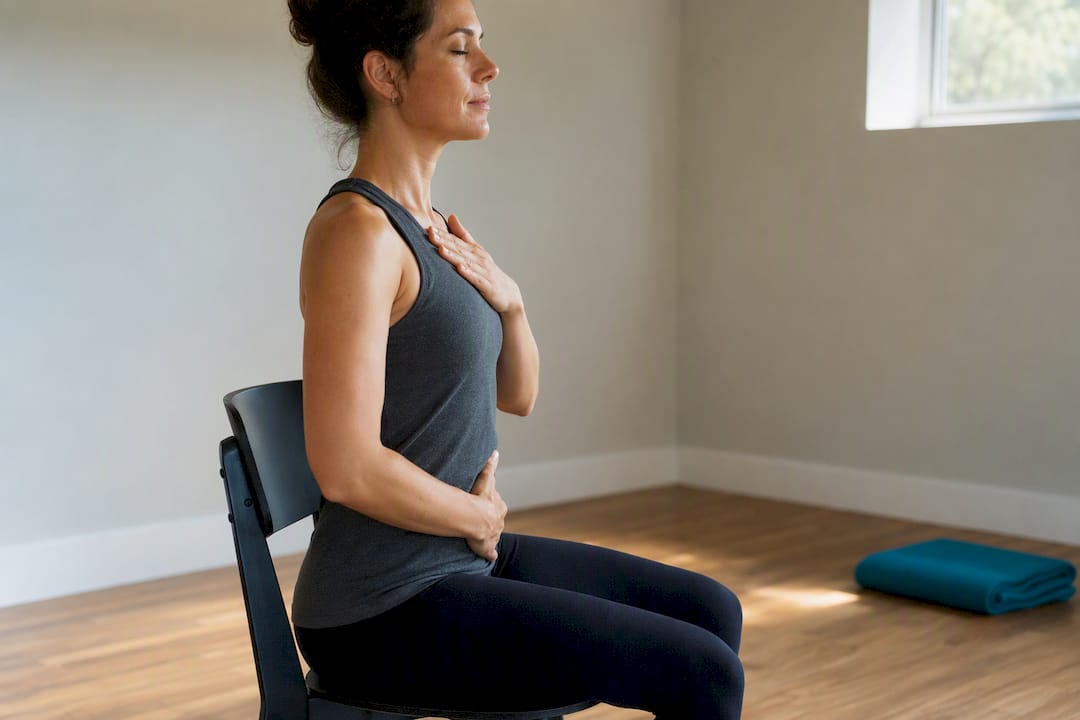
- Place one hand on your upper chest and the other just below your rib cage, following the hand-placement method Cleveland Clinic recommends.
- Inhale slowly through your nose. Your belly hand should rise while the chest hand stays still.
- Exhale through pursed lips, gently drawing your abdominal muscles in as the air leaves.
Sitting and standing
Once lying feels natural, sit tall in a chair with feet flat and repeat the same hand check, doing shorter sets of five or six breaths. Standing comes last: keep the same neutral pelvis and relaxed shoulders, and expect the belly movement to feel smaller since you’re now working against gravity instead of with it.
A simple starting tempo is a 4 second inhale, a 2 second hold, and a 6 second exhale. If hand placement feels awkward, a light paperback or tissue box balanced on your belly works as a visual substitute.
Pro Tip: If your chest hand moves before your belly hand, slow the inhale down by half. Speed is almost always the reason chest breathing sneaks back in.
How Often Should You Practice Diaphragmatic Breathing?
Consistency beats intensity here. Harvard Health recommends practicing 5 to 10 minutes, several times a day, which is enough to reinforce the pattern without turning it into a chore.
- Week one: practice lying down only, twice daily, focusing purely on the hand-placement check.
- Week two: add seated practice, then standing, once the lying pattern feels automatic.
- Week three onward: layer in walking and light activity, checking in with a quick hand test whenever you remember.
On packed days, shrink the session instead of skipping it. Three or four slow breaths at a red light or before opening your laptop still counts. The real goal is transfer: getting the diaphragm-first pattern to show up automatically during a stressful email, a workout, or a long commute, not just during dedicated practice time.
Why Isn’t My Diaphragmatic Breathing Working?
Most people run into one of a handful of predictable snags. Recognizing which one is yours usually fixes the problem faster than any amount of extra effort.
- Your chest moves more than your belly, usually from breathing too fast or too shallow.
- Your neck and shoulders tense up on the inhale, often from raising the ribs instead of letting them expand sideways.
- You force your belly outward instead of letting the inhale pull it there naturally.
- You rush the exhale, which cuts the relaxation benefit short.
If you’re stuck, slow everything down, drop your shoulders deliberately, and let the inhale be quieter and smaller than feels natural at first. Guy’s and St Thomas’ NHS points to exactly these two compensations, neck recruitment and over-bracing, as the most common blocks, and recommends rhythm over force as the fix.
Pro Tip: If you feel dizzy or increasingly short of breath during practice, stop and get a clinical assessment rather than pushing through it. That’s not a normal part of learning the technique.
When Does Breathing Practice Need Backup From Posture Treatment?
Breathing drills alone often resolve mild, habit-driven chest breathing within a few weeks of consistent practice. But when the rib cage itself is structurally rigid, such as with a pronounced thoracic kyphosis, no amount of hand-placement cueing will fully open that space back up.
- Persistent shallow breathing despite weeks of correct practice often points to a structural rather than habitual cause.
- A posture assessment can identify whether thoracic stiffness, not just muscle memory, is limiting your rib expansion.
- Clinicians often pair manual posture correction with breathing retraining rather than prescribing either in isolation.
A Practitioner’s Honest Take on the Learning Curve
Progress here is rarely linear, and that trips people up. You’ll nail the pattern lying down in a day or two, then feel like you’ve lost it completely once you stand up and try to hold a conversation. That’s normal, not failure. Keep the practice short, keep checking in with your hands, and give the standing version weeks, not days, to catch up. If breathing ever triggers dizziness or real distress, stop and get it checked rather than pushing harder.
— Aman
When Posture Won’t Budge, Try a Hands-On Assessment
Sometimes the reason your belly won’t rise isn’t effort. It’s a rib cage or spine that’s structurally stuck, and no amount of solo practice will fully free it up. Some practitioners assess thoracic and rib mobility hands-on and build personalized plans around what the body is actually restricted in, rather than offering one-size-fits-all routines.

A chiropractic consultation starts with exactly that kind of assessment, checking how your spine and rib cage move before recommending anything. From there, treatment might involve spinal alignment work or a structured posture correction program depending on what’s actually limiting you. If weeks of breathing practice haven’t moved the needle, book a consultation and find out whether your posture, not your effort, is the real bottleneck.
Sources
- Diaphragmatic Breathing Exercises & Benefits — Cleveland Clinic
- Breathing Techniques — Johns Hopkins Medicine
- Learning diaphragmatic breathing — Harvard Health
- Effect of adding diaphragmatic breathing to corrective exercises on kyphotic angle and diaphragmatic excursion — PubMed
- Abdominal breathing — Guy’s and St Thomas’ NHS
FAQ
Does diaphragmatic breathing help with posture?
Yes. Practicing the two together compounds the effect. The RCT on corrective exercises found that combining diaphragmatic breathing with posture exercises improved diaphragmatic excursion significantly more than posture exercises alone.
What is the best position for diaphragmatic breathing?
Lying on your back with knees bent is the easiest starting position because gravity assists the diaphragm’s downward movement. Progress to sitting, then standing, once the pattern feels automatic.
How do I know if I’m doing diaphragmatic breathing correctly?
Place one hand on your chest and one below your rib cage. If the belly hand rises more than the chest hand on inhale, you’re using the correct pattern, per Cleveland Clinic’s guidance.
What are common mistakes in diaphragmatic breathing?
The most frequent errors are breathing too fast, letting the neck and shoulders tense up, and forcing the belly outward instead of letting the inhale draw it there naturally. Slowing the breath usually resolves all three.
Can chiropractic care help if breathing exercises alone aren’t working?
Yes, particularly when rigid posture or thoracic stiffness limits rib expansion. A posture assessment can identify structural restrictions that breathing drills can’t fix on their own.