The Clinical Burden of Cervical Spine Disease
Cervical spine conditions affect thousands of working adults in Singapore annually. The cervical spine contains incredibly delicate and vital neurological structures. Age-related degeneration severely compromises these essential spinal pathways over time. Spinal discs gradually lose their internal hydration as the body ages. This progressive degeneration leads to bulging or herniation of the disc.
Herniated discs often compress adjacent cervical nerve roots1. This direct nerve compression causes a condition known as cervical radiculopathy. Symptoms include radiating arm pain and localized physical numbness2. Patients frequently experience sharp tingling or weakness in their hands2.
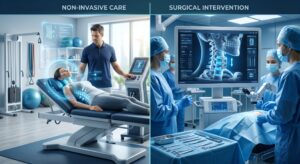
Left untreated, chronic nerve compression worsens significantly over time. Patients constantly seek effective and lasting relief strategies for their pain. They face a highly critical healthcare decision in their recovery journey. They must choose between non-invasive therapies and structural surgical intervention.
Cervical decompression machines offer a purely conservative, clinic-based approach. Surgery offers definitive, physical correction of the underlying spinal anatomy. Both treatment pathways provide unique and documented clinical benefits. Both options carry distinct financial implications within the Singaporean healthcare system. Recovery times also vary dramatically between these two specific interventions. This detailed guide explores these interventions in exhaustive clinical depth. It provides a nuanced decision-making framework for patients and clinicians.
Understanding Non-Invasive Cervical Decompression
Non-surgical spinal decompression is an advanced conservative treatment modality. It utilizes a highly sophisticated, computer-controlled traction table3. The machine gently and precisely stretches the targeted cervical spine. This specialized stretching creates negative intradiscal pressure4.
Negative pressure acts exactly like an internal physiological vacuum. It helps retract herniated disc material away from the nerve. This mechanical retraction relieves pressure on irritated spinal nerves immediately3. Decompression therapy also fundamentally promotes natural disc healing processes. It drastically improves the flow of nutrients into the injured disc.
Oxygen and vital fluids are drawn into the damaged area3. This effectively rehydrates the damaged intervertebral disc over multiple sessions. It creates an optimal physiological environment for natural tissue repair.
Leading Decompression Machine Technologies
Not all spinal decompression machines perform identically in clinical settings. Clinics across Singapore utilize various advanced technological platforms. The specific technology used directly impacts the generated force curve.
The DRX9000 utilizes complex, computer-controlled logarithmic force curves4. This unique curve avoids triggering natural muscle guarding reflexes7. Bypassing muscle spasms allows for much deeper and safer spinal distraction. The DRX9000 reportedly creates negative pressure reaching -160 mmHg5. Clinical research indicates exceptionally high patient satisfaction with this device4.
SpineMED utilizes a different, more linear traction force model4. It offers a modern harness-free setup for maximum patient comfort8. The SpineMED system accommodates patients of virtually any size easily8. It is officially FDA-cleared for both lumbar and cervical spinal decompression8.
The Triton DTS features a highly versatile six-section table design7. It allows both prone and supine treatment positioning for patients7. It utilizes a sophisticated progressive loading process to relax spinal muscles7. The Triton DTS effectively treats both cervical and lumbar conditions7.
| Decompression Machine | Force Application Profile | Key Technological Feature |
| DRX9000 | Logarithmic decompression curve | Creates significant negative intradiscal pressure |
| SpineMED | Linear traction force | Harness-free, completely repeatable session protocols |
| Triton DTS | Multi-axial mechanical traction | Six-section table for varied anatomical positioning |
The Clinical Care Pathway
Treatment sessions are entirely outpatient procedures performed in clinics. Each individual therapy session takes roughly twenty to thirty minutes3. The therapy is generally comfortable and completely non-invasive3. Many patients actually find the sessions relaxing enough to sleep7.
A full conservative treatment arc involves multiple scheduled clinic visits. A typical clinical protocol requires ten to twenty dedicated sessions3. These sessions are usually spread evenly over six to ten weeks3. Severe chronic conditions may require up to thirty cumulative sessions.
Understanding Cervical Spine Surgery
Surgery remains the definitive treatment for severe structural spinal issues. When prolonged conservative therapies fail, surgery often becomes absolutely necessary. It physically removes the exact anatomical source of nerve compression.
Anterior Cervical Discectomy and Fusion (ACDF)
ACDF is widely considered the gold standard for cervical surgical intervention. It has a historically high clinical success rate worldwide10. The surgeon carefully accesses the cervical spine from the anterior neck. They completely remove the damaged or herniated intervertebral disc. This removal immediately relieves physical pressure on the spinal cord11.
The surgeon then fuses the two adjacent cervical vertebrae together. Specialized bone grafts or titanium cages strongly facilitate this fusion12. Fusion permanently prevents any painful micro-motion at that specific segment. ACDF effectively treats herniated discs and severe cervical spondylosis11.
Cervical Disc Replacement (CDR)
Artificial disc replacement is a modern alternative to spinal fusion13. The surgeon removes the damaged disc exactly like an ACDF procedure. However, they insert a highly engineered artificial implant instead13. This implant physically preserves natural motion at the treated spinal segment13.
CDR may significantly reduce mechanical stress on adjacent spinal levels15. It is becoming increasingly popular among younger patients in Singapore. The Singapore Ministry of Health evaluated CDR positively in 202415. It demonstrated excellent long-term clinical effectiveness compared to traditional fusion15.
Comprehensive Cost Analysis in Singapore
Financial considerations play a massive role in complex treatment decisions. The total cost gap between clinics and private hospitals is substantial. Patients must evaluate their insurance coverage before committing to surgery.
Costs of Non-Invasive Clinic Care
Decompression costs are significantly lower and are usually paid incrementally. Clinics in Singapore charge between $100 and $250 per session16. Standard chiropractic spinal adjustments start around $80 to $12017. Initial clinical consultations often cost slightly extra for new patients. They range from $80 to $200 across various local clinics17.
Many clinics legally mandate baseline spinal X-rays before starting treatment. These diagnostic X-rays cost between $100 and $250 typically17. Patients typically purchase bundled treatment packages for better financial value. A standard twenty-session decompression program costs approximately $3,20020.
Total conservative treatment costs generally remain relatively low overall. They rarely exceed $4,000 for a completely uncomplicated clinical case19. Some clinics may attempt to sell unnecessary lifelong maintenance packages. Patients should avoid clinics pushing fifty-session packages without clear goals19.
| Clinic Service Type | Estimated Cost Per Session (SGD) | Total Estimated Program Cost (SGD) |
| Initial Consultation | $80 – $200 | $80 – $200 |
| Baseline Spinal X-Rays | $100 – $250 | $100 – $250 |
| Single Decompression Session | $100 – $250 | N/A |
| 20-Session Treatment Package | $150 – $180 | $3,000 – $3,500 |
Costs of Advanced Neck Surgery
Neck surgery requires highly significant financial resources upfront. ACDF performed in a private hospital is very expensive. The typical private inpatient bill averages $57,352 for one segment11. This figure includes surgeon fees, anesthesia, and premium ward charges. Specialized spinal implants alone cost around $10,184 for one segment11.
Public hospital surgical routes are significantly cheaper for Singaporean citizens. A heavily subsidised Ward B2 ACDF bill averages just $8,85111. Unsubsidised public hospital bills hover around $26,154 for similar procedures11.
Cervical disc replacement costs range broadly from $22,000 to $40,00014. Two-level fusion surgeries cost substantially more than single-level procedures. A two-segment ACDF in a private hospital averages $65,22911.
| Surgical Procedure Type | Public Subsidised Ward B2 | Private Hospital Inpatient |
| 1-Segment ACDF | $8,851 | $57,352 |
| 2-Segment ACDF | $14,012 | $65,229 |
| Cervical Disc Replacement | N/A | $22,000 – $40,000 |
Navigating Insurance: MediSave and MediShield Life
Singapore offers highly robust healthcare financing schemes for complex surgeries. Major spine surgery qualifies for these national financial insurance frameworks. However, MediSave does not currently cover outpatient chiropractic clinic care19.
MediSave Surgical Limits
MediSave covers inpatient surgical costs based on specific procedure codes. A one-segment ACDF falls under TOSP Code SB803C11. The official MediSave surgical withdrawal limit is exactly $3,26011. For two segments, the maximum withdrawal limit increases to $3,61011.
Patients can also claim daily inpatient hospitalisation charges concurrently. They can use up to $1,130 daily for the first two days11. They can use $400 per day for subsequent hospitalisation days11.
MediShield Life and Integrated Shield Plans
MediShield Life provides vital additional foundational coverage layers for citizens. It claims up to $3,540 for Table 6A surgical procedures11. Surgical implants have a completely separate $7,000 maximum claim limit11. MediShield Life applies a strict pro-ration factor for private hospital care11.
Private Integrated Shield Plans (IP) cover the financial bulk. IPs can cover private hospital surgeries almost completely14. This remains strictly subject to annual deductibles and co-insurance requirements14. The Ministry of Health mandates a minimum five percent co-payment21. Patients with excellent IPs pay very little cash out-of-pocket. This makes private surgery highly accessible for adequately insured individuals.
Comparative Risk Profiles and Complications
Evaluating clinical risk is absolutely crucial for informed patient decision-making. Every medical intervention inevitably carries some degree of inherent risk. Patients must balance these potential risks against expected therapeutic benefits.
Risks of Decompression Therapy
Non-invasive spinal decompression is exceptionally safe overall for appropriate candidates22. It entirely avoids general anesthesia, deep incisions, and hospital infections22. The primary reported risk is mild muscle soreness post-treatment. Rare cases might experience a temporary, minor symptom exacerbation initially.
Decompression is strictly contraindicated for severe osteoporosis or spinal fractures. Patients with surgical hardware in their spine must avoid decompression. Overall, it remains an incredibly low-risk, highly conservative clinical pathway.
Risks of Cervical Spine Surgery
Surgery carries significant inherent operative and long-term structural complications. Dysphagia, or immense difficulty swallowing, affects many post-ACDF patients23. Postoperative swallowing difficulties usually resolve but can sometimes persist permanently. Research shows two-level ACDF carries higher odds of developing dysphagia23.
Adjacent segment disease (ASD) is a major long-term surgical concern. It negatively affects up to twenty-five percent of post-fusion patients24. This typically occurs within ten years of the original fusion surgery24.
Fused spinal segments place excess mechanical stress on neighboring discs25. These adjacent cervical discs consequently degenerate much faster as a result. Revision surgeries frequently become necessary to fix this secondary issue23.
Postoperative infections and mechanical implant failures are rare but severe risks. Some patients may experience incomplete bone fusion following surgery. This painful structural failure is clinically referred to as pseudarthrosis26.
| Intervention Type | Primary Complications | Long-Term Structural Risks |
| Decompression Therapy | Mild transient muscle soreness | None documented |
| ACDF Surgery | Postoperative dysphagia, infection | Adjacent segment disease (25% at 10 years) |
| CDR Surgery | Implant migration, infection | Heterotopic ossification, implant wear |
Downtime and Rehabilitation Timelines
Recovery timelines strictly dictate how quickly patients resume normal life. This is a major determining factor for busy working professionals. Extended time away from work creates immense secondary financial strain.
Zero Downtime in Clinic Care
Non-invasive decompression therapy requires absolutely zero recovery downtime whatsoever. Patients often return to work immediately after finishing their sessions22. The complete therapy arc simply spans several weeks of repeated visits.
Noticeable symptom relief typically begins within the first four weeks22. Active rehabilitation exercises are eventually combined with the decompression therapy27. This combination effectively builds core strength to prevent future relapses. This makes decompression ideal for maintaining a demanding daily schedule.
Prolonged Surgical Rehabilitation
Spinal surgery demands highly significant and dedicated physical recovery periods. ACDF usually requires a one to four-day inpatient hospital stay10. Patients often wear a rigid supportive cervical collar post-operation1. This collar severely restricts basic neck mobility during early healing.
Returning to a sedentary desk job takes several full weeks. Returning to heavy physical labor takes six to twelve weeks10. Complete structural bone fusion takes several consecutive months to complete entirely.
Targeted physiotherapy is absolutely essential for effective post-surgical rehabilitation1. Structured postoperative therapy programs significantly optimize long-term surgical recovery outcomes29. Complete recovery remains a lengthy and physically demanding medical process.
Advanced Physiotherapy Modalities
Physiotherapy plays a crucial role in both conservative and surgical pathways. Modern clinics utilize diverse modalities to significantly enhance patient recovery. These treatments heavily complement primary decompression or surgical interventions.
Manual therapy and mobilizations improve restricted cervical range of motion30. Deep neck flexor training builds essential muscular endurance and stability30. Exercise combined with self-mobilization effectively reduces chronic neck disability30.
Pulsed electromagnetic field (PEMF) stimulation is sometimes utilized post-surgery. PEMF stimulation may actually lead to slightly improved surgical fusion rates29. Stabilometer platforms help patients regain balance lost to nerve compression31. An aggressive, well-designed physical therapy program provides highly significant relief32.
Red Flags: When Surgery Becomes Urgent
Conservative care should almost always be attempted before considering surgery. Clinical guidelines strongly recommend trying physiotherapy and decompression therapy initially32. However, surgery becomes urgently and undeniably necessary under specific neurological conditions.
Cervical myelopathy is a strict, undeniable indicator for surgical intervention33. This dangerous condition occurs when the spinal cord itself is compressed. Symptoms include severe gait instability and progressively worsening hand clumsiness33. Patients may frequently drop objects or struggle with basic shirt buttons34.
Any sudden loss of bowel or bladder control is an absolute emergency34. Severe progressive muscle weakness absolutely mandates immediate emergency surgical evaluation33. Lhermitte’s sign involves shooting electric shocks down the spine during flexion33. This specific clinical sign heavily indicates severe spinal cord compression33.
Hoffman’s sign also suggests dangerous upper motor neuron involvement clinically33. In these severe scenarios, decompression machines are dangerously insufficient and inappropriate. Prompt surgical decompression absolutely prevents permanent spinal cord damage and paralysis.
The Biomechanics of Intervertebral Discs
Understanding disc biomechanics explains why decompression machines are highly effective. The intervertebral disc lacks a direct, dedicated vascular blood supply. It relies entirely on passive diffusion to receive necessary vital nutrients.
Daily upright posture constantly places heavy compressive loads on these discs. This relentless mechanical pressure literally squeezes water out of the nucleus. Spinal decompression therapy artificially reverses this harmful gravitational loading process.
Cadaveric studies confirm that specific postures heavily affect cervical intradiscal pressure35. Extension typically decreases pressure, while flexion generally increases intradiscal pressure35. Decompression machines perfectly optimize the precise physical angle of cervical distraction. This maximizes the therapeutic vacuum effect within the damaged disc.
Decision-Making Algorithm for Patients
Choosing between these two pathways requires careful, comprehensive medical evaluation. Patients must heavily weigh their unique symptoms, finances, and risk tolerance.
| Clinical Presentation | Recommended Primary Intervention | Rationale for Clinical Choice |
| Mild to Moderate Neck Pain | Conservative Decompression | High clinical success rate, low cost, absolute zero downtime. |
| Radiculopathy (Arm Pain) | Conservative Decompression | Safely relieves nerve root pressure without highly invasive surgery. |
| Failed Conservative Care (>8 weeks) | Surgical Consultation (ACDF/CDR) | Structural correction is likely required for definitive anatomical relief. |
| Cervical Myelopathy (Cord Compression) | Urgent Surgical Decompression | Prevents permanent neurological deficit and lifelong physical disability. |
| Severe Progressive Muscle Weakness | Urgent Surgical Decompression | Indicates acute, severe nerve damage requiring immediate physical intervention. |
Patients should always consult both clinical chiropractors and specialized orthopaedic surgeons. Reviewing detailed MRI scans with multiple specialists provides highly balanced perspectives.
Uninsured patients may heavily prefer affordable, clinic-based decompression trials initially. Fully insured patients might tolerate the surgical pathways much more easily. Understanding individual insurance coverage prevents unexpected, massive postoperative financial burdens.
Conclusion
Cervical decompression machines and neck surgery serve fundamentally different clinical needs. Decompression therapy offers a safe, low-cost, zero-downtime medical alternative. It effectively treats mild to moderate disc herniations and chronic radiculopathy.
Neck surgery invariably provides definitive structural relief for extremely severe cases. ACDF and CDR strictly remain the undisputed gold standards for treating myelopathy.
Cost structures in Singapore highly favor conservative care for initial treatment. However, robust national insurance frameworks make private surgery highly financially viable. Patients must weigh their symptoms, finances, and risk tolerance extremely carefully. Always seek comprehensive, multidisciplinary medical evaluations before finalizing any permanent treatment pathway.
Works cited
- Cervical Radiculopathy Treatment in Singapore | Achieve Spine, https://achievespine.com/cervical-radiculopathy-treatment/
- Neck Pain Radiating to the Arm: Is It a Pinched Nerve? (Singapore, https://painclinic.com.sg/neck-pain-radiating-to-the-arm-is-it-a-pinched-nerve-singapore-guide/
- Spinal decompression therapy in Singapore – Elite Spine Centres, https://elitespinecentres.com/services/spinal-decompression
- DRX9000 vs SpineMED: Evidence and Technology Compared, https://drxchicago.com/non-surgical-spinal-decompression/drx9000-vs-spinemed/
- Difference between Spinal Decompression and Traction, https://www.prietochiropractic.com/spinal-decompression/difference-between-spinal-decompression-and-traction
- Influences of spinal decompression therapy and general traction, https://pmc.ncbi.nlm.nih.gov/articles/PMC4339166/
- Triton DTS Decompression Table – Newport Beach, California, https://drdigrado.com/triton-dts-decompression-table/
- SpineMed Decompression Systems, https://www.spinemed.com/
- DRX9000® Lumbar True Spinal Decompression™ Machine, https://excitemedical.com/drx9000-lumbar-spinal-decompression-machine/
- Anterior Cervical Discectomy and Fusion – ACDF Cost in Singapore, https://medigence.com/hospitals/neurology/anterior-cervical-discectomy-and-fusion-acdf/singapore
- Spine Surgery Cost in Singapore: What You May Pay | Health in Asia, https://healthinasia.com/sg/blog/spine-surgery-cost
- How Much Does Spinal Surgery Cost in Singapore? – Spine Surgeon, https://spinesurgeon.sg/how-much-does-spinal-surgery-cost-in-singapore/
- Cervical Disc Replacement vs. ACDF: What’s the Difference?, https://www.youtube.com/shorts/Vqi4TN1GU5s
- Spine Surgery Cost in Singapore (2026) – SG Specialists, https://sgspecialists.com.sg/costs/spine-surgery-cost-singapore/
- Cervical artificial disc replacement, https://isomer-user-content.by.gov.sg/68/919577b2-5b12-4aff-88fc-bbaf6a4871ac/cervical-artificial-disc-replacement-for-cervical-disc-degenerative-disease-(published-1-may-2024).pdf
- Chiropractor Costs in Singapore: Full Price Breakdown at Livewell, https://livewellchiropractic.com.sg/chiropractor-singapore-cost/
- What Should Be on Your Singapore Chiropractor Pricelist? – Natrahea, https://natrahea.com.sg/chiropractor-singapore-price-list/
- How Much Does Chiropractic Cost in Singapore? | One Spine Clinic, https://www.onespine.sg/blog/how-much-does-a-chiropractic-session-cost-in-singapore
- Chiropractor Singapore Price Guide 2026: Trial Rates vs. Total, https://squareone.com.sg/resources/how-much-does-it-cost-to-see-a-chiropractor-in-singapore/
- Prices and rates at Back In Health, Singapore., https://www.backinhealth.com.sg/prices-and-rates
- Spinal Fusion Surgery Costs at Private Hospitals in Singapore, https://www.thomsonmedical.com/blog/spinal-fusion-surgery-cost-singapore
- Decompress Therapy – Physiotherapy Treatment Singapore. Fast, https://physioclinic.sg/physiotherapy/spinal-decompression-therapy/
- Comparative Outcomes of 1-Level vs. 2-Level Anterior Cervical, https://pmc.ncbi.nlm.nih.gov/articles/PMC12524864/
- Adjacent segment disease following cervical spine surgery – PubMed, https://pubmed.ncbi.nlm.nih.gov/23281466/
- Adjacent Segment Pathology after Anterior Cervical Fusion – PMC, https://pmc.ncbi.nlm.nih.gov/articles/PMC4917780/
- A Meta-Analysis of Surgical Outcomes in 25727 Patients … – PMC, https://pmc.ncbi.nlm.nih.gov/articles/PMC11571742/
- An intensive non-invasive protocol combining non-surgical spinal, https://pmc.ncbi.nlm.nih.gov/articles/PMC12198015/
- Comparison of outcomes after anterior cervical discectomy and, https://pmc.ncbi.nlm.nih.gov/articles/PMC10919030/
- Postoperative Rehabilitation to Improve Outcomes After Cervical, https://pmc.ncbi.nlm.nih.gov/articles/PMC10269395/
- Effects of exercise combined with cervicothoracic spine self … – PMC, https://pmc.ncbi.nlm.nih.gov/articles/PMC10912754/
- Physiotherapeutic Methods in the Treatment of Cervical Discopathy, https://pmc.ncbi.nlm.nih.gov/articles/PMC9032857/
- Cervical Radiculopathy – StatPearls – NCBI Bookshelf – NIH, https://www.ncbi.nlm.nih.gov/books/NBK441828/
- Cervical Decompression Surgery in Singapore: When Is It, https://precisionneurosurgery.com.sg/cervical-decompression-surgery-in-singapore-when-is-it-recommended/
- Cervical Spondylosis Treatment in Singapore | Professional Care, https://www.femsurgery.com/spine-centre-1/cervical-spondylosis-treatment-in-singapore
- Cervical intradiscal pressure responses to end-range supine postures, https://pmc.ncbi.nlm.nih.gov/articles/PMC12613518/