
Anterior pelvic tilt happens when the pelvis rotates forward, tipping the front of the pelvis down and exaggerating the curve in your lower back. Most cases tied to posture and muscle imbalance respond well to a combined program of stretching tight hip flexors, strengthening glutes and abdominals, and retraining how the pelvis moves during daily activity. Improvement typically requires consistent effort over weeks. See a clinician if you notice numbness, weakness, or pain that radiates down a leg.
TL;DR:
- Correcting anterior pelvic tilt typically takes eight to twelve weeks of consistent stretching, strengthening, and motor control exercises, especially for habitual or chronic cases.
- Self-assessment methods like the wall test, side photo analysis, and Thomas test can help identify tilt severity and guide targeted intervention.
- Exercises focusing on hip flexor stretches, glute activation, hamstring strengthening, and anti-extension core work are essential components of an effective correction program.
- Structural pelvic tilt due to bony or congenital differences often requires professional evaluation and may respond less predictably to exercise alone.
- Long-term untreated tilt can worsen muscle imbalances, alter movement mechanics, and increase the risk of chronic lower back or hip issues.
Table of Contents
- What Anterior Pelvic Tilt Actually Is
- Why Anterior Pelvic Tilt Develops and What It Feels Like
- How to Check Yourself for Anterior Pelvic Tilt
- A Progressive Program to Correct Anterior Pelvic Tilt
- When Conservative Care Isn’t Enough
- Everton Chiropractic’s Approach to Pelvic Alignment
- How Long Correction Actually Takes
- What Happens If You Leave It Untreated
- Why the “Perfect Posture” Advice Misses the Point
- Sources
- FAQ
What Anterior Pelvic Tilt Actually Is
Picture two bony landmarks on your pelvis: the ASIS (the front hip bones you can feel through your pants pockets) and the PSIS (the back dimples near your sacrum). In a neutral pelvis, these sit roughly level. In anterior pelvic tilt, the ASIS drops relative to the PSIS, the pelvis rotates forward like a bowl tipping toward your toes, and the lumbar spine compensates with extra curve, called lordosis. Posterior pelvic tilt is the mirror image: the pelvis rotates backward, flattening the lower back.
Not every forward-tilted pelvis is a problem. Research on pelvic tilt notes that a mild degree of anterior tilt is normal anatomy, and reference values in studies put the average tilt in healthy adults around a moderate angle considered normal. (https://pmc.ncbi.nlm.nih.gov/articles/PMC7017593/). What clinicians actually watch for is excess tilt paired with symptoms, not the presence of tilt itself.
Clinicians generally sort anterior pelvic tilt into three buckets, and the distinction matters because it changes what you should expect from treatment:
- Positional or acute tilt shows up after a long stretch of sitting, a new training block, or pregnancy. It tends to ease once the triggering activity changes.
- Chronic or habitual tilt develops over years from repeated posture and movement patterns. Muscles adapt their resting length, and the nervous system starts treating the tilted position as “normal.”
- Structural tilt stems from bony or congenital differences, like unequal leg length or a fixed spinal curve. This type responds to exercise less predictably and often needs a full clinical workup.
Most people asking about anterior pelvic tilt fall into the first two categories. That’s the good news: postural and habitual tilt is largely a soft-tissue and motor-control problem, which means it’s trainable.
Why Anterior Pelvic Tilt Develops and What It Feels Like
Sitting is the single biggest driver. Prolonged sitting shortens the hip flexors and weakens the glutes and abdominals at the same time, and that combination pulls the pelvis into a forward tilt almost by default. Someone sitting eight or nine hours a day at a desk is running a daily experiment in exactly the imbalance that causes this posture.
Other common contributors layer on top of sitting:
- Tight hip flexors and lower back muscles from limited stretching or repetitive flexed-hip activity (cycling, driving).
- Weak glutes and deep abdominal muscles that fail to counterbalance the pull of the hip flexors.
- Pregnancy, where hormonal changes loosen pelvic ligaments and the shifting center of gravity encourages forward tilt.
- High heels or footwear that shifts weight onto the forefoot, subtly pulling the pelvis forward to compensate.
- Sport-specific patterns, like heavy quad-dominant training without matching posterior-chain work.
The symptoms usually track the mechanics. Expect lower back discomfort, especially after standing or walking for a while, tight or “stuck” hip flexors, and a noticeable limit on how far you can extend your hip behind you (try to swing a leg backward and it stops early). Many people also notice their glutes look flatter and their belly seems to protrude, even without weight gain, simply from the pelvis and spine repositioning.
A systematic review of non-surgical treatments for excessive anterior pelvic tilt found very low-certainty evidence overall, but three of four included trials still reported measurable improvement, with tilt reductions of 1.7 to 5.8 degrees alongside symptom relief in patients who started symptomatic. That’s a real signal, just not a guarantee, and it’s worth knowing before you expect dramatic before-and-after angles.
Some clinicians also connect chronic anterior tilt to sacroiliac joint pain or femoroacetabular impingement, since altered pelvic position changes hip joint mechanics. The evidence linking tilt directly to these conditions is still thin and mostly observational, so treat that connection as plausible rather than proven.
How to Check Yourself for Anterior Pelvic Tilt
You don’t need a clinic visit to get a reasonable read on your own posture. Three simple checks, done in sequence, cover most of what a first assessment would look for.
- The wall test. Stand with your heels, glutes, and shoulder blades against a wall, feet a few inches out. Slide a flat hand into the gap between your lower back and the wall. A snug fit suggests a neutral pelvis; enough space to slide in a fist or more suggests an exaggerated lumbar curve consistent with anterior tilt.
- The side-photo check. Take a relaxed standing photo from the side, in fitted clothing. Look at where your ASIS sits relative to your pubic bone. If the front hip points sit noticeably lower than that landmark and your lower back shows a deep curve, that lines up with anterior tilt.
- The Thomas test. Lie on your back at the edge of a bed or table, hugging one knee to your chest while the other leg hangs off the edge. If the hanging leg’s thigh doesn’t drop close to flat, or the knee straightens involuntarily, that points to a tight hip flexor on that side, a common driver of forward pelvic rotation.
In a clinic setting, practitioners often go a step further with objective measurement. Inclinometer-based assessment of the ASIS–PSIS angle is a standard technique in physical therapy research, and smartphone apps with built-in inclinometers now let clinicians capture dynamic pelvic angle changes during movement, not just static standing posture. Imaging like X-ray is reserved for research settings or cases with suspected structural involvement. It isn’t part of a routine posture check.
A few signs mean this stops being a do-it-yourself project:
- Numbness, tingling, or shooting pain down one or both legs.
- Sudden loss of bladder or bowel control.
- Pain that wakes you at night or doesn’t ease with rest or position changes.
- A recent fall, accident, or trauma before symptoms started.
Any of those warrants a same-week appointment, not a home stretching routine.
A Progressive Program to Correct Anterior Pelvic Tilt
Fixing anterior pelvic tilt is a three-part job: lengthen what’s tight, strengthen what’s weak, and teach the nervous system a new default position. Skip any one piece and the other two tend to unravel. Commonly recommended corrective exercises include hip flexor stretches, glute bridges, and posterior pelvic tilt drills, but the sequence and dosage matter as much as the exercise list.
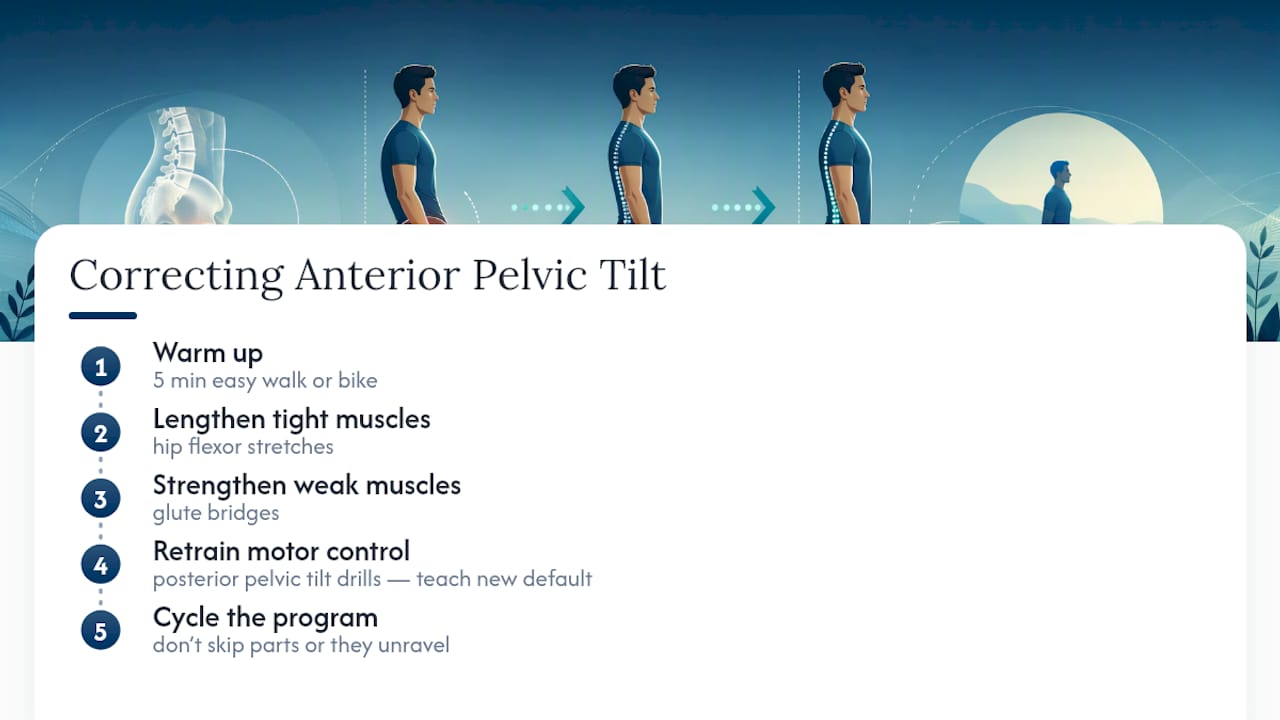
Warm up with five minutes of easy walking or a stationary bike before stretching. Cold hip flexors don’t lengthen well, and pushing a stretch too hard on tight, unwarmed tissue tends to trigger a protective clench rather than a release.
Phase 1: Activation and mobility (weeks 1 to 2)
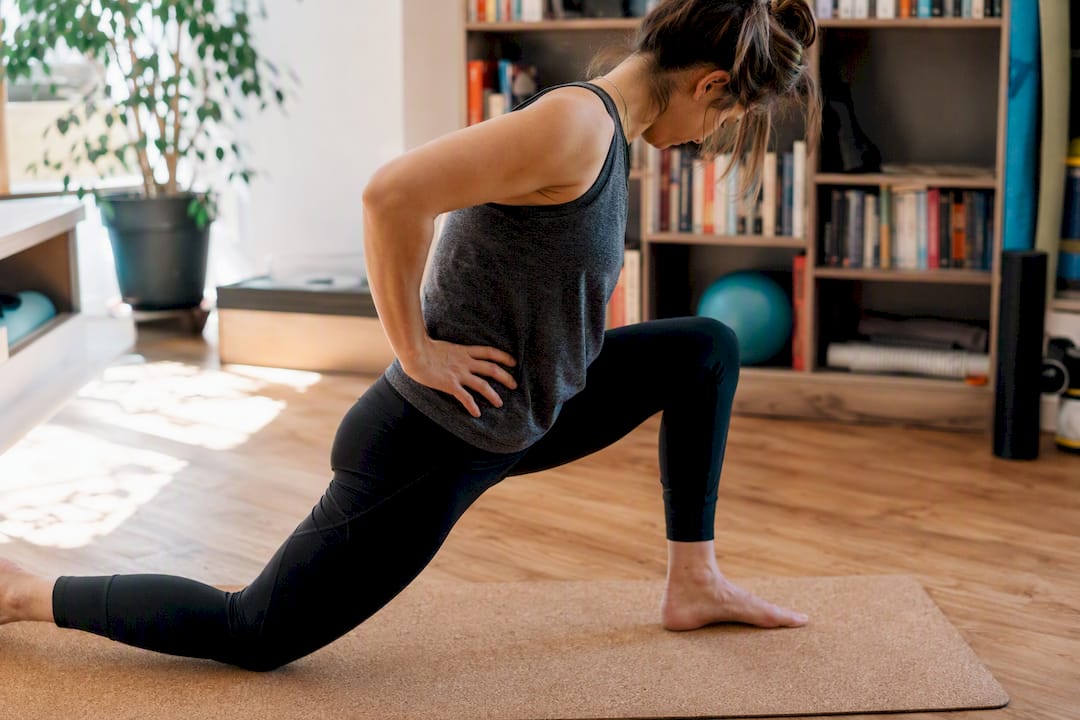
1. Half-kneeling hip flexor stretch. Kneel on one knee with the other foot forward, flat on the floor. Tuck your tailbone under and gently squeeze the glute on the kneeling side before leaning your hips forward. Hold 30 seconds, three rounds per side, daily.
2. Standing quad stretch. Standing on one leg, pull the opposite heel toward your glutes while keeping your hips level and pelvis tucked slightly under. Hold 20 to 30 seconds per side.
3. Posterior pelvic tilt drill. Lie on your back, knees bent. Flatten your lower back into the floor by gently tightening your abs and glutes together, without pushing through your heels. Hold five seconds, ten reps. This is the exact movement pattern you’re trying to make automatic later.
Phase 2: Strength building (weeks 2 to 5)
4. Glute bridge progressions. Start with a basic two-leg bridge, squeezing glutes at the top for two seconds. Once ten clean reps feel easy, progress to single-leg bridges, then to a barbell or band-resisted hip thrust.

5. Hamstring-focused hinge work. Romanian deadlifts or single-leg deadlifts with lightweight train the posterior chain to pull its share of pelvic control, since weak hamstrings let the hip flexors dominate.
6. Dead bug. Lying on your back with arms and legs raised, lower one arm and the opposite leg toward the floor while keeping your lower back pressed flat. Reset, switch sides. This is anti-extension core work: it trains your abs to resist the exact arch that defines anterior tilt.
7. Hollow hold. A static version of the same principle. Lower back stays flat on the floor, legs and shoulders lifted slightly. Start with 15 to 20 second holds.
Avoid traditional sit-ups and crunches during this phase. They pull through the hip flexors and reinforce lumbar extension, working against the exact pattern you’re correcting. Dead bugs and hollow holds train the same abdominal muscles without the trade off.
Phase 3: Movement integration (weeks 4 onward)
8. Loaded hinge and squat practice. Once the posterior pelvic tilt drill feels automatic lying down, practice finding that same position standing, then carry it into bodyweight squats and hip hinges.
9. Walking with cued pelvic position. Periodically through the day, do a quick internal check: ribs stacked over pelvis, slight glute engagement, no exaggerated arch. This is where lasting change actually happens, not in the fifteen minutes of daily stretching.
Pro Tip: Set a recurring phone alarm for a “posture reset” three times a day, not to force a rigid stance, but to notice what your pelvis is doing right then. Awareness is the whole game in the first few weeks, before the strength changes catch up.
Train this program three to four times weekly, resting a day between strength sessions. Progress load or difficulty only once the current version feels genuinely easy for ten clean reps, not just achievable. Sharp pain, numbness, or symptoms that worsen after a session are signals to scale back and check the movement pattern, ideally with professional input. A little muscle soreness the next day is normal; a pain that lingers or spreads is not.
One more piece worth building in early: adjust your workstation and walking shoes alongside the exercises. A standing desk habit or supportive flat footwear does more heavy lifting over months than people expect, since it removes the daily trigger you’re otherwise fighting against with fifteen minutes of exercise.
When Conservative Care Isn’t Enough
Most anterior pelvic tilt responds to the stretch, strengthen, and retrain approach above, given consistent effort over weeks, as explained in The Real Low Back Pain Fix: Move More, Hurt Less. But conservative treatment through physical therapy or chiropractic assessment adds value in a few specific situations: when self-directed exercise hasn’t moved the needle after four to six weeks, when pain limits basic movement like walking or standing, or when you’re unsure whether your tilt is positional or structural.
A typical clinical assessment goes beyond the wall test and Thomas test you can do at home. Expect a movement screen that checks hip extension range, glute activation timing, and how your pelvis behaves during a squat or step-up, not just how it looks standing still. Clinicians often track outcome measures over repeat visits, like the ASIS–PSIS angle or functional tests, so progress gets measured against a baseline rather than guessed at.
Common conservative treatment options include:
- Structured rehabilitation programs building on the phases outlined above, adjusted to your specific limitations.
- Manual therapy to address particularly restricted hip or lumbar joints that resist stretching alone.
- Activity modification, such as adjusting a training program that’s overloading hip flexors without matching posterior-chain work.
Imaging or specialist referral becomes appropriate when red flags appear: suspected structural leg-length discrepancy, symptoms that don’t track with typical postural patterns, or neurological signs like numbness and leg weakness. For the average case of postural anterior pelvic tilt, imaging adds little and delays the exercise work that actually moves the needle.
Everton Chiropractic’s Approach to Pelvic Alignment
Everton Chiropractic treats anterior pelvic tilt as a motor-control problem before it’s a stretching problem. Dr. Richard’s clinical view is that forcing a posture correction, cueing someone to yank their pelvis into a “perfect” neutral position without addressing why the nervous system defaults to the tilted pattern, tends to create new strain rather than resolve the old one. Muscles that get stretched without a matching strength and control program usually drift right back to their old length within weeks.
Forcing a posture change without building the strength and control to hold it new position rarely lasts. The goal isn’t a perfect-looking pelvis on command; it’s a neutral position that stays put without you thinking about it, under real loads like walking, lifting, and standing through a workday.
The clinic’s process runs assessment first, functional movement screening that looks at hip extension, glute firing patterns, and lumbar movement quality, then builds an exercise plan matched to what that specific assessment turns up. Progress gets tracked against those same metrics on review visits, rather than relying on how posture “looks” in a mirror.
A few principles shape that process:
- Every plan is individualized to the patient’s baseline, not a generic printed handout of stretches.
- Neuromuscular retraining, teaching the body to find and hold a neutral pelvis under load, gets prioritized over passive stretching alone.
- Manual adjustment, when used, supports the exercise work rather than replacing it.
Readers dealing with lower back pain alongside their pelvic tilt often find that addressing the underlying alignment resolves the pain more durably than treating the back in isolation, since the two are mechanically linked.
How Long Correction Actually Takes
Timelines depend heavily on which type of anterior pelvic tilt you’re dealing with. Positional tilt, the kind that shows up after weeks of heavy sitting or a new training block, often improves within two to four weeks of consistent stretching and activation work. Chronic, habitual tilt built up over years typically needs eight to twelve weeks of the full three-phase program before the change starts feeling automatic rather than effortful. Structural tilt may never fully “correct” through exercise alone, though strength work still improves comfort and function.
Track these markers rather than staring in the mirror daily:
- Reduced lower back discomfort after standing or walking.
- Increased hip extension range on your own Thomas test check.
- A tighter wall-test gap between your lower back and the wall.
Consistency matters more than intensity here. The systematic review of non-surgical interventions that reported real tilt reductions was working with trials running several weeks of structured exercise, not single sessions. If a marker hasn’t budged after several weeks of genuine adherence, that’s the point to reassess the program rather than push harder on the same exercises.
What Happens If You Leave It Untreated
Anterior pelvic tilt rarely stays isolated. Left unaddressed, the exaggerated lumbar curve keeps loading the same segments of your lower back, and that repeated stress is a plausible contributor to chronic lower back pain over years, not just the occasional ache after a long day standing.
The muscle imbalance driving the tilt also tends to deepen rather than plateau. Hip flexors that started merely tight can become chronically shortened, and glutes that started merely underused can become functionally weaker, since a forward-tilted pelvis lets you get through daily movement without ever asking them to fire properly. That’s how someone ends up years into a desk job with glutes that barely activate during a simple bridge test.
Movement mechanics shift as a result. Hip extension keeps narrowing, which changes stride length when walking or running and can shift load onto the knees and lower back to compensate. Some clinicians also link long-standing anterior tilt to increased risk of hip impingement symptoms, since the altered pelvic angle changes how the femur sits in the hip socket during flexion, though this connection remains observational rather than firmly established.
None of this is a countdown to guaranteed injury. Plenty of people carry mild anterior tilt for years without major issues. But the trend line runs one direction: unaddressed muscle imbalance and altered movement patterns tend to compound, and the exercises that fix a two-month-old tilt take considerably less effort than the ones needed to unwind a decade-old pattern.
Why the “Perfect Posture” Advice Misses the Point
Most anterior pelvic tilt advice online promises a fix measured in days: one stretch, one trick, one viral exercise. The evidence doesn’t back that up. The systematic review on non-surgical interventions that gets cited most often in this space rates its own evidence as very low certainty, and the actual tilt reductions researchers measured were modest, a few degrees, not a dramatic before-and-after transformation.
That’s not a reason to skip the work. It’s a reason to set the right target. The conventional advice fixates on the angle itself, as if hitting some ideal ASIS–PSIS number is the goal. It isn’t. The real target is a pelvis that holds a reasonable position automatically, under the load of an actual workday, without you consciously bracing for it.
Prioritize the boring stuff first: consistent daily practice of the posterior pelvic tilt drill, glute strength that actually holds under load, and breaking up long sitting blocks. Skip anything promising results in a week. If you’ve done the work honestly for six weeks and nothing has moved, that’s a real signal to get an actual assessment rather than a longer list of exercises to try alone.
— Aman
This article is general information, not a substitute for advice from a qualified doctor. Consult a qualified healthcare professional about your own circumstances before acting on anything here.
Sources
- Pelvic Tilt — Cleveland Clinic
- Non-surgical interventions for excessive anterior pelvic tilt — PMC
- 5 Exercises for Anterior Pelvic Tilt — Healthline
FAQ
Can you actually fix anterior pelvic tilt?
Yes, in most cases where the tilt is postural or habitual rather than structural. A combined program of hip flexor stretching, glute and core strengthening, and motor-control retraining produces measurable improvement over several weeks, though research on non-surgical interventions still rates the evidence quality as low.
How can I correct anterior pelvic tilt posture?
Combine hip flexor and quad stretches with glute bridge progressions, hamstring strengthening, and anti-extension core work like dead bugs, then practice holding that neutral pelvis position during walking and daily movement until it becomes automatic.
What muscles are weak if I have anterior pelvic tilt?
The glutes and abdominal muscles, particularly the deep core stabilizers, are typically underactive, while the hip flexors and lower back muscles are usually tight and overactive by comparison.
Do most girls have anterior pelvic tilt?
There’s no solid evidence that anterior pelvic tilt is more common in women overall, though pregnancy is a well-documented temporary trigger due to hormonal changes in the pelvic ligaments and a shifting center of gravity. Outside of pregnancy, prolonged sitting and muscle imbalance affect people of any gender similarly.