
Key Takeaways
Cervical decompression is designed to reduce loading around an irritated disc without surgery, but it is not appropriate for everyone. Understanding the anatomy, evidence, and safety considerations can help patients have a more useful conversation with a qualified clinician.
- A cervical disc contains a softer nucleus pulposus surrounded by a stronger outer ring.
- A bulging or herniated disc may irritate a nearby nerve through pressure and inflammation.
- Controlled, intermittent traction is intended to unload the neck rather than forcefully stretch it.
- Negative intradiscal pressure is a proposed mechanism, not a guaranteed explanation for every result.
- Assessment, gradual rehabilitation, and medical supervision remain central to responsible care.
Foundations of cervical disc herniation and intradiscal pressure
The neck is a compact, highly mobile part of the spine, and its discs help distribute force between the cervical vertebrae. When a disc changes shape, symptoms may arise from both mechanical pressure and chemical irritation around nearby nerves. This is why a scan alone rarely tells the whole story; symptoms and examination findings matter too. The basic anatomy provides a useful starting point for understanding the idea behind decompression.
Cervical disc anatomy and the role of the nucleus pulposus
Each cervical disc sits between two vertebral bodies and acts as a flexible spacer. Its outer annulus fibrosus is made of layered, tougher tissue, while the nucleus pulposus is a softer, gel-like center that helps the disc absorb and redistribute load. The disc is not simply a cushion that can be squeezed empty; it responds continually to posture, movement, hydration, and pressure.
During ordinary activity, pressure inside a disc changes as the head and neck move. Bending forward, holding the head in one position, or lifting can alter the forces passing through the cervical segments. Those changes are normal, although repeated or excessive loading may contribute to disc degeneration or injury in some people.
What happens when a disc bulges or herniates
A disc bulge generally describes a broader extension of disc tissue beyond its usual boundary, while a herniation usually refers to a more focal displacement. The distinction can be useful, but imaging terminology does not always match symptoms neatly. Some people have visible disc changes without pain, while others have significant symptoms from a relatively modest abnormality.
A herniated fragment can narrow the space where a nerve root travels. At the same time, injured disc tissue may trigger a local inflammatory response. The combination can produce neck pain, shoulder discomfort, arm pain, tingling, numbness, or weakness, depending on the level and nerve involved.
How pressure changes can irritate spinal nerves
A nerve root may become sensitive when surrounding space is reduced, but pressure is only part of the picture. Inflammation can make a nerve more reactive, and restricted movement may cause the neck and shoulder muscles to tighten defensively. Symptoms can therefore fluctuate with posture, activity, sleep position, and general irritability of the nervous system.
Pain that travels into the arm is often more informative than neck pain alone, although it does not prove that a disc is responsible. A careful clinician compares the symptom pattern with strength, sensation, reflexes, and movement. That clinical correlation helps distinguish a disc-related problem from other causes of neck or arm pain.
Why “slipped disc” is an imprecise but commonly used term
“Slipped disc” is familiar language, but a disc does not usually slide out like a loose coin. The phrase may refer to a bulge, protrusion, extrusion, or general disc degeneration. Using more precise terms can improve communication, especially when discussing an MRI report or considering treatment.
At Everton Chiropractic, chiropractic services may be discussed in the context of a patient’s symptoms, examination, and goals rather than the scan label alone. A reassuring consultation should explain what is known, what remains uncertain, and why a particular approach is being considered.
How cervical decompression is designed to work
Nonsurgical cervical decompression uses carefully controlled traction to vary the load applied through the neck. The intention is to create periods of unloading that may reduce irritation around a disc and its neighboring nerve structures. It is not a promise that displaced tissue will return to its original position, and it should not be confused with emergency care for progressive neurological problems.

The mechanics of controlled cervical traction
Traction applies a lengthwise force along the spinal column while the head and neck are supported. In cervical treatment, the direction, amount, and duration of force need to be adjusted to the person and the suspected level involved. Small changes in neck angle can also alter which structures receive more or less load.
The goal is usually a tolerable, gradual sensation rather than a forceful pull. A clinician watches the patient’s response and modifies the setup if symptoms become sharper, spread farther down the arm, or fail to settle after treatment.
How unloading may create temporary negative intradiscal pressure
When compressive loading is reduced, the disc may experience a change in its internal pressure. The term negative intradiscal pressure describes a pressure state that is lower than the surrounding reference pressure during a period of unloading. In theory, that pressure difference may encourage fluid movement and reduce the mechanical stress acting on sensitive tissues.
The effect is expected to be temporary and dependent on the person’s anatomy, posture, disc condition, and the traction parameters used. It is more accurate to describe negative pressure as a proposed mechanism than as a guaranteed event that produces the same response in every patient.
The proposed effect on disc material and nerve-root compression
A decompression approach may create more room around a compressed segment for a limited time. That change could reduce contact or tension affecting a nerve root, while the reduction in loading may also make movement more comfortable. Any improvement in symptoms may involve several factors, including altered muscle activity, reduced fear of movement, and the natural course of the condition.
This is why treatment should be framed around function as well as anatomy. Pain relief is not the only outcome that matters; better arm movement, improved sleep, steadier strength, and greater tolerance for ordinary activity can be equally meaningful.
Why decompression is different from forceful or continuous traction
The word traction covers many techniques, and they are not interchangeable. A controlled decompression session commonly uses a planned pattern of loading and unloading, whereas a forceful or continuous stretch may create a different mechanical and sensory response. More force is not automatically more effective.
Patients exploring nonsurgical decompression therapy should ask what type of traction is being used, how the force is selected, and how the clinician will respond if symptoms change. Those questions are more useful than relying on the treatment name alone.
What happens during a nonsurgical decompression session
A session typically begins with a review of current symptoms and any changes since the previous visit. The clinician then positions the patient and selects settings intended to match the treatment goal. The process should feel measured and communicative, with opportunities to pause or adjust the treatment rather than simply tolerating discomfort.
Positioning the neck and targeting the affected level
The head is supported so the cervical spine can be placed in a selected position. The clinician may use the symptom pattern, examination findings, and available imaging to decide how to approach the suspected level. Positioning is not a mechanical guarantee that only one disc will be affected; forces are shared across connected tissues.
A good setup also considers comfort, breathing, muscle guarding, and the patient’s ability to communicate. If the position reproduces familiar arm pain or causes new symptoms, the treatment plan should be reconsidered.
How the treatment device varies the traction force
A motorized or manually controlled device may alter the traction force according to a preset or clinician-directed protocol. The settings can include the level of force, the duration of each phase, and the length of rest periods. These variables are adjusted gradually rather than assumed to be appropriate from one patient to the next.
A patient should be able to describe whether the sensation feels like gentle lengthening, pressure, pulling, or pain. That feedback helps the clinician decide whether the current force is appropriate and whether a different position or protocol is needed.
The role of intermittent loading and rest cycles
Intermittent treatment alternates a traction phase with a period of reduced force or rest. The reasoning is that repeated, tolerable unloading may be easier for sensitive tissues than one prolonged stretch. Rest cycles also give muscles and nerves a chance to respond before the next phase begins.
The presence of cycles does not prove that a disc has been physically repositioned. It simply describes how the treatment is delivered and why the experience may differ from holding the neck in a single sustained stretch.
What patients may feel during and after treatment
Some patients notice a mild pulling sensation, relaxation around the neck, or temporary changes in arm symptoms during a session. Others may feel no immediate difference. Mild soreness can occur afterward, particularly when the tissues are not accustomed to the movement or when the settings need refinement.
Symptoms that become progressively sharper, travel farther into the arm, or are accompanied by new weakness should not be dismissed as a normal response. The clinician should know about these changes promptly so the session can stop or be modified.
What the evidence says about negative intradiscal pressure
Research on decompression is difficult to interpret because treatment protocols, patient groups, and outcome measures vary. Some studies examine pressure or imaging under controlled conditions, while others focus on pain and function over time. These forms of evidence answer different questions and should not be treated as interchangeable.
What laboratory and imaging studies can show
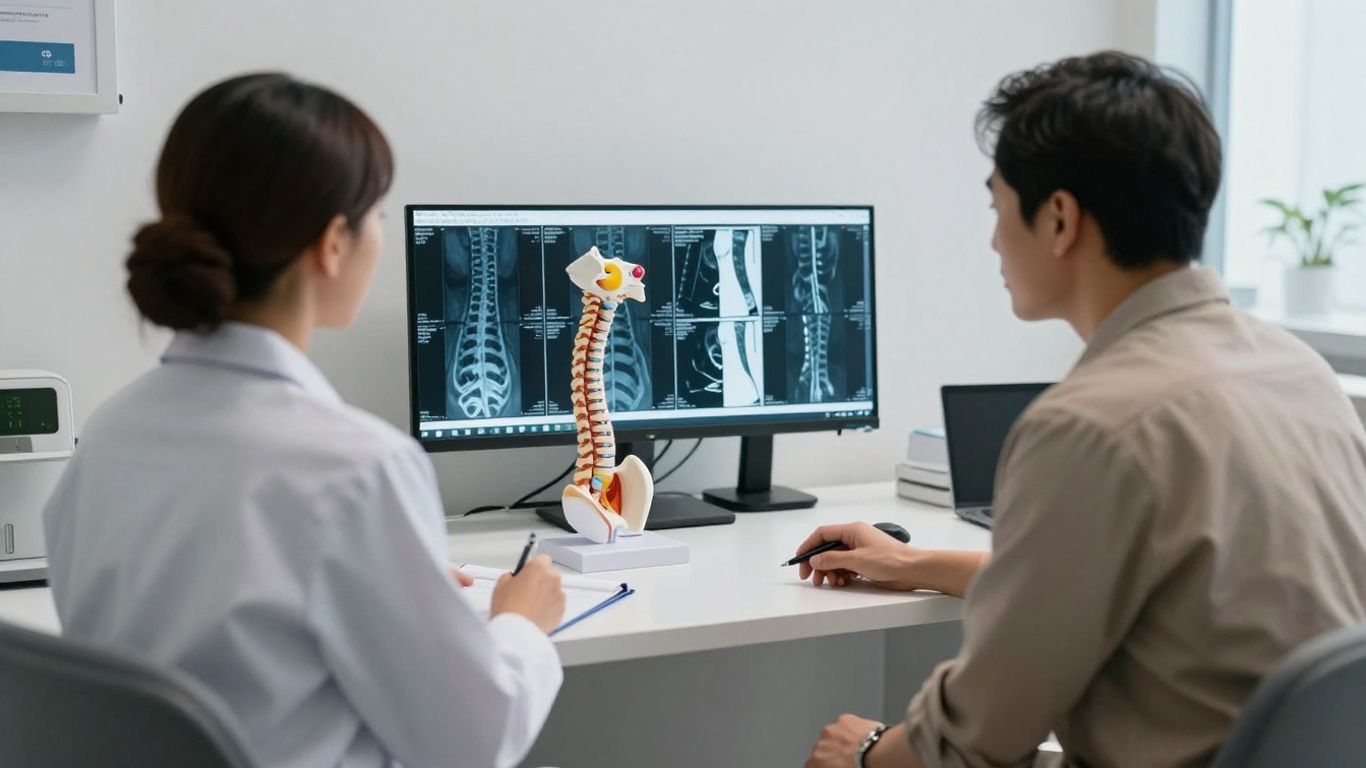
Laboratory models can help researchers study how spinal segments respond to loading, unloading, and changes in position. Imaging may show disc shape, space around nerve structures, or other anatomical features before and after an intervention. Such findings can make a proposed mechanical explanation more plausible.
They cannot, by themselves, establish that a patient will feel better or that a visible disc change caused the original symptoms. Human bodies are variable, and an imaging snapshot may not capture movement, inflammation, muscle behavior, or the patient’s daily experience.
How symptom improvement is measured in clinical research
Clinical research may track pain intensity, arm symptoms, disability, range of motion, medication use, sleep, and return to activities. A meaningful result is usually broader than a small change on a numerical pain scale. Researchers may also compare outcomes with a baseline or follow patients over a defined period.
The following distinction helps keep the evidence in proportion:
| Evidence type | What it can help assess | What it cannot establish alone |
|---|---|---|
| Pressure measurement | Mechanical changes during unloading | Long-term symptom relief |
| Imaging | Disc shape or available space | Whether an abnormality causes pain |
| Patient-reported outcomes | Pain, function, sleep, and daily limits | The exact biological mechanism |
| Clinical examination | Strength, sensation, reflexes, and movement | Every structural detail inside a disc |
Taken together, these measures can provide a more balanced view than any single scan or pressure reading. A plausible mechanism is useful, but patient-centered outcomes remain essential when deciding whether treatment is worthwhile.
The limits of pressure-based explanations
Negative intradiscal pressure may be one part of a larger response, but it does not explain every possible improvement. Symptoms can change because inflammation settles, activity becomes more manageable, protective muscle tension decreases, or the condition improves naturally. The same pressure change might also feel different in a healthy disc, a degenerated disc, and an acutely irritated disc.
For that reason, responsible explanations use words such as “may,” “could,” and “proposed.” They avoid presenting decompression as a guaranteed method for drawing a herniation back into place or permanently restoring a disc.
Why decompression results can differ between patients
Results may vary according to the duration of symptoms, the degree of nerve irritation, the condition of the disc, general health, sleep, stress, and the accuracy of the working diagnosis. Treatment parameters and adherence to rehabilitation can matter as well. Some patients improve quickly, while others need a different strategy or more time.
Information about spinal decompression therapy can offer a starting point for questions, but it should not replace an individual assessment. The most useful decision is the one that fits the clinical findings and the patient’s preferences.
Who may be a candidate for cervical decompression
Cervical decompression may be considered for selected people with neck symptoms that appear related to disc loading or nerve-root irritation. Candidacy is not determined by the phrase “herniated disc” alone. The clinician must first decide whether the symptoms are likely to respond to a conservative mechanical approach and whether treatment can be delivered safely.
Disc-related neck pain and radiating arm symptoms
A patient with neck pain, arm pain, tingling, or altered sensation may be evaluated for a disc-related pattern. Symptoms often change with neck position or sustained posture, although this is not universal. The distribution of pain and sensory changes can help identify which nerve root might be involved.
Decompression is generally considered in the context of nonsurgical care, not as a replacement for urgent treatment when neurological function is deteriorating. The presence of symptoms in the arm should prompt a proper examination rather than a self-directed traction experiment.
Findings that should be confirmed with examination or imaging
A clinician may assess neck movement, arm strength, sensation, reflexes, coordination, and signs of spinal cord involvement. Imaging can be useful when symptoms are persistent, severe, atypical, or not responding as expected. The decision to image depends on the clinical situation rather than on a desire to explain every ache with a scan.
The most persuasive picture is usually a pattern in which the history, examination, and imaging point in the same direction. When they do not, further assessment may be more appropriate than proceeding with decompression.
When conservative care may be tried before surgery
For some people without urgent neurological warning signs, an initial conservative period may include activity modification, guided exercise, education, medication discussed with a medical professional, and other suitable therapy. Decompression may be one component if the clinician believes the potential benefits outweigh the risks. Improvement can occur over time even when no single treatment explains it fully.
At Everton Chiropractic, a discussion of chiropractic services should remain grounded in the individual’s presentation and should not imply that surgery is always avoidable. A referral or surgical opinion can be appropriate when symptoms are severe, progressive, or resistant to reasonable conservative care.
Factors that can reduce the likelihood of success
Decompression may be less suitable when the diagnosis is uncertain, symptoms are driven mainly by a non-disc problem, or there is substantial neurological impairment. Long-standing symptoms, major structural narrowing, significant degeneration, and poor tolerance of traction may also affect the outlook. None of these factors can be judged reliably without an assessment.
A realistic plan includes a clear trial period, agreed measures of progress, and a point at which the approach will be changed if it is not helping. That structure prevents treatment from continuing simply because the original theory has not been revisited.
Safety, contraindications, and medical decision-making
Cervical traction places mechanical force on the neck, so safety screening is essential. A technique that is comfortable for one person may be unsuitable for another because of bone health, vascular concerns, instability, recent injury, or neurological findings. Treatment should begin only after the clinician has considered relevant medical history and current symptoms.
Conditions that may make cervical traction inappropriate
Potential concerns can include a recent fracture, significant spinal instability, severe osteoporosis, certain inflammatory or infectious conditions, suspected spinal cord compression, and some vascular or surgical conditions. Pregnancy, cancer history, and medication use may also require individualized discussion rather than a simple yes-or-no rule.
The exact contraindications depend on the person and the technique. A clinician should explain why traction is being considered, what risks are relevant, and whether another form of care would be safer.
Warning signs that require prompt medical evaluation
New or worsening weakness, loss of hand coordination, difficulty walking, widespread numbness, or changes in bladder or bowel control require prompt medical attention. Severe pain after trauma, fever with significant spinal pain, or unexplained weight loss also deserves evaluation. These signs should not be managed by increasing traction or waiting for a routine session.
A sudden change in symptoms is clinically meaningful even if the person has already been told that a disc is involved. The next step may be medical assessment, imaging, or urgent referral rather than continued conservative treatment.
Common temporary side effects and treatment adjustments
Temporary soreness, a feeling of neck fatigue, mild headache, or a short-lived increase in symptoms can occur. These responses should be reported, especially if they recur or last longer than expected. Adjustments may include reducing the force, changing the angle, shortening the session, increasing rest periods, or stopping treatment.
Before beginning, it helps to agree on what the patient should monitor at home. A simple plan might include the location and intensity of symptoms, arm strength, sleep quality, and how long any post-treatment response lasts.
Why treatment should be supervised by a qualified clinician
Supervision allows the clinician to screen for risks, choose a suitable setup, and recognize when the working diagnosis no longer fits. It also keeps decompression within a wider plan instead of treating pressure as the only relevant variable.
Dr. Richard Chew is the Principal Chiropractor at Everton Chiropractic, where chiropractic services are offered. Any treatment decision should still be based on the patient’s own history and examination, with referral to another medical professional when the presentation calls for it.
How cervical decompression fits into a broader recovery plan
Decompression is best viewed as one possible tool rather than a complete recovery plan. Neck symptoms often respond better when treatment addresses strength, movement habits, sleep, work demands, and confidence with activity. The plan should evolve as the patient’s symptoms and function change.
Combining decompression with exercise and posture rehabilitation
Gentle, progressive exercise can help restore movement and improve the capacity of the neck, upper back, and shoulder muscles. Posture work is not about holding a rigid “perfect” position all day. It is more useful to build variety, change positions regularly, and develop enough strength and control to tolerate normal tasks.
Decompression may temporarily make movement more comfortable for some patients, creating an opportunity to practise appropriate exercises. It should not be used as a reason to avoid movement indefinitely.
Managing activity, ergonomics, and symptom flare-ups
Most people benefit from adjusting aggravating activities without stopping everything. A workstation may need changes to screen height, chair support, or keyboard position, while driving and phone use may require more frequent breaks. During a flare-up, reducing intensity for a short period can be sensible, followed by a gradual return rather than prolonged bed rest.
Useful day-to-day habits often include:
- Changing neck position before discomfort becomes intense.
- Keeping frequently used items within an easy reach.
- Taking short movement breaks during screen-based work.
- Returning to exercise gradually after a symptom flare.
These steps do not treat a disc mechanically on their own, but they can reduce repeated aggravation and make progress easier to judge. The right changes are practical ones that a person can maintain beyond the treatment room.
Tracking progress beyond pain scores
Pain is valuable information, but it is only one measure. A person may still have some discomfort while sleeping better, turning the head farther, lifting the arm more easily, or needing fewer breaks at work. Recording these changes can reveal gradual improvement that a single pain score misses.
A useful review might compare symptom location, arm function, strength, sleep, work tolerance, exercise capacity, and recovery time after activity. Progress should be judged over a meaningful period rather than by one unusually good or difficult day.
When persistent symptoms may require another treatment approach
If symptoms do not improve within the agreed trial period, or if they repeatedly worsen, the diagnosis and plan should be reassessed. Further examination, imaging, medication review, specialist input, or a different rehabilitation approach may be appropriate. Persistent weakness or signs of spinal cord involvement should receive particular attention.
The goal is not to defend one treatment indefinitely. It is to identify the safest and most useful next step as the clinical picture becomes clearer.
Conclusion
Cervical decompression is designed around controlled unloading, with temporary negative intradiscal pressure offered as one possible explanation for how symptoms may change. The approach may suit some people with disc-related neck and arm symptoms, but it requires careful screening, realistic expectations, and a broader rehabilitation plan. A qualified clinician can help determine whether it is appropriate or whether another form of care is the better choice.
Frequently Asked Questions
What is negative intradiscal pressure?
Negative intradiscal pressure describes a pressure state inside a disc that is lower than a surrounding reference pressure during unloading. It is a proposed mechanical effect of decompression, not a guaranteed treatment result.
Can cervical decompression permanently fix a herniated disc?
No treatment can promise that a herniated disc will permanently return to its original shape. Symptoms may improve for several reasons, and the change in pain or function does not always correspond to a visible structural change.
Is cervical decompression painful?
The treatment is generally intended to feel controlled and tolerable, though some people may notice pulling or temporary soreness. Sharp, spreading, or worsening symptoms should be reported immediately so the treatment can be adjusted or stopped.
How is a slipped disc diagnosed?
Diagnosis usually combines the symptom history with a physical and neurological examination. Imaging may be recommended when symptoms persist, are severe or unusual, or when the examination suggests a need for more information.
Who should avoid cervical traction?
People with certain fractures, instability, bone-health problems, vascular concerns, infections, suspected spinal cord compression, or other medical conditions may need to avoid traction or obtain specialist clearance. Suitability depends on the individual and the technique.
Can exercise be used with cervical decompression?
Often, a carefully selected exercise program can complement symptom management and help restore strength, movement, and activity tolerance. The exercises should be matched to the person’s symptoms and changed if they provoke neurological warning signs.
When should neck and arm symptoms be evaluated urgently?
Prompt evaluation is warranted for new or worsening weakness, loss of coordination, difficulty walking, widespread numbness, bladder or bowel changes, severe symptoms after trauma, or other concerning systemic symptoms such as fever with significant spinal pain.