
Key Takeaways
Tech neck is often less about one dramatic injury than the accumulated effect of long screen hours, poor workstation positioning, and too little movement. A careful, non-surgical plan can address symptoms while building better daily habits.
- Prolonged forward-head posture can increase stress across the neck and upper back.
- Non-surgical decompression uses controlled traction rather than an operation or forceful manipulation.
- Relief depends on the cause, symptom pattern, treatment response, and consistency between sessions.
- Ergonomic adjustments and regular movement breaks are part of recovery, not optional extras.
- Numbness, weakness, severe pain, or other warning signs deserve prompt clinical assessment.
Understanding tech neck among Singapore CBD workers
For many Singapore CBD workers, the workday shifts between a laptop, a second monitor, and a phone. That constant visual attention can quietly draw the head forward and leave the neck working harder than it should. Tech neck is a useful everyday description, not a formal diagnosis, and symptoms can have several causes. Everton Chiropractic is a Singapore chiropractic practice that offers chiropractic services for people seeking help with pain and mobility concerns.
How prolonged screen time changes neck posture
When the eyes stay fixed on a screen, the chin often moves forward and the upper back rounds slightly. The muscles at the back of the neck then remain active for hours to keep the head from dropping. Over time, this may make a neutral posture feel unfamiliar and can contribute to aching, stiffness, headaches, or soreness around the shoulder blades. The issue is usually the repeated position, rather than a single bad sitting session.
Why laptops, phones, and hybrid workstations increase strain
A laptop placed low on a desk encourages the user to look down, while a phone often brings the neck into an even deeper bend. Hybrid work adds another variable: a carefully arranged office workstation may be followed by a kitchen counter, sofa, or hotel desk. Small changes in screen height and chair support can therefore repeat the same strain in different forms. Alternating positions helps, but variation works best when each position is reasonably supported.
Common symptoms of tech neck and cervical disc stress
Symptoms may include a dull neck ache, reduced turning, tight upper shoulders, or discomfort that becomes more noticeable late in the day. Some people also report tingling or pain travelling into an arm, which can suggest irritation of a nerve and deserves more careful assessment. Symptoms should guide the next step, but they cannot identify the precise structure involved on their own. A clinician may need to consider posture, movement, strength, sensation, and the wider history.
A simple symptom record can make that history more useful. Note when discomfort begins, what activity increases it, whether rest changes it, and whether symptoms reach the arm or hand. This turns a vague end-of-day complaint into a clearer pattern for discussion.
When neck discomfort may signal a more serious condition
A new symptom that is severe, rapidly worsening, or associated with significant weakness should not be treated as ordinary desk fatigue. The same applies to symptoms after a substantial accident, unexplained fever, or problems with balance and coordination. Even when the pain feels familiar, a meaningful change in its pattern is worth taking seriously. Seek prompt clinical evaluation rather than attempting self-directed traction or aggressive stretching when these features appear.
Foundations and how decompression works
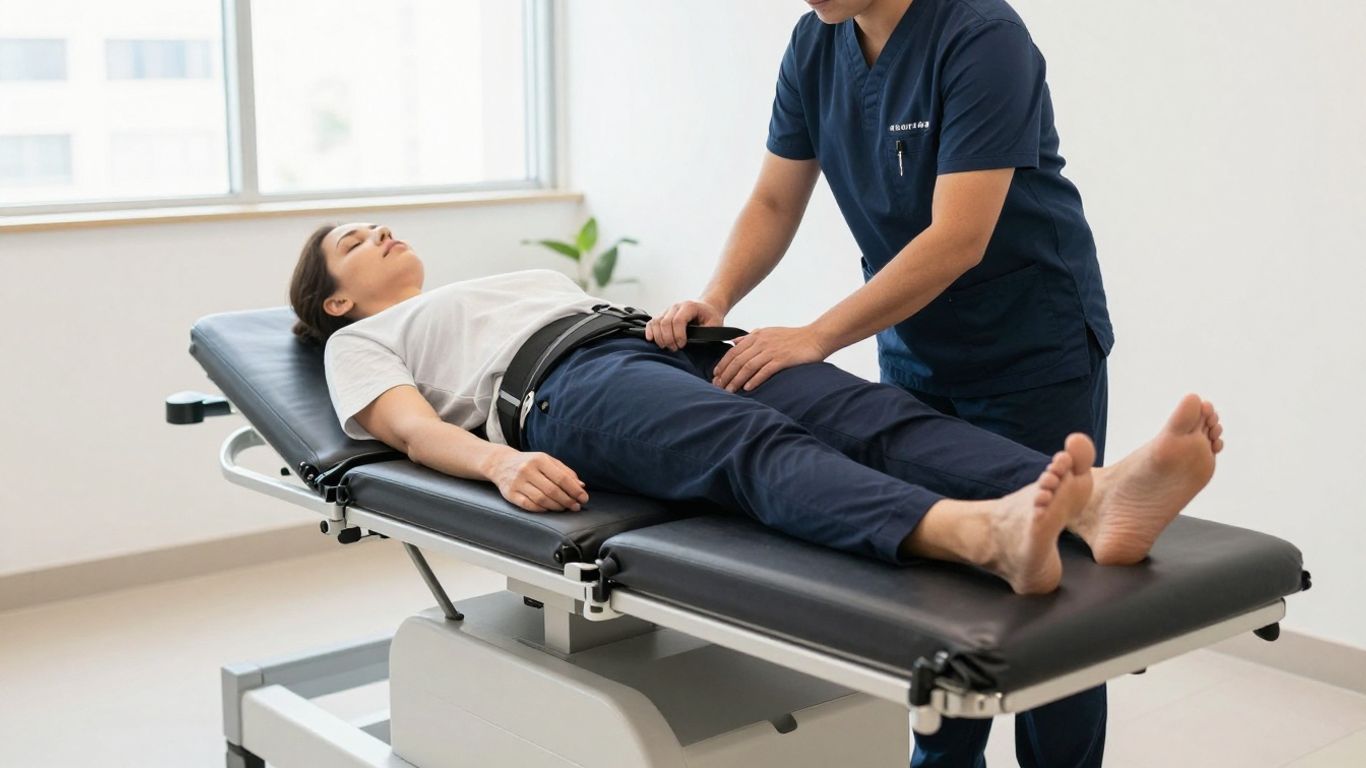
Foundations & How Decompression Works begins with a simple distinction: non-surgical decompression is a treatment approach, not surgery and not a promise of a particular result. It generally uses a table, harness, and controlled pulling force to create a gradual change in spinal loading. The purpose is to see whether reducing mechanical irritation helps a suitable patient move and function more comfortably. Spinal decompression therapy is commonly described in terms of reducing pain, easing pressure on discs, and supporting range of motion, although outcomes vary.
What non-surgical spinal decompression involves
During a session, the patient is positioned on a treatment table while a harness or support system applies traction to the relevant region. The process is non-surgical, so it does not involve an incision or the physical removal of tissue. A provider should first establish whether the presentation is appropriate for this type of care. The session should also allow the patient to communicate clearly about comfort, symptoms, and any unusual response.
How controlled traction may reduce pressure on spinal structures
The basic idea is to vary the load on spinal structures rather than hold the spine in one continuous stretch. In some situations, this may temporarily reduce pressure around an irritated disc or nerve and make movement more comfortable. The mechanism is not a guarantee that a disc will return to a particular position, and evidence for decompression is mixed across conditions. A useful explanation of the proposed process describes controlled traction and changing pressure within spinal discs without presenting it as a cure.
That distinction matters for people who have tried to “stretch it out” at home. A controlled clinical approach can be adjusted in response to symptoms, while an unsupervised pull may be poorly matched to the person’s condition.
The role of positioning, cycles, and gradual force
Positioning determines which part of the spine receives the intended load and how comfortable the patient feels. Treatment may use cycles of tension and relaxation, with force increased gradually rather than applied abruptly. The clinician’s observations and the patient’s response help determine whether the setting should remain the same, be modified, or be discontinued. There is no need to chase a strong stretching sensation; comfort and a sensible response are more useful guides.
How decompression differs from surgery, manipulation, and general stretching
Surgery physically changes spinal anatomy through an operation, while non-surgical decompression aims to influence loading without an incision. Manipulation is a different hands-on approach, and general stretching is usually broader, less targeted, and not delivered through a programmed traction cycle. These approaches should not be treated as interchangeable. How decompression works offers a general description of the motorised-table approach and its proposed effects, but an individual assessment still determines whether it is suitable.
Why decompression may suit desk job recovery
Desk-related neck pain often returns because the conditions that provoked it remain in place. A treatment session may provide a window in which movement feels easier, but the working day can recreate the same loading within hours. Non-surgical decompression may suit some people as one part of recovery, particularly when symptoms are linked with mechanical irritation and ordinary rest has not restored comfortable movement. It should be considered alongside, not instead of, clinical reasoning and active rehabilitation.
Addressing the mechanical causes behind recurring discomfort
A useful plan looks beyond the painful spot. The clinician may consider how the neck, upper back, shoulders, and arms move together, as well as how sitting and reaching affect symptoms. If a workstation keeps placing the head forward, short-term relief will have limited value unless that pattern changes. Decompression may be discussed when reducing spinal loading appears relevant, but the approach should remain connected to the person’s actual symptom behaviour.
Supporting movement when rest alone is not enough
Rest can calm an irritated area, yet too much rest may leave the neck and upper back deconditioned. Gentle, appropriate movement can help a person regain confidence with turning, reaching, and working. A programme may therefore pair passive treatment with simple exercises that are progressed according to tolerance. The aim is not to force through pain; it is to make useful movement more available over time.
Combining decompression with posture and ergonomic changes
Treatment is easier to sustain when the desk is adjusted at the same time. A patient might begin by raising the screen, bringing the keyboard closer, and changing position before discomfort escalates. The following sequence is practical during a busy office day:
- Check that the top portion of the monitor is near eye level.
- Keep the keyboard and mouse close enough that the shoulders can relax.
- Change position or stand briefly before stiffness becomes pronounced.
- Use the phone at a height that avoids prolonged downward gazing.
These changes are deliberately ordinary. Their value comes from repeating them across office, home, and travel workstations rather than making one perfect adjustment and ignoring it afterward.
Setting realistic expectations for relief and recovery time
Some people notice a change quickly, while others need a longer period of assessment and gradual rehabilitation. Relief may fluctuate with workload, sleep, stress, and the amount of movement between sessions. A treatment plan should define what improvement means, such as easier neck rotation, fewer painful work periods, or better tolerance for commuting. If progress is absent or symptoms worsen, the plan should be reviewed rather than continued automatically.
What a Singapore decompression programme may include
A Singapore programme will vary according to the provider, the patient, and the suspected source of symptoms. It may begin with a conversation and physical assessment before any treatment setting is chosen. Sessions are only one part of the picture; what happens during the working week can strongly influence the result. Everton Chiropractic offers chiropractic services, with a professional and reassuring approach suited to people seeking help for pain, mobility, or general wellness concerns.

Initial assessment of posture, mobility, and symptom patterns
An initial assessment may explore when symptoms began, what makes them better or worse, and whether they extend beyond the neck. The clinician can observe posture, active movement, muscle control, and basic neurological features where appropriate. This information helps separate a straightforward desk-related pattern from one needing further medical investigation. It also creates a baseline for judging whether later changes are meaningful.
Choosing appropriate treatment settings for each patient
There is no single force, angle, or session schedule that suits everyone. The position of the neck, the person’s tolerance, the symptom response, and any relevant health history all influence the decision. Treatment should begin conservatively and be adjusted only when the response supports doing so. A comfortable session is not proof that decompression is right for every patient, just as mild short-term soreness does not automatically mean it is harmful.
Adding therapeutic exercise and soft-tissue techniques
Exercise may address endurance in the deep neck muscles, control of the shoulder blades, and mobility through the upper back. Soft-tissue techniques may be used where muscle guarding or local tenderness is contributing to restricted movement. These additions do not need to be complicated to be useful. The right choice is the one a patient can perform accurately and continue between appointments.
Tracking progress between office days and treatment sessions
A brief record can show whether an intervention is helping in real situations rather than only immediately after treatment. It may be useful to track sitting tolerance, driving or commuting comfort, sleep disruption, arm symptoms, and ease of turning. A simple comparison is clearer when only a few measures are followed consistently:
| Progress area | What to observe | Why it helps |
|---|---|---|
| Neck movement | Turning and looking up or down | Shows functional change |
| Work tolerance | Time before symptoms build | Connects care with office demands |
| Arm symptoms | Frequency, reach, or intensity | Flags changing nerve-related symptoms |
| Recovery after work | Stiffness later that evening | Reflects the day’s total load |
The point is not to create a perfect score. It is to give the patient and clinician enough information to decide whether to continue, adjust, or reconsider the programme.
Safety, suitability, and treatment limitations
Non-surgical decompression is not automatically appropriate because pain is located in the neck. The cause, severity, duration, general health, and neurological findings all matter. A responsible plan explains potential benefits and limitations before treatment begins. It also leaves room for referral when another type of evaluation is more suitable.
Who may benefit from non-surgical decompression
Some people with mechanical neck pain or symptoms associated with disc and nerve irritation may be considered for a trial of non-surgical care. Suitability depends on the clinical assessment and on whether the person can tolerate the position and loading. The expected goal may be improved comfort or function rather than a structural cure. A patient should understand what will be monitored and how success will be judged.
Conditions that require medical clearance or another approach
A history of serious spinal disease, significant trauma, unstable joints, certain bone or inflammatory conditions, or recent surgery may require medical clearance or a different approach. Pregnancy, vascular concerns, and other health factors should also be discussed with a qualified clinician before traction is considered. This is not a complete exclusion list. The safest decision comes from reviewing the full history rather than relying on a generic online checklist.
Warning signs that need prompt clinical evaluation
Prompt assessment is appropriate for progressive weakness, increasing numbness, loss of coordination, severe unrelenting pain, or symptoms following major trauma. Fever, unexplained weight loss, or new bladder or bowel changes alongside spinal symptoms also warrant urgent medical attention. Do not delay evaluation by booking repeated decompression sessions. The treatment question comes after the more urgent cause has been considered.
Why an individual assessment matters more than a standard protocol
Two office workers can use similar laptops and still have very different conditions, movement habits, and risk factors. One may respond to ergonomic changes and exercise, while another may need medical imaging or a different form of care. An individual assessment keeps treatment proportional to the problem. Everton Chiropractic’s stated focus is providing chiropractic solutions that address patient needs and improve quality of life, but no general practice statement can replace a personal clinical evaluation.
Building a sustainable tech neck prevention plan
Prevention is less about holding a rigid posture all day and more about reducing long, uninterrupted exposure to one position. The most effective plan is usually simple enough to survive a crowded calendar. It should include the desk, the body, and the transitions between meetings, commuting, and home working. Even after symptoms settle, these habits help reduce the chance of returning to the same cycle.
Adjusting monitor height, chair support, and keyboard position
Place the main screen so the head does not need to remain angled down, and keep it close enough that leaning forward is unnecessary. Support the lower back without forcing the spine into an exaggerated arch. The keyboard and mouse should allow the elbows to stay near the body and the shoulders to remain relaxed. Check the arrangement again after moving between office and home, since a workstation that works in one room may not work in another.
Using movement breaks during long CBD workdays
A movement break does not need to be a full exercise session. Standing for a call, walking to refill water, gently rotating the shoulders, or changing tasks can interrupt a long static period. Set a reminder if meetings regularly run back to back. The aim is frequent variation before stiffness becomes the strongest signal that movement is needed.
Strengthening the neck, shoulders, and upper back
Strength work can improve tolerance for ordinary desk demands, but it should be matched to the person’s symptoms and current capacity. Exercises may include controlled neck movements, shoulder-blade work, and upper-back mobility, progressing gradually rather than chasing fatigue. Pain that radiates, produces weakness, or persists after exercise should be discussed with a clinician. Quality and consistency matter more than an ambitious routine performed for one week.
Maintaining results after the treatment programme ends
When treatment finishes, keep the habits that made daily work easier instead of returning immediately to the old setup. Continue the exercises that were well tolerated, vary positions, and review the workstation after changes in job role or equipment. Everton Chiropractic offers chiropractic services, but lasting progress still depends on how a person manages ordinary work and recovery days. If symptoms begin returning, early review is usually more useful than waiting until the problem is severe.
Conclusion
Tech neck recovery is rarely solved by one session or one posture correction. Understanding the mechanical pattern, checking whether non-surgical decompression is suitable, and pairing care with movement and workstation changes gives desk workers a more measured path forward. The right next step is an individual clinical assessment, especially when symptoms are persistent, spreading, or changing.
Frequently Asked Questions
Is tech neck a medical diagnosis?
Tech neck is an informal term for discomfort and movement problems associated with prolonged screen use and forward-head positioning. A clinician still needs to assess the underlying cause, which may involve muscles, joints, discs, nerves, or another condition.
Can non-surgical decompression cure neck pain?
Non-surgical decompression is not a guaranteed cure. It may help some suitable patients manage pain or move more comfortably, but results vary and should be evaluated alongside the person’s diagnosis, daily habits, and response over time.
Does decompression hurt?
Treatment should be controlled and tolerable, though temporary soreness can occur. New, severe, or worsening symptoms should be reported promptly, and a clinician should reconsider the approach if the response is consistently poor.
How long does a decompression programme take?
The duration depends on the symptoms, assessment findings, treatment response, and goals. Some people may have a short trial, while others need a longer period of combined care and exercise. A schedule should be reviewed rather than assumed in advance.
Should I stop exercising if my neck hurts?
Not necessarily. Gentle movement may be helpful, but exercises should be appropriate to the symptoms and performed without provoking spreading pain, weakness, or significant numbness. Seek professional guidance when the cause is uncertain or symptoms are escalating.
What workstation change helps tech neck most?
Raising a low screen and reducing the need to lean forward are often useful starting points. Keyboard distance, chair support, lighting, and regular position changes also matter because no single adjustment can offset an entire day of static sitting.
When should neck pain be checked urgently?
Urgent assessment is warranted for progressive weakness, serious numbness, coordination problems, severe pain after major trauma, fever, or new bladder or bowel changes with spinal symptoms. These signs should not be managed through self-directed stretching or repeated treatment sessions.