Does your back bulge unevenly when you bend over? Do friends or family tell you your posture looks “different” or tilted? Have you noticed your clothes just don’t hang right
These aren’t just quirks of your body. They are the classic warning signs of Scoliosis.
Scoliosis is a condition where the spine twists and curves to the side, forming an “S” or “C” shape instead of a straight line. It often starts young (during growth spurts), but if ignored, it doesn’t just go away. It can follow you into adulthood, permanently affecting how you look, how you move, and how much pain you feel.
Scoliosis is often a silent developer. You might not feel pain initially, so visual checks are your best defense. Stand in front of a mirror or ask a friend to check your back for these key indicators:

While you may not have caused your scoliosis, your daily habits can feed the curve and make the asymmetry worse.
Watch Out For:
In the early stages, scoliosis might feel like nothing more than mild stiffness or fatigue after standing for a long time. However, as the curve progresses or as you age, the twisted spine begins to compress nerves, leading to sharper, more debilitating problems.
A twisted spine often puts uneven pressure on the lower back discs and nerves. This can trigger Sciatica. pain that radiates along the sciatic nerve.
Where Sciatica Affects the Body
Since I cannot insert a literal photograph, visualize the “Pain Pathway” below. If you have scoliosis, you may feel electric shocks, dull aches, or burning sensations in these specific areas:
There is a common misconception that scoliosis is caused merely by heavy school bags. While heavy bags strain the back, the root causes of true scoliosis are usually deeper:
The cause is unknown. It typically develops during adolescence (ages 10-18) and is often genetic.
A structural abnormality present at birth where the vertebrae didn't form correctly.
Found in adults, caused by wear and tear on the spine and discs over time, leading to a new curve.
Ignoring scoliosis allows gravity to worsen the curve over time. Treatment is essential to stop progression and manage pain.
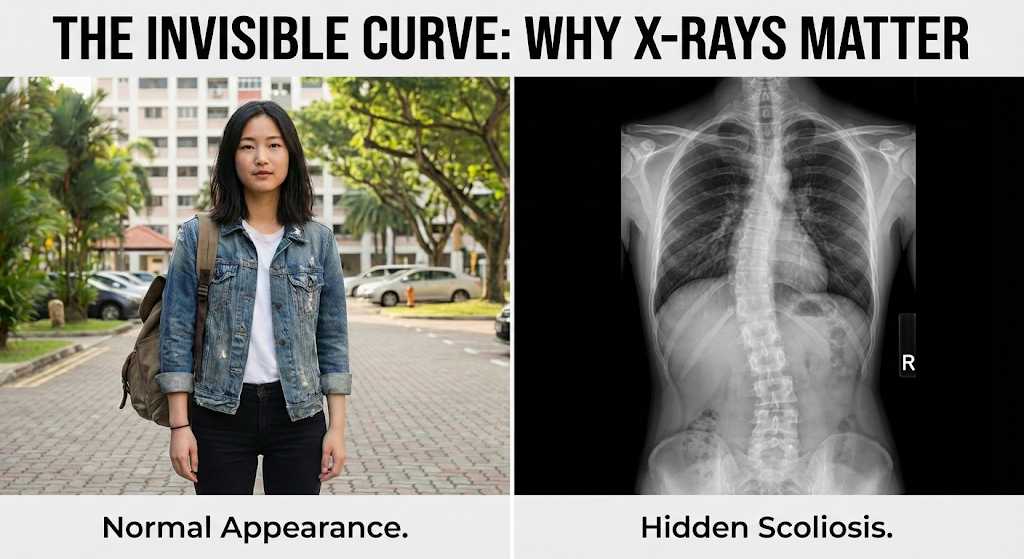
This is a critical first line of defense for non-surgical management. A chiropractor does not "force" the spine straight but uses precise adjustments to mobilize joints and restore function.
Strengthening the muscles on the "weak" side of the curve is vital to support the spine.
For adolescents with rapidly growing curves, a brace may be used to halt progression.
Reserved for severe cases where the curve is large enough to impact heart or lung function.
If your back bulges when you bend, your hips look uneven, or are you feeling that shooting pain down your leg, do not wait. Early management is the only way to prevent the curve from defining your future. Get yourself checked at Everton Chiropractic today.
Outram Park MRT, Purple Line Exit 5
Bus to Blk 3: 61, 197, 166
From the carpark. 6A Everton Park MSCP