It starts unexpectedly. Maybe it’s a dull ache in your buttock when you sit too long, or perhaps a searing, electric-like jolt shooting down the back of your leg when you sneeze. It’s uncomfortable, it’s frustrating, and for millions of people, it can be downright debilitating.
This is sciatica.
While often categorized generally as “back pain,” sciatica is quite specific. It is distinct in its origin, its pathway, and the unique brand of misery it inflicts on those who suffer from it. The good news? It is treatable, and very often without drugs or surgery.
Here is everything you need to know about what sciatica is, why it happens, and how to finally find relief.
It is crucial to understand that sciatica is not actually a medical diagnosis; it is a symptom of an underlying medical condition.
Sciatica refers to pain that radiates along the path of the sciatic nerve. The sciatic nerve is the longest and widest nerve in the human body. It begins from several nerve roots in your lower (lumbar) spine, bundles together, runs deep through your buttocks, and travels all the way down the back of each leg to your feet.
When something irritates or compresses this massive nerve trunk at any point along its journey, usually at the root in the lower spine, the resulting pain is called sciatica.
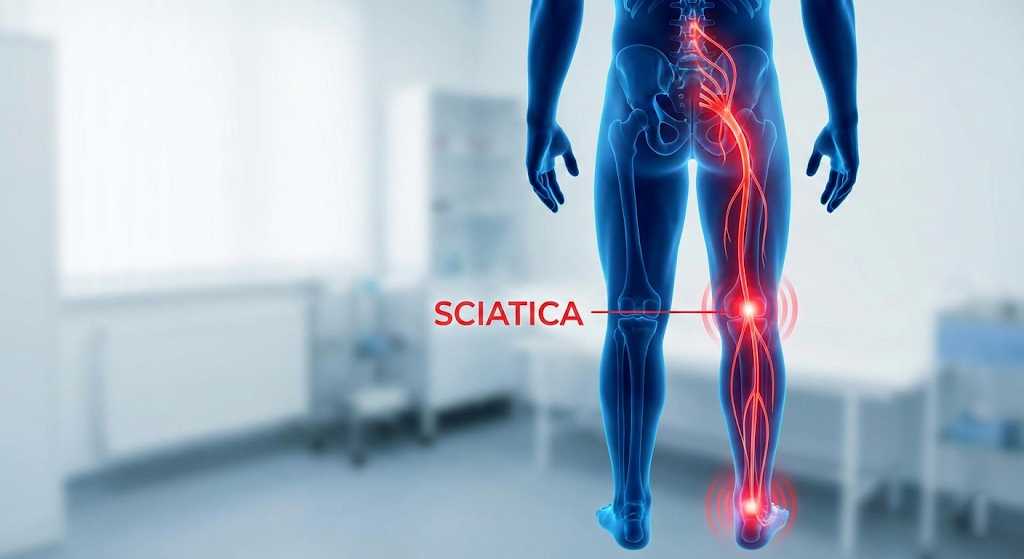
The path of the sciatic nerve originates in the lower back and travels down both legs.
Sciatica occurs when the nerve is pinched, irritated, or compressed. But what caused the pinching?
While factors like age, obesity, prolonged sitting, and diabetes can increase your risk, the immediate physical cause is usually structural.
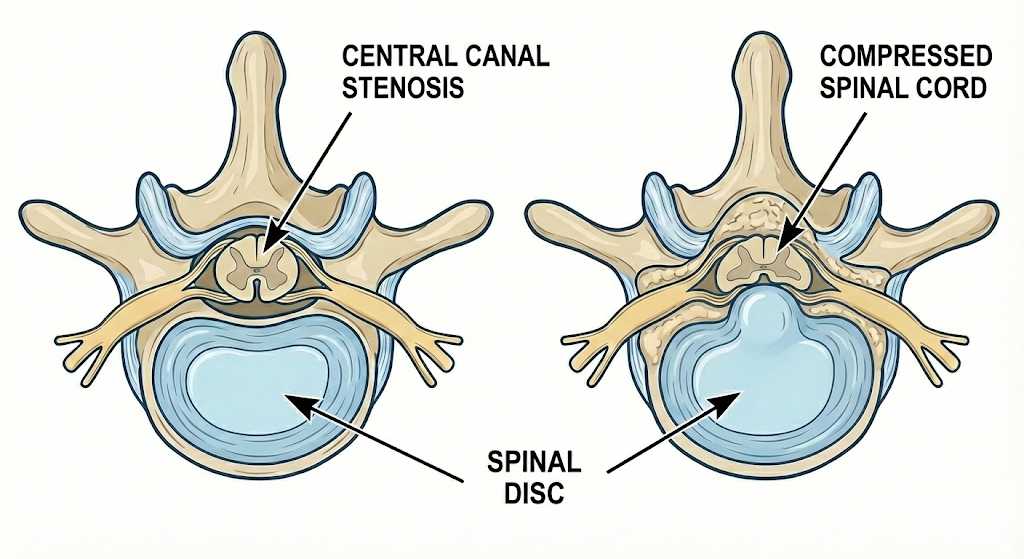
Your vertebrae are cushioned by soft discs that act like shock absorbers. If the jelly-like center of a disc pushes out through its tougher exterior casing, it can press directly onto a nerve root exiting the spine, triggering sciatica.
As we age, spinal discs can wear down and shrink. This reduces the space between vertebrae and can narrow the nerve openings, leading to irritation.
This is a narrowing of the spinal canal, the hollow passage the spinal cord runs through. This narrowing puts pressure on the nerves.
Sometimes the issue isn't in the spine at all. The piriformis muscle is located deep in the buttock, right on top of the sciatic nerve. If this muscle spasms or gets too tight, it can compress the nerve, mimicking the symptoms of a spinal issue.
Sciatica is notoriously varied in how it presents. For some, it’s an annoying ache; for others, it’s agonizing.
Crucially, sciatica almost always affects only one side of the body.
Common sensations include:
For acute flare ups, initial treatment often involves self-care measures to reduce inflammation and calm the nerve spasm.
Alternating hot and cold packs to reduce inflammation and heat to relax muscles.
While bed rest seems appealing, prolonged inactivity can make it worse. Gentle walking and specific stretching can help.
NSAIDs (like Panadol, ibuprofen) can help manage pain temporarily.
However, these methods often only mask the symptoms. To truly fix sciatica, you must address the root cause of the compression.
Chiropractic care is widely recognized as one of the most effective, non-invasive treatment options for sciatica because it focuses specifically on the structural integrity of the spine and musculoskeletal system.
If your sciatica is caused by a herniated disc, misaligned vertebra (subluxation), or muscle tightness, chiropractic addresses the source of the pressure.
How Chiropractic Helps:

Chiropractic offers a drug-free path to recovery that aims to correct the problem, rather than just dulling the pain signals.
If you are experiencing the shooting pain, numbness, or nagging ache of sciatica, do not ignore it in hopes that it will simply go away. Ignoring nerve compression can sometimes lead to permanent nerve damage or chronic pain.
You don’t have to rely on painkillers or jump straight to considering surgery.
Stop letting sciatica dictate your life. If you want to address the root cause of your pain and get back to moving freely, schedule a consultation with us at Everton Chiropractic today. A thorough examination can determine the exact cause of your sciatica and put you on the path to real recovery.
Outram Park MRT, Purple Line Exit 5
Bus to Blk 3: 61, 197, 166
From the carpark. 6A Everton Park MSCP