
Facet joint pain usually shows up as a dull, deep ache along the spine that gets worse when you arch backward or twist, and eases somewhat with rest or bending forward. It often refers into a broader area rather than staying pinpointed: neck facets can send pain toward the shoulders and base of the skull, low back facets often spread into the buttocks and upper thighs. Confirming the diagnosis usually requires more than a scan. If you notice numbness, weakness, or bladder changes, that points to something else and needs urgent evaluation.
TL;DR:
- Most cases respond well to conservative treatment such as activity modification, physiotherapy, and manual therapy before considering injections or procedures.
- Diagnostic blocks, using local anesthetic, are the most reliable method to confirm the facet joint as the pain source, but multiple tests may be necessary for accuracy.
- Imaging findings of degeneration are common in asymptomatic individuals and do not confirm the joint pain source, so clinical pattern recognition remains crucial.
- Typical facet joint pain presents as dull, deep, and localized discomfort that worsens with extension or rotation, usually easing with movement and lying down.
- Urgent medical evaluation is required if symptoms like bowel or bladder control loss, saddle numbness, or progressive leg weakness occur, as these suggest serious conditions beyond facet joint issues.
Table of Contents
- What Facet Joint Pain Symptoms Look Like by Spinal Region
- The Key Clinical Features That Point to Facet Joint Dysfunction
- How Facet Pain Gets Diagnosed (and Why Scans Aren’t Enough)
- Treatment Options for Facet Joint Pain
- When Facet Pain Symptoms Need Urgent Medical Attention
- Can Facet Joints Heal, and What Affects Recovery?
- Practical Steps to Manage a Facet Pain Flare
- A Clinician’s View on Living With Facet Joint Pain
- How some chiropractic clinics approach facet joint symptoms
- Sources
- FAQ
What Facet Joint Pain Symptoms Look Like by Spinal Region
Facet joints sit at every level of the spine, and where the pain shows up tells you a lot about which joints are involved. The pattern isn’t random. Each region tends to produce its own signature.
Cervical facet joints (neck) commonly cause localized neck stiffness along with headaches that start at the base of the skull and wrap toward the temples. Pain frequently spreads into the shoulder girdle and upper back, which is why people often blame their shoulders when the real source is a joint two or three levels up in the neck.
Thoracic facet joints (mid-back) tend to produce a more localized ache between the shoulder blades or along the rib cage. It can mimic flank pain badly enough that people sometimes get checked for kidney issues before anyone considers the spine.
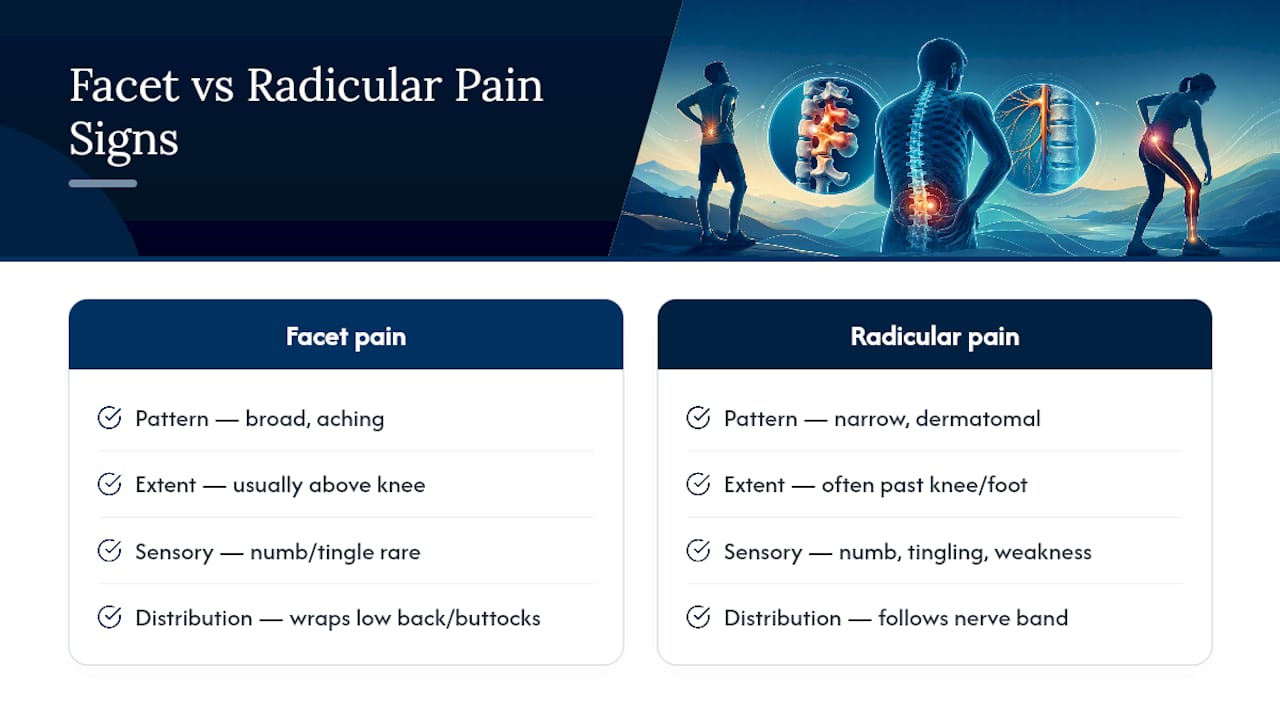
Lumbar facet joints (low back) generate what’s often called a “cycling shorts” pattern: pain that wraps across the low back and down into the buttocks, hips, and upper thighs. According to Ohio State Wexner Medical Center, this referral pattern typically stops above the knee, which is one of the most useful clues for telling facet pain apart from a pinched nerve.
That last point matters more than most people realize. Radicular pain, the kind caused by a compressed nerve root, follows a dermatomal path: a narrow band that often runs past the knee and into the foot, frequently paired with numbness, tingling, or measurable weakness. Facet pain almost never does that. If your discomfort stays broad, achy, and above the knee, facet involvement is more likely than a disc or nerve problem.
The Key Clinical Features That Point to Facet Joint Dysfunction
Beyond location, certain qualities of the pain itself help separate facet joint dysfunction from other spine problems. These are the details a clinician listens for during a history and exam.
- Pain often feels dull, deep, or “band-like” rather than sharp or burning, and some patients describe a jamming sensation with certain movements.
- Stiffness and pain are frequently worse first thing in the morning or after sitting still, then loosen slightly with gentle movement.
- Extension and rotation, think looking up, backing out of a parking space, or arching to reach a high shelf, tend to reproduce or worsen the pain.
- Forward bending or lying down often brings temporary relief, which is the opposite of what you’d expect with some disc-related pain patterns.
- There’s usually no consistent numbness, tingling, or measurable weakness. When those show up, they suggest a nerve root is involved rather than the facet joint alone.
Physical exam maneuvers like the Kemp test, extending and rotating the spine to reproduce pain, can support a suspicion of facet involvement, though the StatPearls review on facet joint disease notes that these findings suggest the joint is involved without proving it definitively. Morning stiffness that eases with light activity is common enough that some clinics build entire self-care routines around managing that first hour after waking.
How Facet Pain Gets Diagnosed (and Why Scans Aren’t Enough)
Diagnosing facet joint pain starts with pattern recognition, not a machine. A clinician looks for localized tenderness along the spine next to the joints, pain that worsens with extension or rotation, and the absence of true radicular signs like dermatomal numbness or reflex changes. Recent consensus work using Delphi methodology has identified specific clusters of these findings, unilateral pain, tenderness over the joint, pain provoked by extension, that help primary care clinicians flag likely lumbar facet joint pain and refer appropriately.
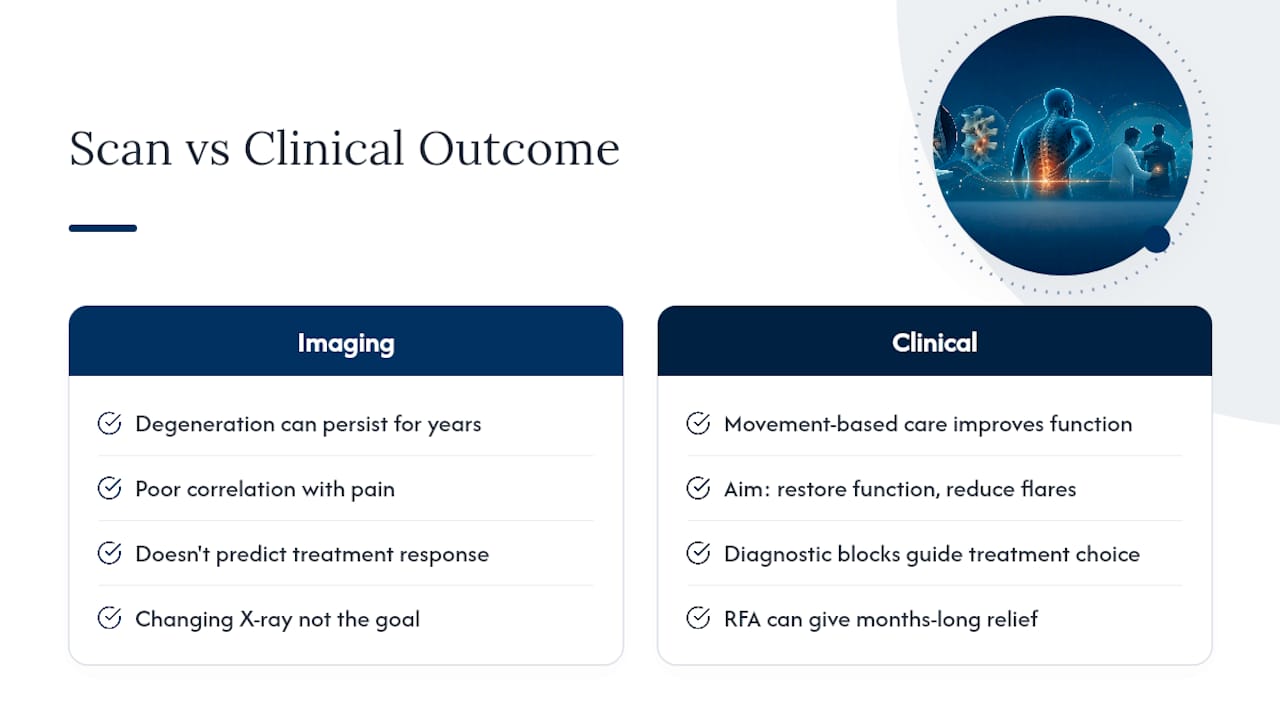
Imaging plays a smaller role than most patients expect. X-rays, MRI, and CT scans can show facet joint degeneration, but that degeneration shows up constantly in people with zero pain. A scan can suggest facet involvement; it can’t confirm the joint is the actual source of your symptoms.
That’s where diagnostic blocks come in. Medial branch blocks and intra-articular injections use local anesthetic, guided by fluoroscopy or ultrasound, to numb the suspected joint. If your pain drops significantly, that’s strong evidence the facet joint is the culprit.
Pro Tip: A single block isn’t always definitive. Many specialists repeat the injection on a separate visit before relying on the result, because a first block can occasionally read as positive even when the joint isn’t the true source.
- Clinical exam looks for paravertebral tenderness, extension-provoked pain, and absence of radicular signs.
- Imaging shows structural changes but frequently overlaps with pain-free individuals.
- Diagnostic medial branch or intra-articular blocks confirm the joint as the pain generator.
- Repeat blocks are sometimes needed because false-positive rates are a known limitation of a single injection.
Treatment Options for Facet Joint Pain
Care almost always starts conservative and escalates only if needed. Jumping straight to procedures rarely happens, and for good reason: most people improve with simpler steps first.
- Conservative care first. Activity modification, graded exercise, physiotherapy, manual therapy, and short-term analgesics form the foundation. This phase alone resolves a large share of cases, particularly when flare-ups are caught early.
- Diagnostic and therapeutic injections. Medial branch blocks or intra-articular injections serve double duty, confirming the diagnosis while sometimes providing weeks or months of relief on their own.
- Radiofrequency denervation (RFA). For patients with chronic pain who respond clearly to diagnostic blocks, RFA uses heat to disrupt the nerve signal from the joint. A multidisciplinary review of facet joint interventions describes RFA as an established option for this selected group.
- Surgery, rarely. Surgical intervention for isolated facet pain is uncommon and reserved for very specific circumstances, not a default step in the pathway.
Guidance from the NHS Knowledge NoW resource on suspected facet joint pain is direct on sequencing: documented failure of conservative care and a positive response to diagnostic blocks should come before RFA is considered, and imaging findings alone shouldn’t be treated as a green light. For a broader look at conservative pathways, see this rundown of non-surgical back pain options.
When Facet Pain Symptoms Need Urgent Medical Attention
Most facet-related pain is uncomfortable, not dangerous. A short list of symptoms changes that.
- Loss of bowel or bladder control, or numbness in the saddle area (inner thighs, groin), needs emergency care immediately.
- Sudden or progressively worsening leg weakness alongside back pain is not typical facet behavior and needs urgent review.
- Severe pain at night, unexplained weight loss, fever, or a personal history of cancer all warrant prompt medical assessment rather than a wait-and-see approach.
These signs align with the international framework of red flags for serious spinal pathology, and none of them are typical of isolated facet joint dysfunction.
Can Facet Joints Heal, and What Affects Recovery?
Many people improve substantially with movement-based conservative care, even when imaging still shows degeneration years later. That mismatch is normal. Structural changes on a scan don’t reliably predict how much pain someone feels or how well they’ll respond to treatment. The clinical goal is restoring function and cutting down flare frequency, not making an X-ray look different. For patients who go through the full diagnostic pathway and respond well to blocks, RFA can offer sustained relief for months at a stretch.
Practical Steps to Manage a Facet Pain Flare
During a flare, avoid repeated backward bending under load, think lifting overhead or arching to paint a ceiling, and favor gentle, varied movement over total rest. A focused trial of two to four conservative care sessions often clarifies how you’ll respond before anyone discusses imaging or injections.
Pro Tip: If pain persists past a short trial of care, that’s the signal to talk about imaging or diagnostic blocks, not a sign that conservative care failed you.
A Clinician’s View on Living With Facet Joint Pain
Facet pain responds well to consistent, sensible movement, far better than most people expect once they stop fearing the discomfort. Skip the trap of chasing a “perfect” scan. If pain limits your day or isn’t budging after reasonable self-care, get assessed.
— Aman
How some chiropractic clinics approach facet joint symptoms
If you’ve been stretching, resting, and hoping the ache in your neck or low back settles on its own, some clinics offer more structured alternatives: a focused assessment that identifies whether your pain fits a facet pattern before guessing at treatment.

A first visit typically involves a detailed history, movement testing, and a look at how your pain behaves with extension, rotation, and rest, the same pattern-recognition approach described throughout this article. From there, Dr. Richard builds a short trial of care around your specific presentation, whether that means spinal alignment treatment for axial stiffness or a broader look at posture habits feeding the flare-ups. For readers whose pain spreads into the leg and raises questions about nerve involvement rather than referred facet pain, the clinic’s sciatica treatment service addresses that overlap directly. Some chiropractic approaches center on personalized, evidence-informed care rather than a one-size-fits-all adjustment plan, with treatment built around actual goals and daily activity levels. If your neck or back pain has been nagging for weeks without a clear explanation, book a chiropractic consultation and get a straight answer on what’s actually driving it.
Sources
The clinical claims in this article draw on peer-reviewed reviews, consensus criteria, and health service guidance rather than general wellness content. Worth reading directly if you want the primary evidence behind any of the above:
- Facet joint disease – StatPearls
- Facet joint syndrome: from diagnosis to interventional management (PMC)
- Facet joint pain suspected — Knowledge NoW (NHS)
Every case still depends on individual history and exam findings, so use this as background before your own conversation with a clinician, not a substitute for one.
FAQ
What Are the Treatment Options for Facet Joint Irritation?
Treatment usually starts with conservative care, activity changes, exercise, and manual therapy, before moving to diagnostic injections if pain persists. For selected chronic cases that respond well to diagnostic blocks, radiofrequency denervation is an established next step, with surgery reserved for rare situations.
Is Facet Joint Arthritis an Autoimmune Disease?
No. Facet joint arthritis, also called facet arthropathy, is a degenerative and mechanical condition related to wear, alignment, and loading over time, not an autoimmune process. It’s closer in nature to other forms of osteoarthritis than to conditions like rheumatoid arthritis.
What Are the Symptoms of Back Facet Joint Pain?
Back facet joint pain typically feels like a dull, deep ache in the low back that spreads into the buttocks and upper thighs, staying above the knee. It’s usually worse with backward bending and after periods of rest, and it lacks the numbness or weakness seen with nerve-related pain, as described by Ohio State Wexner Medical Center.
Can a Facet Joint Heal on Its Own?
Many facet-related flare-ups settle with conservative, movement-based care even though degenerative changes on a scan don’t disappear. Pain reduction and restored function are the realistic goals, not a “clean” image, and for people who don’t improve with self-care, chiropractic consultation can help clarify next steps.