Recovery time depends entirely on tissue and severity: mild strains and sprains typically clear up in days to a couple of weeks, moderate injuries take several weeks to months, and severe or surgical injuries often need several months or longer. The number on the calendar matters less than what your body can actually do. Return to sport should follow functional milestones, not a fixed date, and any injury that isn’t improving or involves severe swelling, deformity, or numbness needs a clinician’s eyes on it before you push further.
TL;DR:
- Muscle strains, especially grades two and three, often require several weeks to months for full recovery, with complete tears sometimes needing surgical repair.
- Ligament sprains vary from a week or two for grade I injuries to months or surgery for severe sprains, particularly in unstable ankles.
- Tendon and cartilage injuries, such as Achilles ruptures or meniscus tears, generally take the longest, often requiring six months or more for full return to sport.
- Proper recovery depends on progressing through stages of rehab based on objective functional milestones, not fixed timeframes.
- Ignoring early warning signs like severe swelling or inability to weight-bear can lead to complications, emphasizing the importance of professional assessment and milestone-based clearance.
Table of Contents
- How Tissues Heal: The Three Phases Behind Every Sports Injury Recovery Timeline
- Typical Recovery Timelines by Tissue and Injury Severity
- Rehab, Phase by Phase: What to Actually Do at Each Stage
- What “Ready to Play” Actually Looks Like
- Red Flags: When to Stop Guessing and See a Clinician
- The Mental Side of Recovery Nobody Warns You About
- How Everton Chiropractic Approaches a Sports Injury Recovery Timeline
- A Quick Note on Getting This Wrong
- Ready for a Milestone-Based Recovery Plan?
- Sources
- FAQ
How Tissues Heal: The Three Phases Behind Every Sports Injury Recovery Timeline
Every sports injury recovery timeline runs through the same three biological phases, whether you tore a hamstring or rolled an ankle. The inflammation phase kicks in within hours and typically runs three to five days. Blood vessels dilate, immune cells flood the area, and swelling shows up as your body clears damaged tissue. It’s uncomfortable, but it’s necessary groundwork, not a setback.
The repair and proliferation phase follows, usually lasting from several days out to about six weeks. This is where collagen and new tissue start filling the gap, though that new tissue is still weak and disorganized. Then comes remodeling and maturation, which can stretch from six weeks to well over a year for denser tissue like tendon or cartilage, as fibers reorganize and gradually regain strength and structure.
- Inflammation: hours to about 5 days
- Repair/proliferation: roughly 4 days to 6 weeks
- Remodeling/maturation: 6 weeks to 12+ months depending on tissue
Quick fact: Healing occurs in these three biological phases regardless of which tissue you injured, but the timeline within each phase varies enormously by tissue type and injury severity.
Age, general health, nutrition, and comorbidities like diabetes all shift these windows. A 22-year-old and a 55-year-old with the identical ankle sprain won’t necessarily heal at the same pace. And here’s the part people miss: finishing biological repair doesn’t mean you’re ready to compete. Tissue can be technically healed while your strength, balance, and confidence still lag weeks behind.
Typical Recovery Timelines by Tissue and Injury Severity
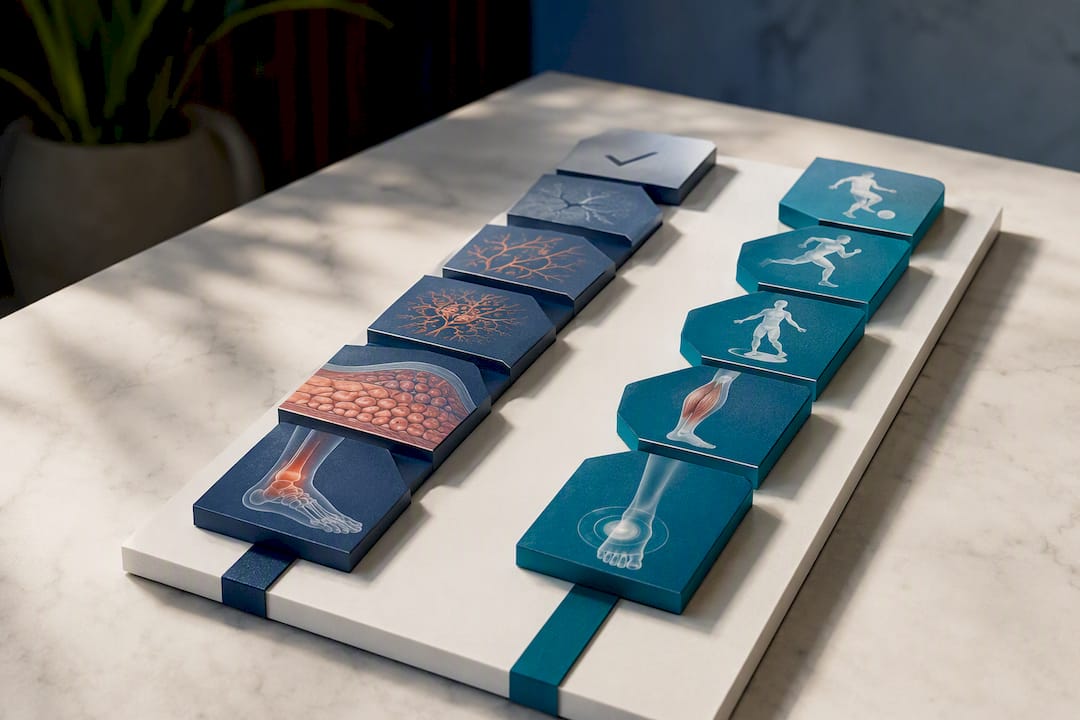
Recovery ranges shift dramatically depending on which tissue got hurt and how badly. Here’s what the evidence-backed ranges actually look like across the injuries we see most.
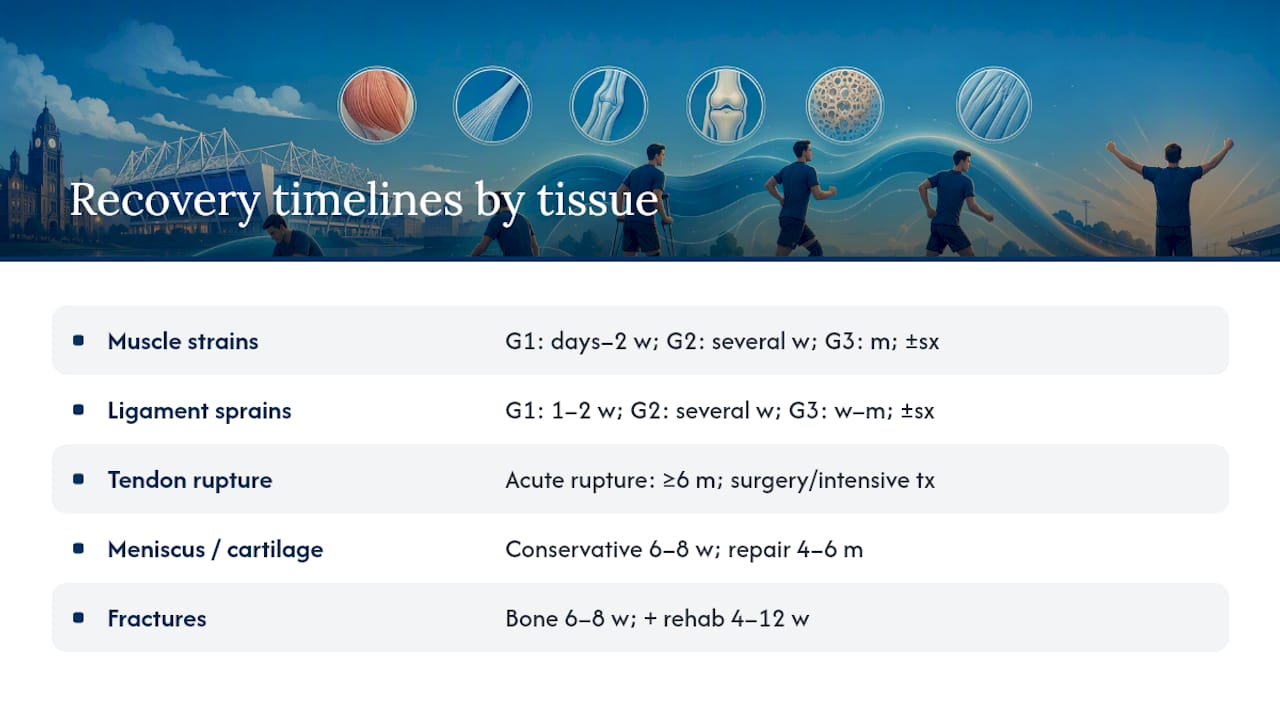
Muscle strains are graded one through three. Grade 1 (mild overstretch) often resolves in days to about two weeks. Grade 2 strains, involving partial tearing, generally take several weeks. Grade 3, a complete tear, can take months to heal and sometimes requires surgical repair, particularly for muscles like the quadriceps or hamstring that bear heavy load.
Ligament sprains, most commonly at the ankle, follow a similar grading system. A grade I ankle sprain often clears in one to two weeks, while grade II sprains typically need several weeks of structured rehab. Grade III sprains, where the ligament is fully torn, carry the widest range: some recover with weeks of bracing and physical therapy, others need surgical stabilization if the ankle stays chronically unstable.
Tendon injuries are their own animal. An acute rupture (think Achilles) usually needs surgical or intensive conservative treatment followed by months of graduated loading, often six months or more before full sport clearance. Chronic tendinosis, the overuse kind, can drag on even longer because it’s a degenerative issue, not a single traumatic event, and it responds slowly to anything short of patient, progressive loading.
Cartilage and meniscus injuries, along with labral tears in the hip or shoulder, tend to have the most unpredictable timelines of the bunch. Small meniscus tears managed conservatively might settle in six to eight weeks. Larger tears requiring surgical repair often need four to six months before return to sport, since cartilage has limited blood supply and repairs slowly.
Fractures follow a fairly predictable bone healing timeline: roughly six to eight weeks for the bone itself to knit in most healthy adults. But that’s not the finish line. Add another four to twelve weeks of rehab afterward to rebuild the strength, mobility, and confidence that months in a cast or boot stripped away.
Rehab, Phase by Phase: What to Actually Do at Each Stage
Rehab isn’t one long block of “recovery.” It moves through distinct stages, each with its own goals and appropriate exercises.
- Immediate care (days 0 to 3). The old RICE approach has evolved. Many clinicians now favor PEACE & LOVE (protection, elevation, avoiding anti-inflammatories, compression, education, then load, optimism, vascularization, exercise) over strict rest, because early gentle movement tends to outperform prolonged immobilization for most sprains and strains. Get assessed if you can’t bear weight or if swelling is severe.
- Early mobilization (days 3 to 14). Gentle range-of-motion work, isometric holds, and protected weight-bearing come next. Think ankle circles, quad sets, or light resistance band work, nothing that reproduces sharp pain.
- Rebuilding capacity (weeks 2 to 8). This is where progressive strengthening enters: resistance training, load management, and cross-training on a bike or in a pool to maintain fitness without overloading the healing tissue.
- Advanced conditioning (weeks 6 onward). Proprioception drills, agility ladders, cutting and pivoting work, and sport-specific drills performed under fatigue round out the final stretch before full clearance.
Pro Tip: Track your progress by function, not just how sore you feel. A knee that “feels fine” standing still can still fail a single-leg hop test. Function is the real scoreboard.
Skipping straight from stage one to stage four is the single most common way people re-injure themselves. Each stage builds tolerance the next stage depends on.
What “Ready to Play” Actually Looks Like
Clearance shouldn’t hinge on how many weeks have passed. It should hinge on what your body can objectively demonstrate.
Clinicians typically look for:
- Strength within about 90 to 95 percent of the uninjured side, measured, not guessed
- Full, pain-free range of motion in the joint or muscle group involved
- Successful single-leg hop tests without compensation or pain
- Repeated sprint and agility performance holding steady even under fatigue
Quick fact: Recovery from athletic injury tends to be lengthy and multidisciplinary, and progression should track the resolution of impairments rather than a fixed calendar date.
Return to sport usually unfolds in stages of its own: training-only participation first, then full team training, then game or competition clearance. Each step up should require the same objective testing as the last, since fatigue often exposes weaknesses that a fresh, rested test completely misses. A clinician’s judgment, combined with the numbers and the demands of your specific sport, decides when you actually go. If you played a cutting sport like basketball or soccer, the bar for agility testing sits higher than it would for a distance runner.
Red Flags: When to Stop Guessing and See a Clinician
Some symptoms mean you shouldn’t wait to “see how it feels tomorrow.”
- Inability to bear any weight on the injured limb
- Severe or rapidly worsening swelling and bruising
- Visible deformity at the joint or bone
- Numbness, tingling, or loss of sensation below the injury
Persistent instability, a joint that catches or locks, or an injury that simply isn’t progressing after a couple of weeks of conservative care are all reasons to request imaging, according to Mayo Clinic’s guidance on muscle strains. Surgical referral typically comes into play for complete ligament or tendon ruptures, joints that stay chronically unstable despite rehab, and displaced fractures that won’t heal properly on their own.
The Mental Side of Recovery Nobody Warns You About
Feeling better and being ready are two different things, and confusing them is how a lot of second injuries happen. Pain easing off doesn’t mean your tissue has regained full load tolerance. That gap between subjective comfort and objective capacity is exactly why fatigue-based testing matters so much before clearance.
The most common mistakes: skipping rehab phases because you feel good, undertraining out of fear of reinjury, or fixating on pain scores while ignoring whether your actual function is improving.
- Maintain cardiovascular fitness with low-impact options like swimming or cycling while the injury heals
- Set measurable weekly goals instead of vague ones like “feel normal again”
- Track strength and mobility numbers, not just how sore you feel that day
Pro Tip: Keep a simple log of range of motion and strength each week. Numbers don’t lie the way “it feels okay” sometimes does.
How Everton Chiropractic Approaches a Sports Injury Recovery Timeline
A recovery plan should be built around the principle that milestones decide readiness, not the calendar. An evidence-informed approach means each patient’s timeline can be mapped against measurable markers, strength symmetry, pain-free range of motion, and functional testing, rather than relying on generic time estimates.
When a case calls for it, coordination with physiotherapists and medical specialists can help ensure nothing gets missed between disciplines. You can read more about how this plays out in practice in our guide on how chiropractic supports safe return to sport and the techniques used along the way in chiropractic sports techniques for athletes.
A Quick Note on Getting This Wrong
The biggest mistake I see people make isn’t rushing back too fast, though that happens plenty. It’s treating recovery like a straight line instead of a series of checkpoints. Progress stalls, plateaus happen, and that’s normal, not failure. Set goals around function, loop in a clinician early, and lean on resources like our guide to restoring post-injury movement when you need a second opinion on where you actually stand.
— Aman
Ready for a Milestone-Based Recovery Plan?
Generic advice and a spreadsheet timeline can only take you so far. What actually shortens a sports injury recovery timeline is a plan built around your specific tissue, your specific sport, and objective testing along the way, not a one-size-fits-all handout.
At Everton Chiropractic, a first visit means a real assessment: how you move, where you’ve lost strength or range, and what your sport actually demands of you before you go back. Dr. Richard builds milestone-based plans from there and coordinates with physiotherapists or medical specialists when your case calls for it, so you’re not piecing together conflicting advice on your own. If you want a clearer read on what your recovery should actually involve, book a chiropractic consultation or explore sports chiropractic care to get a plan built around your actual injury, not a generic timeline.
Sources
- Acute Ankle Sprain – StatPearls – NCBI Bookshelf
- Muscle strains: causes, symptoms, treatment & recovery — Cleveland Clinic
- Recovery From Injury in Sport — PMC (NIH)
This article is general information, not a substitute for advice from a qualified doctor. Consult a qualified healthcare professional about your own circumstances before acting on anything here.
FAQ
Which sports injury takes the longest to heal?
Tendon and cartilage injuries generally take the longest because both tissues have limited blood supply and heal slowly under load. A torn Achilles or a significant meniscus tear can require months of graduated rehab before full return to sport, far longer than most muscle strains or mild ligament sprains.
Why do I keep getting injured so easily?
Repeated injuries usually point to unresolved deficits, weakness, tightness, or poor movement patterns left over from a previous injury that never fully rehabilitated. Skipping rehab phases or returning to sport before hitting objective strength and function benchmarks is one of the most common causes of repeat injury.
How do I mentally get past a sports injury?
Set measurable, function-based goals instead of vague ones like “feeling normal,” and track weekly progress in strength and range of motion rather than daily pain levels alone. Working with a clinician who checks progress against real milestones tends to ease the anxiety that comes with an uncertain timeline.
What part of the body heals the slowest after injury?
Cartilage and tendon tissue typically heal slowest of all, since both have relatively poor blood supply compared to muscle or bone. That’s why cartilage and labral injuries carry some of the widest and least predictable recovery windows of any sports injury.
How long does a typical sports injury recovery timeline last?
It depends entirely on tissue and grade: mild strains and sprains often resolve within one to two weeks, moderate injuries take several weeks to a couple of months, and severe or surgical cases can take three to nine months or longer. Return to sport should always be confirmed by functional testing, not just how many weeks have passed.