Targeted hip and glute strengthening, paired with controlled quadriceps work and gradual loading, is the most effective conservative treatment for runner’s knee. Most runners improve within a few weeks of consistent, slow, well-formed reps rather than high-intensity effort. Mild soreness is normal; sharp or catching pain means stop and reassess. Progress load gradually, and if pain persists past six weeks, see a clinician.
TL;DR:
- Strengthening the hip abductors and gluteus medius is essential to correct inward thigh rotation that drags the kneecap out of place, which often causes runner’s knee.
- Progress in exercises should be gradual, focusing on increasing reps first, then resistance, and only reintroducing running when pain-free, with careful attention to form and pain levels.
- Foam rolling helps manage tissue tightness around the knee but cannot replace targeted strengthening of hip and glute muscles necessary for long-term recovery.
- A personalized assessment of gait and biomechanics is crucial, especially if stiffness or pain persists beyond six weeks despite consistent exercise.
- Incorporating mobility stretches like quad, hamstring, and calf stretches as part of a warm-up or cool-down can support strength routines but do not address underlying mechanical issues.
Table of Contents
- Runner’s Knee Exercises to Start Today
- Why Hip and Glute Strength Fix Knee Alignment
- Stretches That Support Your Knee Rehab
- How to Progress Runner’s Knee Exercises Safely
- When to See a Clinician for Knee Pain
- Should You Foam Roll for Runner’s Knee?
- Common Mistakes That Slow Down Recovery
- An Alignment-First View on Runner’s Knee Recovery
- Guided Rehab for Runner’s Knee: What Evertonchiropractic Offers
- Sources
- FAQ
Runner’s Knee Exercises to Start Today
Runner’s knee, known clinically as patellofemoral pain syndrome, is irritation around the kneecap that flares with running, squatting, or stairs. Before chasing complicated programs, start with a short routine that unloads the kneecap while waking up the muscles that stabilize it.
Do this sequence every other day, resting the leg on off days:
- Glute bridges — lie on your back, knees bent, feet flat. Squeeze your glutes and lift your hips until your body forms a straight line from shoulders to knees. 2 to 3 sets of 12 to 15 reps.
- Clamshells — lie on your side, knees bent at 90 degrees, feet together. Lift the top knee without rotating your hips back. 2 to 3 sets of 15 reps per side.
- Wall sits — back against a wall, knees bent to a comfortable angle (not past 60 degrees at first). Hold for 20 to 30 seconds, 3 rounds.
- Straight leg raises — lying down, one knee bent, the other leg straight. Lift the straight leg to hip height, hold briefly, lower slowly. 2 to 3 sets of 10 to 12 reps.
- Standing hip abduction — holding onto a wall for balance, lift one leg out to the side without leaning your torso. 2 sets of 12 reps per side.
A dull, achy soreness that fades within a day is fine. A sharp, pinching, or catching pain during or after the movement is your cue to stop and scale back the range of motion.
Why Hip and Glute Strength Fix Knee Alignment
The kneecap tracks in a groove at the end of your thighbone, and it needs balanced pull from the surrounding muscles to stay centered. When the hip abductors and gluteus medius are weak, the thigh rotates inward during running and single-leg loading, dragging the kneecap off track with every stride, as explained in this guide to gelenkschonender Sport für kniende Gesundheit. That inward collapse, not the knee joint itself, is usually the root mechanical problem behind patellofemoral pain, according to clinical guidance on the kinetic chain and alignment. Strengthening the hip stabilizers corrects that pull before you ever touch heavier knee-specific work, a sequencing supported by research on progressive hip stabilization.
Layer these exercises in once the starter routine feels manageable:
- Banded lateral walks: loop a resistance band above your knees, sit into a quarter squat, and step sideways in slow, controlled steps. This targets the gluteus medius directly and mimics the stabilizing demand of running.
- Step-downs: stand on a low step, slowly lower your opposite heel toward the floor without letting the standing knee cave inward, then return to start. Start with a 4-inch step and build height gradually.
- Mini-squats: bodyweight squats to a shallow depth, focusing on tracking the knees directly over the toes.
- Single-leg balance progressions: once double-leg work feels solid, shift to single-leg glute bridges and single-leg wall sits to build the stability running actually demands.
Combined hip and quadriceps programs show better long-term outcomes than quad work alone, per practice guidelines from the American Physical Therapy Association.
Pro Tip: Slow the last few reps of every set down to a three-second count on the way down. Clinical guidance consistently notes that controlled tempo and clean form matter more than cranking through extra reps.
If any exercise reproduces sharp pain, shrink the range of motion or drop the resistance before abandoning the movement entirely.
Stretches That Support Your Knee Rehab
Stretching won’t fix the strength deficit that’s driving your pain, but loosening tight tissue around the knee reduces the pull on the kneecap and makes strength work more comfortable. Use these as a cool-down, never as a substitute for the strengthening routine above.
- Quad stretch: standing, pull one heel toward your glutes, keeping knees together. Hold 20 to 30 seconds per side.
- Hamstring stretch: seated or lying, extend one leg and reach toward your toes with a flat back. Hold 20 to 30 seconds.
- IT band stretch: cross one leg behind the other and lean your hip out to the side away from the crossed leg. Hold 20 to 30 seconds.
- Hip flexor stretch: kneel in a lunge position and gently press your hips forward. Hold 20 to 30 seconds per side.
- Calf stretch: hands on a wall, one leg back with the heel pressed down. Hold 20 to 30 seconds per side.
Simple stretches like these, alongside basic strengthening, are part of standard NHS guidance for runners, and none of them should ever produce sharp pain.
How to Progress Runner’s Knee Exercises Safely
Progression is where most runners either recover well or stall out by rushing it. The pattern that works: build reps first, then add resistance, then add complexity (single-leg variations), and only after that reintroduce running.
- Add reps before load. Once you can complete all sets with clean form and minimal next-day soreness, add 2 to 3 reps per set before adding weight or resistance.
- Use a 0 to 10 pain scale. Anything at 2 or below that settles within 24 hours is acceptable. A 3 or higher, or pain that lingers into the next day, means back off the last progression.
- Progress one exercise ladder at a time. For step-downs: start at 4 inches, then 6, then 8, adding height only when the movement stays controlled with no knee wobble.
- Return to running gradually. Once daily activities are pain-free, use run-walk intervals (say, one minute running, two minutes walking) before extending continuous run time, increasing total distance by roughly 10% a week.
- Pause and reassess if pain spikes at any stage, or if a new symptom (swelling, locking) appears. Gait adjustments, such as shortening stride length or increasing cadence, can also reduce load on the kneecap as part of a broader plan, per guidance from the Human Performance Resource Center.
When to See a Clinician for Knee Pain
Most runner’s knee cases respond to consistent home exercise, but certain signs mean it’s time to get an assessment rather than push through. See a clinician if you notice sharp, catching, or locking pain, swelling that doesn’t settle, a feeling of the knee giving way, or no meaningful improvement after six weeks of consistent exercise.
Bring a simple log to your appointment: which exercises you’ve tried, how often, and a rough pain pattern (when it flares, what eases it). A clinician can run a movement assessment, check your gait, and build a personalized plan, which research on knee pain treatment identifies as valuable when strengthening alone isn’t cutting it. In some cases, referral to physical therapy for knee pain follows directly from that first evaluation.
Should You Foam Roll for Runner’s Knee?
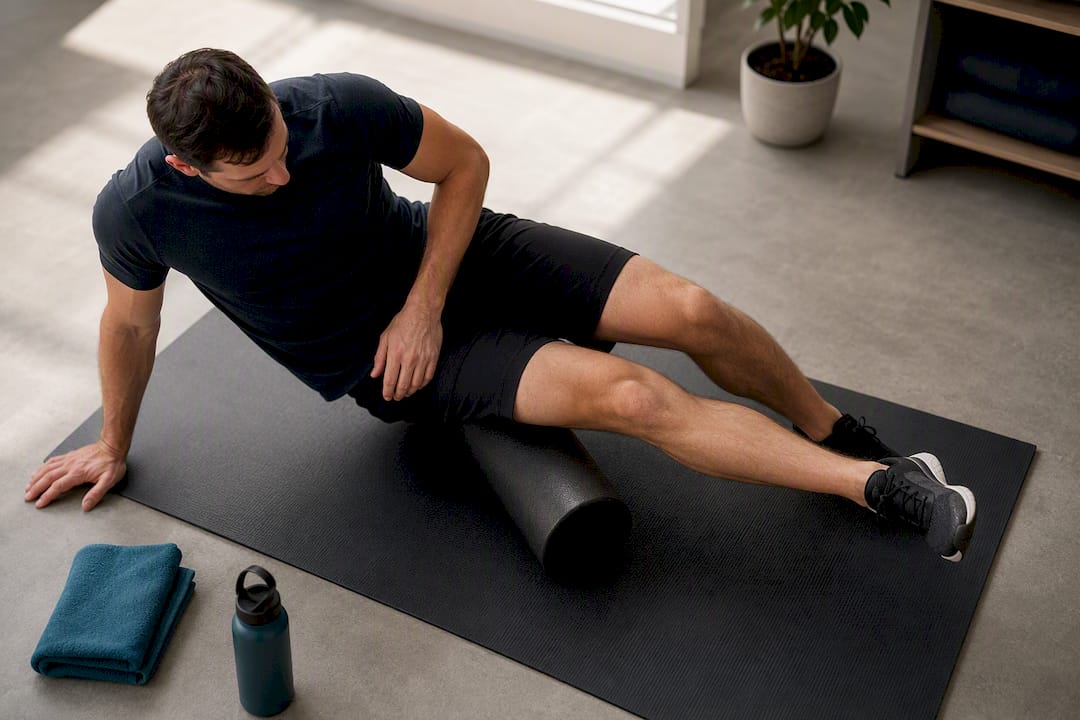
Foam rolling won’t correct the hip weakness driving your knee pain, but it’s a useful add-on for managing tightness that builds up around the kneecap. Rolling the quads, IT band, and hip flexors before your strength session can loosen restricted tissue and make the working muscles easier to activate.
Spend 30 to 60 seconds per area, rolling slowly rather than rushing back and forth. Avoid rolling directly over the kneecap itself, and skip any spot that produces sharp, radiating pain rather than a dull pressure sensation. Most runners get the most value from rolling the outer thigh (IT band region) and the front of the thigh (quadriceps), since tightness there directly affects how the kneecap tracks during movement.
Self-massage with a lacrosse ball or massage stick works the same way for smaller, more specific spots, like the hip flexor crease or the muscles just above the kneecap. Use it after your strength routine or on rest days, not as a warm-up substitute. Cold tissue rolled aggressively can actually feel worse, so save deeper pressure work for after you’ve moved around a bit.
Think of foam rolling as maintenance, not treatment. It buys you comfort and range of motion; the clamshells, bridges, and step-downs are what actually rebuild the stability your knee is missing. Skipping the strength work in favor of rolling and stretching is one of the most common reasons runner’s knee keeps coming back.
Common Mistakes That Slow Down Recovery
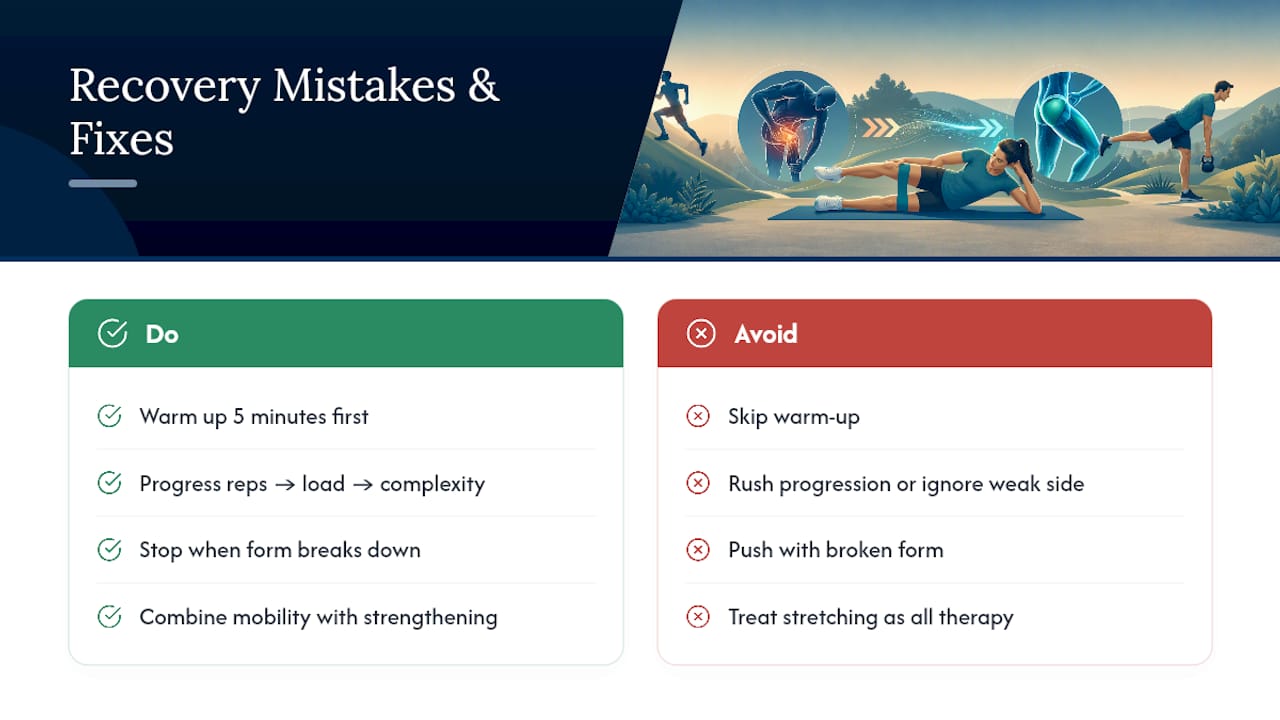
Skipping the warm-up is the first mistake worth fixing. Jumping straight into wall sits or step-downs on cold muscles increases strain on tissue that’s already irritated. Five minutes of easy walking or marching in place before you start gets blood moving and makes the exercises noticeably easier to perform with good form.
Rushing progression is the second big one. Runners often feel a bit better after a week and jump straight to single-leg step-downs or add running back in too fast, undoing the stability gains they just built. Stick to the rep-before-load-before-complexity order described earlier.
Sloppy form under fatigue causes a third common problem. Letting the knee cave inward during the last few reps of a set, just to squeeze out one more, reinforces the exact movement pattern that caused the pain in the first place. Stop a set when form breaks down rather than pushing to a fixed number.
Ignoring one-sided weakness trips up a lot of runners, too. If you always start your reps on your stronger leg, that leg gets stronger while the weaker one lags. Start and finish each set on the side that hurts, and match reps exactly.
Finally, treating stretching as the whole program is a mistake worth repeating one more time: stretching relieves tightness but does nothing for the underlying hip weakness. Pair mobility work with the strengthening routine, not instead of it, and modify exercises to a smaller range of motion when a stage feels too aggressive rather than skipping the strength work altogether.
An Alignment-First View on Runner’s Knee Recovery
Most runners treat their knee pain as a knee problem. It usually isn’t. The hip is doing the failing; the knee is just where you feel it. An evidence-informed, alignment-first approach means assessing how someone’s hip and gait mechanics feed into the kneecap’s tracking pattern before handing over a generic sheet of quad exercises.
That’s where a personalized assessment earns its keep over a one-size-fits-all printout. Two runners can have identical pain locations and completely different root causes, one from hip weakness, another from a footstrike pattern that overloads the knee with every stride. Some approaches center on identifying which mechanical pattern is actually at play before prescribing a movement plan, rather than assuming every anterior knee pain case needs the same six exercises.
Clinician oversight matters most when progress stalls, gait issues are complex, or pain keeps returning despite consistent home exercise. That’s the point where a trained eye on your movement pattern speeds things up considerably.
— Aman
Guided Rehab for Runner’s Knee: What Evertonchiropractic Offers
A generic exercise sheet treats every runner’s knee the same way. Evertonchiropractic doesn’t. Dr. Richard starts with a movement and alignment assessment to find your specific mechanical driver, whether that’s hip weakness, foot mechanics, or a gait pattern overloading the kneecap, then builds a supervised progression around it instead of a one-size-fits-all handout.
At a first visit, expect a hands-on evaluation of hip, knee, and foot alignment, a discussion of your training history and pain pattern, and a personalized plan for loading your knee back toward pain-free running. That kind of tailored progression is at the core of Evertonchiropractic’s approach to long-term pain relief, built around correcting mechanics rather than just chasing symptoms. If you’ve been stuck cycling through the same exercises without progress, book a functional movement assessment to find out what’s actually driving your knee pain and get a plan built around it.
Sources
Guidance drew on the NCBI patellofemoral pain overview, APTA guidelines, NHS knee exercise guidance, and Mayo Clinic’s knee pain overview.
This article is general information, not a substitute for advice from a qualified doctor. Consult a qualified healthcare professional about your own circumstances before acting on anything here.
- Rehabilitation strategies emphasizing progressive hip stabilization
- Knee pain – Diagnosis and treatment – Mayo Clinic
- Knee exercises for runners | NHS
FAQ
What Is the Fastest Way to Fix Runner’s Knee?
There’s no true shortcut, but consistent hip and quad strengthening combined with reduced running load during flare-ups is the fastest evidence-supported path. Most runners notice improvement within two to four weeks of daily, well-formed exercise.
Is It Good to Massage Runner’s Knee?
Gentle self-massage or foam rolling around the quads and IT band can ease tightness and complement your strength routine, but it won’t fix the hip weakness causing the problem. Avoid pressing directly on the kneecap or rolling through sharp pain.
Does Runner’s Knee Ever Fully Heal?
Yes, most cases resolve fully with consistent strengthening and gradual return to running, though ongoing hip and glute maintenance work helps prevent recurrence. If pain persists past six weeks despite consistent exercise, a clinician assessment through a service like Evertonchiropractic’s knee pain care can identify what’s being missed.
Is Walking OK With Runner’s Knee?
Walking is generally fine and often encouraged, since it keeps you moving without the repetitive impact loading of running. Stop or shorten your walk if you feel sharp or worsening pain rather than mild, settling soreness.