Explore our advanced clinical protocols for preventive spinal health here.
Introduction to Age-Related Cervical Spondylosis
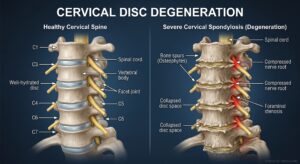
Cervical spondylosis is an age-related degenerative condition affecting the spine. It targets intervertebral discs, facet joints, and supporting spinal ligaments1. This progressive disease commonly manifests as localized and persistent neck pain. It can also advance to severe cervical radiculopathy and myelopathy1. The condition imposes a substantial economic and functional burden globally2.
As populations age, symptomatic spinal degeneration becomes increasingly prevalent worldwide2. Current public health modeling suggests symptomatic disease affects many adults globally3. Patients often wonder if proactive medical interventions can stop this disease. Can cervical decompression prevent cervical spondylosis effectively as you age?
To answer this, we must examine underlying spinal biomechanics carefully. We must compare modern surgical and non-surgical decompression strategies thoroughly. Both primary modalities aim to manage neural compression and restore function2. However, their exact mechanisms for combating age-related disc degeneration differ significantly. This report explores these distinct comparative mechanisms in exhaustive clinical detail.
The Molecular Pathophysiology of Disc Degeneration
The pathogenesis of cervical spondylosis involves a complex degenerative cascade1. The dominant driver is the age-related deterioration of the intervertebral disc2. Proteoglycans form the vital structural core of healthy intervertebral discs6. These crucial molecules consist of a core protein attached to glycosaminoglycans7.
Glycosaminoglycan side chains carry a fixed negative electrical cellular charge6. This electrical charge generates a powerful internal osmotic swelling pressure6. This osmotic pressure actively draws vital water into the nucleus pulposus6. Aging drastically reduces the natural synthesis of these glycosaminoglycan molecules9.
The severe loss of proteoglycans dehydrates the gelatinous nucleus pulposus entirely2. This specific dehydration process diminishes the structural elasticity of the disc2. The once-elastic intervertebral disc quickly becomes fibrotic, rigid, and functionally compromised2. This biochemical failure marks the irreversible onset of clinical cervical spondylosis.
Cellular Biomarkers in Advancing Spinal Degeneration
Recent molecular research identifies specific cellular biomarkers associated with disc degeneration. Bone morphogenetic protein-2 expression correlates positively with severe disc degeneration12. Studies reveal positive cell cluster formations in highly degenerative disc specimens12. This BMP-2 expression is significantly elevated compared to healthy control specimens12.
Furthermore, pSMAD1/5/8 expression is also significantly upregulated in degenerated human discs12. These findings strongly suggest that BMP-SMAD signal activity increases during degeneration12. Interestingly, catabolic activity indicators like MMP-13 do not show significant changes12. Similarly, ALK3 expression remains relatively unchanged across different degenerative disc grades12.
Understanding these biomarkers helps clinicians track the progression of cervical spondylosis. This biochemical perspective highlights why reversing established degeneration is profoundly difficult. Therefore, early mechanical interventions are paramount for maintaining long-term spinal health. Preventing the initial loss of hydration protects the underlying cellular matrix.
Structural Consequences of Disc Height Loss
Cellular dehydration directly lowers the overall cervical disc space height2. Normal biomechanical load transmission becomes severely disrupted across the entire spine2. Compressive stress shifts unnaturally toward the outer annulus fibrosus directly11. This added structural stress promotes dangerous fissuring within the annular tissues11.
Loss of disc height ultimately triggers massive macroscopic structural spinal failures2. The cervical spine eventually loses its natural protective lordotic sagittal curvature2. This severe malalignment forces Sharpey fibers to detach from vertebral endplates2. This abnormal detachment initiates a massive reactive bone formation response locally2.
Osteophytes rapidly arise along the ventral and dorsal vertebral bone margins2. These bony spurs project directly into the critical intervertebral spinal foramina2. This projection drastically worsens existing nerve root compression and local inflammation2. Uncovertebral and facet joint hypertrophy occurs due to this disrupted load2.
Simultaneously, the continued mechanical collapse of the spinal motion segment occurs. The posterior longitudinal ligament begins to buckle under the intense strain2. The ligamentum flavum thickens and encroaches directly into the spinal canal2. This combined structural failure causes dangerous, progressive cervical spinal stenosis2.
The Biomechanics of Modern Postural Stress
Modern lifestyle factors act as potent accelerants for cervical spondylosis development2. Technology usage forces prolonged periods of extreme cervical neck flexion daily15. Spinal surgeon Kenneth Hansraj analyzed severe mechanical stresses caused by posture15. An adult human head weighs roughly ten to twelve pounds naturally16.
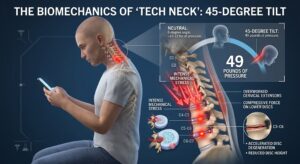
Forward head posture exponentially amplifies this effective gravitational physical weight15. For every inch of forward translation, the perceived weight increases dramatically15. This abnormal mechanical load destroys the cervical spine’s antigravity support system15. Disc desiccation accelerates dramatically under these intense and sustained biomechanical pressures16.
| Neck Flexion Angle | Effective Gravitational Load | Biomechanical Spinal Consequence |
| 0 Degrees | 10 to 12 pounds | Neutral spine; optimal load distribution. |
| 15 Degrees | 27 pounds | Early muscular fatigue; mild joint stress. |
| 30 Degrees | 40 pounds | Increased annular stress; disc desiccation risk. |
| 45 Degrees | 49 pounds | Severe anterior compression; rapid height loss. |
| 60 Degrees | 60 pounds | Extreme degenerative risk; structural remodeling. |
This chronic strain leads to early-onset cervical spondylosis and facet degeneration19. The problem is especially profound in young people utilizing mobile devices19. Teenagers might spend thousands of additional hours in these compromised positions19. This massive mechanical loading directly threatens their future preventive spinal health16.
Ergonomics and Prolonged Desktop Computer Usage
Prolonged desktop and laptop computer usage causes similar biomechanical spinal issues15. Laptop screens often sit fifteen inches below a natural eye level18. This fundamental design flaw forces constant downward head tilt during work18. The neck muscles must continuously support nearly fifty extra pounds daily18.
These constant forces cause superior facets to lock abnormally over time15. The resulting mechanical compression directly drives chronic cervical facet joint pain20. Corrective ergonomic intervention requires raising screens to proper eye level immediately16. Utilizing an external keyboard helps maintain a neutral cervical spine posture18.
Patients must practice specific thoracic extension exercises to improve upper posture16. Deep neck flexor strengthening supports the cervical spine against gravity effectively16. Implementing the twenty-twenty-twenty rule helps reduce severe neuromuscular fatigue significantly16. Reducing overall screen time significantly lessens cumulative mechanical spinal stress16.
Diagnostic Imaging and the Pfirrmann Grading System
Accurate clinical diagnosis separates age-related degeneration from acute spinal injuries2. Magnetic resonance imaging remains the gold standard diagnostic imaging modality4. MRI accurately visualizes ligaments, intervertebral discs, and compressed neural structures13. Clinicians utilize established grading systems to quantify the severity of degeneration22.
The Pfirrmann classification system evaluates T2-weighted MRI signal intensity reliably22. This specific system accurately estimates water content and morphological disc changes22. Grade I represents a healthy, highly hydrated, and youthful intervertebral disc22. Conversely, Grade V indicates a completely collapsed, severely degenerated intervertebral disc22.
| Pfirrmann Grade | Nucleus Pulposus Signal | Disc Height Status | Clinical Implication |
| Grade I | Hyperintense (White) | Normal height | Healthy, youthful disc. |
| Grade II | Hyperintense (White) | Normal height | Early asymptomatic aging. |
| Grade III | Intermediate (Gray) | Normal to slightly decreased | Moderate dehydration present. |
| Grade IV | Hypointense (Dark) | Moderately decreased | Advanced disc desiccation. |
| Grade V | Hypointense (Black) | Severely collapsed | End-stage cervical spondylosis. |
Objective imaging parameters drastically improve diagnostic accuracy and clinical treatment planning24. Cervical disc height index measurements quantify structural loss objectively over time26. The Suzuki classification system was developed specifically for evaluating cervical discs23. It explicitly documents dangerous disc bulging alongside cellular dehydration metrics effectively23.
Non-Surgical Decompression: Traditional Cervical Traction
Conservative management is always the initial treatment phase for cervical spondylosis1. Traditional physical therapy frequently utilizes static or mechanical cervical traction modalities11. Traction stretches soft tissues and temporarily enlarges the narrowed intervertebral foramens28. Mechanical traction demonstrates beneficial medium-term effects on patient pain parameters27.
Cervical traction effectively reduces associated symptoms like cervicogenic headaches and anxiety28. Studies show significant improvement in pain and overall quality of life27. Simultaneous use of cervical traction and neural mobilization improves flexion-extension mobility27. However, continuous static traction can unfortunately trigger reactive muscle guarding spasms5.
This muscle guarding prevents true decompression of the targeted intervertebral disc29. Traction lacks the precise feedback necessary to overcome intrinsic muscular resistance5. Therefore, simple traction provides mostly temporary relief rather than structural restoration5. To achieve true disc rehydration, a more sophisticated mechanical intervention is required.
Computerized Spinal Decompression Therapy Mechanisms
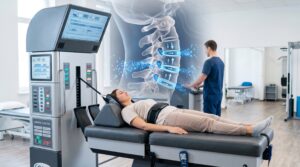
Computerized spinal decompression offers an advanced, highly calibrated therapeutic clinical alternative31. Systems like DRX9000 and IDD Therapy use targeted cyclical distraction patterns32. They dynamically adapt to the patient’s neurological feedback during the treatment5. This dynamic adaptation minimizes muscle spasms and activates neural relaxation responses5.
These sophisticated machines create vital negative intradiscal pressure within the spine5. This negative pressure acts as a powerful internal vacuum healing mechanism32. Intradiscal pressures can drop dramatically to negative 150 millimeters of mercury34. This targeted vacuum effect pulls herniated nuclear material safely inward30.
Computerized decompression uses a specific pull-and-release cycle beyond simple surface stretching31. Unlike basic traction, decompression cycles the pull on and off precisely30. This careful timing avoids muscle guarding and produces a true unloading effect30. The mechanism works through a vital principle called intradiscal pressure modulation35.
Restoring Disc Height for Preventive Spinal Health
Creating negative intradiscal pressure stimulates a critical osmotic biological fluid gradient34. Water, oxygen, and vital cellular nutrients flow back into the disc31. Discs lack direct blood supply and rely entirely on this diffusion34. Enhanced fluid exchange directly reverses the dehydrative state of early degeneration34.
This specific cellular rehydration helps restore normal cervical disc height naturally5. Increased disc height expands the space available for exiting nerve roots30. It relieves pressure on adjacent facet joints and inflamed surrounding tissues32. Gentle mechanical oscillations also stimulate fibroblast activity for natural collagen repair5.
Clinical studies show excellent patient-reported outcomes for computerized spinal decompression therapy31. Patients often experience significant radicular pain reduction within six clinical sessions5. Fluid content within affected discs improves by over seventy percent post-treatment34. This therapeutic mechanism supports true preventive spinal health and long-term maintenance30.
Chiropractic BioPhysics and Sagittal Alignment Restoration
Spinal alignment profoundly influences long-term intervertebral disc health and overall durability. Normal cervical lordosis protects neural and vascular structures from chronic compression1. Loss of lordosis accelerates biomechanical wear and tear exponentially over time1. Postural rehabilitation therapies actively aim to restore this natural spinal curve14.
Chiropractic BioPhysics uses specialized extension traction to improve sagittal cervical alignment14. Ideal cervical curvature measures roughly negative forty-two degrees in healthy patients14. Anterior head translation ideally measures zero millimeters from the body’s center14. Chiropractic BioPhysics protocols push patient measurements closer to these ideal parameters14.
Improved spinal alignment increases both anterior and posterior intervertebral disc height14. Postural correction relieves chronic nerve compression and reduces patient functional disability14. Restoring the natural curve minimizes the excessive loading on the annulus13. Maintaining structural lordosis is an absolutely essential component of preventive spinal health.
Surgical Decompression: Anterior Cervical Discectomy and Fusion
When conservative measures fail, surgical decompression becomes a necessary clinical intervention2. Moderate to severe cervical myelopathy strongly indicates immediate operative surgical treatment4. Timeliness is critical; shorter preoperative symptom durations yield better surgical outcomes4. Surgery effectively decompresses the affected spinal cord and compromised nerve roots1.
Anterior cervical discectomy and fusion remains the traditional surgical gold standard1. ACDF effectively relieves radicular pain and stabilizes the affected spinal segment37. It restores cervical lordosis through the precise insertion of structural grafts37. Single-level ACDF procedures consistently report fusion rates exceeding ninety-seven percent37.
However, spinal fusion permanently eliminates all natural motion at that segment39. This restricted motion alters the normal biomechanical load distribution quite drastically40. Mechanical stress shifts unnaturally to the unoperated adjacent cervical spinal segments39. The adjacent discs degenerate rapidly due to this increased biomechanical stress42.
The Challenge of Adjacent Segment Disease
Adjacent segment disease frequently occurs after seemingly successful cervical fusion surgeries39. This term describes new-onset radiculopathy or myelopathy at an adjacent level42. Long-term follow-up suggests a quarter of patients develop this new disease43. It typically manifests radiographically before producing clear clinical neurological symptomology43.
Patients with adjacent segment disease often require subsequent surgical interventions eventually43. The rigid fusion construct forces neighboring discs to absorb extra motion39. This accelerates the depletion of their internal proteoglycans and structural glycosaminoglycans. Fusion surgery does not prevent systemic cervical spondylosis from advancing systemically43.
It merely stabilizes a localized structural failure caused by the disease1. Because fusion increases adjacent stress, it actively threatens long-term preventive health39. Researchers continuously seek alternative surgical modalities to mitigate this specific complication38. Motion preservation is the key to protecting adjacent cervical spinal segments.
Cervical Disc Arthroplasty for Motion Preservation
Cervical disc arthroplasty provides a modern, motion-sparing alternative to spinal fusion38. CDA replaces the degenerated disc entirely with an artificial mobile implant38. It maintains physiological mobility and anatomical disc space height highly successfully47. CDA theoretically decreases the dreaded long-term risk of adjacent segment disease38.
Extensive ten-year follow-up studies compare CDA and ACDF clinical outcomes rigorously40. CDA patients show significantly fewer secondary adjacent surgeries over a decade41. Both procedures maintain high rates of long-term overall neurological functional success40. Patient-reported outcome scores are often superior in the cervical arthroplasty cohorts41.
Specific implants like the Baguera C prosthesis show excellent safety profiles48. Motion was preserved in over eighty-six percent of these specific patients48. The Mobi-C device also demonstrated statistical superiority to ACDF for clinical success50. These results strongly support the long-term effectiveness of cervical disc arthroplasty50.
Heterotopic Ossification Risks in Arthroplasty
However, a major complication called heterotopic ossification occurs frequently after arthroplasty48. Unwanted ectopic bone slowly forms around the artificial disc implant over time40. This ectopic bone severely limits the long-term range of motion achieved40. High-grade heterotopic ossification affects a substantial percentage of all arthroplasty patients40.
In Bryan disc trials, heterotopic ossification was observed in most patients51. Grade 4 ossification was observed in roughly a third of levels51. This bony overgrowth fundamentally converts a mobile arthroplasty into a fusion40. Therefore, the protective motion-sparing benefits of CDA may degrade over time40.
| Surgical Modality | Motion Preservation Status | Adjacent Segment Disease Risk | Heterotopic Ossification Risk |
| ACDF (Fusion) | None (Segment permanently fused) | High (Altered biomechanics) | Not applicable |
| CDA (Arthroplasty) | Preserved (Artificial joint moves) | Lower (Maintains natural load) | High (Bone forms around implant) |
Neither surgical procedure truly prevents systemic cervical spondylosis from advancing systemically43. Surgery cannot cure the underlying cellular depletion of healthy structural proteoglycans. Therefore, preventive non-surgical maintenance remains crucial even after successful operative interventions. Lifestyle modification must accompany any surgical decompression to ensure lasting results.
Posterior and Endoscopic Surgical Decompression Approaches
Posterior decompression techniques offer another valid operative route for severe cases1. Laminectomy allows for extensive multilevel decompression of the compressed spinal cord1. It is typically paired with instrumented fusion to prevent post-surgical instability2. Laminoplasty involves reshaping the posterior bone to expand the spinal canal1.
Laminoplasty retains the posterior elements and preserves some native spinal motion1. It minimizes the specific morbidity risks associated with anterior surgical approaches1. Anterior approaches carry unique risks like dysphagia and vocal cord paralysis21. However, posterior decompression is strictly contraindicated in patients with cervical kyphosis36.
Fixed kyphosis prevents the decompressed spinal cord from drifting backward effectively36. Endoscopic posterior cervical decompression is gaining traction as a modern technique52. Procedures like CE-ULFBD achieve bilateral decompression through a unilateral endoscopic approach53. These minimally invasive surgeries reduce postoperative pain and accelerate patient recovery53.
Comparative Effectiveness of Endoscopic Interventions
Endoscopic techniques mitigate the risks of extensive posterior cervical muscle injury53. They significantly decrease visual analogue scale pain levels during patient recovery53. Functional capacities improve substantially without the heavy morbidity of open laminectomy53. The PPPV PECD technique permits safe access directly to the intervertebral disc52.
This specific procedure creates working space by drilling the pedicle safely52. It achieves satisfactory radiological correction of neck alignment and facet dimensions52. Endoscopic procedures successfully relieve radiculopathy while preserving critical native stabilizing structures52. This preservation aligns perfectly with the overarching goals of preventive spinal health.
Despite these surgical advancements, the primary focus must remain on prevention. Once neurological deficits appear, the spinal damage is often extremely advanced. Proactive interventions focusing on hydration, alignment, and mechanics offer better long-term prognoses. The medical community must emphasize non-surgical decompression to combat early-stage degeneration.
Daily Lifestyle Modifications and Preventive Protocols
Preventive spinal health requires continuous vigilance during all daily routine activities. Cigarette smoking is highly detrimental to preserving healthy intervertebral disc height2. Smoking fundamentally compromises vertebral microcirculation and increases destructive cellular oxidative stress2. This directly hastens disc desiccation and accelerates the entire degenerative cascade2.
Smoking cessation is a mandatory first step in any preventive protocol. Nutritional support focusing on hydration and cellular health is also beneficial. Weight management reduces the overall mechanical burden on the entire spine. Regular cardiovascular exercise promotes healthy blood flow to surrounding spinal tissues.
Patients must actively avoid prolonged periods of extreme forward cervical flexion16. Correcting postural deficits halts the rapid progression of cervical spondylosis significantly16. It prevents the cervical facet joints from locking in dangerous flexed positions15. Comprehensive lifestyle modifications are required to truly combat age-related disc degeneration.
Summary of Clinical Interventions by Disease Stage
Different stages of cervical spondylosis require vastly different clinical therapeutic approaches. Asymptomatic cord compression generally warrants close clinical observation rather than prophylactic surgery4. Mild radiculopathy responds exceptionally well to computerized non-surgical spinal decompression therapy4.
Moderate to severe myelopathy requires immediate surgical decompression to prevent irreversible paralysis4. Choosing between treatments depends entirely on disc height, stability, and alignment1.
| Disease Stage | Primary Clinical Presentation | Recommended Intervention | Primary Clinical Goal |
| Early Stage | Mild axial neck pain; stiffness. | Ergonomics; Postural correction. | Prevent lordosis loss. |
| Moderate Stage | Radiculopathy; disc height loss. | Computerized decompression. | Rehydrate disc; relieve nerve. |
| Severe Stage | Myelopathy; severe stenosis. | ACDF, CDA, or Endoscopic. | Decompress cord; stabilize. |
Conclusion: Decision-Making for Age-Related Degeneration
Cervical spondylosis remains an inevitable biological consequence of standard human aging2. However, its painful clinical progression is not entirely predetermined or unavoidable1. The question remains: can cervical decompression prevent cervical spondylosis effectively as you age? The answer depends entirely on the chosen modality and the intervention timing.
Surgical decompression treats severe existing pathology but cannot prevent systemic aging4. Procedures like ACDF and CDA decompress nerves but alter native biomechanics40. Non-surgical computerized decompression therapy offers a highly effective preventative physiological mechanism32. By creating negative intradiscal pressure, it actively rehydrates desiccated intervertebral discs5.
Maintaining optimal disc height prevents foraminal stenosis and nerve root impingement2. Correcting modern postural deficits mitigates excessive biomechanical loads on the spine16. Ultimately, early intervention focuses heavily on proactive, preventive spinal health maintenance4. Proper ergonomics, coupled with targeted decompression therapies, preserves cervical spine integrity remarkably well16.
Works cited
- Degenerative Cervical Spondylosis: Natural History, Pathogenesis, https://pmc.ncbi.nlm.nih.gov/articles/PMC3433115/
- Cervical Spondylosis – StatPearls – NCBI Bookshelf, https://www.ncbi.nlm.nih.gov/books/NBK551557/
- Knowledge, attitude, and practice of cervical spondylosis in … – PMC, https://pmc.ncbi.nlm.nih.gov/articles/PMC12464322/
- Cervical Myelopathy – StatPearls – NCBI Bookshelf – NIH, https://www.ncbi.nlm.nih.gov/books/NBK482312/
- Spinal Decompression Therapy at TIRW – True Integration Wellness, https://trueintegrationwellness.ca/blog/spinal-decompression/
- Degeneration and regeneration of the intervertebral disc – PMC – NIH, https://pmc.ncbi.nlm.nih.gov/articles/PMC3008962/
- Proteoglycan Dysfunction as a Key Hallmark of Intervertebral Disc, https://pmc.ncbi.nlm.nih.gov/articles/PMC10992636/
- Degenerative Disc Disease of the Spine: From Anatomy to … – PMC, https://pmc.ncbi.nlm.nih.gov/articles/PMC9698646/
- Glycosaminoglycan Synthesis in the Nucleus Pulposus – PMC – NIH, https://pmc.ncbi.nlm.nih.gov/articles/PMC6119535/
- A Method for Characterising Human Intervertebral Disc … – PMC – NIH, https://pmc.ncbi.nlm.nih.gov/articles/PMC5865475/
- Cervical Degenerative Disc Disease – StatPearls – NCBI Bookshelf, https://www.ncbi.nlm.nih.gov/books/NBK560772/
- Bone Morphogenic Protein-2 Signaling in Human Disc … – PMC, https://pmc.ncbi.nlm.nih.gov/articles/PMC8356724/
- Cervical Degenerative Disc Disease – StatPearls – NCBI Bookshelf, https://www.ncbi.nlm.nih.gov/sites/books/NBK560772/
- Increased Cervical Disc Height and Decreased Neck Pain … – PubMed, https://pubmed.ncbi.nlm.nih.gov/41749768/
- Text Neck and Desktop Neck – ABMP, https://www.abmp.com/massage-and-bodywork-magazine/issues/marchapril-2015/text-neck-and-desktop-neck
- Tech Neck Treatment Chelsea – Sloane Square Chiropractors, https://www.sloanesquarechiropractors.com/tech-neck-treatment-chelsea/
- Assessment of stresses in the cervical spine caused by posture and, https://www.researchgate.net/publication/268234150_Assessment_of_stresses_in_the_cervical_spine_caused_by_posture_and_position_of_the_head
- Laptop Posture: Fixing Neck Pain at a Desk, on the Couch, and in Bed, https://www.sitsense.app/blog/laptop-posture-guide
- ‘Text neck’ is becoming an ‘epidemic’ and could wreck your spine, https://aprcnj.com/articles/text-neck-is-becoming-an-epidemic-and-could-wreck-your-spine-the-washington-post/
- Text Neck: A Modern Epidemic of Epic Proportions, https://modernchiropracticcenter.com/blog/text-neck-modern-epidemic-epic-proportions/
- Cervical Disc Herniation – StatPearls – NCBI Bookshelf, https://www.ncbi.nlm.nih.gov/books/NBK546618/
- Quantitative Pfirrmann Disc Degeneration Grading System to … – PMC, https://pmc.ncbi.nlm.nih.gov/articles/PMC4844654/
- How Should We Grade Cervical Disk Degeneration? A Comparison, https://pmc.ncbi.nlm.nih.gov/articles/PMC8668218/
- Clinical application of intervertebral disc to spinal cord signal ratio, https://pmc.ncbi.nlm.nih.gov/articles/PMC12851636/
- Quantitative T2 Magnetic Resonance Imaging Compared to … – PMC, https://pmc.ncbi.nlm.nih.gov/articles/PMC3912130/
- Improvement of Objectivity and Accuracy in Cervical Disc … – PMC, https://pmc.ncbi.nlm.nih.gov/articles/PMC12401951/
- Cervical Radiculopathy: Effectiveness of Adding Traction to Physical, https://www.researchgate.net/publication/322282018_Cervical_Radiculopathy_Effectiveness_of_Adding_Traction_to_Physical_Therapy-A_Systematic_Review_and_Meta-Analysis_of_Randomized_Controlled_Trials
- Effect of cervical traction on cervicogenic headache in patients with, https://pmc.ncbi.nlm.nih.gov/articles/PMC11515553/
- Do You Really Need Back Surgery? Here’s the Truth About Spinal, https://pauldbaumgardnerdc.com/do-you-really-need-back-surgery-heres-the-truth-about-spinal-decompression-in-naples/
- Spinal Decompression | Apollo Beach, https://www.spineability.com/services/spinal-decompression/
- Spinal Decompression Vs. Spinal Traction: Back Pain Relief Solutions, https://chiropracticsportscare.com/chicago-spinal-decompression-vs-spinal-traction-exploring-back-pain-relief-treatment-methods/
- Spinal Decompression Therapy in Erie, PA | Lombardi Chiropractic, https://myeriechiropractor.com/spinal-decompression
- Cervical Spinal Decompression Using the DRX9000C – Excite Medical, https://excitemedical.com/cervical-decompression-drx9000c-usf/
- How Fluid Exchange During IDD Therapy Relieves Chronic Pain, https://iddtherapy.com/fluid-exchange-aids-spinal-pain/
- Spinal Decompression (Back on Trac) | Alma, https://www.rootschirowell.com/alma/services/spinal-decompression/
- Cervical Myelopathy – Spine – Orthobullets, https://www.orthobullets.com/spine/2031/cervical-myelopathy
- Anterior Surgical Treatment of Cervical Spondylotic Myelopathy – PMC, https://pmc.ncbi.nlm.nih.gov/articles/PMC4342400/
- Anterior Cervical Discectomy with Arthroplasty versus Arthrodesis for, https://journals.plos.org/plosone/article?id=10.1371/journal.pone.0043407
- Segment selection for fusion and artificial disc replacement in the, https://www.frontiersin.org/journals/bioengineering-and-biotechnology/articles/10.3389/fbioe.2024.1345319/full
- Comparison of clinical outcomes between cervical disc arthroplasty, https://pubmed.ncbi.nlm.nih.gov/36481680/
- Ten-Year Outcomes of Cervical Disc Arthroplasty Versus Anterior, https://pubmed.ncbi.nlm.nih.gov/38018778/
- Management of Adjacent Segment Disease After Cervical Spinal, https://musculoskeletalkey.com/management-of-adjacent-segment-disease-after-cervical-spinal-fusion/
- Adjacent Segment Pathology After Treatment With Cervical Disc, https://pmc.ncbi.nlm.nih.gov/articles/PMC7343266/
- Cervical Adjacent Segment Disease – Spine – Orthobullets, https://www.orthobullets.com/spine/322194/cervical-adjacent-segment-disease
- The incidence of adjacent segment degeneration after cervical disc, https://www.ncbi.nlm.nih.gov/books/NBK109861/
- Adjacent Segment Degeneration and Disease of the Cervical and, https://neupsykey.com/adjacent-segment-degeneration-and-disease-of-the-cervical-and-lumbar-spine/
- Comparison of 10‐year Outcomes of Bryan Cervical Disc … – PMC, https://pmc.ncbi.nlm.nih.gov/articles/PMC6904630/
- Cervical disc arthroplasty with the Baguera C prosthesis – PubMed, https://pubmed.ncbi.nlm.nih.gov/37422768/
- Ten-year Outcomes of Cervical Disc Replacement With the BRYAN, https://pubmed.ncbi.nlm.nih.gov/30325888/
- Results From a Prospective, Randomized Clinical Trial at 3 Sites, https://pubmed.ncbi.nlm.nih.gov/37028803/
- Application of Cervical Arthroplasty With Bryan Cervical Disc – PubMed, https://pubmed.ncbi.nlm.nih.gov/26751058/
- Clinical and Radiological Outcomes of a Comparative Study … – PMC, https://pmc.ncbi.nlm.nih.gov/articles/PMC10383634/
- (PDF) Novel Cervical Endoscopic Unilateral Laminoforaminotomy, https://www.researchgate.net/publication/379316175_Novel_Cervical_Endoscopic_Unilateral_Laminoforaminotomy_for_Bilateral_Decompression_in_Cervical_Spondylosis_Myeloradiculopathy_A_Technical_Note_and_Clinical_Results
- Novel Cervical Endoscopic Unilateral Laminoforaminotomy … – MDPI, https://www.mdpi.com/2077-0383/13/7/1910