
Chiropractic care is a reasonable first option for sacroiliac joint pain when a clinician confirms the SI joint as the source through proper testing. The evidence base is stronger for restoring function and reducing disability than for erasing pain outright, and patients caught early with a clean provocation-test pattern tend to do best. The right next step is booking an assessment with a clinician trained in SI joint provocation testing and manual therapy, not guessing at home.
TL;DR:
- Manual therapy shows more benefit for improving function than for completely eliminating sacroiliac joint pain, especially in unselected populations.
- Most effective treatment involves combining targeted adjustments or mobilizations with pelvic stabilization and motor control exercises for long-term relief.
- About two to four chiropractic sessions, spaced weekly, are typically sufficient for initial improvement, with ongoing rehab extending past manual therapy.
- Soreness or stiffness after adjustments is normal, but lasting or worsening pain indicates the need for reassessment and possible alternative interventions.
- Proper diagnosis relies on provocation tests; imaging rarely confirms SI joint issues, making clinical examination essential for appropriate treatment planning.
Table of Contents
- How Chiropractors Diagnose Sacroiliac Joint Dysfunction
- Chiropractic Treatment Options for the Sacroiliac Joint
- What Does the Research Say About Chiropractic for SI Joint Pain?
- Is Chiropractic Care Safe for the SI Joint?
- How Many Chiropractic Sessions Does SI Joint Pain Need?
- A Clinic’s View on Treating the SI Joint
- Everton Chiropractic’s Approach to Sacroiliac Joint Pain
- Sources
- FAQ
How Chiropractors Diagnose Sacroiliac Joint Dysfunction
The sacroiliac joint sits where the sacrum meets the pelvis on each side, and it barely moves. A few millimeters of shear and rotation, nothing more. But that small joint carries enormous load every time you stand, twist, or shift weight from one leg to the other, which is why dysfunction there produces pain that mimics a disc problem or hip issue.
A chiropractor starts with history. When did the pain start? Was there a fall, a pregnancy, a hip surgery, or a single awkward twist? That story usually points toward or away from the SI joint before any hands-on testing begins.
From there, the exam relies on provocation tests, movements designed to reproduce the pain by stressing the joint directly:
- Thigh thrust — pressure through a flexed hip and knee
- FABER (Patrick’s test) — flexion, abduction, and external rotation of the hip
- Compression and distraction — pressure applied across the pelvis
- Gaenslen’s test — hip extension on one side while the other flexes
No single test is reliable alone, but clinical guidance holds that three or more positive provocation tests strongly suggest the SI joint as the pain source. Imaging rarely confirms SI joint dysfunction directly. It’s mainly useful for ruling out fractures, tumors, or infection. A diagnostic injection, where numbing medication is placed directly into the joint under imaging guidance, sometimes serves as the real confirmatory test. Fever, major trauma, progressive numbness or weakness, and unexplained weight loss are red flags that call for urgent medical referral before any manual therapy begins.
Chiropractic Treatment Options for the Sacroiliac Joint
Once the SI joint is confirmed as the pain generator, treatment usually blends several approaches rather than relying on one technique alone.
- HVLA thrust adjustments. High velocity, low amplitude thrusts aim to restore normal joint mechanics and reduce the muscle guarding that builds up around a locked or irritated joint. Positioning varies, but a common setup has the patient side-lying with the affected side up.
- Low-force mobilization and muscle energy technique. For patients who find thrust techniques too intense, or who simply prefer gentler care, a chiropractor can use graded, sustained pressure or have the patient push against resistance to reset joint position without an audible thrust.
- Soft tissue work. Myofascial release and trigger point therapy address the piriformis, gluteal, and lumbar muscles that tighten protectively around a painful SI joint. Kinesio taping and pelvic support belts sometimes supplement this between visits.
- Rehabilitation and motor control exercise. Pelvic girdle stabilization drills, glute strengthening, and motor control retraining teach the pelvis to share load correctly again, which matters more for lasting results than any single adjustment.
Pro Tip: Ask your chiropractor which combination they’re recommending and why. A plan built only around manual therapy, with no exercise component, tends to produce shorter-lived relief than one that pairs adjustment with rehab.
Combination care, hands-on treatment plus a structured exercise program, is what most clinical guidance points to for durable improvement rather than manipulation used in isolation.
What Does the Research Say About Chiropractic for SI Joint Pain?
The evidence splits along an interesting line: manual therapy appears more effective for restoring function than for eliminating pain outright.
A 2024 systematic review pooling 16 randomized controlled trials found very low certainty evidence that manual therapy significantly reduced pain, but low certainty evidence of a moderate improvement in disability, with a standardized mean difference of negative 0.67 for disability scores. That’s a real signal for function, muddier for pain, and the researchers flagged heterogeneity across trials as a limiting factor.
Pragmatic clinical data tell a more dramatic story than the trial pool. In a single-center cohort of 100 adults treated with a standardized manipulation protocol, median pain scores dropped from 8 to 0 on a 10-point scale by the second or third session, with disability scores improving significantly at three months.
That gap between trial-level caution and cohort-level results is common in manual therapy research. Carefully selected patients in real clinics often respond faster than mixed populations in a randomized trial. A separate physiologic study adds a mechanistic piece: a randomized experimental trial found a targeted chiropractic SI joint adjustment produced a measurable change in innominate bone angle, averaging about 2.25 degrees on the restricted side, a statistically significant shift.
Taken together, the picture is plausible benefit for function and for well-selected patients, inconsistent effects on pain across broader populations, and a clear need for larger, higher-quality trials before anyone calls this settled science.

Is Chiropractic Care Safe for the SI Joint?
Most patients notice local soreness or mild stiffness for a day or two after an adjustment, similar to how a muscle feels after a new workout. A short-lived flare in symptoms sometimes happens before things improve, usually settling within 24 to 48 hours with rest, ice, or gentle movement.
- Local soreness or transient stiffness for one to two days
- Occasional short-term flare before improvement
- Serious complications are rare when the SI joint is properly diagnosed and technique is appropriate
- Escalation options exist when conservative care stalls: diagnostic injection, cooled radiofrequency ablation, or referral for SIJ fusion in recalcitrant cases
Pro Tip: If soreness after an adjustment lasts more than a few days or gets worse instead of better, that’s your signal to check back in, not to push through.
Chiropractors coordinate with physicians and pain specialists when a case doesn’t respond to conservative care within a reasonable trial, following the same stepwise pathway most orthopedic and pain guidelines recommend: conservative treatment first, injections or ablation next, surgery last.
How Many Chiropractic Sessions Does SI Joint Pain Need?
Most protocols studied in the literature don’t drag on for months. A common structure looks like this:
- Initial trial, roughly two to four manipulation sessions spaced about a week apart, often mirroring the once-weekly, four-week schedule used in clinical research on SI joint manipulation.
- Reassessment using pain scores (NRS or VAS) and a disability measure like the Oswestry Disability Index, alongside practical markers such as sitting or walking tolerance.
- Continued rehab, since exercise and motor control work typically extend well past the point manual therapy sessions taper off.
Patients with recent-onset pain, a clean pattern of three or more positive provocation tests, and no major underlying spine pathology tend to respond faster. If a short trial produces no meaningful change in pain or function, that’s the cue to reassess the diagnosis or shift strategy rather than repeating the same approach indefinitely.
A Clinic’s View on Treating the SI Joint
Individualized assessment matters more than any single technique. Two patients with identical provocation test results can need very different care depending on how they sit, stand, and move through the day. Care combines validated provocation testing with a manual therapy and rehabilitation plan built around each patient’s actual goals: fewer flare-ups, better sitting tolerance, and pelvic control that holds up outside the clinic. [author_bio] [brand_signal] Dr. Richard brings to SI joint cases, with a focus on.
— Aman
Everton Chiropractic’s Approach to Sacroiliac Joint Pain
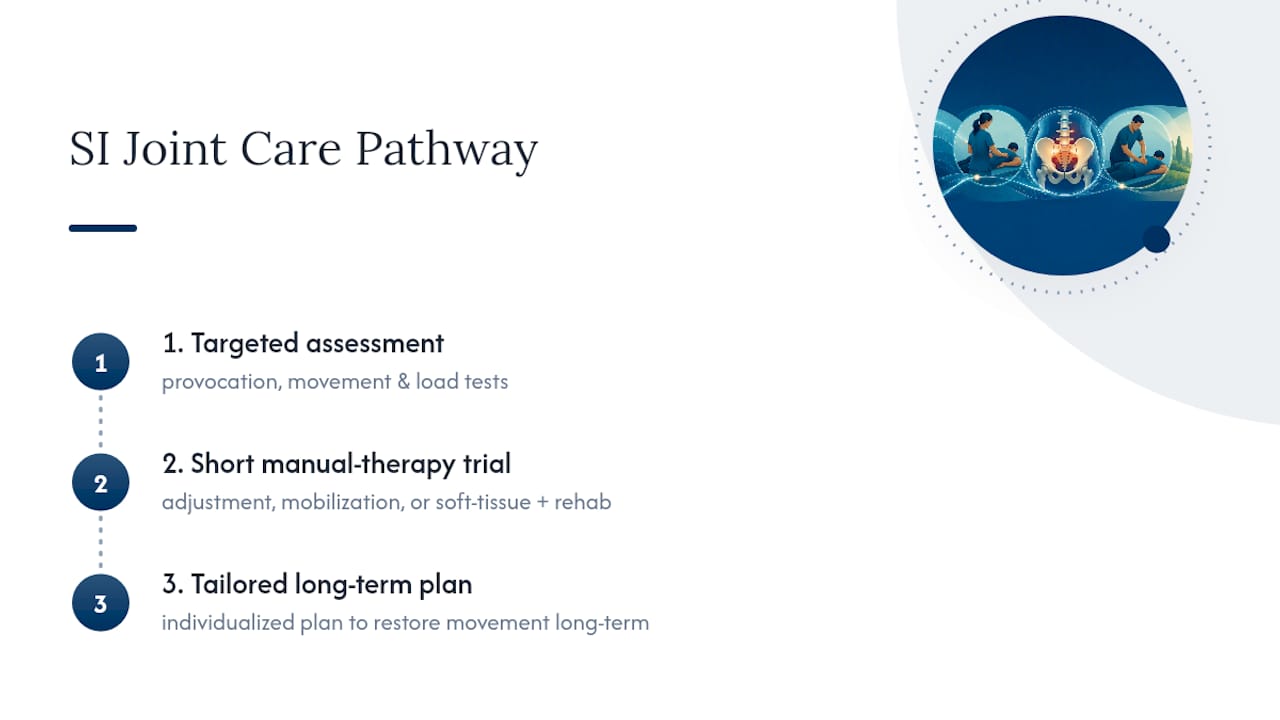
Getting the diagnosis right is half the battle with SI joint pain, and it’s the half most self-treatment guides skip entirely. Chiropractic care for SI joint pain starts from a targeted SI joint assessment: provocation testing, a functional movement assessment, and a look at how the pelvis moves under real-world load, not just on the treatment table.

Your first visit centers on that assessment, followed by a short trial of manual therapy matched to what your body actually needs, whether that’s a direct adjustment, a gentler mobilization, or soft tissue work paired with a rehab program. From there, you get a tailored plan built to restore movement long-term, not a one-size-fits-all series of visits. Sciatica-like referral pain down the leg often travels alongside SI joint dysfunction, and understanding how nerve pain relief targets the actual cause helps set realistic expectations before you start.
If sitting, standing, or walking has started to feel limited by pelvic or lower back pain, book an assessment and find out whether your SI joint is the source, and what a realistic path back to normal movement looks like.
This article is general information, not a substitute for advice from a qualified doctor. Consult a qualified healthcare professional about your own circumstances before acting on anything here.
Sources
- Sacroiliac joint manipulation for low back and radicular pain: outcomes in a 100-patient single-center cohort | Neurologia i Neurochirurgia Polska
- The effect of sacroiliac chiropractic adjustments on innominate angles (PMC)
- Systematic review/meta-analysis of manual therapy for sacroiliac joint pain (2024)
- Sacroiliac Joint Pain – StatPearls – NCBI Bookshelf
FAQ
Can a chiropractor adjust your sacroiliac joint?
Yes. Chiropractors commonly use HVLA thrust techniques, low-force mobilization, or muscle energy technique to address SI joint dysfunction once provocation testing confirms the joint as the pain source.
How do you realign your sacroiliac joint?
A trained clinician uses targeted manual techniques such as thrust adjustments or gentler mobilizations, often combined with pelvic stabilization exercises. Research shows targeted adjustments can produce a measurable shift in innominate bone angle, supporting a mechanical basis for these techniques.
Why does my SI joint hurt after a chiropractic adjustment?
Mild, short-term soreness or stiffness for a day or two is a normal response as muscles and ligaments adjust to restored joint position. Pain that worsens or lasts beyond a few days warrants a follow-up visit.
How do I know if my SI joint is out of alignment?
The most reliable sign is a clinical exam with three or more positive provocation tests, such as thigh thrust, FABER, and compression, which strongly suggests SI joint involvement. Self-diagnosis from pain location alone is unreliable since SI joint pain often mimics sciatica or hip pathology.