Yes, poor posture can cause real, non-cardiac chest tightness by shortening chest muscles and restricting rib movement. It is common and usually treatable. But sudden, crushing chest pressure, shortness of breath, or pain spreading to the jaw or arm is never a posture problem to self-diagnose. Call emergency services first and ask questions after.
TL;DR:
- Poor posture can cause chest tightness by shortening chest muscles and restricting rib movement, leading to a banding or squeezing sensation.
- Symptoms that worsen with movement, improve with posture correction, or are tender to touch are likely musculoskeletal, not cardiac emergencies.
- Common posture-related diagnoses include costochondritis, muscle strains, nerve irritation, and upper-crossed syndrome, each responding differently to assessment and treatment.
- Combining posture correction with breathing exercises significantly improves respiratory function and reduces chest tightness over time.
- Emergency symptoms like crushing chest pain with shortness of breath and radiating pain require immediate medical attention, regardless of posture factors.
Table of Contents
- How Poor Posture Causes Chest Tightness
- Chest Tightness From Posture vs. Heart or Lung Problems
- Common Posture-Related Diagnoses Behind Chest Tightness
- What Research Shows About Posture, Breathing, and Chest Tightness
- Relieving Chest Tightness: A Short Self-Care Protocol
- When to See a Provider for Chest Tightness
- A Clinician’s View on Posture-Related Chest Tightness
- Get a Real Assessment, Not Another Guess
- Sources
- FAQ
How Poor Posture Causes Chest Tightness
Slouching does more to your chest than it looks like from the outside. A forward head and rounded shoulders pull the ribcage into a compressed, downward position, which physically shortens the pectoral muscles and the muscles between your ribs over time. Shortened muscle fibers under constant low-level tension feel tight, and eventually they start to ache.
That same posture pushes the diaphragm out of its resting position, forcing you to lean on your neck and shoulder muscles to breathe instead. Upper-chest breathing like this is inefficient, and it recruits muscles that were never built to work all day, which is exactly the kind of pattern chronic postural stress creates in the surrounding muscles and joints.
A few specific mechanisms drive the sensation:
- Compression at the costochondral and costovertebral joints, where ribs meet the sternum and spine, can irritate local nerves and produce sharp or aching pain.
- Shortened pec minor and intercostal muscles create a banding or squeezing feeling across the upper chest.
- Reliance on accessory breathing muscles causes fatigue that people describe as tightness rather than pain.
This is also why the feeling often shifts with position: leaning back, standing tall, or pressing on the sore spot changes how much load sits on the joint or muscle, which is a strong clue you are dealing with a mechanical problem, not a cardiac one.
Chest Tightness From Posture vs. Heart or Lung Problems
Some symptoms demand a 911 or 999 call immediately, no exceptions. Sudden, squeezing or crushing chest pressure, especially with shortness of breath, cold sweat, nausea, dizziness, fainting, or pain radiating to the jaw, neck, back, or arm, needs emergency evaluation right away, according to NHS urgent-care guidance.
Signs that point toward posture or muscle, not heart:
- The tightness eases when you sit up straight or change position.
- Pressing on a specific spot on your chest wall reproduces the pain.
- It worsens with certain arm or neck movements but not with exertion like climbing stairs.
- There is no sweating, nausea, or radiating pain accompanying it.
The NHS chest pain guidance draws this same line: pressure that worsens with exertion or comes with sweating and nausea suggests a cardiac cause, while pain that is tender to touch or changes with position points toward the chest wall. If symptoms persist beyond a few days, or you are unsure, see a primary care provider. A clinician will typically check your vitals, reproduce the pain manually, and rule out cardiac or pulmonary causes with an ECG or basic bloodwork before diagnosing anything musculoskeletal, following the same exclusion-first approach Cleveland Clinic describes for chest wall pain.
Common Posture-Related Diagnoses Behind Chest Tightness
Once cardiac and pulmonary causes are off the table, a handful of specific musculoskeletal diagnoses show up again and again in people with poor posture.
- Costochondritis. Inflammation where the ribs meet the sternum, causing localized tenderness that gets worse with pressure or deep breathing. It is one of the most common non-cardiac chest pain diagnoses in outpatient clinics.
- Intercostal or pectoral strain and trigger points. Overworked muscles between the ribs or across the chest develop tender, ropy bands that ache with activity and calm down with rest.
- Thoracic or cervical nerve irritation. A compressed nerve root in the upper spine can send shooting or burning pain around the ribcage, sometimes mimicking cardiac pain closely enough to worry people.
- Upper-crossed syndrome. Tight pecs and neck extensors paired with weak mid-back muscles pull the shoulders forward, creating a banding sensation across the front of the chest along with pain between the shoulder blades.
Each of these responds differently to touch and movement, which is part of why a hands-on assessment matters more than guessing from symptoms alone.
What Research Shows About Posture, Breathing, and Chest Tightness
The connection between posture and breathing is not just anecdotal. A 2024 study describes what researchers call a triangular link between breathing, posture, and psychological state: people who struggled with deep abdominal breathing also showed reduced postural stability and higher anxiety scores, suggesting the three factors feed into each other rather than operating independently.
Difficulty performing deep abdominal breathing correlated with both reduced postural stability and higher anxiety, pointing to a self-reinforcing cycle between how you sit, how you breathe, and how you feel.
That mechanical link shows up in lab testing too. Researchers who induced forward head posture in healthy subjects measured an immediate drop in diaphragm strength and other respiratory function scores, confirming that head position alone changes how well your diaphragm works, not just how you feel.
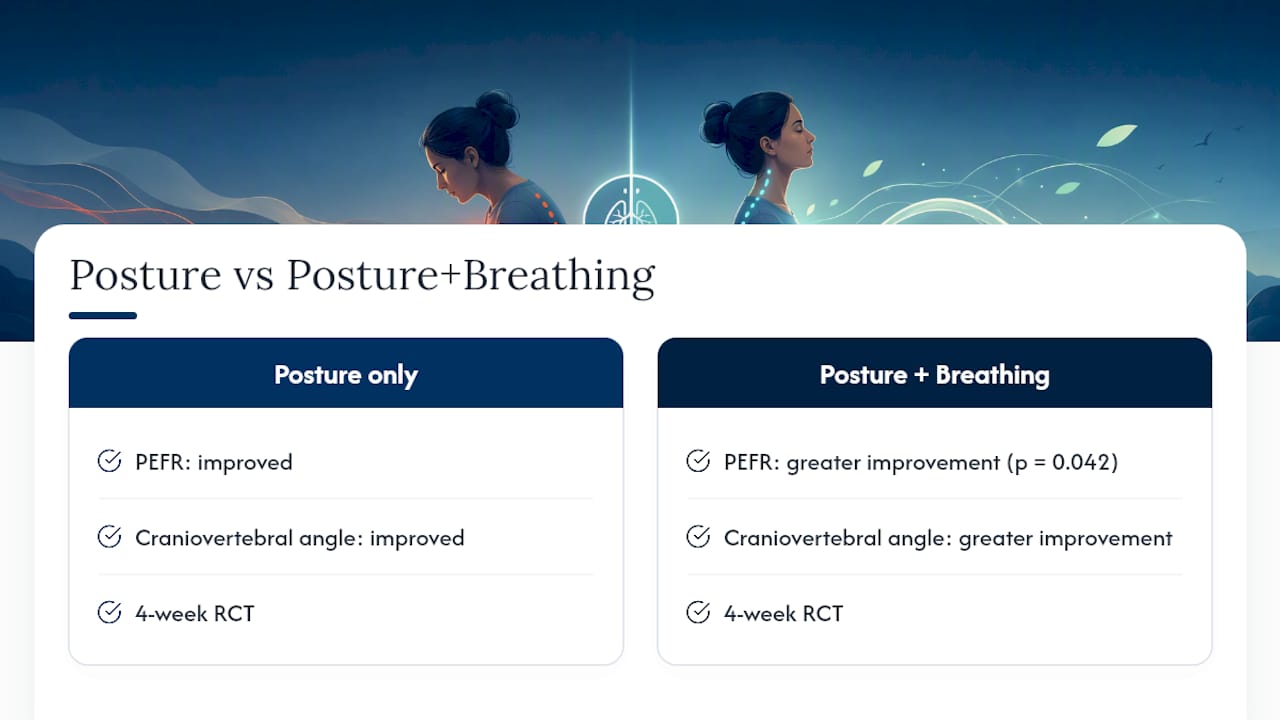
The practical payoff comes from a randomized controlled trial that tested posture correction alone against posture correction combined with breathing exercises. The combined group showed significantly greater improvement in peak expiratory flow rate and craniovertebral angle after four weeks, with a statistically significant between-group difference in PEFR (p = 0.042). Posture drills alone help. Pairing them with breathing work helps more.
Relieving Chest Tightness: A Short Self-Care Protocol
Once you have ruled out red-flag symptoms, a few simple moves can ease tightness within minutes and, with repetition, retrain the pattern that caused it.
- Stop and reset position. Stand up, roll your shoulders back, and let your arms hang loosely for 30 seconds.
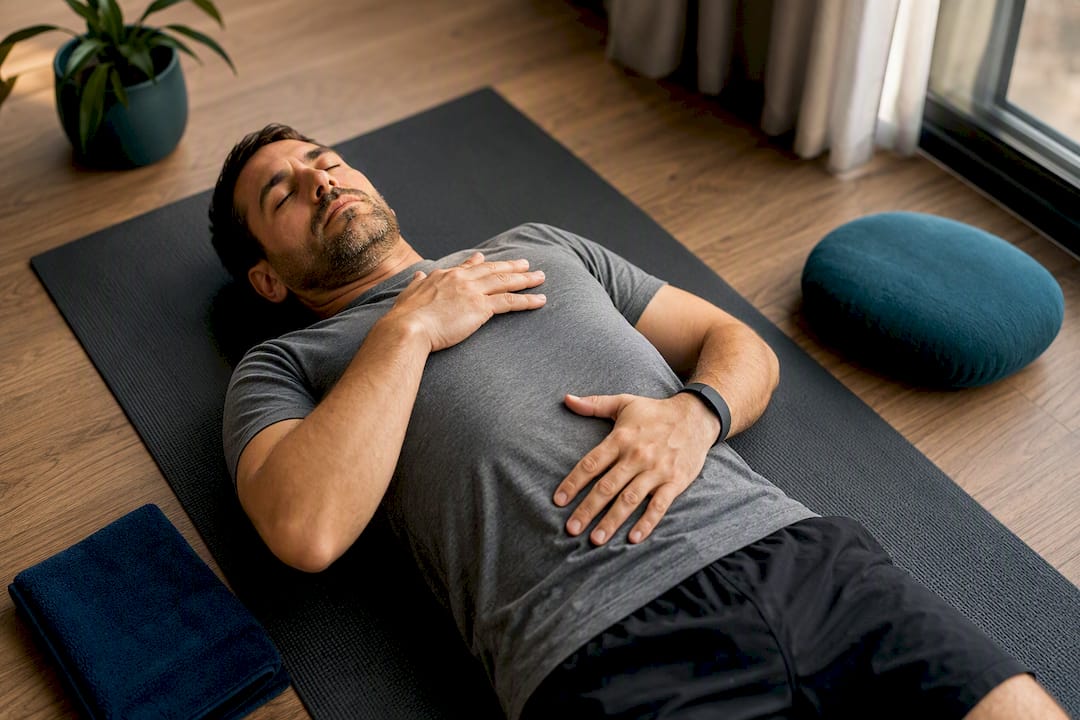
- Diaphragmatic breathing. Lie on your back, one hand on your belly, and breathe so the hand rises more than your chest does. Continue for 2 to 3 minutes.
- Doorway pec stretch. Place your forearm on a doorframe at shoulder height and gently rotate your body away for 20 to 30 seconds per side.
- Thoracic extension over a foam roller. Lie with the roller under your upper back and let your head and arms drop back gently, 8 to 10 reps.
- Scapular retraction sets. Squeeze your shoulder blades together and hold for 5 seconds, 10 reps.
- 4-4-6 paced breathing. Inhale for 4 counts, hold for 4, exhale for 6. Repeat for five cycles.
Do this sequence two to three times a day. Stop any stretch that sharply increases pain, and use ice for acute soreness or heat for ongoing muscle tightness. Over-the-counter anti-inflammatories can help short term, but they are not a substitute for finding out why the tightness kept coming back.
Pro Tip: Do a round of diaphragmatic breathing immediately before your posture stretches, not after. Calming the breathing pattern first makes the stretches land deeper and helps the new position actually stick.
When to See a Provider for Chest Tightness
Muscle strains from a single bad day of slouching often settle within days of consistent stretching and breathing work. Chronic postural patterns built up over years take longer, typically weeks to a few months of consistent correction, before the tightness stops returning.
A clinician evaluating postural chest tightness will typically:
- Check vital signs and rule out anything that needs urgent referral.
- Reproduce the pain through palpation and specific movements.
- Run a basic neurological screen to catch nerve involvement.
- Recommend imaging or cardiology referral only if something does not fit the musculoskeletal picture.
Conservative care from there usually combines manual therapy and soft-tissue work with targeted strengthening, breathing retraining, and a home exercise program, an approach detailed further in how chiropractic care addresses postural imbalances. Improvement means less frequent tightness and a longer stretch between flare-ups, not instant, permanent relief after one visit. A reasonable question to ask any provider: what specifically about my posture are we correcting, and how will we know it is working?
A Clinician’s View on Posture-Related Chest Tightness
Most chest tightness that walks into a clinic is not a heart attack in disguise, but every good clinician treats it like it could be until proven otherwise. That order of operations matters more than anything else in this article: rule out the emergency, then treat the pattern. Once cardiac and pulmonary causes are excluded, the fix is rarely complicated. It is breathing mechanics and joint mobility, addressed together rather than one at a time.
What gets missed in most generic posture advice is the breathing piece. Stretching a tight pec without retraining the breathing pattern that keeps recruiting it is treating half the problem. Some clinicians build assessments around exactly that overlap, using an evidence-informed approach that looks at how someone actually breathes and moves before deciding what to correct. If tightness has been showing up for weeks with no clear trigger, that is a reasonable point to get it looked at properly rather than waiting it out.
— Aman
Get a Real Assessment, Not Another Guess
Stretches and breathing drills go a long way, but they cannot tell you whether the tightness is coming from a stiff thoracic joint, a shortened pec, or a nerve root that needs a different approach entirely. That is the gap a hands-on assessment closes. A chiropractor evaluates posture, rib mechanics, and breathing pattern together, then builds a plan around what is actually driving your symptoms rather than a generic stretch routine.

Dr. Richard’s approach starts with the same safety-first triage covered above: red flags get referred out, and everything else gets a personalized plan combining manual therapy with the kind of long-term pain relief strategies that address the posture pattern, not just the symptom of the week. A first visit typically includes a full postural and movement assessment before any treatment starts. If chest tightness has been a recurring issue, booking a posture correction assessment is a straightforward next step toward figuring out what is actually going on.
Sources
For anyone who wants to check the clinical detail directly, the NHS chest pain symptom guide lays out the triage logic clinicians use every day. The triangular-link study on breathing, posture, and psychological health covers the research behind the posture-breathing connection in more depth, and Cleveland Clinic’s overview of musculoskeletal chest pain explains how clinicians distinguish it from cardiac causes. Readers interested in safe strengthening alongside posture work may also find the osteoporosis exercise safety guidelines useful background.
- Effect of head and neck posture on respiratory function (spirometry/SNIP study)
- Cleveland Clinic — musculoskeletal chest pain overview
- Effectiveness of breathing exercise and posture correction exercise in improving PEFR
FAQ
When should I worry about tightness in my chest?
Treat it as an emergency if the tightness is sudden, crushing, or comes with shortness of breath, sweating, nausea, dizziness, or pain spreading to the jaw or arm. Call emergency services immediately rather than waiting to see if it passes.
How can I tell if chest pain is muscular or heart related?
Muscular pain usually changes with position, gets reproduced by pressing on the sore spot, and does not come with sweating or nausea. Cardiac pain typically worsens with exertion and often includes those additional warning symptoms.
Can poor posture cause heart problems?
Poor posture does not directly cause heart disease, but it can produce chest tightness that feels alarming and mimics cardiac symptoms closely enough to need medical evaluation to rule out a real cardiac cause.
What does chest pain from bad posture feel like?
It usually feels like a dull ache, tightness, or banding sensation across the upper chest that worsens with certain movements or slouching and eases when you sit up straight or stretch the area.
Can breathing exercises actually help postural chest tightness?
Yes. A randomized trial found that adding breathing exercises to posture correction improved lung function and neck alignment more than posture correction alone, supporting breathing retraining as part of any recovery plan.