Yes, neck problems can cause dizziness. When they do, doctors call it cervicogenic dizziness, a non-spinning sense of imbalance tied to how your neck moves and holds tension. It’s usually not dangerous, but sudden dizziness with slurred speech, facial drooping, or one-sided weakness needs emergency care immediately. If your dizziness lingers alongside neck pain or stiffness, book a clinical evaluation rather than waiting it out.
TL;DR:
- Most cases of cervicogenic dizziness improve within weeks to months of targeted physiotherapy, mobilization, and posture correction.
- Dizziness linked to neck issues typically occurs minutes to hours after neck movements or prolonged poor posture, rather than sudden or lasting for days.
- Diagnosis relies on clinical testing, such as neck torsion and joint position error assessments, since no definitive blood test or scan exists.
- Suitable treatments include manual therapy, vestibular rehab, and graded head movements, with self-exercise programs showing significant benefits.
- Urgent medical care is critical if dizziness is accompanied by symptoms like slurred speech, facial weakness, or occurs immediately after severe trauma.
Table of Contents
- What Is Cervicogenic Dizziness and How Is It Different From Inner-Ear Vertigo?
- What Symptoms Point to Dizziness From Neck Issues?
- What Causes Neck-Related Dizziness?
- How Do Doctors Diagnose Dizziness Caused by the Neck?
- What Treatments Help With Cervicogenic Dizziness?
- How Long Does Recovery From Neck-Related Dizziness Take?
- When Should You Seek Urgent Care for Dizziness?
- How Everton Chiropractic Approaches Neck-Related Dizziness
- The Anatomy Behind Why Your Neck Can Make You Dizzy
- How Neck Dysfunction Actually Triggers the Sensation of Dizziness
- How Do You Tell Cervicogenic Dizziness Apart From Other Causes?
- Why Diagnosis-of-Exclusion Status Doesn’t Mean Diagnosis-of-Guesswork
- Sources
- FAQ
What Is Cervicogenic Dizziness and How Is It Different From Inner-Ear Vertigo?
Cervicogenic dizziness comes from a sensory mismatch. Your neck is packed with proprioceptors, tiny sensors that tell your brain where your head sits in space. When neck muscles or joints get irritated, those signals get scrambled and clash with what your inner ear and eyes are reporting. The result is dizziness that’s usually non-rotatory, meaning the room doesn’t spin the way it does with classic inner-ear vertigo. You feel unsteady, foggy, or tilted instead.
You’ll sometimes see this called cervical vertigo, though that term is a bit misleading since true spinning is uncommon. Typical triggers include:
- Turning your head quickly to check a blind spot while driving
- Looking up at a shelf or ceiling for more than a few seconds
- Sitting at a desk for hours with your chin jutted forward
- Getting out of bed after sleeping in an awkward neck position
What Symptoms Point to Dizziness From Neck Issues?
The dizziness itself often feels like lightheadedness, a rocking-boat sensation, or general unsteadiness rather than the room spinning. Most people report it alongside neck stiffness, a dull ache at the base of the skull, and sometimes mild nausea or blurred vision when they turn their head.
Timing matters for figuring out what’s going on. Cervicogenic episodes typically last minutes to a few hours, and they show up right after a provoking neck movement or a long stretch in one posture, unlike inner-ear vertigo, which can hit in sudden, intense spells lasting seconds to minutes regardless of neck position.
Watch for these patterns:
- Neck-related pattern: Dizziness tracks closely with neck pain, stiffness, or a specific head position
- Inner-ear pattern: True spinning vertigo, ringing in the ears, or hearing loss
- Cardiac or neurologic pattern: Fainting, chest pain, double vision, or slurred speech
This isn’t a rare complaint hiding in the shadows of other diagnoses. Cervicogenic dizziness shows up in 5 to 6 percent of ENT practice visits, but among patients who specifically come in for neck pain, that number climbs as high as 40 percent.
What Causes Neck-Related Dizziness?
Whiplash from a car accident or sports collision is one of the most common triggers, since the sudden jolt can strain neck ligaments and joints without showing up clearly on imaging. Cervical spondylosis, the wear-and-tear arthritis that builds up in the neck’s joints over the years, is another frequent cause, especially in people over 50.
Plenty of cases have nothing to do with trauma or arthritis at all. Hours spent hunched over a laptop or phone (so-called tech neck) strains the same muscles and joints that feed proprioceptive signals to your brain, and that strain alone can trigger dizziness.
A vicious cycle often develops once symptoms start:
- Your neck hurts, so you unconsciously hold your head rigid to avoid pain
- That stiffness reduces normal neck movement and proprioceptive feedback
- Reduced feedback worsens the sensory mismatch driving the dizziness
- The dizziness makes you protect your neck even more, and the cycle repeats
People with chronic postural strain, prior whiplash injuries, or existing degenerative disc disease tend to see symptoms stick around longer. Age matters too. Cervical spondylosis is progressive, so the longer degenerative changes go untreated, the more entrenched the dizziness pattern can become.
How Do Doctors Diagnose Dizziness Caused by the Neck?
There’s no blood test or scan that confirms cervicogenic dizziness on its own. It’s a diagnosis of exclusion, meaning clinicians first have to rule out vestibular disorders, cardiac arrhythmias, and neurological conditions before landing on a neck-related cause.
A typical workup moves through several steps:
- History taking. The clinician looks for a temporal link, meaning dizziness that started or worsened around the same time as a neck injury or new neck pain.
- Head–neck differentiation test. This compares dizziness triggered when the trunk rotates under a head held still versus when the head and trunk rotate together, which helps isolate a cervical contribution from a vestibular one.
- Cervical torsion test. The neck is rotated while the body stays fixed. Reported positive results carry meaningful diagnostic weight for pointing toward a cervical source.
- Cervical relocation (joint position error) test. This checks how accurately you can reposition your head to a remembered target, a proxy for proprioceptive dysfunction.
- Vestibular testing, such as the Dix–Hallpike maneuver, when inner-ear causes remain on the table.
A positive vestibular test doesn’t automatically rule out a neck contribution. Plenty of patients have both a vestibular component and a cervical one running at the same time, which is why combining vestibular and neck-directed rehabilitation often works better than treating either system alone.
Pro Tip: Keep a simple log of when dizziness hits and what your neck was doing at the time (turning, looking up, after sitting still). That pattern is often the single most useful piece of information you can hand your clinician.
What Treatments Help With Cervicogenic Dizziness?
Conservative care comes first, and for good reason. Physiotherapy, manual therapy, vestibular rehabilitation, and structured home exercise programs form the backbone of treatment, and most clinical reports show meaningful improvement with this approach alone.
The evidence for self-directed exercise specifically is stronger than a lot of people expect. A randomized controlled trial found that patients doing a self-exercise program, combining strength work, mobilization drills, and oculomotor training, scored significantly better on dizziness handicap and neck disability measures than those who didn’t.
Medications play a supporting role rather than a starring one. Short courses of muscle relaxants, over-the-counter analgesics, or vestibular suppressants can calm acute flare-ups, but they’re meant to bridge you to active treatment, not replace it. If symptoms persist despite weeks of conservative care, that’s when a clinician might consider imaging or referral to a specialist.
Once you have clearance from a clinician, home strategies that tend to help include:
- Correcting forward-head posture during desk work and phone use
- Practicing graded head turns, small range first, building up slowly
- Doing oculomotor exercises like following a moving target with your eyes while keeping your head still
- Avoiding the urge to keep your neck completely rigid, since that protective stiffness often prolongs symptoms
Pro Tip: Don’t jump straight into aggressive neck stretching on your own. Graded, clinician-guided progression works better than pushing through pain, and it avoids flaring up an already irritated joint.
How Long Does Recovery From Neck-Related Dizziness Take?
Most people improve within weeks to a few months of starting conservative treatment, though the timeline depends heavily on how long symptoms went untreated before care started. Roughly three-quarters of patients see real benefit from mobilization, targeted exercise, and posture correction.
Recovery slows down for a few predictable reasons: delayed treatment, a coexisting vestibular problem that also needs addressing, chronic pain that’s settled into the nervous system, and psychological stress that keeps muscles guarded. When any of those factors are in play, a multidisciplinary team, pulling in an ENT specialist, neurologist, physiotherapist, and chiropractor, usually gets better results than any single provider working alone.
When Should You Seek Urgent Care for Dizziness?
Certain symptoms mean skip the wait-and-see approach entirely:
- Sudden slurred speech, facial drooping, or one-sided weakness, call emergency services right away
- Dizziness that starts immediately after significant neck trauma, such as a car accident or a hard fall
- New numbness, vision loss, or worsening symptoms after starting conservative treatment
How Everton Chiropractic Approaches Neck-Related Dizziness
Care builds around the same conservative principles the research backs: posture correction, personalized exercise programs, manual therapy, and movement retraining rather than one-size-fits-all adjustments. Treatment plans are structured around each patient’s actual lifestyle and goals instead of a generic protocol, which matters when dizziness triggers can be as specific as one person’s desk setup or another’s driving habits.
A typical first visit involves a detailed history (including that temporal link between neck symptoms and dizziness onset), a physical assessment of neck mobility and posture, and a discussion of functional goals. Progress from there gets tracked with concrete markers:
- Range of motion in the neck, measured session to session
- Frequency and intensity of dizziness episodes
- Posture changes during work and daily activities
- Functional milestones tied to the patient’s own goals, not a generic checklist
For patients whose dizziness ties back to chronic tension or cervicogenic headaches, that overlap often gets addressed in the same treatment plan.
The Anatomy Behind Why Your Neck Can Make You Dizzy
Seven small vertebrae make up your cervical spine, and the top two, the atlas and axis, allow most of your head’s rotation and nodding motion. That’s precisely the region loaded with the highest density of proprioceptive receptors in the entire spine. These receptors sit in the small joints (facet joints) and deep muscles like the suboccipitals at the base of your skull, and they’re constantly feeding your brainstem information about head position relative to your torso.
Your brain doesn’t process that cervical input in isolation. It fuses it with signals from your vestibular system (the fluid-filled canals in your inner ear that detect motion) and from your eyes, which track the visual horizon. This three-way integration happens largely in the brainstem and cerebellum, the same regions responsible for keeping you upright without conscious thought.
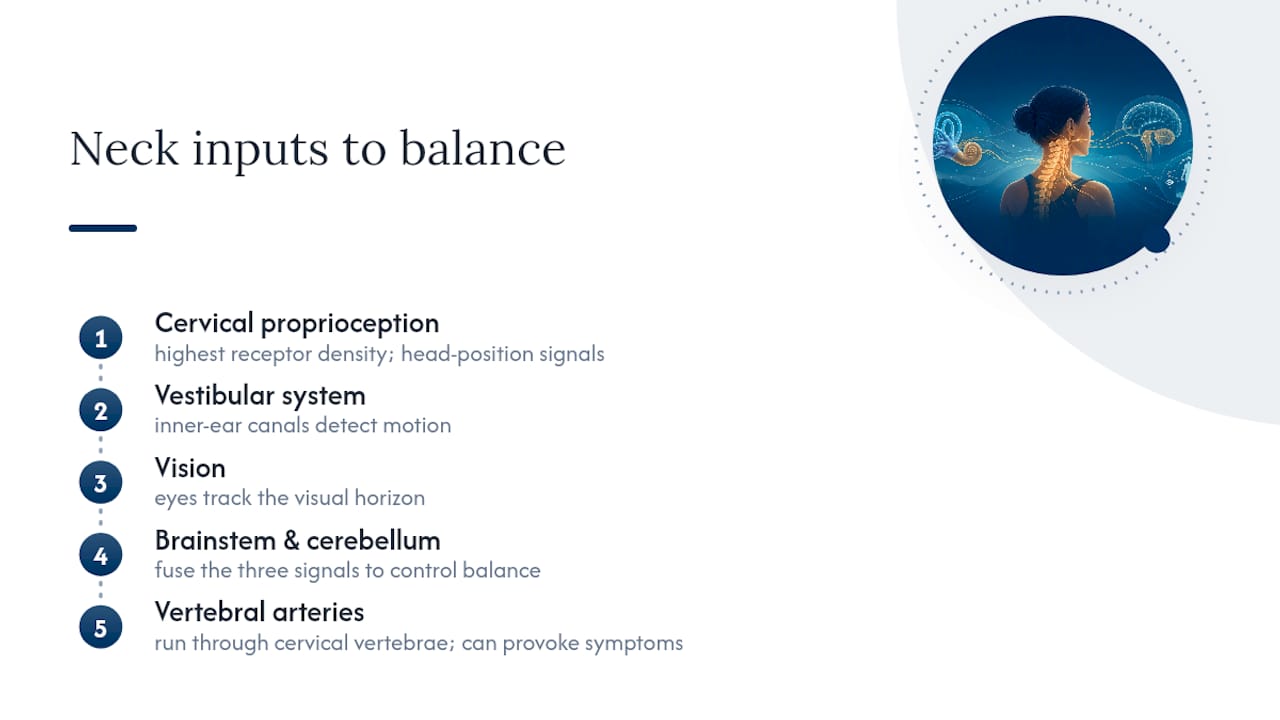
The vertebral arteries also run through small openings in the cervical vertebrae on their way to the brainstem, which is worth knowing because it explains why certain neck positions occasionally provoke symptoms through a different mechanism than proprioceptive mismatch. When any part of this densely wired system, joints, muscles, or the arteries running through them, gets irritated by injury or chronic strain, the ripple effects reach far beyond local neck pain.
How Neck Dysfunction Actually Triggers the Sensation of Dizziness
The mechanism starts with corrupted input rather than a structural problem in your inner ear or brain. When cervical joints or muscles are inflamed, strained, or stiff, the proprioceptive signals they send become inaccurate or delayed. Your brainstem still expects clean, synchronized data from the neck, eyes, and inner ear, and when the neck’s contribution is off, the three systems disagree about where your head actually is.
That disagreement is what you feel as dizziness. It’s not the same as a vestibular disorder, where the inner ear itself sends a false signal. Here, the inner ear may be working correctly, but the brain can’t reconcile it with faulty neck data, and the perceptual result is similar: unsteadiness, a sense of tilting, or brief visual blurring during head movement.
There’s a second layer to this that explains why some cases drag on. Central maladaptation and sensory reweighting can set in over time, meaning your brain starts compensating for the faulty cervical input in ways that become their own problem. Even after the original neck injury calms down, the brain’s adjusted weighting of sensory input can keep producing dizziness. This is a big part of why treatment aimed only at reducing neck pain sometimes falls short. Retraining how the brain integrates cervical, visual, and vestibular signals, through graded movement and oculomotor exercises, addresses the adaptation itself, not just the original strain.
How Do You Tell Cervicogenic Dizziness Apart From Other Causes?
Separating cervicogenic dizziness from other conditions is exactly why it remains a diagnosis of exclusion. Three look-alikes come up most often in clinical practice, and each has distinguishing features worth knowing.
Vertebrobasilar insufficiency involves reduced blood flow through the vertebral arteries, sometimes triggered by extreme neck rotation or extension. Unlike cervicogenic dizziness, it often comes with more alarming companions: visual disturbances, slurred speech, or brief loss of consciousness. Any dizziness paired with those symptoms needs urgent medical evaluation, not a wait-and-see approach.
Vestibular migraine produces episodes that can last much longer, sometimes a full day or more, and frequently comes bundled with light sensitivity, sound sensitivity, or a headache, even without dizziness being the dominant complaint. Cervicogenic episodes tend to be shorter and more tightly linked to a specific neck movement or posture.
Benign paroxysmal positional vertigo (BPPV), tested through the Dix–Hallpike maneuver, causes brief, intense spinning triggered by specific head position changes, like rolling over in bed, rather than the sustained neck pain and stiffness pattern typical of cervicogenic dizziness.
The overlap between these conditions is real, and mixed presentations aren’t unusual. That’s precisely why clinicians run several tests rather than relying on any single finding, and why treatment sometimes needs to address more than one system at once.
Why Diagnosis-of-Exclusion Status Doesn’t Mean Diagnosis-of-Guesswork
Cervicogenic dizziness gets treated in a lot of clinical writing like a diagnostic afterthought, the thing you land on once you’ve ruled out everything scarier. That framing does readers a disservice. The absence of one gold-standard test doesn’t mean the condition is vague or unfalsifiable. The cervical torsion test, joint position error testing, and the head–neck differentiation approach give clinicians real, reproducible signals to work with. The diagnostic process is stepwise, not a shrug.
Where conventional advice tends to fall short is in treating this as a pain problem instead of a sensory integration problem. Plenty of people get their neck pain under control and still feel dizzy for weeks afterward, then get told it’s “just anxiety” or “just stress.” The sensory reweighting research suggests something more specific is going on: the brain adapted to bad cervical input and needs active retraining, through graded movement and oculomotor work, to unwind that adaptation.
If you take one thing from this, prioritize finding a clinician willing to test rather than guess, and commit to the graded exercise piece even after the neck pain fades. Stopping treatment the moment pain resolves is the single most common reason dizziness lingers longer than it needs to.
— Aman
This article is general information, not a substitute for advice from a qualified doctor. Consult a qualified healthcare professional about your own circumstances before acting on anything here.
Sources
- Self-exercise as add-on therapy in non-traumatic cervicogenic dizziness (randomized controlled trial)
- Proprioceptive cervicogenic dizziness: a narrative review of pathogenesis, diagnosis, and treatment
FAQ
How Do I Know If My Dizziness Is From My Neck?
The strongest clue is timing: if dizziness consistently shows up or worsens with neck movement, sustained posture, or neck pain flare-ups, and you don’t have spinning vertigo, hearing changes, or fainting, a cervical cause is likely. A clinician can confirm it using tests like cervical torsion and joint position error assessment.
How Do You Get Rid of Cervicogenic Dizziness?
Conservative treatment, including physiotherapy, manual therapy, vestibular rehabilitation, and a structured self-exercise program, resolves most cases. Trial data shows self-exercise programs combining strength, mobilization, and oculomotor training meaningfully reduce dizziness and neck disability scores.
How Do I Stop My Neck From Making Me Dizzy?
Correct forward-head posture, avoid holding your neck rigid out of fear of pain, and practice graded head movements once a clinician has cleared you. Addressing the underlying neck dysfunction, rather than just avoiding triggers, is what breaks the cycle long term.
How Long Does It Take for Cervicogenic Dizziness to Go Away?
Most patients improve within weeks to a few months with consistent conservative care, and roughly three-quarters see meaningful benefit from mobilization, exercise, and posture correction. Recovery takes longer when treatment starts late or a vestibular component is also present.
If neck pain and dizziness have been running your day-to-day for weeks, a proper evaluation beats guessing at home exercises alone. Everton Chiropractic’s personalized approach to long-term pain relief starts with understanding your specific triggers, whether that’s posture, an old whiplash injury, or years of desk work, before building a treatment plan around your actual goals.