
Most whiplash cases improve sharply within the first two weeks and settle within 2 to 3 months. In the first 48 hours, rule out a more serious neck or spine injury, control pain with over-the-counter medication and heat or cold rather than a rigid collar, and start gentle neck movement as soon as you can tolerate it. If you’re still struggling by six weeks, that’s the point to arrange supervised rehabilitation instead of waiting it out.
TL;DR:
- Most people recover from whiplash within 2 to 3 months, but those with high initial pain, headache, older age, or anxiety may take longer.
- Imaging is rarely necessary unless severe symptoms like numbness, weakness, or loss of control indicate nerve or spinal injury.
- Early movement, over-the-counter pain relief, and avoiding prolonged collars support faster recovery, with supervised rehab recommended if symptoms persist beyond six weeks.
- Gentle active exercises and pacing activity help rebuild neck strength, but worsening pain or new numbness require prompt medical reassessment.
- Stress reduction and maintaining movement within pain limits can improve outcomes, while chiropractic care should supplement active treatments rather than replace movement-based therapy.
Table of Contents
- What Are the Symptoms of Whiplash Injury?
- What Causes Whiplash and Who Recovers Slower?
- When Should You See a Doctor for Whiplash?
- What Should You Do in the First 48 to 72 Hours?
- What Are the Best Whiplash Treatment Options?
- What Are the Best Exercises for Whiplash?
- How Long Does Whiplash Take to Fully Heal?
- Can Stress Make Whiplash Symptoms Worse?
- How Chiropractic Care Fits Into Whiplash Recovery
- What This Recovery Timeline Actually Means for You
- Getting Supervised Care When Recovery Stalls
- Sources
- FAQ
What Are the Symptoms of Whiplash Injury?
Whiplash symptoms don’t always show up right away. Pain, stiffness, and other signs often begin 24 to 48 hours after the impact, which is why so many people feel fine at the scene of a car accident and terrible the next morning.
Once symptoms start, they typically include neck pain and stiffness that worsens with movement, headaches often starting at the base of the skull, shoulder, upper back, or arm pain, tingling or numbness running down one or both arms, as well as dizziness, fatigue, or trouble concentrating.
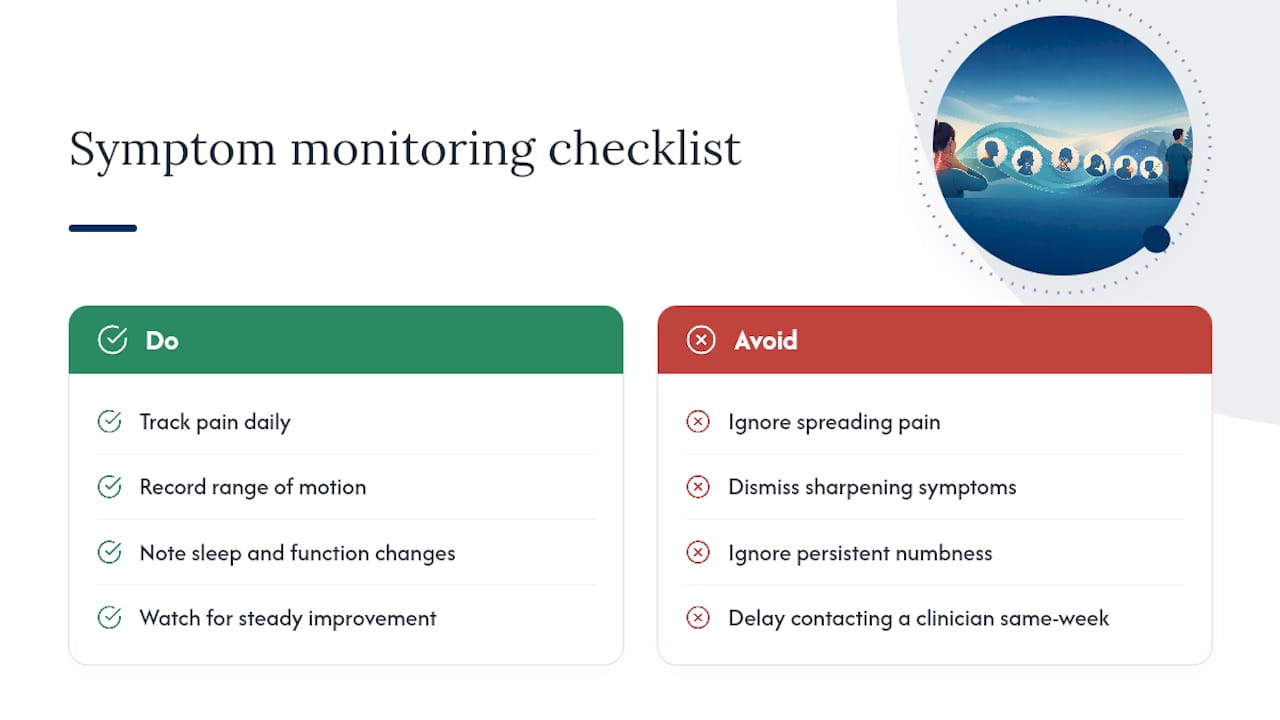
Track how your pain, range of motion, sleep, and daily function change day to day. Steady improvement is reassuring. Symptoms that spread, sharpen, or come with numbness that doesn’t fade are worth a same-week call to a clinician.
What Causes Whiplash and Who Recovers Slower?
Whiplash comes from a rapid back-and-forth motion of the neck, most often in car accidents, but falls, contact sports, and even rough amusement rides can do it. The sudden acceleration and deceleration strain the neck’s muscles, ligaments, and joints, producing a soft-tissue sprain that rarely shows up on an X-ray or MRI. That’s exactly why imaging looks “normal” in most cases even when pain is severe.
Some people bounce back in days; others struggle for months. Research points to a handful of factors tied to slower recovery:
- High pain intensity in the first days after injury
- Headache present from the start
- A history of prior neck problems
- Older age
- High stress levels or anxiety about the injury
Imaging becomes necessary only when red-flag signs point to something beyond a soft-tissue sprain.
When Should You See a Doctor for Whiplash?
Diagnosis is mostly clinical. A clinician examines your neck, checks your range of motion, and tests strength and reflexes in your arms. Imaging isn’t automatic. Decision tools like the NEXUS and Canadian C-Spine rules guide clinicians on when an X-ray or CT scan is actually warranted, sparing most patients unnecessary radiation.
That said, certain signs mean don’t wait:
- Numbness, weakness, or loss of function in an arm or leg
- Loss of bladder or bowel control
- Sudden trouble with balance or coordination
- Severe, worsening headache unlike anything you’ve had before
- Confusion, fainting, or vision changes after the injury
If any of these show up, go to an emergency department rather than waiting for a regular appointment. Otherwise, seek timely medical evaluation and be ready to describe exactly how the injury happened and how symptoms have changed since.
What Should You Do in the First 48 to 72 Hours?
Short rest helps, but only briefly. Give yourself a day, maybe two, before easing back into normal movement. Staying immobile longer than that tends to slow recovery rather than speed it up.
For pain relief:
- Acetaminophen or NSAIDs (like ibuprofen) as directed, if you have no contraindications
- Heat or cold applied for about 15 minutes at a time, spaced a few hours apart, with a towel between the pack and your skin
- A supportive pillow that keeps your neck in a neutral position while sleeping
Skip the soft foam collar except for brief comfort during flare-ups, as prolonged use may weaken neck muscles.
Pro Tip: Alternate heat and cold rather than picking one. Cold calms acute inflammation in the first day; heat loosens stiff muscle once the sharpest pain has faded.
Seek same-day care if you develop new numbness, worsening headache, or dizziness that gets worse rather than better.
What Are the Best Whiplash Treatment Options?
Whiplash treatment usually follows a step-up pattern rather than jumping straight to the most intensive option. Most people start with home care, and only escalate if progress stalls.
- Home care first: gentle movement, OTC pain relief, and heat or cold for the first one to two weeks.
- Physical therapy or supervised exercise: brought in if pain or stiffness hasn’t meaningfully eased by around six weeks.
- Manual therapy alongside exercise: chiropractic adjustment or mobilization paired with an active program, not used as a stand-alone fix.
- Specialist referral: for cases with nerve symptoms, or pain that hasn’t budged after several weeks of structured rehab.
The evidence behind this sequence is consistent: early mobilization and supervised exercise reduce pain and disability more reliably than rest alone. Manual therapies tend to work best as one piece of an active plan, not a passive substitute for movement. Injections or advanced imaging are reserved for the minority of cases with nerve involvement or no response to standard care after a reasonable trial. If symptoms persist past three months, a broader evaluation for chronic pain drivers makes sense.
What Are the Best Exercises for Whiplash?
A simple home routine, done consistently, beats an intense one done sporadically.
- First few days: gentle active neck rotations, tilts, and nods, done every 1 to 2 hours in short sets of 2 to 3 reps. Stay well within pain-free range.
- Week one to two: add isometric neck exercises, pressing gently against your own hand without moving your head, to rebuild strength without strain.
- Week two through six: progress to scapular stabilizer work and posture-focused strengthening for the upper back, since a slumped posture keeps reloading the injured tissue.
- Ongoing: pace activity in short bouts rather than pushing through a long session, and build back up gradually.
Stop and get reassessed if any exercise sharply increases pain, triggers new numbness, or brings on dizziness. A structured neck and headache routine can help you know what “normal” soreness feels like versus a warning sign.
Pro Tip: Set a phone reminder for gentle neck movement every hour or two during the first week. Frequent small doses of motion beat one long stretching session.
How Long Does Whiplash Take to Fully Heal?
Most people see substantial improvement within the first two weeks, and the majority recover within 2 to 3 months.
A minority of patients still struggling at 6 to 12 weeks face a meaningfully higher chance of symptoms dragging on. In some tracked groups, roughly half remain symptomatic at one year once they hit that slow-progress mark, which is exactly why six weeks is treated as a decision point, not just a milestone.
Track your progress with a few concrete markers: how far you can turn your head without pain, whether you’re sleeping through the night, whether you’ve returned to work or your usual activities, and whether your pain score is trending down week over week. You don’t need to be pain-free to go back to work or hobbies. Gradual, graded return is part of the recovery process, not something to wait until “after” you’ve healed.
Can Stress Make Whiplash Symptoms Worse?
Physical tissue damage in whiplash is usually minor, even when pain feels severe. What often determines whether symptoms drag on has less to do with the injury itself and more to do with how the nervous system and mind respond to it. Fear of movement, catastrophic thinking about the injury, and high stress levels are all linked to slower, more complicated recovery.
The fix isn’t complicated, even if it takes discipline:
- Keep moving within pain-free limits instead of guarding the neck out of fear
- Use basic stress-management tools like paced breathing or short walks
- Add psychological support if anxiety about the injury is blocking your progress, not just the pain itself
- Loop in more than one professional (a physiotherapist alongside your doctor, for instance) if progress stalls
Coordinated care between disciplines, rather than one provider working in isolation, tends to produce better functional outcomes for people at risk of chronic symptoms.
How Chiropractic Care Fits Into Whiplash Recovery
Chiropractic care works best as one part of an active recovery plan, not a replacement for movement. A clinician-led approach can help manage pain in the early weeks, restore range of motion through manual mobilization, and prescribe a progressive exercise plan that adjusts as you improve.
Consider a supervised plan if any of these apply:
- Progress has stalled by the six-week mark
- Pain or stiffness is limiting basic tasks like driving or working at a desk
- Symptoms come and go instead of steadily improving
- You want a structured program instead of guessing at exercises
A clinician builds plans around each patient’s specific pattern of pain and movement limitation rather than a generic protocol, which matters because whiplash presents differently from one person to the next. For readers who want the physiology behind why supervised care can shorten recovery windows, that’s worth a closer look before your six-week checkpoint arrives.
What This Recovery Timeline Actually Means for You
Most whiplash cases resolve on a predictable schedule, and the biggest mistake I see is people either panicking in week one or giving up on movement by week three. Three things matter more than anything else: get moving early, control pain without leaning on a collar, and reassess honestly at six weeks rather than hoping symptoms will quietly disappear. If they haven’t, that’s not a failure. It’s just your cue to get supervised rehab involved.
— Aman
Getting Supervised Care When Recovery Stalls
If you’re past the six-week mark and still fighting stiffness, headaches, or pain that hasn’t meaningfully improved, doing more of the same rarely fixes it. Personalized plans combine manual mobilization with progressive exercise, adjusted as your neck responds, instead of handing every patient the same generic stretch sheet.

Every first visit typically starts with a full movement assessment to map exactly where your restriction and pain are coming from, then a plan is built around your specific case rather than a standard whiplash template. If you’re weighing manual therapy against continuing on pain medication alone, this comparison of spinal adjustment versus pain medication breaks down what each approach actually addresses. When you’re ready, you can look into long-term pain relief approaches and book a first visit to get an assessment tailored to where your recovery has stalled.
This article is general information, not a substitute for advice from a qualified doctor. Consult a qualified healthcare professional about your own circumstances before acting on anything here.
Sources
FAQ
What Are the Symptoms of Delayed Whiplash Pain?
Delayed whiplash pain typically appears 24 to 48 hours after the injury and includes neck stiffness, headaches, shoulder or arm pain, and sometimes dizziness or tingling in the arms.
How Do You Relieve Whiplash Pain?
Use acetaminophen or NSAIDs as appropriate, apply heat or cold for about 15 minutes at a time, and keep the neck moving gently rather than staying still. Supervised exercise or chiropractic care becomes appropriate if pain hasn’t eased significantly by six weeks.
What Is the Best Way to Sleep With Whiplash?
Sleep with a supportive pillow that keeps your neck in a neutral position, avoiding positions that tuck your chin down or twist your neck to one side for hours at a time.
What Should You Not Do With Whiplash?
Avoid prolonged rest or immobilization, don’t wear a foam collar for extended periods since it can weaken neck muscles, and don’t push through sharp pain, new numbness, or dizziness without getting it checked.