
Most of the time, sciatica means a lumbar nerve root is pinched or inflamed at the spine, while piriformis syndrome means a muscle deep in your buttock is irritating the sciatic nerve further down the line. The fastest clue is location: back pain that shoots down one leg in a clear band usually points to the spine, while pain that starts and stays in the buttock, worsened by sitting, usually points to the piriformis. If you have sudden leg weakness, loss of bladder control, or numbness in the saddle area, skip the self-diagnosis and get seen immediately.
TL;DR:
- Imaging often shows normal results in deep gluteal syndrome cases, which are frequently mistaken for lumbar radiculopathy, making clinical exam critical.
- Pain patterns, such as buttock pain worsening with sitting and leg pain starting in the buttock, help differentiate piriformis syndrome from spine-originating sciatica.
- Physical tests like the FAIR test and specific positional triggers provide more accurate diagnosis than MRI alone when assessing sciatic pain sources.
- Treatment should target the actual cause, with spine-focused care for disc-related sciatica and muscle therapies for piriformis syndrome or deep gluteal syndrome.
- Urgent care is necessary if symptoms include sudden loss of bladder control or leg weakness, as these indicate potential cauda equina syndrome.
Table of Contents
- What Is Sciatica and What Causes It?
- What Is Piriformis Syndrome and Deep Gluteal Syndrome?
- How Do You Tell Sciatica and Piriformis Syndrome Apart?
- What Are the Treatment Options for Each Condition?
- When Should You Seek Urgent Care for Leg Pain?
- What Happens During an Assessment at Everton Chiropractic?
- Sciatica vs. Piriformis Syndrome: What Actually Matters
- Sources
- FAQ
What Is Sciatica and What Causes It?
Sciatica isn’t a diagnosis on its own. It’s a symptom pattern, technically called radiculopathy, caused by a compressed or irritated nerve root in the lumbar spine. The nerve gets squeezed at its origin, and pain travels along the path it feeds, sometimes from your lower back all the way to your foot.
The usual suspects behind sciatica are mechanical and spinal:
- A herniated or bulging disc pressing on a nerve root
- Spinal stenosis, where the space around the spinal cord narrows with age or degeneration
- Spondylolisthesis, where one vertebra slips forward over the one below it
What separates true sciatica from other leg pain is the pattern. Look for low back pain that came first, a specific strip of numbness or tingling running down one leg, and sometimes measurable weakness in the foot or calf. A positive straight leg raise test, where lifting your straightened leg while lying down reproduces the leg pain, is a classic sign your clinician will check for. When symptoms are severe, progressive, or don’t improve after several weeks of conservative care, imaging like an MRI or a referral to a spine specialist usually follows.
What Is Piriformis Syndrome and Deep Gluteal Syndrome?
Piriformis syndrome happens when the piriformis, a small muscle running from your sacrum to the top of your femur, spasms or tightens around the sciatic nerve as it passes underneath or through it. The Cleveland Clinic describes it as a common but often overlooked cause of buttock and leg pain that mimics sciatica without any disc involvement at all.
Piriformis syndrome is actually one piece of a larger picture called deep gluteal syndrome (DGS), a term that covers several ways the sciatic nerve can get irritated inside the buttock, not just by the piriformis but by fibrous bands, the gemelli-obturator internus complex, or nearby hamstring tendinopathy.
Common triggers and symptoms include:
- Prolonged sitting, especially on hard surfaces or in a car seat
- Direct trauma to the buttock, like a fall
- Anatomic variants where the sciatic nerve runs through, rather than under, the piriformis
- Buttock-dominant pain that worsens with sitting and improves with standing or walking
- Leg radiation without the strong lower-back component typical of a disc problem
DGS is frequently mistaken for lumbar radiculopathy precisely because both can send pain down the leg, and it likely explains a meaningful share of sciatica-like cases that don’t show anything on a spine MRI.
How Do You Tell Sciatica and Piriformis Syndrome Apart?
The differential comes down to three things: where the pain starts, what makes it worse, and what a handful of physical tests reproduce.
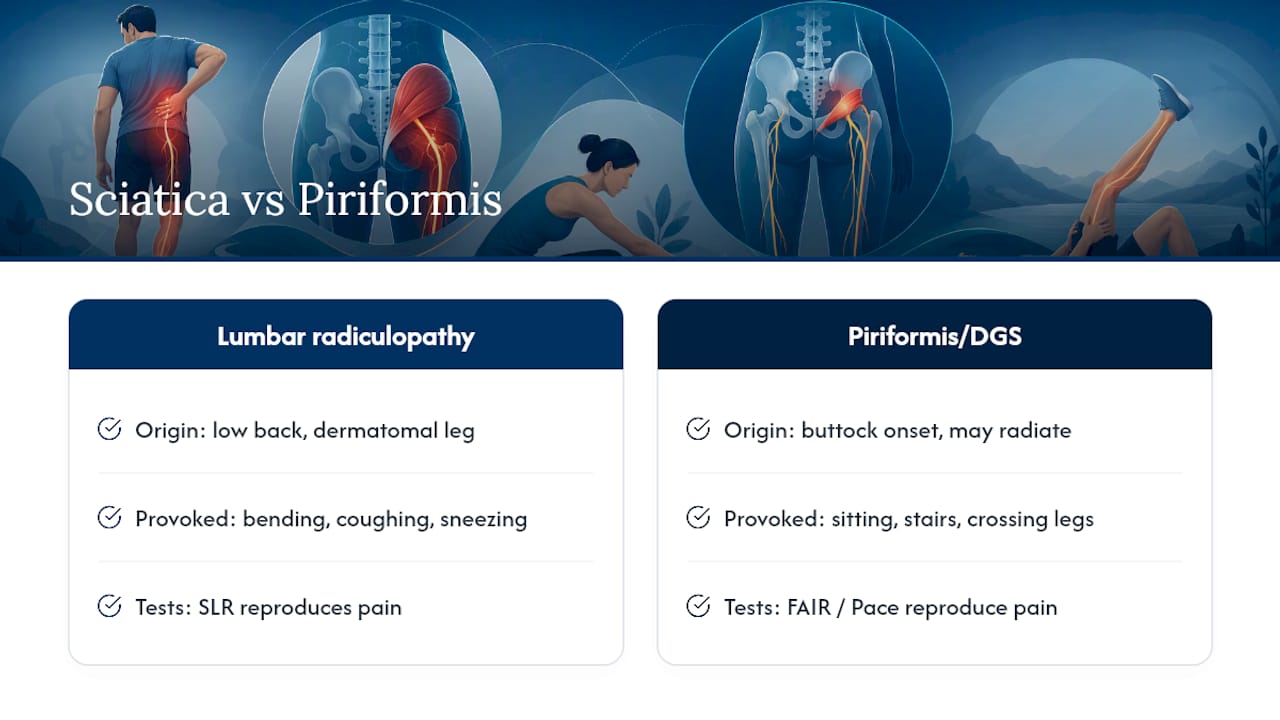
1. Where the pain originates. Lumbar radiculopathy typically starts in the low back and travels down in a specific dermatomal stripe. Piriformis and DGS pain usually starts in the buttock itself and may or may not travel further.
2. What provokes it. Discogenic sciatica often worsens with bending, coughing, or sneezing, since those movements increase pressure on the disc. Piriformis-related pain worsens with sitting, climbing stairs, or crossing your legs, movements that compress or stretch the muscle directly.
3. What the bedside tests show. Clinicians rely on a few maneuvers to sort this out. The straight leg raise (SLR) test is the classic check for lumbar nerve tension, done by lifting your straightened leg while lying flat. The FAIR test, which stands for flexion, adduction, and internal rotation of the hip, and the Pace sign, resisted hip abduction while seated, are used to reproduce piriformis-specific pain instead. “Reproduction of pain” means the test position recreates your actual symptom, not just general muscle tightness.
Research on deep gluteal pathology suggests a meaningful minority of sciatica-like presentations trace back to the buttock rather than the spine, which is one reason MRI results often come back normal even when leg pain is real and disabling. Lumbar imaging is genuinely useful for confirming disc herniation or stenosis, but a clean MRI doesn’t rule out piriformis or DGS. It just means you’re looking in the wrong place. When the diagnosis is still unclear, some clinicians use a diagnostic injection, a local anesthetic placed near the piriformis, and treat a strong reduction in pain as confirmation that muscle is the source.
Pro Tip: If your pain gets noticeably worse within twenty minutes of sitting and eases almost immediately when you stand and walk, that sitting-intolerance pattern is one of the more reliable clues pointing toward the piriformis rather than the spine.
What Are the Treatment Options for Each Condition?
Treatment splits along the same line as diagnosis: spine-driven sciatica responds to spine-focused care, and buttock-driven pain responds to muscle-focused care, though both start conservatively.
For general sciatica symptoms, first-line care usually includes:
- Activity modification, avoiding prolonged sitting or aggressive spinal flexion
- Targeted stretching and physical therapy aimed at reducing nerve tension
- NSAIDs for short-term inflammation control
- Neural mobilization exercises, sometimes called nerve glides
For discogenic sciatica specifically, spine-directed physiotherapy is the backbone of care, and most cases improve within weeks to a few months without invasive treatment. Epidural steroid injections are an option for select cases with persistent radicular pain, and surgical decompression is generally reserved for progressive neurological deficit, not pain alone.
For piriformis syndrome and DGS, treatment leans on soft-tissue work: targeted piriformis stretching, manual soft-tissue therapy, and sometimes radial extracorporeal shockwave therapy (ESWT). Image-guided injections can help in stubborn cases, and botulinum toxin has been tried for resistant muscle spasm, though the evidence base there is still thin. Surgery is a last resort, used only when conservative and injection-based options fail over months.
One caution worth repeating: exercises that help a disc-related sciatica case can aggravate a piriformis problem, and vice versa. If you’re not sure which one you have, get assessed before building a home stretching routine around a guess.
When Should You Seek Urgent Care for Leg Pain?
Most sciatica and piriformis pain, however miserable, is not an emergency. A short list of symptoms is, and none of them should wait for a callback.
- Sudden loss of bladder or bowel control
- Numbness across the inner thighs, groin, or genital area (saddle anesthesia)
- Rapidly worsening leg weakness or new inability to lift your foot
- Inability to walk or bear weight
- Pain so severe it isn’t controlled by rest or over-the-counter medication
Any of these can signal cauda equina syndrome, a compression of the nerve bundle at the base of the spine that requires emergency imaging and often same-day surgery. Call emergency services or go straight to an emergency department, and be ready to describe when symptoms started, how fast they’re progressing, and any recent trauma. Persistent or worsening neurological signs always deserve prompt professional evaluation rather than a wait-and-see approach.
What Happens During an Assessment at Everton Chiropractic?
An assessment for buttock or leg pain starts with a focused history: when the pain began, what makes it worse, and whether it started in the back or the buttock. From there, movement and functional tests alongside targeted palpation, including SLR and FAIR-style positioning, can help narrow down whether the spine or the piriformis is the likely driver, with onward MRI or referral arranged when appropriate.
Treatment options relevant to both diagnoses include spinal adjustments, soft tissue and trigger point therapy, guided rehabilitation, and movement-quality coaching built around specific symptom patterns rather than generic protocols.
Pro Tip: Note exactly what position triggers your pain in the 24 hours before your visit, sitting, bending, walking, since that single detail often narrows the diagnosis faster than any single test.
Ready to get a clear answer instead of a guess? Everton Chiropractic’s approach to nerve pain targets the actual source of sciatica-like symptoms rather than masking them, and you can also read about long-term pain relief strategies built around personalized assessment.
Sciatica vs. Piriformis Syndrome: What Actually Matters
The conventional advice on this topic tends to overcomplicate a distinction that’s actually fairly learnable. Patients get handed lists of dozens of symptoms and walk away more confused than when they started. What the evidence actually supports is simpler: pay attention to where the pain began and what position makes it worse, because those two data points do most of the diagnostic work before a single test is run.
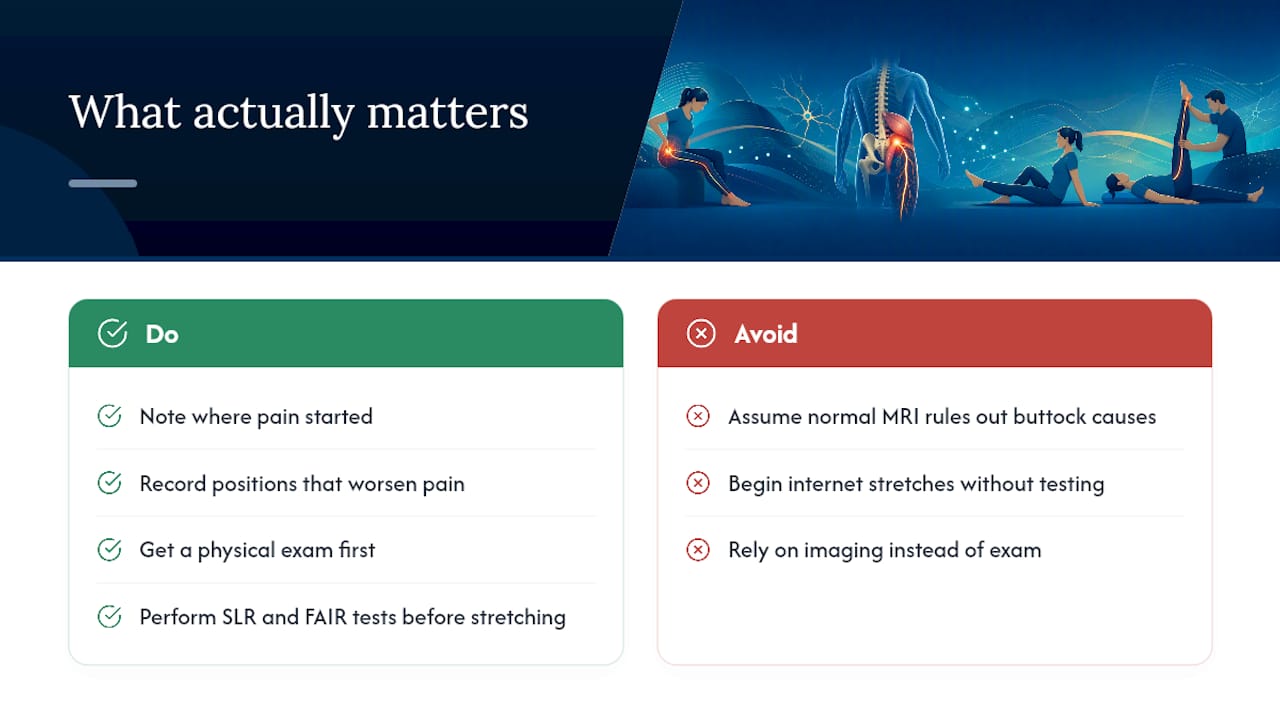
Where I think the conventional approach falls short is imaging bias. Too many people assume a normal MRI means their pain isn’t real or isn’t serious, when deep gluteal syndrome research makes clear that a clean spine scan says nothing about what’s happening in the buttock. That gap leaves patients bouncing between providers with no answer.
If you take one thing from this, prioritize getting an actual physical exam, SLR and FAIR testing, before you commit to a stretching routine pulled from the internet. The wrong exercises for the wrong diagnosis can genuinely set you back weeks.
— Aman
This article is general information, not a substitute for advice from a qualified doctor. Consult a qualified healthcare professional about your own circumstances before acting on anything here.
Sources
- Piriformis syndrome — StatPearls / NCBI Bookshelf
- Deep gluteal syndrome review (PMC)
- Piriformis syndrome — Cleveland Clinic
- Clinical tests for piriformis syndrome (PubMed)
FAQ
How do I know if I have piriformis syndrome or sciatica?
Piriformis syndrome tends to cause buttock-dominant pain that worsens with sitting, while sciatica from a lumbar cause usually starts in the low back and radiates down the leg in a specific band, often with numbness or weakness. A clinician can confirm this with tests like SLR and FAIR, since symptoms alone can overlap.
What activities should I avoid if I have piriformis syndrome?
Avoid prolonged sitting, especially on hard surfaces, deep squatting, and crossing the affected leg over the other, since these positions compress or stretch the piriformis directly. Taking regular sitting breaks throughout the day generally helps more than complete rest.
Is walking good for piriformis strain?
Gentle walking is usually well tolerated and often helpful, since it doesn’t compress the muscle the way sitting does, though pace and distance should stay within what feels comfortable rather than pushing through sharp pain.
How long does it take to heal the piriformis muscle?
Mild cases often improve within a few weeks with stretching, activity changes, and soft tissue therapy, while more stubborn cases can take a few months, particularly if sitting habits or underlying muscle imbalances aren’t addressed alongside the symptoms.