
Introduction
If your back pain has persisted for weeks, radiates into your leg, or comes with numbness and tingling, spinal decompression therapy may be exactly what your spine needs. Recognizing whether you’re a good candidate for spinal decompression starts with understanding five specific symptoms that point to disc-related problems – the kind that respond particularly well to this non-invasive treatment.
This article covers how to identify the common signs that you may need spinal decompression, what the therapy involves, and who benefits most. It focuses exclusively on non surgical spinal decompression – not spinal decompression surgery or other surgical procedures. If you’re a Singapore adult dealing with persistent back pain, sciatica, or nerve symptoms and want to explore options before considering back surgery, this guide is for you.
The five signs include: chronic back pain lasting over 6 weeks, radiating leg pain or arm pain, numbness or tingling in your extremities, failed conservative treatments, and diagnosed disc problems on imaging. When these signs appear together, they strongly suggest you’re a prime candidate for spinal decompression.
Here’s what you’ll gain from reading further:
-
How to recognize whether your symptoms align with candidacy for decompression therapy
-
Why timing matters – and when therapy is most effective
-
Clear answers to misconceptions about treatment comfort, severity requirements, and how spinal decompression works
-
When to seek a proper evaluation
-
How decompression compares to other non surgical alternatives
Understanding Spinal Decompression Therapy
Non surgical spinal decompression is a form of motorized traction therapy designed to gently stretch the spine, creating negative pressure within spinal discs. This negative pressure – sometimes called a vacuum effect – helps retract herniated or bulging disc material away from compressed nerve roots, increases the space within the spinal canal, and encourages nutrient flow to damaged discs to promote healing.
For Singapore patients seeking drug-free, non invasive treatment for chronic pain, decompression therapy offers a targeted approach that addresses the root cause of disc compression rather than masking symptoms with medication.
How the Treatment Works
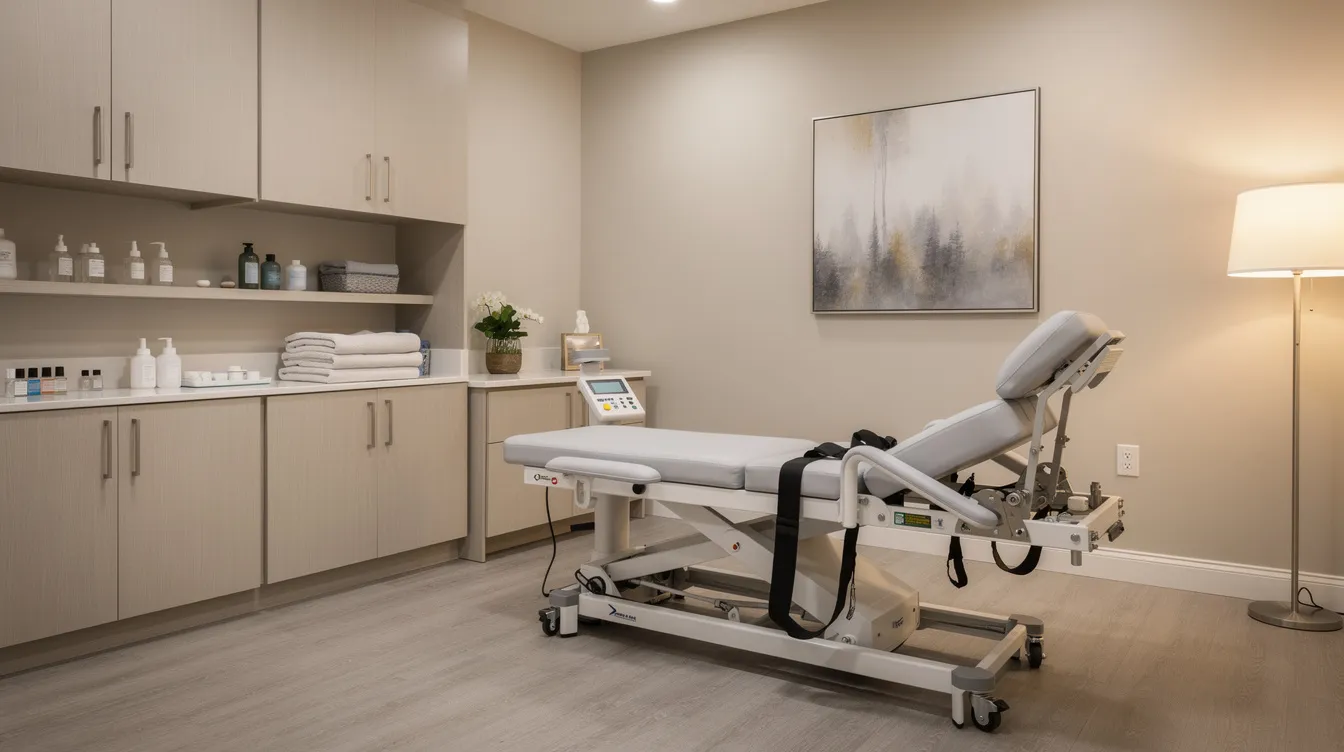
During a session, you lie on a computer-controlled traction table. The system applies precise, cyclical distraction forces to your spine – carefully modulating the direction, magnitude, and duration of each pull. This is fundamentally different from simple stretching or manual traction. The programmed distraction creates measurable negative pressure inside your discs, which helps draw herniated material back into place, open foraminal spaces where nerves exit the spine, and relieve pressure on pinched nerves.
Spinal decompression therapy creates negative pressure between vertebrae, and this mechanism is what makes it effective for conditions involving disc compression and nerve irritation. Sessions typically last 30 to 45 minutes each, and the treatment is gentle enough that many patients actually fall asleep during the process.
Ideal Conditions for Treatment
Spinal decompression works best for specific spine conditions where disc pathology or nerve compression is the primary driver of pain. These include:
-
Herniated discs – where disc material has pushed outward and presses against a nerve root
-
Disc bulge – a less severe form of disc displacement that still causes symptoms
-
Sciatica – pain resulting from compression of the sciatic nerve, typically radiating down the leg
-
Degenerative disc disease – the gradual breakdown of spinal discs that leads to chronic pain
-
Mild to moderate spinal stenosis – where the spinal canal narrows, compressing nerves
These conditions respond well because decompression directly addresses the mechanical problem: reducing pressure on nerves by creating more space around the disc and nerve root. Conditions driven primarily by muscle strain, ligament injury, or inflammatory causes without disc involvement tend to respond less dramatically.
With that foundation in place, let’s look at the five signs that indicate you’re a strong candidate for spinal decompression.
The 5 Key Signs You’re a Prime Candidate
These five signs frequently appear together in patients who go on to experience significant relief from decompression therapy. While any single sign may warrant investigation, the presence of multiple signs strongly suggests disc-related problems that respond well to this treatment.

Sign 1: Chronic Back Pain Lasting More Than 6 Weeks
Persistent back or neck pain that lasts for several weeks or months without improvement is one of the most common reasons patients explore spinal decompression. Chronic back pain lasting weeks may require spinal decompression, particularly when rest, ice, and basic self-care haven’t helped.
The six-week threshold matters clinically. Most acute muscle strains and minor injuries resolve within this timeframe. When low back pain or neck pain persists beyond it, the underlying cause is more likely structural – a disc problem, degenerative changes, or ongoing nerve compression rather than simple soft tissue inflammation. In clinical studies evaluating non surgical decompression, patients with chronic symptoms consistently show better candidacy profiles. One documented case involved a patient whose symptoms had persisted for 12 months before achieving complete resolution through an intensive decompression protocol.
If your pain has lingered beyond several weeks despite rest, this timeline alone signals that a thorough evaluation is warranted. Limited mobility – difficulty bending or standing for long periods – often accompanies this chronic pain and further points toward disc involvement. Mobility issues can signal the need for spinal decompression therapy and should not be dismissed as normal aging.
Sign 2: Radiating Pain Down Your Leg or Arm
Shooting pain that travels from your lower back into your buttock, down your leg, or from your neck into your shoulder and arm is a hallmark of nerve root compression. This radiating pain – commonly known as leg pain sciatica when it affects the lower body – indicates that a disc is pressing directly against a spinal nerve.
Sciatica results from compression of the sciatic nerve, typically by a herniated disc in the lumbar spine. The pain follows specific pathways called dermatomes, which map to the nerve being compressed. Research published in the New England Journal of Medicine confirms that radiating pain correlating with imaging findings of nerve root compression predicts a strong response to decompressive approaches.
Radiating pain indicates pressure on a spinal nerve root, and this is precisely the mechanism that spinal decompression is designed to address. In cervical cases, patients may experience pain radiating into the shoulder, arm, or hand – sometimes with reduced grip strength or reflexes. A 2026 case study documented complete MRI resolution of a large C6-7 cervical disc extrusion in a patient with 12 months of radiculopathy, with the modified Disc Herniation Index dropping from 0.405 to 0 – a 100% reduction.
If your leg pain or arm pain follows a consistent path and worsens with certain positions, this is a strong indicator that you’re a candidate for spinal decompression.
Sign 3: Numbness, Tingling, or Weakness in Extremities
Numbness or tingling in limbs indicates possible nerve compression that has progressed beyond pain alone. When you experience pins-and-needles sensations, patches of numbness, or weakness in a specific muscle group, the nerve compression is substantial enough to disrupt sensory or motor signals.
These neurological symptoms follow a recognizable progression: pain comes first, then sensory changes like numbness and tingling, and finally muscle weakness. Severe nerve compression symptoms indicate a need for decompression – and early intervention matters significantly. Prolonged compression can cause irreversible nerve damage, making timely treatment essential.
A retrospective review of 267 patients receiving non surgical decompression found that neurological signs – reflexes, myotomes, and dermatomes – improved in 60-78% of cases. This demonstrates that nerve function can recover when the underlying disc compression is effectively addressed.
Severe neurological changes may indicate urgent treatment is required. If you’re experiencing progressive weakness or loss of sensation, don’t wait – seek evaluation promptly. However, note that symptoms suggesting cauda equina syndrome (saddle-area numbness, bladder or bowel dysfunction) require emergency surgical assessment, not decompression therapy.
Sign 4: Conservative Treatments Haven’t Provided Relief
If you’ve tried rest, anti-inflammatory medications, physical therapy, and chiropractic adjustments without achieving lasting relief, this failure itself is a significant diagnostic signal. Failed conservative treatments indicate a significant underlying issue – typically a structural disc problem that these therapies alone cannot fully resolve.
A lack of relief from previous conservative treatments suggests a need for evaluation specifically for decompression. In virtually all major studies, non surgical spinal decompression was applied after standard conservative methods had failed to produce sufficient improvement. Patients who had tried physical therapy, manual therapy, and medication without adequate results consistently formed the study populations that went on to benefit most from decompression.
Research into predictors of conservative treatment failure shows that high baseline pain levels, long symptom duration, and opioid use correlate with inadequate response to standard care. These patients are prime candidates to consider decompression earlier rather than later – positioning it as the logical next step between conservative care and surgery, not a last resort.
Failed conservative treatments suggest a need for spinal decompression, and the sooner you pursue evaluation after recognizing this pattern, the better your outcomes are likely to be.
Sign 5: Diagnosed Disc Problems on MRI or X-ray
Imaging confirmation of disc-related problems provides the objective foundation for candidacy. Herniated or bulging discs press against nearby nerve roots, and when MRI or CT scans reveal disc herniation, protrusion, extrusion, degenerative disc disease, or spinal stenosis, you have concrete evidence supporting decompression therapy.
Disc-related problems should be evaluated for decompression therapy, especially when imaging findings correlate with your clinical symptoms. A 2025 case series from the University of South Florida required pre- and post-MRI imaging for all patients and demonstrated measurable improvements: disc height increased by 1.0-1.6 mm and spinal canal dimensions expanded by 1.5-2.1 mm after 20 decompression sessions.
Degenerative disc disease involves the gradual breakdown of spinal discs, leading to reduced disc height, annular fissures, and potential nerve irritation. Spinal stenosis narrows spaces in the spine, compressing nerves and sometimes affecting the spinal cord itself, particularly when thickened ligaments contribute to the narrowing.
It’s worth noting that imaging must be interpreted within your clinical context – a small portion of people have disc bulges visible on MRI without any symptoms. The combination of imaging findings with the symptoms described in Signs 1-4 is what truly identifies the strongest candidates.
Treatment Process and What to Expect
Understanding what happens during your treatment journey helps you prepare and set realistic expectations. Here’s how the process typically unfolds at a chiropractic clinic.
Initial Assessment and Evaluation
A comprehensive evaluation is essential before beginning any decompression protocol. This includes:
-
Medical history review – documenting your pain history, previous treatments, medical conditions, and any contraindications such as severe osteoporosis, spinal hardware from prior surgery, spinal instability, active infections, or pregnancy
-
Symptom analysis – mapping pain patterns, neurological symptoms, and functional limitations to identify the likely source
-
Physical examination – testing nerve function through reflex, strength, and sensation assessments to evaluate the degree of nerve compression
-
Imaging review – analyzing existing MRI or X-ray results (or recommending imaging if none is available) to confirm disc involvement
-
Candidacy determination – developing a personalized treatment plan based on findings, including session frequency and expected timeline
This thorough evaluation process is critical to ensure safety and to confirm that decompression therapy, rather than another approach, is the right fit. Patients may require 15 to 30 sessions for effective treatment, typically scheduled 2-3 times per week over 6-8 weeks.
Treatment Comparison: Decompression vs Other Therapies
|
Criterion |
Spinal Decompression |
Manual Therapy |
Physical Therapy |
|---|---|---|---|
|
Pain Relief Mechanism |
Negative pressure / disc retraction |
Joint mobilization |
Muscle strengthening / movement |
|
Session Duration |
30-45 minutes |
45-60 minutes |
45-60 minutes |
|
Typical Course |
15-25 sessions |
8-12 sessions |
12-16 sessions |
|
Best For |
Disc problems, nerve compression |
Joint dysfunction, stiffness |
Muscle weakness, poor mobility |
|
Relief Type |
Structural + symptomatic |
Primarily symptomatic |
Functional + preventive |
When disc issues are the primary driver, spinal decompression offers a targeted mechanism that manual therapy and physical therapy alone may not achieve. However, when symptoms are mild or driven by joint dysfunction and muscle imbalance, those approaches may deliver comparable results at lower cost. Many patients benefit from combining approaches – decompression alongside exercises and lifestyle modifications produces the most comprehensive results.
Common Misconceptions and Concerns
Several persistent misunderstandings prevent people from exploring decompression therapy even when they’re strong candidates. Let’s address the three most common ones.

“Is Spinal Decompression Painful?”
This is perhaps the most frequent concern – and the most unfounded. Non surgical decompression is designed to be gentle and comfortable. The motorized table gradually increases traction force with built-in rest phases during each session. Most patients describe a gentle pulling sensation that is not painful.
Mild muscle soreness following the first few sessions is normal, similar to what you might feel after a good stretch, but it typically diminishes quickly. Many patients find the experience so relaxing that they fall asleep during treatment. If you experience any significant discomfort, treatment parameters can be adjusted immediately – computer-controlled systems allow real-time modifications to force and positioning.
“Is It Only for Extreme Cases or Surgical Candidates?”
Spinal decompression is not exclusively reserved for severe or extreme cases. In fact, research supports its use most strongly in moderate cases – patients with chronic pain, disc bulges or herniations, and radiculopathy who haven’t responded to initial conservative care.
Early intervention, after conservative treatment failure but before permanent nerve damage develops, tends to produce the best outcomes. Positioning decompression as a last-resort option before surgery actually misses the window where it’s most effective. On the other end, extreme degeneration, spinal instability, or neurological emergencies like cauda equina syndrome are not appropriate for this therapy and require surgical assessment.
Think of decompression as occupying the productive middle ground – beyond temporary relief from medication, but well short of the invasiveness of spinal decompression surgery.
“Is It Just Fancy Stretching?”
Non surgical decompression is fundamentally different from generalized stretching. While stretching affects muscles and superficial tissues, decompression uses programmed distraction forces that create measurable negative pressure inside the disc itself. This vacuum effect draws herniated material back toward the center of the disc, increases disc height, opens the foraminal spaces where nerves exit, and promotes nutrient and fluid flow into the disc to support natural healing.
The biomechanical effects are well documented: changes in intradiscal pressure, altered facet joint loading, and widening of the spinal canal dimensions. The USF case series demonstrated imaging-verified increases in disc height and canal dimensions – structural changes that stretching simply cannot produce. In that study, pain improved by approximately 80%, disability by roughly 50%, and subjective recovery by about 75%.
Next Steps and Getting Started
These five signs – chronic back pain beyond six weeks, radiating leg pain or arm pain, numbness or tingling, failed conservative treatments, and diagnosed disc problems – form a reliable framework for identifying whether you’re a strong candidate for spinal decompression therapy. The more signs you recognize in your own experience, the more likely decompression can help you find relief.
Here’s what to do next:
-
Schedule a consultation at Everton Chiropractic for a thorough evaluation of your spine and symptoms
-
Gather recent imaging – bring any MRI or X-ray results you already have to your appointment
-
Prepare a symptom timeline – note when your pain started, what makes it worse, what treatments you’ve already tried, and how your symptoms have progressed
If you’re also dealing with neck pain or want to explore complementary approaches like improving spinal mobility and posture correction, these topics are worth exploring alongside your decompression evaluation. A qualified professional can help determine the best combination of treatments for your specific situation.
Frequently Asked Questions
How quickly will I know if decompression is working for me?
Most patients notice some improvement within the first 5-6 sessions, though meaningful and lasting relief typically develops over the full treatment course of 15-25 sessions. A large retrospective review found that approximately 90.5% of patients reported some pain decrease over their treatment course, with average pain scores dropping from 6.9 to 2.5 on a 10-point scale. Your clinician will monitor progress at regular intervals and adjust the protocol as needed.
Can I continue other treatments alongside spinal decompression?
Yes – and in many cases, combining decompression with physical therapy and other supportive care produces the best results. The cervical disc extrusion case that achieved 100% structural resolution used a combined protocol of decompression, physical therapy, and targeted injections. Your treatment plan should be coordinated by a qualified professional to ensure all approaches complement each other.
What happens if I’m not a good candidate for decompression?
Not everyone with back pain needs spinal decompression. If your evaluation reveals contraindications – such as severe osteoporosis, spinal hardware from failed back surgery, significant instability, or conditions unrelated to disc compression – your provider will recommend alternative approaches. These may include targeted physical therapy, chiropractic adjustments, or referral for surgical consultation when appropriate.
Do I need an MRI before starting treatment?
While an MRI provides valuable confirmation of disc issues and helps guide treatment planning, it isn’t always required before beginning decompression. A thorough clinical examination – including your medical history, symptom patterns, and neurological testing – can often identify strong candidacy. However, imaging is recommended when neurological symptoms are present, when symptoms are severe, or when previous treatments have failed, as it helps rule out contraindications and confirms the specific disc problem being targeted. How many sessions you’ll ultimately need often depends on the severity revealed through both clinical and imaging assessment.