Soft tissue therapy (STT) is a hands-on or instrument-assisted clinical approach that targets muscles, fascia, tendons, and ligaments to reduce pain, restore movement, and support recovery. According to the Association for Soft Tissue Therapists (SMA), STT encompasses assessment, treatment, and rehabilitation of these structures, with qualified practitioners trained to recognize when manual treatment is unsuitable and to refer accordingly.
People who commonly benefit include:
- Adults with chronic neck, back, or shoulder pain
- Athletes managing overuse injuries or seeking faster return to sport
- Patients recovering from surgery or trauma with scar tissue restrictions
- Office workers with persistent postural tension
- Anyone dealing with tendinopathy, muscle strains, or reduced joint mobility
Key Takeaways
Soft tissue therapy produces its most reliable results when hands-on techniques are combined with progressive exercise and clear clinical goals, not used as a standalone passive treatment.
| Point | Details |
|---|---|
| What STT is | Hands-on or instrument-assisted treatment targeting muscles, fascia, tendons, and ligaments for pain relief and mobility. |
| Strongest evidence | Spinal and lower-limb conditions show the most consistent gains in pain and range of motion across systematic reviews and meta-analyses. |
| Safety essentials | Temporary soreness is normal; red flags like neurological symptoms or worsening pain require immediate medical review. |
| Best outcomes | Combining STT with progressive loading and functional rehab produces stronger, more lasting results than manual work alone. |
| Evertonchiropractic | Offers evidence-informed STT integrated with personalized rehab plans and outcome tracking for lasting pain relief and mobility gains. |
Table of Contents
- When clinicians commonly use soft tissue therapy
- Common STT techniques and what each aims to do
- How STT produces change in your body
- What happens in a typical STT session
- Clinical benefits and what the research shows
- Risks, common side effects, and when to avoid treatment
- How STT fits into a rehabilitation plan and self-care options
- Where soft tissue therapy came from
- How to choose a qualified soft tissue therapist
- Cost and accessibility considerations for treatment
- What the evidence really tells us about when STT helps most
- Everton Chiropractic offers hands-on care that goes beyond the session
- Sources
- FAQ
When clinicians commonly use soft tissue therapy
STT fits a wide range of musculoskeletal problems, but it is not a universal solution. Knowing whether your condition is a primary or adjunct indication helps set realistic expectations.
Primary indications (STT as the main treatment):
- Acute muscle strains and ligament sprains in the subacute phase
- Chronic neck and low back pain with myofascial involvement
- Tendinopathy (Achilles, rotator cuff, patellar)
- Scar tissue restriction limiting range of motion
- Sports overuse syndromes (IT band syndrome, plantar fasciitis)
Adjunct indications (STT as part of a broader rehab plan):
- Post-operative soft tissue recovery alongside progressive loading
- Post-trauma rehabilitation where mobility is a limiting factor
- Chronic pain management combined with exercise therapy
STT is unlikely to be appropriate for open wounds, active local infection, uncontrolled inflammation, suspected deep vein thrombosis, or certain acute fractures. A qualified clinician should screen for these before any hands-on treatment begins. For overuse injury management, STT is typically one component of a structured plan rather than a standalone fix.
Common STT techniques and what each aims to do
The eight techniques you are most likely to encounter differ in pressure, tools, and goals. Here is a plain-language breakdown:
- Myofascial release (MFR): Sustained, low-load pressure applied to fascial layers to improve tissue glide and reduce tension. Gentle and slow, often described as a “melting” sensation rather than deep pressure.
- Trigger point therapy: Focused compression on hyperirritable muscle knots that refer pain to other areas. Pressure is held until the referral pattern eases. Read more in this trigger point therapy explainer.
- Deep tissue massage: Firm, directional strokes targeting deeper muscle layers. Useful for chronic tension and post-exercise recovery, though it can feel intense during treatment.
- Muscle energy technique (MET): The patient actively contracts a muscle against the clinician’s resistance, then relaxes. This neurological reset lengthens the muscle and improves joint range without aggressive force.
- Skin rolling: The skin and superficial fascia are lifted and rolled between the fingers to mobilize the tissue layer just beneath the skin. Often used over scar tissue or areas of chronic restriction.
- Gua Sha: A smooth-edged tool is scraped firmly along the skin surface to stimulate circulation and fascial mobility. Temporary redness (petechiae) is normal and expected.
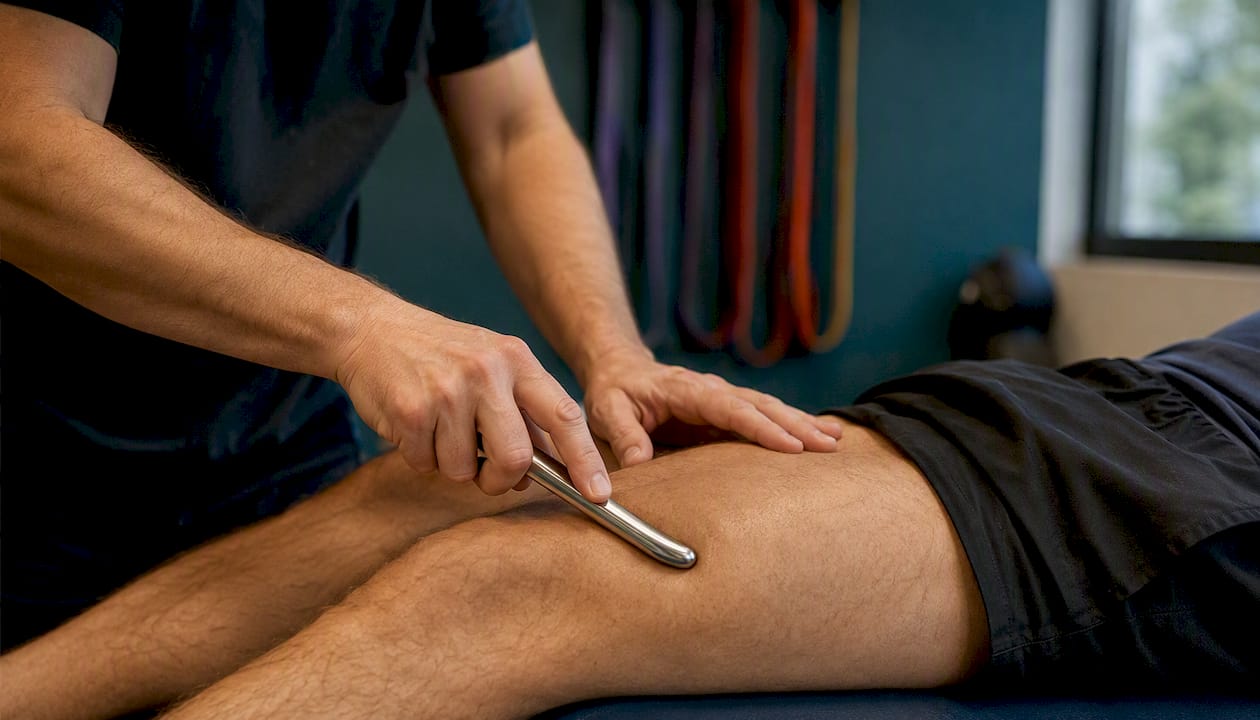
- Graston® / Instrument-Assisted Soft Tissue Mobilization (IASTM): Stainless steel or similar instruments are used to detect and treat fascial restrictions. The Graston Technique is one branded IASTM protocol with a specific set of tools and training requirements.
- FAKTR (Functional and Kinetic Treatment with Rehabilitation): IASTM applied while the patient moves through functional patterns, combining instrument work with active rehabilitation in the same session.
Clinicians choose among these based on assessment findings, tissue depth, patient tolerance, and treatment goals. A patient with post-surgical scar restriction needs a different approach than an athlete with acute hamstring tightness.
Pro Tip: If your goal is improved range of motion and return to sport, ask your clinician about MET or IASTM combined with movement. If scar remodeling is the priority, skin rolling and MFR tend to be the first tools selected.
How STT produces change in your body
STT does not work through a single mechanism. Several overlapping physiological and neurological processes explain why soft tissue techniques do more than just relax muscles:
- Gate-control pain modulation: Mechanical stimulation activates large-diameter sensory fibers that compete with pain signals traveling to the brain, reducing perceived pain during and after treatment.
- Mechanoreceptor stimulation: Pressure and movement activate Golgi tendon organs and muscle spindles, resetting resting muscle tone and reducing protective guarding.
- Parasympathetic activation: Sustained, rhythmic manual contact shifts the nervous system toward a calmer state, which itself reduces muscle tension and pain sensitivity.
- Improved local circulation: Increased blood flow to treated tissue supports nutrient delivery and metabolic waste clearance, particularly relevant after injury or surgery. Clinical literature documents that manual therapy can modulate inflammation and support tissue recovery after muscle damage.
- Fascial glide restoration: Myofascial methods aim to improve the ability of fascial layers to slide against each other, rather than making a standalone claim of “breaking adhesions.” The goal is layer mobility, not structural destruction.
Short-term effects (reduced tone, pain relief) appear within a session. Longer-term tissue remodeling requires repeated treatment combined with progressive exercise, not manual work alone.
What happens in a typical STT session
Most sessions follow a consistent sequence, though the details vary by clinician and condition.
Typical flow:
- Intake and assessment: The clinician reviews your history, identifies the primary complaint, and screens for contraindications.
- Targeted testing: Range of motion, palpation, and functional movement tests identify which tissues are restricted or painful.
- Treatment: One or more techniques are applied, with ongoing communication about pressure and sensation.
- Reassessment: The clinician retests the same movements to confirm a change and adjusts the plan if needed.
- Home advice: You leave with specific guidance on activity, stretching, or self-care between sessions.
Sessions typically run from half an hour up to an hour. Acute conditions often respond after a few sessions, while chronic or post-surgical cases may need several weeks of treatment, with progress tracked through pain scales, range of motion measurements, and functional tasks. Mild soreness for a day or two after treatment is normal, similar to post-exercise muscle fatigue. Stay hydrated, avoid intense activity on the same day, and contact your clinician if you notice sharp neurological symptoms, significant swelling, or worsening pain beyond two days.
Clinical benefits and what the research shows
The evidence for STT is strongest in specific areas and more limited in others. Here is an honest summary.
Measured benefits across the literature:
- Reduced pain intensity (acute and chronic musculoskeletal conditions)
- Improved joint range of motion, particularly in the spine and lower limb
- Faster return to functional activities after injury or surgery
- Reduced muscle tone and improved tissue extensibility
A systematic review of STT for knee disorders found that most included studies reported improvements in functional parameters, range of motion, and pain in patients with knee conditions and post-operative recovery. For IASTM specifically, a 2026 meta-analysis published in the European Journal of Medical Research found clinically meaningful pain relief and increased range of motion, with the most reliable improvements seen for spinal and lower-limb conditions. Effects were stronger when IASTM was combined with conventional rehabilitation rather than used alone.
Evidence note: The evidence is most consistent for spinal and lower-limb conditions. Some upper-limb conditions and certain chronic pain presentations have smaller or less consistent trial results. STT is best understood as producing modest-to-moderate improvements, most reliably when paired with a structured rehab program.
Where the evidence is weaker: some upper-limb tendinopathies, headache management, and conditions with significant central sensitization show less consistent results across trials. Research samples are often small, and study designs vary, so research in some areas remains limited.
Pro Tip: The biggest predictor of lasting benefit is not which technique your clinician uses. It is whether manual treatment is paired with progressive loading and movement retraining. STT opens the window; exercise keeps it open.
Risks, common side effects, and when to avoid treatment
STT is generally safe when delivered by a qualified clinician, but knowing what is normal versus what is a warning sign matters.
Common, expected side effects:
- Temporary muscle soreness lasting 24–48 hours
- Superficial bruising or redness after IASTM or Gua Sha (petechiae)
- Mild fatigue or a feeling of heaviness in treated areas
Contraindications (defer or avoid treatment):
- Open wounds or active skin infection over the treatment area
- Active local inflammation in the acute phase (first 24–72 hours post-injury)
- Suspected or confirmed deep vein thrombosis
- Patients on uncontrolled anticoagulation therapy
- Acute fractures or suspected bone pathology in the treatment region
- Malignancy in or near the treatment area
Red flags requiring immediate medical evaluation:
- New or worsening neurological symptoms (numbness, tingling, weakness)
- Unexplained systemic symptoms (fever, unexplained weight loss, night sweats)
- Sudden severe pain that is disproportionate to the treatment
- Symptoms that worsen progressively rather than improving after 2–3 sessions
A responsible clinician stops treatment and refers when the patient’s response is adverse or when findings suggest a condition outside the scope of manual therapy. This referral responsibility is a core professional standard highlighted by the SMA.
How STT fits into a rehabilitation plan and self-care options
STT works best as one layer of a broader plan, not as a standalone treatment. The clinical evidence consistently frames it as an outcome-driven approach focused on function and return to activity, distinct from relaxation massage.
How combined plans typically look:
- Chronic neck pain: IASTM to reduce fascial restriction, followed immediately by cervical mobility drills and progressive deep neck flexor strengthening.
- Post-surgical scar mobility: Skin rolling and MFR to the scar site, combined with progressive range-of-motion exercises and functional retraining.
- Sports overuse: Trigger point therapy to reduce pain inhibition, then eccentric loading protocols for the affected tendon.
Between-session self-care:
- Targeted mobility drills prescribed by your clinician (not generic stretching)
- Pacing activity to avoid re-aggravating the tissue before it has adapted
- Basic self-massage tools (foam rollers, massage balls) for maintenance, not as a replacement for clinical treatment
Session sequencing matters. STT early in a session prepares tissue for exercise; exercise after STT consolidates the neurological and mobility gains. Realistic timelines: acute strains often resolve in 4–8 weeks with consistent combined care; chronic conditions may take 3–6 months of progressive work. For post-trauma recovery, rebuilding confidence in your body is as much a part of the process as restoring tissue mobility.
Where soft tissue therapy came from
The roots of STT stretch back centuries. Swedish massage, formalized in the early 19th century by Per Henrik Ling, established the foundational strokes and tissue-pressure concepts that later clinical techniques built on. Osteopathic medicine, developed by Andrew Taylor Still in the 1870s, introduced the idea that manual work on soft tissues could influence systemic health and function, not just local muscle tension.
The 20th century saw a rapid expansion. Janet Travell and David Simons mapped trigger points and their referral patterns in the 1950s–1980s, producing the clinical framework still used today. Myofascial release as a distinct method was developed and popularized by John Barnes from the 1960s onward. IASTM tools emerged in the 1990s, with the Graston Technique developed by athletes and clinicians seeking a more systematic instrument-based approach to fascial treatment.
Today, STT sits within physiotherapy, chiropractic, sports medicine, and remedial massage as a recognized clinical discipline, supported by professional associations and an expanding evidence base.
How to choose a qualified soft tissue therapist
Credentials matter more than marketing language. Here is what to look for:
A qualified practitioner holds a recognized degree or diploma in physiotherapy, chiropractic, osteopathy, or remedial/sports massage, depending on your country’s regulatory framework. For IASTM and Graston specifically, look for post-graduate certification from an accredited training body. Membership in a professional association (such as the SMA, the Australian Physiotherapy Association, or an equivalent national body) signals adherence to a code of practice and continuing education requirements.
Ask direct questions before booking: What assessment process do you use? How do you track progress? When would you refer me to another provider? A clinician who cannot answer these clearly is a concern regardless of their technique list.
Red flags in marketing: promises of permanent results from a single session, claims that STT “detoxifies” the body, or pressure to commit to large treatment packages upfront without an initial assessment. Personalized care plans built around your specific goals and tracked against measurable outcomes are the standard to expect.
Cost and accessibility considerations for treatment
STT session costs vary significantly by provider type, location, and session length. Physiotherapists and chiropractors typically charge more per session than remedial massage therapists, reflecting the additional diagnostic and clinical scope of their training. In Singapore, private physiotherapy or chiropractic sessions that include STT generally range from SGD 80 to SGD 200 per session, though prices are not publicly standardized and vary by clinic.
Insurance coverage depends on your policy. Many health insurance plans in Singapore cover physiotherapy sessions up to a set annual limit; chiropractic is covered by some but not all plans. Always confirm coverage before starting a course of treatment.
Accessibility considerations: if cost is a barrier, community health centers and polyclinics in Singapore offer subsidized physiotherapy for eligible patients. For athletes, sports medicine clinics attached to national sports bodies sometimes offer more accessible pricing. Telehealth cannot replace hands-on STT, but it can be useful for follow-up consultations, exercise prescription, and progress reviews between in-person sessions.
What the evidence really tells us about when STT helps most
The most common mistake patients make is treating STT as a passive fix. You come in, the clinician works on you, you feel better, and you assume the problem is solved. It rarely is, at least not durably.
The research picture is clear on one point: manual soft tissue work produces the most consistent, lasting results when it is the opening act, not the whole show. The meta-analytic data on IASTM shows this directly. Combine it with conventional rehabilitation and the effects are stronger and more reliable. Use it alone and the results are more variable.
Where STT genuinely shines is in breaking the pain-inhibition cycle. When a muscle is guarded, a patient cannot load it properly, so it never gets stronger, so it stays guarded. A well-timed STT session interrupts that loop, creating a window where movement is possible. What the patient does in that window determines whether the improvement sticks.
The other underappreciated factor is practitioner clinical reasoning. The technique matters less than the assessment behind it. A skilled clinician choosing the right tool for the right tissue at the right stage of healing will outperform any single “best” technique applied without that judgment. That is why credentials and outcome tracking are not optional extras.
Everton Chiropractic offers hands-on care that goes beyond the session
Persistent pain and restricted movement rarely resolve with one approach alone. At Evertonchiropractic, Dr. Richard combines evidence-informed soft tissue techniques, including trigger point therapy and instrument-assisted methods, with structured rehabilitation and spinal care to address the underlying cause rather than just the symptom. Every patient receives an individualized assessment before treatment begins, and progress is tracked against specific functional goals.
For patients dealing with chronic pain, post-injury recovery, or mobility restrictions that have not responded to passive treatment alone, Evertonchiropractic’s integrated approach offers a clear path forward. Explore long-term pain relief approaches or book a consultation directly at Evertonchiropractic to start with a proper clinical assessment.
Sources
The sources below are peer-reviewed research, professional association guidance, and clinical references used throughout this article. Each represents a reliable starting point for deeper reading.
- Evaluating the Effectiveness of Soft Tissue Therapy in the Treatment of Disorders and Postoperative Conditions of the Knee Joint—A Systematic Review – PMC
- Instrument-assisted soft tissue mobilization for musculoskeletal disorders: a systematic review and meta-analysis of its effects on pain, function, and range of motion | European Journal of Medical Research | Springer Nature Link
- The SMA – About Soft Tissue Therapy
- What Is Manual Soft Tissue Therapy? – Return to Play Institute, LLC
- Soft Tissue Mobilization Therapy: What It Is – Healthline
This article is general information, not a substitute for advice from a qualified doctor. Consult a qualified healthcare professional about your own circumstances before acting on anything here.
FAQ
What is soft tissue therapy in plain terms?
Soft tissue therapy is a clinical, hands-on approach that treats muscles, tendons, ligaments, and fascia to reduce pain and restore movement. It uses techniques ranging from manual pressure and stretching to instrument-assisted tools, always guided by an assessment of the patient’s specific condition.
Does the Graston Technique actually work?
A 2026 meta-analysis found IASTM (the broader category that includes Graston®) produced clinically meaningful pain relief and range-of-motion improvements, especially for spinal and lower-limb conditions. Results are stronger when Graston is combined with conventional rehabilitation rather than used as a standalone treatment.
What is the fastest way to heal soft tissue?
No single method accelerates soft tissue healing in isolation. The most consistent evidence supports combining manual therapy (to reduce pain inhibition and restore mobility) with progressive loading and exercise, starting as early as the subacute phase allows. Basic first-aid measures like RICE remain appropriate for the acute phase immediately after injury.
How many sessions of soft tissue therapy do you typically need?
Acute conditions often respond within a few sessions; chronic or post-surgical cases may need several weeks of treatment. Progress should be tracked through measurable outcomes like range of motion and pain scores, not just subjective comfort.
Is soft tissue therapy the same as a regular massage?
No. Clinical STT is assessment-driven and focused on specific functional outcomes like pain reduction and return to activity, which makes it distinct from relaxation massage. As the Return to Play Institute notes, it is a targeted, outcome-driven approach, not a general wellness service.
Recommended
- Trigger Point Therapy: What It Is and How It Works – Everton Chiropractic
- Accelerating Muscle Recovery: The Benefits of Shockwave Therapy – Everton Chiropractic
- Combining Red Light Therapy and Chiropractic Adjustments for Faster Healing – Everton Chiropractic
- Chiropractic Sports Techniques: 8 Examples for Athletes – Everton Chiropractic