
Patient goals determine what care is offered, how success is measured, and whether a treatment plan is acceptable to the person receiving it. That single sentence captures the role of patient goals in treatment more accurately than any clinical framework can. When a clinician starts a visit by asking “What matters most to you right now?” instead of jumping straight to diagnosis, the entire shape of the encounter changes. Priorities shift, interventions get filtered, and the patient becomes a participant rather than a recipient.
The practical implications break down into four areas:
- Prioritization: Goals tell you which problems to address first, not just which are clinically urgent.
- Shared decisions: A goal gives both parties a reference point when choosing between two evidence-based options.
- Measurement: Progress means something different when it is measured against what the patient wanted, not just what the clinician expected.
- Iterative review: Goals change as conditions change, so treatment plans need scheduled checkpoints, not just a discharge note.
Pro Tip: On the first visit, write the patient’s goal in their own words at the top of the clinical note. That phrase becomes the anchor for every subsequent decision.
Key Takeaways
Patient goals are the organizing principle of effective treatment: when goals are set collaboratively, documented clearly, and reviewed on schedule, care becomes more relevant, more adherent, and more likely to produce outcomes that matter to the patient.
| Point | Details |
|---|---|
| Goals direct the whole plan | Patient goals determine prioritization, intervention selection, and how success is defined. |
| Three-level framework | Map every intervention to symptom, functional, or fundamental goals to resolve conflicts and stay on track. |
| PROMs and PREMs measure what matters | Use tools like PSFS, ODI, and EQ-5D to track progress against patient-defined outcomes, not just clinical metrics. |
| Review on a schedule | Set checkpoints at week 4 and week 8–10; revise goals when life circumstances change, not only when treatment stalls. |
| Evertonchiropractic | Builds personalized, goal-oriented chiropractic plans with objective progress tracking for patients in Singapore. |
This article is general information, not a substitute for advice from a qualified doctor. Consult a qualified healthcare professional about your own circumstances before acting on anything here.
Table of Contents
- What do “patient goals,” “values,” and “treatment preferences” actually mean?
- Why do patient goals change clinical outcomes?
- What frameworks help clinicians organize patient goals?
- How do you actually ask patients about their goals?
- How do you turn a patient goal into a treatment plan?
- How do you measure progress toward patient goals?
- What training and tools help clinicians build goal-setting skills?
- What do patient goals look like in practice?
- How do you handle conflicts, unrealistic expectations, and cultural differences?
- When should goals be set, reviewed, and revised?
- What does the evidence say, and how does it apply in Singapore?
- What it actually takes to make goal-setting a daily habit
- Everton Chiropractic builds treatment around what you actually want
- Sources
- FAQ
What do “patient goals,” “values,” and “treatment preferences” actually mean?
Clinicians and patients often use these words interchangeably, which creates confusion when it matters most. Here is a working vocabulary.
A patient-defined goal is a specific outcome the patient wants to achieve or maintain. It is always stated in the patient’s language, not clinical shorthand. “I want to walk my daughter to school” is a patient-defined goal. “Improve lumbar flexion by 20 degrees” is a clinical objective that may or may not serve it.
Values sit one level deeper. They are the reasons behind the goal: independence, family participation, dignity, staying off medication. Values do not change as quickly as goals do, which makes them useful anchors when a goal needs to be revised.
A treatment preference is the patient’s position on how care is delivered: which interventions are acceptable, how much discomfort is tolerable, how often they can attend sessions. Preferences constrain the strategy without changing the goal.
An objective or strategy is the clinician’s translation of a goal into a measurable, time-bound target. This is where SMART language belongs.
Goals of care is a broader term used in palliative and complex chronic care. Mold et al.’s categorization organizes goals into four types: prevention of death or disability, maximization of quality of life, optimization of personal growth, and experiencing a good death. For musculoskeletal and chiropractic care, the first two and the third are most commonly relevant.
A value-to-goal mapping looks like this:
Value → Goal → Example objective
Independence → “Walk to the hawker centre without stopping” → Increase pain-free walking distance to 400 meters within eight weeks, measured by timed walk test at each review.
PROMs (patient-reported outcome measures) capture how a patient rates their own health status, function, or symptoms at a point in time. PREMs (patient-reported experience measures) capture how the patient experienced the care process itself. Both sit at the measurement end of the goal-setting chain. SPICT (the Supportive and Palliative Indicators Tool) is a screening checklist used to identify patients whose goals of care may need to shift toward comfort and quality of life, particularly when multiple conditions are deteriorating. It belongs in the clinician’s toolkit when a patient’s fundamental goals suggest that curative or restorative treatment may no longer be the priority.
Why do patient goals change clinical outcomes?
The evidence is consistent: when clinicians and patients set goals together, patients are more motivated, more adherent, and more satisfied with their care. Research in rehabilitation contexts confirms that collaborative goal-setting improves team functioning, patient confidence, and client outcomes. That is not a soft finding about patient happiness. It reflects a real mechanism.
When treatment is aligned to what a patient actually wants, three things happen. First, the patient understands why each intervention matters, which increases follow-through between sessions. Second, the clinician can filter out interventions that are evidence-based but irrelevant to this patient’s priorities, which reduces wasted time and cost. Third, both parties have a shared definition of success, so disagreements about progress are easier to resolve.
The American Heart Association’s scientific statement on person-centered cardiovascular care identifies three non-negotiable components: a focused narrative assessment of the patient’s story, a co-designed care plan, and iterative reassessment as the patient’s status and preferences evolve. These are not cardiovascular-specific ideas. They describe the architecture of any goal-oriented clinical encounter.
Patient-centered care, as NEJM Catalyst frames it, reframes quality to include the patient’s lived experience, not just clinical metrics. That shift requires organizational alignment, not just individual clinician goodwill. A clinic that tracks only pain scores and range of motion is measuring what is easy to measure, not necessarily what the patient came in to fix.
What frameworks help clinicians organize patient goals?
The three-level goal framework
The most practical model for day-to-day clinical use is the three-level hierarchy described by van der Steen et al. It maps every clinical intervention to one of three levels:
- Symptom-specific goals: Reduce pain, decrease stiffness, improve sleep disrupted by discomfort. These are the goals patients usually state first and clinicians are most comfortable addressing.
- Functional goals: Return to a specific activity, walk a certain distance, carry groceries, return to work. These require symptom improvement but are not the same thing.
- Fundamental (life) goals: Remain independent, stay active as a grandparent, continue playing sport, maintain dignity. These are the goals that give the other two levels their meaning.
The framework’s clinical value is in conflict resolution. When a patient’s symptom goal (eliminate all pain) conflicts with a functional goal (return to running), the fundamental goal (stay active and competitive) tells you which trade-off is acceptable. Clinicians who skip the fundamental level often find themselves managing symptoms that the patient does not actually care about.
Three operational frameworks for a clinical visit
- Goal-elicitation framework (values → life goals → care goals → care planning): Developed through recorded goal-elicitation encounters, this four-step sequence moves from broad values to specific care planning questions. It takes roughly five minutes when practiced.
- Goal-to-plan mapping: Once a goal is stated, the clinician draws a simple vertical line on paper: fundamental goal at the top, functional goal in the middle, symptom objective at the bottom. Each intervention is placed at the level it addresses. Any intervention that does not connect upward to a functional or fundamental goal is a candidate for removal.
- Shared decision checklist: Before finalizing a plan, confirm three things: the patient can state the goal in their own words, the patient understands the proposed intervention and its alternatives, and both parties agree on how progress will be measured. This takes under two minutes and prevents the most common source of non-adherence.
How do you actually ask patients about their goals?
Most patients have not been asked what they want from treatment before. They expect to be examined and told what to do. A structured conversation flow makes the transition feel natural rather than awkward.
A five-step conversation sequence
- Open with permission: “Before I examine you, I’d like to spend a few minutes understanding what you’re hoping to get out of treatment. Is that okay?”
- Elicit the presenting goal: “What’s the one thing you most want to be able to do that you can’t do comfortably right now?”
- Clarify the functional and fundamental levels: “If we got that sorted, what would that allow you to do that matters to you?” (Repeat once to reach the fundamental level.)
- Surface preferences and constraints: “Are there any treatments you’d prefer to avoid, or anything that would make it hard to attend regularly?”
- Summarize and confirm: “So if I’ve understood correctly, your main goal is [patient’s words], and success for you would look like [specific outcome]. Does that sound right?”
Sample prompts that work across conditions:
- “What does a good day look like for you physically?”
- “What activity have you had to give up that you miss the most?”
- “How much discomfort would be acceptable if it meant getting back to [activity]?”
- “What would you need to see in the first four weeks to feel like this is working?”
A brief role-play scenario: a 58-year-old office worker presents with chronic lower back pain. She says her goal is “less pain.” The clinician asks, “If the pain were manageable, what would you do that you’re not doing now?” She says she would go back to her morning walks. “And what do those walks give you?” She pauses: “They’re the only time I have to myself before work.” That fundamental goal, personal time and mental reset, now shapes the entire plan. A home exercise program that fits into a 20-minute morning slot becomes far more relevant than one that requires gym equipment.
Pro Tip: When a patient seems ambivalent about a goal, try a brief motivational approach: ask “On a scale of 1 to 10, how important is this goal to you?” then “What would need to change to move that number up?” This surfaces the real barrier faster than any direct question.
How do you turn a patient goal into a treatment plan?
A stated goal is not yet a plan. The conversion requires three steps, and skipping any one of them produces a plan that looks good on paper but does not hold up in practice.
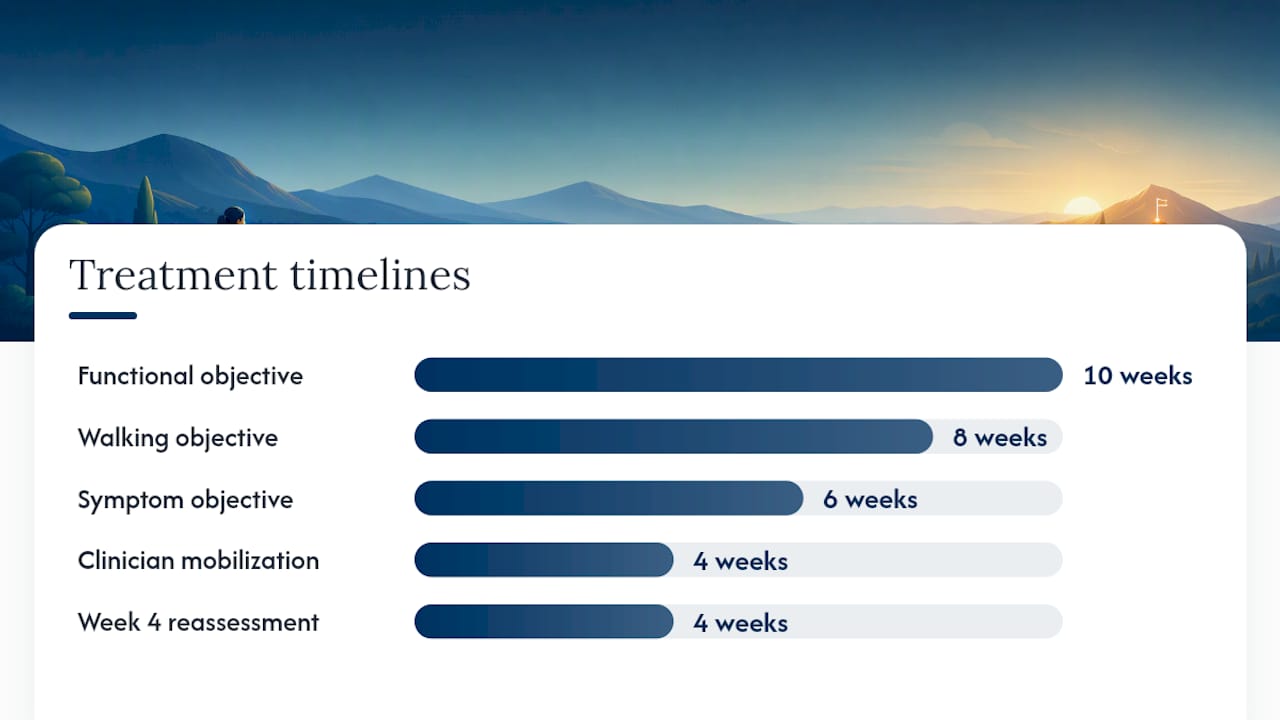
Step 1: Set a measurable objective. Take the patient’s goal and apply SMART criteria: Specific, Measurable, Achievable, Relevant, Time-bound. “Walk to the hawker centre without stopping” becomes “Walk 400 meters continuously at a comfortable pace within eight weeks, confirmed by timed walk test at session 8.”
Step 2: Select evidence-based strategies that serve the goal. Every intervention on the plan should connect to the objective. For the walking goal, spinal mobilization addresses the symptom level, progressive walking intervals address the functional level, and education about pacing and posture supports the fundamental goal of independent daily activity. A personalized treatment plan built this way is structurally different from a generic protocol.
Step 3: Assign responsibility and timeline. Specify what the clinician does in-session, what the patient does between sessions, and when both parties will check progress. Ambiguity about who is responsible for home exercises is one of the most common reasons plans fail.
A SMART template for clinical goals:
- Goal (patient’s words): “Get back to playing tennis on weekends.”
- Functional objective: Serve and rally for 30 minutes without shoulder pain by week 10.
- Symptom objective: Reduce shoulder pain on the Numeric Rating Scale from 6/10 to 2/10 by week 6.
- Responsibility: Clinician provides spinal and shoulder mobilization twice weekly for four weeks; patient completes rotator cuff strengthening three times per week at home.
- Review point: Week 4 reassessment with PROM (DASH or PSFS).
Documenting goals in the clinical record matters more than most clinicians realize. Linking goals to the problem list in the EHR and attaching PROMs to those goals increases the likelihood that the whole team acts on them during follow-up, not just the clinician who set them.
Trade-offs should be made explicit in the record: “Patient understands that returning to tennis at full intensity within six weeks carries a higher re-injury risk; patient accepts this and prefers a faster timeline.” That sentence protects both the patient and the clinician.
How do you measure progress toward patient goals?
PROMs and PREMs: choosing the right tool
PROMs and PREMs are central to measuring whether care achieves patient-centered goals and should be integrated into quality improvement, not treated as optional paperwork. The distinction matters: a PROM tells you how the patient is doing; a PREM tells you how the patient experienced the care.
Common PROMs for musculoskeletal and chiropractic care:
- Numeric Rating Scale (NRS) or Visual Analog Scale (VAS): Pain intensity. Fast, universal, maps directly to symptom-level goals.
- Patient-Specific Functional Scale (PSFS): The patient names up to five activities they find difficult; rates each 0–10. Directly maps to functional goals stated at intake.
- Oswestry Disability Index (ODI): Functional limitation in low back pain. Useful for tracking progress toward functional goals over weeks.
- DASH (Disabilities of the Arm, Shoulder and Hand): Upper limb function. Relevant for shoulder, neck, and arm goals.
- EQ-5D: Generic quality-of-life measure covering five dimensions. Useful for tracking fundamental goals across conditions.
PREMs for clinic use tend to be shorter: a three-to-five-item questionnaire asking whether the patient felt heard, whether the plan was explained clearly, and whether they felt involved in decisions. Experience-based co-design techniques, where patients and families help redesign service workflows, improve the sustainability of patient-centered programs at the clinic level.
| PROM/PREM | What it measures | Goal level | Suggested timing |
|---|---|---|---|
| NRS/VAS | Pain intensity (0–10) | Symptom | Every session |
| PSFS | Patient-specific activity difficulty | Functional | Intake, week 4, week 8 |
| ODI | Low back functional limitation | Functional | Intake, week 6, discharge |
| DASH | Upper limb function | Functional | Intake, week 6, discharge |
| EQ-5D | Quality of life (5 domains) | Fundamental | Intake, 3-month review |
| PREM (3–5 items) | Care experience and involvement | Process | End of each care episode |
Interpretation guidance: A two-point change on the NRS is generally considered clinically meaningful for pain. On the PSFS, a two-point change per activity is the accepted minimal detectable change. If a patient’s PSFS score is not moving by week four, the intervention strategy needs review before the goal does.
What training and tools help clinicians build goal-setting skills?
Clinicians consistently report that they support goal-oriented care in principle but struggle to make it routine. Studies and implementation reports show the gap is not attitudinal but operational: without frameworks, scripts, and workflow integration, goal-setting gets squeezed out by time pressure.
Practical training resources and tools:
- Communication-skills modules: The AAFP’s patient-centered goal-setting resource covers motivational interviewing adaptations and four-step elicitation sequences. Free and directly applicable to primary care and allied health.
- Goal-elicitation scripts: A laminated one-page prompt card with the five-step conversation sequence (see the elicitation section above) placed at the clinician’s workstation reduces the cognitive load of remembering the sequence mid-visit.
- EHR templates: A structured goal field in the clinical note, separate from the chief complaint, prompts documentation. Link PROM scores to that field so progress is visible at a glance.
- SPICT: The Supportive and Palliative Indicators Tool is a brief checklist that flags patients whose clinical trajectory suggests goals of care may need to shift. Relevant for clinicians managing older patients with multiple comorbidities or declining function.
- PROM platforms: In Singapore, PROMs can be administered via paper, tablet, or simple survey tools integrated into clinic management software. The key is consistency: the same tool, the same timing, every time.
A self-audit checklist for clinicians:
- Did I ask the patient’s goal before I examined them?
- Did I reach the functional and fundamental levels, or did I stop at symptoms?
- Did I document the goal in the patient’s own words?
- Did I select a PROM that maps to the stated goal?
- Did I set a review date before the patient left?
If the answer to any of these is “no” more than twice in a week, that is the skill to target in the next training cycle.
What do patient goals look like in practice?
Abstract frameworks become useful when you can see them applied to real scenarios. Here are examples across common musculoskeletal and chiropractic presentations, with SMART conversions for two of them.
- Chronic low back pain: “I want to sit through a full workday without needing to stand up every 20 minutes.”
- Neck pain (office worker): “I want to drive for more than 30 minutes without my neck seizing up.”
- Shoulder pain (recreational tennis player): “I want to serve without pain so I can play on weekends again.”
- Sciatica: “I want to walk my dog every morning without the leg pain stopping me.”
- Post-surgical rehab: “I want to get off the walking frame and use a cane by my daughter’s wedding in four months.”
- Older adult with balance concerns: “I want to feel confident on stairs so I don’t have to move out of my HDB flat.” For this goal, fall prevention strategies for seniors become a direct clinical priority.
- Athlete return-to-sport: “I want to train at full intensity for the upcoming half-marathon.”
- Chronic pain with opioid use: “I want to reduce my reliance on painkillers and manage pain with movement instead.”
SMART conversion, Example 1: Tennis shoulder
- Fundamental goal: Stay competitive in recreational sport.
- Functional objective: Serve and rally for 30 minutes without pain by week 10.
- Symptom objective: Reduce shoulder NRS from 6/10 to 2/10 by week 6.
- Review: DASH score at intake and week 6; PSFS (serving, overhead reach) at intake, week 4, week 8.
SMART conversion, Example 2: Older adult on stairs
- Fundamental goal: Remain in current home independently.
- Functional objective: Ascend and descend 12 stairs without holding the rail by week 12.
- Symptom objective: Reduce knee pain NRS from 5/10 to 2/10 by week 8.
- Review: PSFS (stair climbing, standing from chair) at intake, week 6, week 12; EQ-5D at intake and 3-month review.
When a patient’s goal suggests complexity beyond a single-discipline scope, such as opioid reduction, significant psychological distress, or a goal that requires home modification, that is a signal for referral or multi-disciplinary coordination. Maintaining independence through chiropractic care is achievable for many patients, but some goals require a team.
How do you handle conflicts, unrealistic expectations, and cultural differences?
Common challenges and red flags
- Goal conflicts with safety: A patient wants to return to heavy lifting two weeks post-injury. The clinical risk is real. The response is not to override the goal but to explain the risk explicitly, offer a modified version of the goal with a safer timeline, and document the conversation.
- Unrealistic timelines: “I want to be pain-free in two sessions.” Acknowledge the desire, provide honest evidence about typical recovery trajectories, and reframe: “Let’s aim for a 50% reduction in pain by session four and reassess from there.”
- Family-driven goals: A family member insists the patient needs a specific treatment or outcome. The patient’s own preferences take precedence. The clinician’s role is to facilitate a conversation that includes the family without displacing the patient’s voice.
- Passive patients: Some patients genuinely do not know what they want beyond “fix it.” Start with values: “What’s most important to you in your daily life?” Most patients can answer that even when they cannot articulate a clinical goal.
Cultural competence in Singapore
Singapore’s patient population brings specific dynamics that affect goal-setting. Several are worth naming directly.
- Clinician authority expectations: Many patients, particularly older adults and those from more traditional backgrounds, expect the clinician to tell them what to do rather than ask what they want. Framing goal-setting as part of the clinical process, not an optional exercise, helps: “Part of how I work is understanding what you want to achieve, so I can make sure the treatment actually fits your life.”
- Family involvement: In many Chinese, Malay, and Indian families, health decisions involve the family unit, not just the individual. Inviting a family member into the goal-setting conversation, with the patient’s consent, often produces more realistic and sustainable goals.
- Language and health literacy: Patients who are more comfortable in Mandarin, Malay, or Tamil may struggle to articulate abstract goals in English. Using simple, concrete language and visual aids (a body diagram, a simple 1–10 scale) reduces this barrier.
- Stigma around mental health components: When a patient’s fundamental goal involves stress reduction or mood, they may not volunteer that information. Asking about sleep, energy, and enjoyment of daily activities often surfaces these goals indirectly.
Pro Tip: Keep a translated one-page goal-setting prompt in Mandarin and Malay at the front desk. Patients who complete it before the consultation arrive with a clearer sense of what they want, which shortens the elicitation conversation significantly.
When should goals be set, reviewed, and revised?
Goals are not set once and forgotten. They need a default schedule and clear decision rules for when to revisit them.
A practical default timeline:
- Initial visit: Set the goal, document it in the patient’s words, select the PROM, and schedule the first review.
- Week 4 (short-term review): Check PROM scores against baseline. Is the patient moving toward the functional objective? If not, is the barrier a treatment issue, an adherence issue, or a goal that needs revision?
- Week 8–10 (medium-term reassessment): Full goal review. Has the fundamental goal changed? Are new goals emerging? This is the point to decide whether to continue, modify, or discharge.
- Life-change triggers: A new diagnosis, a significant life event (retirement, bereavement, a move), or a sudden change in function should prompt an unscheduled goal review regardless of where the patient is in the timeline.
A short review checklist for each checkpoint:
- Is the patient making progress toward the stated goal? (Check PROM scores.)
- Has the patient’s situation or priorities changed since the last visit?
- Are the current interventions still the best match for the goal?
- Does the goal need to be revised, or does the strategy?
- Has the decision been documented and shared with the patient?
Responsibility for follow-up should be explicit. The clinician sets the review date; the patient confirms it. When a goal changes, the updated version goes into the clinical record with a note explaining why it changed. This protects continuity of care when a different clinician covers a session.
What does the evidence say, and how does it apply in Singapore?
The evidence base for goal-oriented care is strong and consistent across settings. Collaborative goal-setting in rehabilitation improves patient confidence, motivation, satisfaction, and clinical outcomes. The AHA’s scientific statement establishes narrative assessment, co-designed plans, and iterative reassessment as the operational core of person-centered care. NEJM Catalyst’s analysis adds that sustaining patient-centered care requires organizational alignment, not just individual clinician effort.
Operationalizing goal-oriented care within chronic care models emphasizes co-creation, connection, and collaboration, and suggests that quality indicators should focus on universally meaningful outcomes: the ability to engage in essential activities and, where relevant, the experience of a good death.
For Singapore clinics, translating this evidence into practice means making specific workflow changes:
- Add a structured goal field to the intake form, separate from the chief complaint.
- Train all clinical staff on the five-step elicitation sequence, not just the lead clinician.
- Select two or three PROMs that cover the most common presentations in your clinic and use them consistently.
- Build a default review schedule into the appointment booking system (week 4, week 8–10).
- Involve family members in goal-setting conversations when the patient consents, particularly for older adults.
- Use translated goal-setting prompts for patients who are more comfortable in Mandarin or Malay.
- Document goals in the patient’s own words, not clinical paraphrase.
- Align clinic quality metrics to include at least one patient-defined outcome measure alongside clinical measures.
What it actually takes to make goal-setting a daily habit
The gap between knowing goal-oriented care works and doing it consistently in a busy clinic is real. The clinicians who close that gap tend to share one habit: they treat the first five minutes of every visit as protected time for the patient’s agenda, not the clinician’s.
In practice, that means the goal question comes before the examination, not after. It means the PROM is completed in the waiting room, not handed to the patient as they are leaving. It means the goal is written at the top of the note in the patient’s own words, so it is the first thing visible at the next visit.
Measuring team performance around goal-oriented care does not require a complex audit. Three questions cover it: What percentage of new patients have a documented goal in their own words? What percentage of patients at week four have a PROM score recorded? What percentage of patients who did not reach their goal have a documented reason and a revised plan? Those three numbers, tracked monthly, tell you more about the quality of goal-oriented care in a clinic than any satisfaction survey.
Everton Chiropractic builds treatment around what you actually want
Most chiropractic visits start with “where does it hurt?” Evertonchiropractic starts with “what do you want to be able to do?” That distinction drives everything: which interventions are selected, how progress is measured, and when the plan gets revised.
Led by Dr. Richard, Evertonchiropractic builds personalized treatment plans around each patient’s stated goals, whether that is returning to sport, staying active through retirement, or reducing dependence on pain medication. Progress is tracked against those goals using objective measures, not just the clinician’s impression. For patients dealing with chronic pain, the clinic’s approach to long-term pain relief is built on the same principle: treat the cause, not just the symptom, and measure success by what the patient can do, not just what the scan shows.
Book a goal-setting consultation at Evertonchiropractic to start with a plan that is built around your life, not a generic protocol.
Sources
- Patient Self-Defined Goals: Essentials of Person-Centered Care for Rehabilitation (PMC9574028)
- Operationalizing the Chronic Care Model with Goal-Oriented Care (SpringerLink)
- What Is Patient-Centered Care? | NEJM Catalyst
- Person-Centered Models for Cardiovascular Care: A Scientific Statement From the American Heart Association (Circulation)
FAQ
Why are patient goals important in treatment?
Patient goals align care to what actually matters to the person receiving it, which improves motivation, adherence, and satisfaction. Research in rehabilitation shows that collaborative goal-setting produces better clinical and patient-defined outcomes than clinician-directed care alone.
What are some examples of patient goals of care?
Common examples include returning to a specific sport or activity, walking a set distance without pain, reducing reliance on pain medication, staying in one’s own home independently, and completing daily tasks like driving or carrying groceries. Goals are always stated in the patient’s own words and tied to their daily life, not clinical targets.

What is one of the main goals in treating patients?
Across conditions, one of the most consistent treatment goals is maximizing quality of life, specifically the ability to engage in activities that matter to the patient. Mold et al.’s categorization identifies this as one of four core goal types, alongside prevention of death or disability, personal growth, and, where relevant, experiencing a good death.
What are the 5 P’s of patient care?
The “5 P’s” is not a single standardized framework in the peer-reviewed literature on goal-oriented care; definitions vary by institution and specialty. The concepts most consistently associated with patient-centered care are: the patient’s priorities, their preferences, their perspective on quality of life, participation in decisions, and partnership with the clinical team.
How often should patient goals be reviewed?
A practical default is a short review at week four and a full reassessment at weeks eight to ten, with unscheduled reviews triggered by significant life changes or a sudden shift in the patient’s condition. Goals should be revised when circumstances change, not only when treatment is not working.
Recommended
- Understand Chiropractic Treatment: A Clear Patient Guide – Everton Chiropractic
- Forward Head Posture Treatment That Works – Everton Chiropractic
- Chiropractic Care Between Sessions: Daily Habits That Work – Everton Chiropractic
- The Importance of Proactive Spinal Maintenance Before Chronic Pain Starts Target Preventive Chiropractic Care: Your Guide – Everton Chiropractic