Do this right now: stand up, roll your shoulders back, and tilt your head to the right for 20 seconds. That’s the first move in a stretch breaks office workers checklist that takes two minutes, requires no equipment, and fits between any two meetings. The full routine covers six areas: neck, chest and shoulders, upper back, wrists and forearms, hips and glutes, and ankles. According to a 2024 Applied Ergonomics study summarized by Daily Burn, workers who took 2-minute stretch breaks every 60 minutes reported significantly less neck and shoulder pain and lower-back discomfort compared with workers who only stretched at lunch. Frequency beats duration. Two minutes every hour does more than ten minutes once a day.
Key Takeaways
Consistent 2-minute hourly stretch breaks reduce neck, shoulder, and lower-back discomfort more effectively than a single longer session, making frequency the single most important variable in any office stretching routine.
| Point | Details |
|---|---|
| Hourly 2-minute breaks | Workers taking 2-minute breaks every 60 minutes reported significantly less neck and shoulder pain and lower-back discomfort. |
| Hold times | Hold static stretches for 15–30 seconds; perform dynamic moves like cat-cow for 8–10 slow repetitions. |
| Six body areas | Cover neck, chest/shoulders, upper back, wrists/forearms, hips/glutes, and legs every hour. |
| Habit anchoring | Tie each stretch break to an existing trigger: a water refill, a Pomodoro timer, or the end of a meeting. |
| Seek care when needed | Numbness, radiating pain, or symptoms that worsen after stretching warrant a clinical evaluation, not more self-care. |
Table of Contents
- Your hourly 2-minute desk stretch checklist
- Why short, frequent stretch breaks help desk workers
- How often and how long should you stretch at your desk?
- Step-by-step stretches grouped by body area
- The condensed 2-minute routine you can do every hour
- Safety notes and when to see a healthcare professional
- Research-backed tips to make stretch breaks stick
- A clinician’s perspective on desk stretching
- Sources
- FAQ
Your hourly 2-minute desk stretch checklist
Pin this to your monitor. Each move takes 20 seconds. Do them in order, seated or standing.
- Neck side bend (left) — Drop your left ear toward your left shoulder. Keep both shoulders down. Hold 20 seconds. Seated mod: press your right hand gently on the seat edge to deepen the stretch.
- Neck side bend (right) — Repeat on the right side. Hold 20 seconds. Same seated mod applies.
- Chest opener — Clasp your hands behind your back (or grip the back of your chair). Squeeze your shoulder blades together and lift your chest. Hold 20 seconds. Standing mod: step one foot forward and open your arms wide.
- Seated cat-cow — Sit at the edge of your chair. Arch your back and lift your chest (cow), then round your spine and tuck your chin (cat). Repeat 4–5 slow cycles in 20 seconds.
- Seated figure-four hip stretch — Cross your right ankle over your left knee. Sit tall and hinge gently forward at the hips until you feel a stretch in your right glute. Hold 20 seconds, then switch sides. If time is short, do one side per hour and alternate.
- Ankle pumps — Both feet flat on the floor. Lift your heels, then lower them and lift your toes. Pump 10–12 times in 20 seconds.
Anchor the habit: Set a recurring calendar block or phone alarm labeled “2-min stretch” at the top of every hour. Tie it to a water break so the cue is already built into your day.
Why short, frequent stretch breaks help desk workers
Sitting for hours loads the same muscles and joints continuously. Your hip flexors shorten, your upper trapezius holds constant low-level tension, and the discs in your lumbar spine absorb sustained compressive force. None of that is dramatic on its own, but stacked across an eight-hour workday, it accumulates into the stiffness and ache most desk workers recognize by 3 PM.
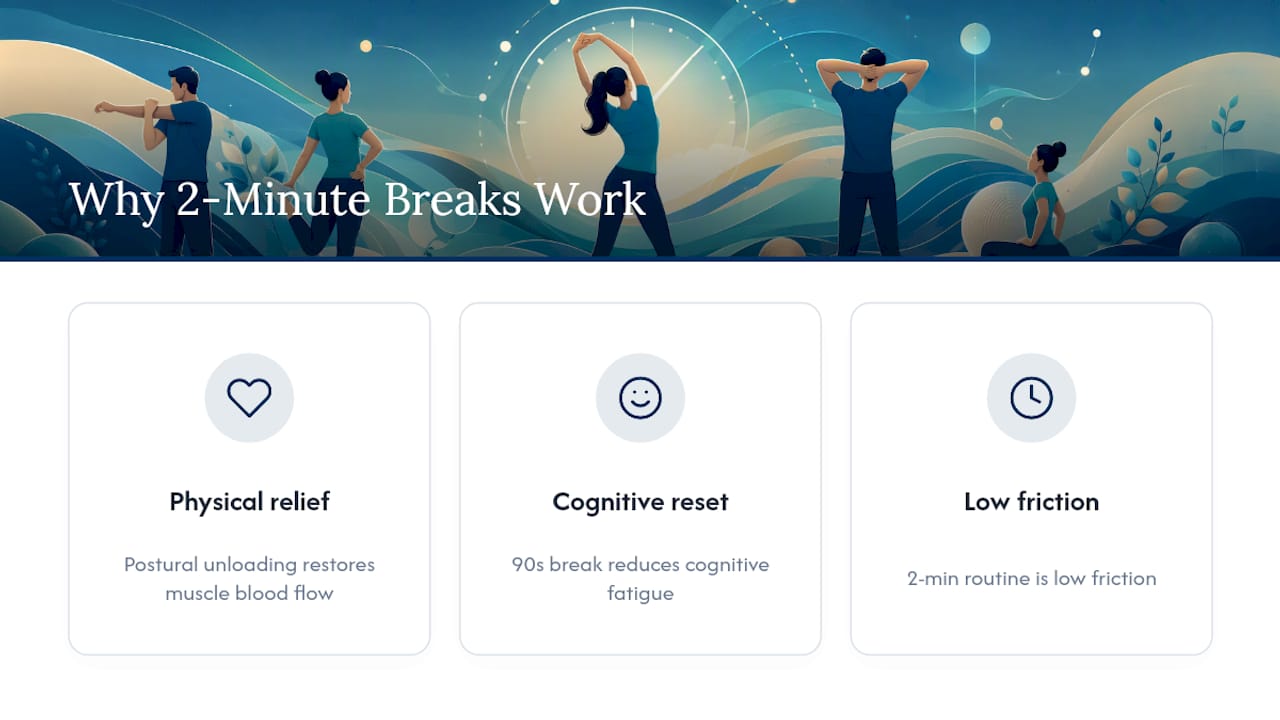
Mayo Clinic notes that brief workplace stretches can prevent or ease stiffness and pain, and that most moves can be done seated or standing without any special equipment. The key mechanism is postural unloading: briefly changing your position releases the sustained tension in soft tissue and restores blood flow to muscles that have been held static. Even a 20-second neck side bend interrupts the loading pattern enough to matter.
The mental benefit is real too. Short movement breaks reset attention. Stepping away from a screen for 90 seconds, even without leaving your chair, tends to reduce the cognitive fatigue that builds from sustained focus. That’s why workday spinal care practices consistently pair movement with productivity, not against it.
Short breaks are also easier to sustain than long ones. A two-minute routine is low enough friction that it survives a busy calendar. A 20-minute yoga session at lunch does not.
How often and how long should you stretch at your desk?
The evidence points to one clear answer: every 30–60 minutes, with each session lasting 1–3 minutes. WebMD recommends stretching every 30–60 minutes and holds of roughly 10–30 seconds per stretch. CCOHS suggests holds of 10–20 seconds and cautions against pushing into pain.
For most office workers, the practical sweet spot is a 2-minute routine at the top of every hour. If your work style is more fragmented, a 1-minute micro-break every 30 minutes works just as well. The goal is to interrupt sustained sitting, not to achieve a training effect.
Hold times by stretch type:
- Static stretches (neck, chest, hips): 15–30 seconds, 1–2 repetitions per side
- Dynamic moves (cat-cow, ankle pumps): 8–12 slow repetitions
- Postural resets (shoulder blade squeeze): 5–10 seconds, 3–5 reps
Pro Tip: Anchor your stretch break to something you already do every hour: refilling your water bottle, finishing a Pomodoro block, or the moment a video call ends. Habit stacking removes the decision entirely.
Step-by-step stretches grouped by body area
Neck
Neck side bend. Sit or stand tall. Drop one ear toward the same shoulder. Keep the opposite shoulder pressed down. Hold 20–30 seconds per side. Discreet on calls: keep your face toward the camera and tilt slowly.
Chin tuck. Sit tall. Gently draw your chin straight back (not down) to create a “double chin.” Hold 5 seconds, repeat 5 times. Targets the deep cervical flexors that weaken from forward-head posture.
Chest and shoulders
Chest opener / shoulder blade squeeze. Clasp hands behind your back or grip the back of your chair. Squeeze shoulder blades together and lift your chest. Hold 20–30 seconds. Verywell Fit highlights chest openers and thoracic rotation as priority moves to restore posture and breathing capacity after keyboard work.
Doorway chest stretch (standing). Place forearms on a doorframe at 90 degrees. Step one foot forward until you feel a stretch across the chest. Hold 20–30 seconds. Seated mod: use the back of your chair instead.
Upper back
Seated cat-cow. Sit at the edge of your chair. Arch your back and open your chest (cow), then round your spine and tuck your chin (cat). 8–10 slow cycles. Keeps thoracic mobility from stiffening during long typing sessions.
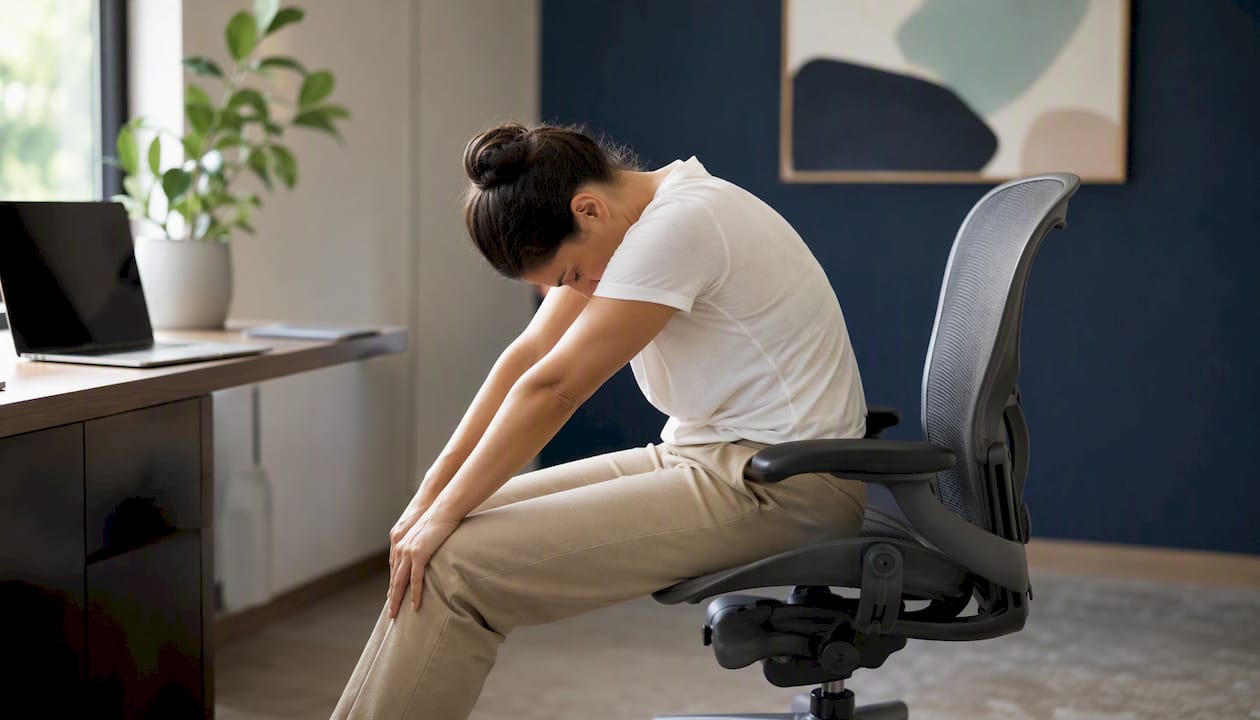
Thoracic rotation. Sit tall, cross your arms over your chest. Rotate your upper body left as far as comfortable, hold 2–3 seconds, return to center, then rotate right. 5 reps per side.
Wrists and forearms
Wrist extension stretch. Extend one arm in front of you, palm facing out. Use your other hand to gently pull the fingers back. Hold 15–20 seconds per side. Addresses the forearm flexor tightness that builds from sustained typing.
Prayer stretch. Press palms together in front of your chest. Slowly lower your hands toward your waist while keeping palms together until you feel a stretch in the wrists and forearms. Hold 15–20 seconds.
Lower back, hips, and glutes
Seated figure-four. Cross one ankle over the opposite knee. Sit tall and hinge forward at the hips. Hold 20–30 seconds per side. Targets the piriformis and glute medius, which tighten from prolonged sitting. Desk-related lower-back discomfort often traces back to hip flexor and glute tightness rather than the spine itself.
Standing hip flexor stretch. Step one foot forward into a shallow lunge. Keep your torso upright and press your back hip forward gently. Hold 20–30 seconds per side. Seated mod: sit at the edge of your chair and slide one leg back as far as comfortable.
Hamstrings and legs
Seated hamstring stretch. Sit at the edge of your chair. Extend one leg straight with your heel on the floor. Sit tall and hinge forward slightly at the hips. Hold 20–30 seconds per side.
Calf raise. Stand behind your chair. Rise onto your toes, hold 2 seconds, lower slowly. 10–12 reps. Improves circulation in the lower legs during long sitting periods.
The condensed 2-minute routine you can do every hour
Memorize this sequence. Breathe slowly throughout and sit tall between moves.
- 0–20 sec: Neck side bend, left
- 20–40 sec: Neck side bend, right
- 40–60 sec: Chest opener (seated, hands clasped behind back)
- 60–80 sec: Seated cat-cow, 4–5 cycles
- 80–100 sec: Seated figure-four, right side (alternate left next hour)
- 100–120 sec: Ankle pumps, 10–12 reps
60-second express option: Cut to moves 1, 3, and 5 only. Still interrupts postural loading and takes less than a minute.
5-minute extended option: Add the doorway chest stretch, thoracic rotation (5 reps per side), wrist prayer stretch, seated hamstring stretch, and 10 calf raises. This works well as a post-lunch or mid-afternoon reset.
Safety notes and when to see a healthcare professional
Three rules apply to every stretch on this list: never force a range of motion, stop immediately if you feel sharp or shooting pain, and avoid aggressive spinal twists if you have a known disc injury or recent spinal surgery.
Most desk stretches are low-risk when done gently. The risk rises when people push through discomfort, bounce in a static stretch, or hold their breath. CCOHS specifically cautions against stretching into pain and recommends keeping holds comfortable and controlled.
Stop and seek evaluation if you notice:
- Numbness, tingling, or weakness in your arms or legs
- Pain that radiates from your neck into your arm or from your lower back into your leg
- Sudden severe pain with no clear cause
- Symptoms that worsen after stretching rather than easing
These can signal nerve involvement or structural issues that stretching alone won’t resolve. A chiropractic assessment for desk workers can identify whether the source of your pain is muscular, joint-related, or neurological, and build a plan that goes beyond self-care. Stretches are a maintenance tool, not a treatment for an active injury.
Research-backed tips to make stretch breaks stick
Frequency is the primary driver of results. The Daily Burn summary of the 2024 Applied Ergonomics study makes this concrete: two minutes every hour outperformed a single longer session for reducing neck, shoulder, and lower-back discomfort. That finding aligns with what behavior design calls “minimum viable habit”: the smaller and more repeatable the action, the more likely it survives a busy week.
Three practical tactics that help:
- Environmental cues. Keep a printed version of the checklist taped to your monitor. Visual cues at the point of action are more reliable than memory.
- Habit stacking. Attach the stretch break to an existing trigger: the moment a meeting ends, the ping of a Pomodoro timer, or the act of standing up to refill your water.
- Pair mobility with activation. Daily Burn’s desk exercise guidance notes that adding brief strengthening moves like glute squeezes and scapular retractions alongside stretches builds postural resilience rather than just temporary relief. Ten glute squeezes while seated takes five seconds and costs nothing.
On the ergonomics side: raise your monitor so the top of the screen is at eye level, and position your keyboard so your elbows stay at roughly 90 degrees. These two adjustments reduce the postural loading that stretches are trying to undo. The workplace activity-break resource guide notes that many activity breaks require little or no equipment and can be done individually, making them easy to implement without employer programs.
Pro Tip: During a video call where your camera is on, the chin tuck, neck side bend, and seated figure-four are all invisible from the waist up. You can run through three moves without anyone noticing.
A clinician’s perspective on desk stretching
The patients who manage desk-related pain best are rarely the ones who do the most stretching. They’re the ones who do a little, consistently. A two-minute routine done every hour for five days does more to reduce accumulated postural tension than a 30-minute session done once on Friday.
What gets overlooked in most office stretching advice is that the stretches themselves are only part of the picture. Tight hip flexors and a stiff thoracic spine are symptoms of a loading pattern, not isolated problems. Addressing the pattern, which means both the movement habits and the workstation setup, is what produces lasting change. When patients come in with persistent neck pain or lower-back stiffness, the stretches they’ve been doing are usually fine. What’s missing is frequency, and sometimes a structural issue that self-care can’t reach.
If your pain persists beyond two or three weeks of consistent micro-breaks, or if it’s worsening, that’s the signal to get a proper assessment rather than add more stretches. A personalized chiropractic treatment plan can identify what’s driving the problem and build a strategy that actually fits your body and your workday.
Sources
- The 5-Minute Desk Stretch Break That Boosts Productivity | Daily Burn
- Office stretches: Stretches you can do at work | Mayo Clinic
- Office Ergonomics – Stretching – At the Workstation | CCOHS
- Physical Activity Breaks for the Workplace, Resource Guide, August 2019
- Stretches you can do at work | WebMD
This article is general information, not a substitute for advice from a qualified doctor. Consult a qualified healthcare professional about your own circumstances before acting on anything here.
FAQ
How often should office workers take stretch breaks?
Every 30–60 minutes is the evidence-backed recommendation, with a 2-minute routine at the top of each hour being the most practical cadence for a standard workday.
How long should you hold each desk stretch?
Hold static stretches for 15–30 seconds per side, and perform dynamic moves like cat-cow for 8–10 slow repetitions. CCOHS recommends keeping holds comfortable and stopping before any pain.
Can you stretch discreetly during a video call?
Yes. The neck side bend, chin tuck, seated figure-four, and ankle pumps are all invisible from the waist up on a camera, making them practical during meetings.
When should desk stretches prompt a visit to a clinician?
Stop stretching and seek evaluation if you experience numbness, tingling, weakness, or pain that radiates into your arm or leg. Symptoms that worsen after stretching rather than easing also warrant a professional assessment.