For most seniors, the safest and most commonly used gentle chiropractic techniques are the Activator Method, flexion-distraction, Thompson drop-table variants, joint mobilization, cervical mobilization, and soft tissue therapy. Every one of these approaches uses low-velocity, low-amplitude (LVLA) force rather than the high-speed thrusts you might picture from a dramatic adjustment video. The single most important safety step before any of them: a documented pre-treatment assessment that screens for osteoporosis, anticoagulant medications, spinal malignancy, and progressive neurological signs.
Here is a quick match between common senior concerns and the technique most often selected:
- Osteoporosis or fragile bones: Activator Method or soft tissue therapy (no rotational force)
- Arthritis-related stiffness: Joint mobilization or gentle stretching
- Disc-related sciatica: Flexion-distraction (table-assisted traction)
- Neck pain or reduced range of motion: Cervical mobilization
- General frailty or post-surgical sensitivity: Soft tissue therapy and prescribed home exercise
A 2026 systematic review that screened 2,295 titles and included 25 articles found that among older adults receiving chiropractic care, the vast majority of adverse events were mild-to-moderate, such as temporary soreness or stiffness. Catastrophic events were not reported in the randomized controlled trials or cohort studies analyzed, and soft tissue and exercise approaches had zero reported adverse events in that dataset.
Table of Contents
- What “gentle” chiropractic care actually means for seniors
- 7 gentle techniques used with elderly patients: what to expect from each
- Which seniors benefit most, and who needs extra caution
- What a safe first visit looks like: session flow, timeline, and cost
- What the evidence says about safety and multimodal care
- How to choose the right chiropractor for an older adult
- Key Takeaways
- The part most guides skip: technique is only half the equation
- Evertonchiropractic offers seniors a safety-first starting point
- Useful sources
- FAQ
What “gentle” chiropractic care actually means for seniors
The word “gentle” in chiropractic has a technical meaning, not just a marketing one. It refers to LVLA techniques: approaches that apply controlled, low-speed force to spinal joints rather than the quick, audible thrust associated with high-velocity low-amplitude (HVLA) manipulation. For older adults, that distinction matters because aging changes bone density, joint tolerance, and vascular resilience in ways that shift the risk profile of any manual therapy.

| Feature | LVLA (Gentle) | HVLA (Traditional Thrust) |
|---|---|---|
| Force level | Low, controlled | High-speed, brief |
| Typical tools | Activator instrument, drop-table, hands | Hands only |
| Audible “pop” | Rarely | Common |
| What it treats | Stiffness, pain, mobility, nerve irritation | Same, plus acute joint fixation |
| Senior suitability | Preferred for osteoporosis, frailty, arthritis | Requires careful screening; often modified |
Technique selection is not just about preference. A clinician’s documented assessment drives the decision. That means reviewing bone density results or DEXA scan history, checking the full medication list (especially blood thinners like warfarin or apixaban), and running a focused neurological screen to catch any deficits that would change the plan.
Pro Tip: New-onset dizziness, sudden-onset headache, or any anticoagulant use should prompt immediate medical clearance before a cervical adjustment. These are not automatic disqualifiers, but they require a conversation with the patient’s primary care physician first.
The audible pop is not required for clinical benefit. Instrument-assisted methods like the Activator focus on neuromuscular re-education through precise, repeatable impulses rather than high-force releases, which is why many seniors find them more comfortable and less anxiety-inducing than traditional adjustments.
7 gentle techniques used with elderly patients: what to expect from each
1. Activator Method
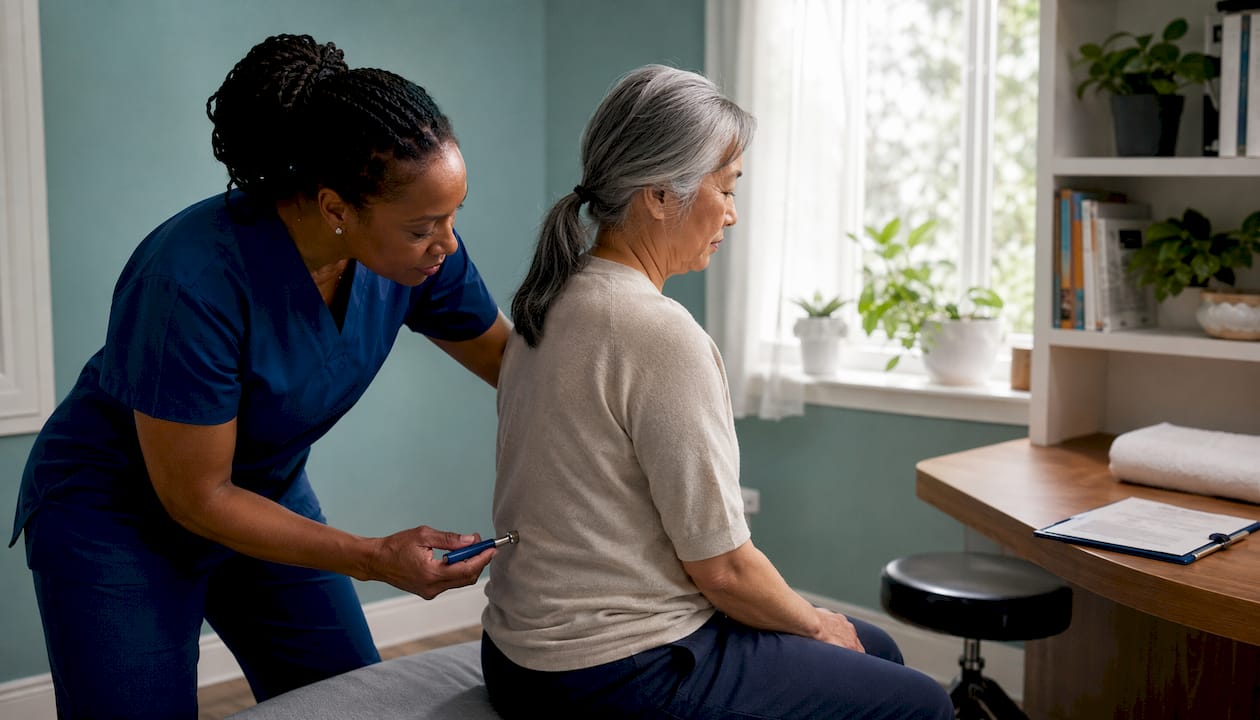
The Activator Method uses a small, spring-loaded handheld instrument to deliver a precise, low-force impulse directly to a spinal joint or extremity. The device fires faster than the body’s protective muscle-guarding reflex can engage, which means the joint receives the stimulus without the surrounding muscles tensing up in response. Case reports show improved pain and function in elderly patients with complex histories, including those with compression fractures and cancer-related comorbidities. Patients typically feel a light tapping sensation with no twisting or rotation involved. It is the first choice when osteoporosis, severe arthritis, or post-surgical fragility rules out any manual thrust.
2. Flexion-distraction
Flexion-distraction uses a specialized segmented table that gently flexes and distracts the lumbar spine in a rhythmic, pumping motion. The chiropractor applies mild hand contact while the table does the mechanical work, creating a decompressive effect on the discs and facet joints. Clinic-based evidence supports its use for disc-related sciatica and lumbar decompression in older adults. Most patients describe it as a gentle rocking sensation, and many find it immediately relieving. It is particularly well-suited for seniors with disc herniation, spinal stenosis, or sciatica who cannot tolerate rotational force.
3. Thompson drop-table technique
The Thompson technique uses a segmented drop-table with spring-loaded sections that drop a fraction of an inch when the chiropractor applies a quick, low-amplitude thrust. The table’s movement absorbs most of the force, so the actual pressure on the patient’s spine is minimal. It is gentler than a standard manual HVLA adjustment and works well for seniors who need some mechanical input but cannot tolerate full manual thrusts. Patients feel a brief dropping sensation under the body part being treated, which most describe as mild and non-threatening.
4. Joint mobilization
Joint mobilization is a purely manual technique where the chiropractor moves a spinal or extremity joint slowly through its range of motion, applying gentle, sustained pressure to the end of that range. There is no thrust, no pop, and no sudden movement. It is effective for reducing stiffness in arthritic joints, improving range of motion in the neck and shoulders, and addressing the kind of gradual joint restriction that builds up over years of postural compensation. Seniors with moderate osteoarthritis often respond well to this approach because it works within the joint’s existing tolerance rather than pushing past it.
5. Cervical mobilization
Cervical mobilization applies the same slow, controlled movement principles to the neck specifically. The chiropractor manually guides the cervical vertebrae through small, deliberate arcs of motion without any rotational thrust. It addresses neck stiffness, cervicogenic headaches, and reduced rotation that makes driving or looking over the shoulder difficult. The technique requires careful pre-screening for vertebrobasilar insufficiency and any history of stroke or vascular anomaly, but when cleared, most seniors tolerate it well and notice improved neck range of motion within a few sessions.
6. Soft tissue therapy
Soft tissue therapy covers myofascial release, trigger point work, and therapeutic massage applied to the muscles, tendons, and connective tissue around the spine and extremities. It does not involve joint manipulation at all, which makes it the lowest-risk option for seniors with severe osteoporosis, active anticoagulation, or recent surgery. The 2026 systematic review found zero reported adverse events for soft tissue approaches in the analyzed studies. Beyond pain relief, it reduces muscle guarding that often develops around arthritic joints and improves tissue flexibility before or after other techniques.
7. Gentle stretching and prescribed exercise
Prescribed stretching and exercise are not afterthoughts. Evidence consistently shows that combining manual therapy with targeted exercise for strength, balance, and flexibility produces better long-term mobility and pain outcomes than manual therapy alone. A chiropractor working with seniors will typically prescribe specific home exercises for hip flexor flexibility, thoracic extension, and balance training, all calibrated to the patient’s current capacity. Patient adherence to the home program is often the single biggest factor in whether gains from in-clinic sessions hold over time.
Technique reference at a glance:
| Technique | Force level | Main uses | Best for |
|---|---|---|---|
| Activator Method | Very low (instrument) | Pain, nerve irritation, stiffness | Osteoporosis, frailty, post-surgical |
| Flexion-distraction | Low (table-assisted) | Disc herniation, sciatica, stenosis | Disc-related pain, lumbar decompression |
| Thompson drop-table | Low-moderate (table-assisted) | General spinal pain, mobility | Seniors needing some mechanical input |
| Joint mobilization | Low (manual) | Arthritis, stiffness, range of motion | Osteoarthritis, moderate joint restriction |
| Cervical mobilization | Low (manual) | Neck pain, headaches, rotation loss | Neck stiffness, cervicogenic headache |
| Soft tissue therapy | None (no joint force) | Muscle tension, pain, tissue flexibility | Severe osteoporosis, anticoagulation, frailty |
| Stretching and exercise | None | Balance, strength, fall prevention | All seniors as home program |
Short-term side effects to expect: Mild muscle soreness for 24–48 hours after the first few sessions is common and usually resolves on its own. Transient stiffness or fatigue is also normal. Anything beyond that, including new neurological symptoms, worsening pain, or unusual headache, warrants a call to the clinic before the next visit.
Which seniors benefit most, and who needs extra caution
Seniors who typically see the clearest benefit from gentle chiropractic care are those dealing with persistent low back or neck pain, reduced mobility from osteoarthritis, chronic sciatica without progressive neurological loss, and postural changes that have built up over decades. These are not acute trauma cases. They are the slow, grinding limitations that make getting out of a chair, sleeping through the night, or walking a few blocks harder than it used to be.
Mobility preservation is one of the clearest documented goals. Chiropractic care for seniors aims to maintain function and quality of life rather than aggressive structural realignment. Pain reduction that reduces reliance on daily analgesics is another common outcome, and fall prevention is increasingly recognized as a legitimate adjunct benefit when balance training is included in the care plan.
Certain conditions require extra caution or a modified approach. Severe osteoporosis raises fracture risk with any compressive or rotational force, which is why instrument-assisted and soft tissue methods are preferred. Known spinal malignancy is a contraindication for manipulation at the affected level. Recent major stroke or progressive focal neurological deficits require medical clearance and often mean chiropractic care is not appropriate until the neurological picture stabilizes. Unstable vascular aneurysm and active anticoagulation with uncontrolled bleeding risk both require physician sign-off before any manual therapy begins.
If a senior develops new weakness, numbness, loss of bladder or bowel control, or sudden severe headache during or after a session, treatment should stop immediately and the patient should be evaluated by a physician. Similarly, if pain is worsening rather than improving after four to six sessions, the care plan needs reassessment, which may include imaging or specialist referral.
What a safe first visit looks like: session flow, timeline, and cost
What the clinic should do at the first visit:
- Take a detailed medical history including all current medications (especially anticoagulants and corticosteroids)
- Review any existing bone density results, X-rays, or MRI reports
- Document fall history and current mobility aids
- Perform a focused neurological and orthopedic examination
- Conduct an informed consent discussion that explains the selected technique, expected sensations, and possible side effects
- Order imaging when structurally indicated before proceeding
Senior-focused clinic protocols recommend bringing prior bone density information and any relevant imaging to the first appointment so technique selection can be made with full structural context.
Typical session flow:
- Arrival and intake review (10–15 minutes for first visit)
- Examination and reassessment of current symptoms
- Tailored gentle technique (Activator, flexion-distraction, mobilization, or soft tissue work)
- Home-exercise prescription and demonstration
- Scheduling of follow-up and discussion of care plan goals
What to expect over time:
- Sessions 1–4: Reduced acute pain and muscle guarding; some patients notice improved sleep and easier movement within the first two weeks
- Sessions 5–10: Functional gains become more consistent; range of motion typically improves; home exercises start to feel less effortful
- Reassessment at 8–12 sessions: If meaningful progress has not occurred, the care plan should be reviewed, and the chiropractor should discuss whether additional imaging, co-management with a physician, or a different approach is warranted
Insurance and cost questions to ask the billing team:
- Does my Medicare or private insurance plan cover chiropractic? (Medicare Part B covers manual spinal manipulation for subluxation when medically necessary.)
- What CPT codes will be billed, and are they covered under my plan?
- Is there a per-visit copay or a deductible I need to meet first?
- Does the clinic offer a payment plan or package pricing for a course of care?
- Will the clinic submit claims directly, or do I pay out of pocket and seek reimbursement?
What the evidence says about safety and multimodal care
Recent research gives a clear picture: chiropractic care for older adults carries a manageable risk profile when pre-treatment screening is done properly.
The 2026 systematic review on adverse events screened 2,295 titles and included 25 articles. Among older adults, 412 study-related adverse events were recorded, nine of which were classified as severe. Catastrophic events were not reported in any randomized controlled trial or cohort study in the dataset. Soft tissue and exercise approaches had no reported adverse events at all.
That finding does not mean chiropractic is risk-free. It means that with appropriate patient selection and technique modification, the risk profile for older adults is consistent with other conservative musculoskeletal interventions. Mayo Clinic notes that chiropractic adjustment is generally safe when performed by a trained, licensed practitioner, with the most common side effects being transient soreness or headache.
The stronger argument for chiropractic in older adults may actually be the multimodal case. Evidence from clinical reviews supports combining manual therapy with prescribed exercise targeting strength, balance, and flexibility for better long-term mobility and pain management outcomes. A Cochrane review cited in the PMC evidence-based practice literature found moderate evidence that exercise prevents recurrences of back pain, and massage combined with exercise and education showed benefit for subacute and chronic nonspecific low back pain. For seniors, that combination also addresses fall risk, which is a separate but overlapping clinical priority.
Home exercises are not optional extras. They are often the decisive factor in whether in-clinic gains hold between sessions and over the long term.
Key sources used in this article:
- 2026 systematic review on adverse events in older adults receiving chiropractic care: safety data, AE rates, soft tissue findings
- PMC evidence-based practice review: chiropractic scope, manipulation evidence, exercise and massage evidence
- ScienceDirect multimodal care review: exercise and manual therapy combination outcomes
- Mayo Clinic chiropractic adjustment overview: general safety, common side effects
How to choose the right chiropractor for an older adult
The single most important criterion is documented geriatric experience paired with a safety-first assessment protocol. A chiropractor who has worked extensively with older adults will already have a workflow for bone-density review, medication checks, and technique modification. One who does not may default to approaches that work fine for a 35-year-old athlete but are inappropriate for a 78-year-old with osteopenia.
Questions to ask on the phone or at the first visit:
- How much of your practice involves patients over 65?
- Are you trained in the Activator Method or flexion-distraction?
- What does your first-visit assessment include for older patients?
- Do you review bone density results and current medications before selecting a technique?
- Can you coordinate with my primary care physician or specialist if needed?
- What is your protocol if a patient’s symptoms worsen after a session?
Credentials to look for:
- Active state chiropractic license (verify at your state board’s website)
- Postgraduate training or certification in geriatric chiropractic or rehabilitation
- Familiarity with instrument-assisted techniques (Activator, Impulse IQ)
- Published patient resources or intake forms that address senior-specific concerns
- Willingness to request or review imaging before proceeding
Red flags to watch for:
- Refuses to review medical history or current medications before treatment
- Recommends high-force HVLA manipulation for a patient with known osteoporosis without documented justification
- Skips informed consent or cannot explain what technique will be used and why
- Discourages the patient from continuing with their primary care physician
- Pushes a long prepaid package before completing a full assessment
If any of these appear, ask directly for an explanation. If the answer is unsatisfactory, seek a second opinion. A good clinician welcomes those questions.
Key Takeaways
Gentle, low-force chiropractic techniques are safe for most elderly patients when a thorough pre-treatment assessment screens for osteoporosis, anticoagulant use, and neurological red flags before any session begins.
| Point | Details |
|---|---|
| Safest techniques for seniors | Activator Method, flexion-distraction, joint mobilization, cervical mobilization, and soft tissue therapy are the most commonly used low-force options. |
| Pre-treatment screening is non-negotiable | Bone density review, medication check, and neurological screen must happen before technique selection, not after. |
| Adverse events are mostly mild | A 2026 systematic review found catastrophic events were not reported in RCTs; most adverse events were temporary soreness or stiffness. |
| Multimodal care produces better outcomes | Combining manual therapy with prescribed home exercise for balance and strength consistently outperforms manual therapy alone for older adults. |
| Evertonchiropractic’s approach | Evertonchiropractic offers personalized, evidence-informed care for seniors with documented assessment protocols and a focus on long-term mobility. |
Immediate next steps for caregivers: Gather the senior’s current medication list, bone density results, and any recent imaging. Call the clinic with the provider questions listed above. Request medical clearance from the primary care physician if osteoporosis, anticoagulant use, or a recent neurological event is part of the picture.
The part most guides skip: technique is only half the equation
Most articles about gentle chiropractic for seniors spend all their time on the techniques themselves and almost none on what happens between sessions. That is where the real outcomes are decided.
A senior who receives excellent flexion-distraction work twice a week but does no balance or hip-strength exercises at home will plateau quickly. The in-clinic work creates a window of improved joint mobility and reduced pain. What fills that window determines whether the gains compound or evaporate. This is not a minor footnote. The research on multimodal care is consistent on this point: the home program is often the decisive variable.
There is also a tendency in popular coverage to frame the “gentle vs. traditional” debate as if gentler automatically means less effective. It does not. Instrument-assisted techniques like the Activator work through neuromuscular re-education, stimulating sensory receptors and improving nervous-system signaling with precise, repeatable impulses. The mechanism is different from a high-force thrust, not inferior to it. For an 80-year-old with osteopenia, that distinction is clinically meaningful.
The other underappreciated point: the goal for a senior patient is not the same as for a younger one. Aggressive structural realignment is not the target. Maintaining the ability to walk to the mailbox, sleep without waking from pain, and get up from a chair without assistance, those are the outcomes that matter. A chiropractor who understands that will build a care plan around functional milestones, not force levels.
Evertonchiropractic offers seniors a safety-first starting point
Seniors dealing with persistent back pain, sciatica, or stiffness from arthritis often find that the hardest part is not the treatment itself. It is knowing whether the treatment is appropriate for their specific situation. Evertonchiropractic, led by Dr. Richard, addresses that directly with documented intake assessments that review bone density, medications, and neurological status before any technique is selected.
What to bring to your first visit at Evertonchiropractic:
- Current medication list (including blood thinners and corticosteroids)
- Bone density or DEXA scan results if available
- Any recent X-rays or MRI reports
- Notes on current mobility aids or fall history
On day one, the clinic reviews that information, conducts a focused orthopedic and neurological exam, and discusses which gentle approach fits your situation before anything is applied. For seniors with nerve pain or sciatica, the nerve pain relief service page explains how Evertonchiropractic targets the source rather than masking symptoms. For those weighing the evidence before booking, the spinal adjustments evidence page walks through what the research actually shows.
Pro Tip: Book a longer first appointment slot, typically 60 minutes rather than 30, so the intake assessment is not rushed. Ask about accessibility and parking when you call, especially if the senior uses a walker or wheelchair.
Call or book online to schedule a safety-first consultation and find out which approach fits your situation.
Useful sources
- Adverse events in older adults receiving chiropractic care: 2026 systematic review: The most current safety data on adverse event rates for older adults, including soft tissue and exercise findings.
- Evidence-Based Practice and Chiropractic Care (PMC): Covers chiropractic scope of practice, manipulation evidence, and the role of exercise and massage in musculoskeletal care.
- Multimodal care combining manual therapy and exercise (ScienceDirect): Reviews evidence for combining manual therapy with exercise programs for older adults.
- Chiropractic adjustment overview (Mayo Clinic): Plain-language overview of what a chiropractic adjustment involves, common uses, and safety considerations.
- Low-force techniques for geriatric patients with complex comorbidities (PMC): Case report evidence for Activator Method and low-force approaches in elderly patients with osteoporosis and cancer history.
- Senior chiropractic care and mobility: Evertonchiropractic guide: Clinic-specific overview of benefits and outcomes for older adults.
- Mobility equipment for seniors (Seventh Chakra): Practical resource on mobility aids that complement chiropractic home programs for fall prevention.
FAQ
Should an 80-year-old go to a chiropractor?
Yes, with appropriate screening. A 2026 systematic review found that adverse events in older adults receiving chiropractic care are mostly mild-to-moderate, and catastrophic events were not reported in controlled studies. The key is selecting a chiropractor with geriatric experience who uses low-force techniques and conducts a thorough pre-treatment assessment.
What is the most gentle chiropractic technique?
The Activator Method is widely considered the gentlest option because it uses a small instrument to deliver a precise, low-force impulse without any rotation, extension, or manual thrust. Soft tissue therapy has no joint force at all and is the lowest-risk choice for seniors with severe osteoporosis or active anticoagulation.
Is chiropractic safe for elderly patients with osteoporosis?
It can be, when the right technique is selected. Instrument-assisted methods like the Activator and soft tissue therapy avoid the compressive and rotational forces that raise fracture risk. High-velocity thrusts are generally avoided for patients with significant bone density loss, and a bone density review should be part of the intake process before any treatment begins.
How can a chiropractor tell if there is inflammation?
A chiropractor assesses inflammation through a combination of patient history, palpation of affected tissues, range-of-motion testing, and orthopedic examination. Warmth, swelling, and pain on movement are physical signs; the chiropractor may also review recent lab work or imaging if the patient brings it. Chiropractors are licensed as primary-contact providers and are trained to differentially diagnose and refer cases that require further medical evaluation.
Why does my jaw hurt after a chiropractic adjustment?
Jaw soreness after a cervical adjustment is uncommon but can occur if the patient held tension in the jaw during treatment or if the neck muscles that connect to the jaw were affected by soft tissue work. It typically resolves within 24–48 hours. If jaw pain is severe, persists beyond two days, or is accompanied by new neurological symptoms, contact the treating chiropractor and your primary care physician.
This article provides general information about chiropractic care for older adults and is not a substitute for professional medical or chiropractic advice. Confirm your specific situation with a licensed chiropractor or your primary care physician before beginning any new treatment.