
What is tech neck, and how does chiropractic care help?
Tech neck, also called cervical kyphosis in clinical settings, is a postural syndrome that develops when you hold your head forward and down for extended periods while looking at screens. Your head weighs roughly 10–12 pounds in a neutral position, but that load multiplies significantly as it tilts forward, placing chronic strain on the muscles, joints, and discs of your neck and upper back. The result is a pattern of pain and dysfunction that doesn’t resolve on its own once the posture becomes habitual.
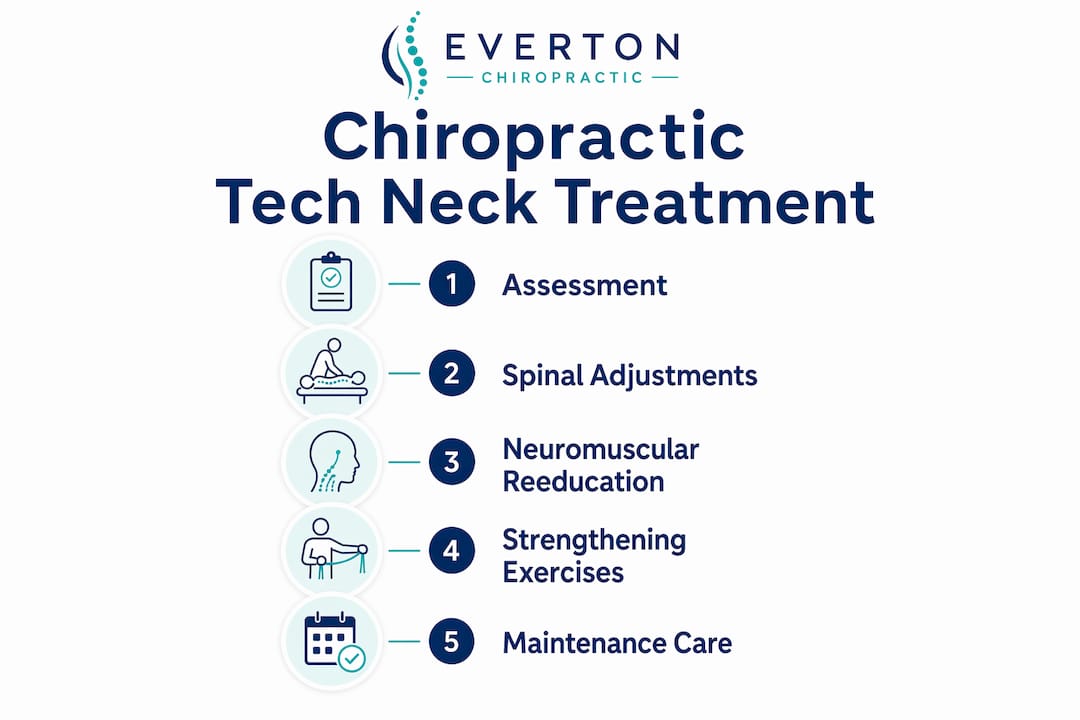
Chiropractic care addresses tech neck at its root by targeting spinal alignment and neuromuscular function, not just the surface-level pain. At Evertonchiropractic, the approach is built around personalized treatment plans that combine:
- Spinal adjustments to realign vertebrae and relieve pressure on surrounding tissues
- Neuromuscular reeducation to retrain how your muscles support your head
- Targeted strengthening exercises for the neck and upper back
- Lifestyle guidance covering movement habits, hydration, and stress management
- Orthotic support when foot posture is contributing to the postural chain
The goal isn’t just short-term relief. It’s correcting the underlying alignment problem so the pain doesn’t keep coming back.
What symptoms tell you that you have tech neck?

The signs of tech neck are easy to dismiss as ordinary tiredness, which is exactly why so many people let them go untreated for months. Recognizing the pattern early makes a real difference in how quickly you recover.
Common tech neck symptoms include:
- Neck and upper back pain, often described as a dull ache that worsens after screen time
- Tension headaches, typically starting at the base of the skull and radiating forward
- Stiffness, especially in the morning or after sitting for long periods
- Forward head posture, where your ears sit noticeably in front of your shoulders
- Rounded shoulders and a hunched upper back
- Muscle fatigue in the neck and shoulder region, even without physical exertion
- Reduced neck mobility, making it harder to turn your head fully side to side
Pain radiating down your arms, or numbness and tingling in your hands, signals possible nerve involvement. Yale Medicine spine surgeon Dr. Peter G. Whang recommends contacting your primary care doctor to rule out nerve compression if those symptoms appear.
What causes tech neck to develop?
Tech neck isn’t caused by a single bad day at your desk. It builds gradually through repeated patterns of poor positioning.
- Prolonged forward head posture from looking down at phones, tablets, or laptops is the primary driver. The further your head tilts forward, the more load your neck muscles carry continuously.
- Muscle imbalances develop over time. The muscles at the front of your neck and chest become tight and shortened, while the muscles at the back of your neck and upper back become overstretched and weak.
- Lack of movement breaks allows muscles to stay in a contracted state for hours, leading to chronic shortening and inflammation.
- Poor workstation setup, such as a monitor positioned too low or a chair without proper lumbar support, forces compensatory postures throughout the day.
- Foot posture problems can trigger a chain reaction up through the body. Collapse of the foot’s transverse arch can lead to a forward lean in the lower trunk, which drives compensatory changes in the neck and shoulders. Custom orthotics are sometimes critical for lasting postural correction because of this connection.
Why tech neck doesn’t fix itself
Changing your posture consciously for a few days rarely solves the problem. Here’s why.
Once the muscles supporting your head have been overstretched and weakened over months or years, they can’t simply snap back into their correct positions through willpower alone. The nervous system adapts to the forward head position and begins treating it as “normal,” making it harder to maintain an upright posture even when you’re trying. Chronic forward head posture leads to joint and disc degeneration over time if left uncorrected, causing persistent pain and dysfunction that goes well beyond muscle soreness.
Poor posture also becomes self-reinforcing. Tight chest and anterior neck muscles pull the head forward, while weak posterior muscles fail to counteract that pull. Without targeted intervention to break that cycle, the imbalance deepens. Stress compounds the problem by increasing baseline muscle tension in the neck and shoulders, and dehydration worsens muscle spasms, making recovery slower without addressing those factors alongside the structural ones.
How chiropractic care treats tech neck
Chiropractic treatment for tech neck works on several levels at once, which is what separates it from simply taking pain medication and hoping for the best.
- Spinal adjustments apply controlled force to specific vertebrae to restore proper alignment and relieve strain on the muscles and connective tissues surrounding them. As Dr. Christopher Howson, DC, of Altru Health System explains, these adjustments realign vertebrae and reduce the mechanical load causing pain.
- Neuromuscular reeducation retrains the postural muscles to hold the head in a neutral position, addressing the nervous system adaptations that reinforce bad posture. Evertonchiropractic’s posture correction approach focuses specifically on this long-term retraining.
- Targeted strengthening exercises for the deep neck flexors and upper back muscles restore the muscular support your spine needs. Overstretching the back of the neck is actually counterproductive; strengthening these muscles is what pulls the head back into alignment.
- Myofascial release addresses trigger points and muscle tightness that contribute to pain and restricted movement.
- Custom orthotics correct foot posture when arch collapse is contributing to the postural chain reaction described above.
- Lifestyle guidance covers hydration, stress management, and ergonomic adjustments to support recovery between appointments.
Pro Tip: Don’t focus on stretching the back of your neck. Those muscles are already overstretched and weak. Strengthening them, along with your upper back, is what actually corrects the forward head position.
Expert insights on managing tech neck beyond adjustments
Chiropractic adjustments do the structural work, but recovery accelerates when you address the daily habits that created the problem in the first place.
- Movement breaks every 20–60 minutes are one of the most effective tools available. Frequent movement with full neck motion reduces inflammation and prevents chronic muscle shortening. Dr. Whang puts it plainly: “Motion is good for any joint, including those in your neck.”
- Hydration and stress reduction are not optional extras. Dehydration worsens muscle spasms, and chronic stress keeps neck muscles in a state of elevated tension. Integrating both into your recovery plan improves your body’s ability to heal between appointments.
- Strengthening over stretching is the consistent message from both chiropractic and physical therapy research. Restoring muscular balance requires building strength in the muscles that have been chronically weakened.
- Foot posture assessment is worth discussing with your chiropractor if you’ve had tech neck symptoms for a long time without full resolution. The kinetic chain runs from the ground up, and addressing it from the feet can unlock progress that spinal work alone hasn’t achieved.
- Early intervention produces faster results. The longer forward head posture goes uncorrected, the more the nervous system normalizes it and the more structural changes accumulate in the discs and joints.
Pro Tip: Set a phone or computer reminder to move every 30 minutes. During each break, take your neck through its full range of motion: forward, back, side to side, and rotation. This takes under 60 seconds and meaningfully reduces cumulative strain.
For additional ways to relieve head tension naturally between chiropractic visits, low-cost at-home strategies can complement your care plan effectively.
How long does it take to see improvement with chiropractic care?
The honest answer is that it depends on how long the problem has been developing. Mild tech neck caught early, with symptoms present for weeks rather than months, often responds within a handful of sessions. Patients typically notice reduced pain and improved mobility fairly quickly once spinal alignment is restored and the muscles begin relearning their correct function.
Chronic cases, where forward head posture has been present for years and structural changes have begun in the discs and joints, require a longer commitment. Neuromuscular reeducation takes time because you’re essentially teaching the nervous system a new default position. Most patients with established tech neck see meaningful improvement over several weeks to a few months of consistent care, with the pace depending on how consistently they apply the exercises and lifestyle changes between sessions.
Maintenance care after the initial correction phase helps prevent regression, particularly for people whose work requires long hours at a screen. Think of it less like fixing a broken bone and more like correcting a movement habit: the adjustment creates the opportunity, and the daily practice locks it in.
Risks and contraindications to know before starting chiropractic care
Chiropractic care for tech neck is generally safe for most adults, but there are situations where it requires modification or where a different approach is more appropriate.
Spinal adjustments are not recommended for patients with certain conditions, including severe osteoporosis, spinal instability, active fractures, or specific types of inflammatory arthritis affecting the cervical spine. Anyone with symptoms suggesting nerve compression, such as arm pain, numbness, or tingling, should have a thorough assessment before beginning adjustments to confirm the diagnosis and rule out conditions that need medical management first.
Mild soreness after an adjustment is common and typically resolves within a day or two. Serious adverse events from cervical adjustments are rare, but the risk is worth discussing openly with your chiropractor before treatment begins. A qualified chiropractor will take a full health history, review any imaging if relevant, and tailor the techniques used to your specific situation. At Evertonchiropractic, Dr. Richard’s evidence-informed approach means that patient safety and individual suitability are assessed before any treatment plan is recommended.
If your neck pain from screen use has been building for a while, Evertonchiropractic offers personalized assessments that identify the specific postural and structural factors driving your symptoms. Whether you’re dealing with nerve-related neck pain or chronic postural strain, the clinic’s approach targets the cause rather than masking the symptoms.

Key Takeaways
Chiropractic care addresses tech neck by correcting spinal alignment, retraining postural muscles, and targeting the root causes that prevent the condition from resolving on its own.
| Point | Details |
|---|---|
| Tech neck requires intervention | Forward head posture causes progressive joint and disc degeneration if left uncorrected over time. |
| Strengthening beats stretching | Overstretching the back of the neck worsens the problem; strengthening those muscles restores alignment. |
| Movement breaks matter | Moving every 20–60 minutes with full neck motion reduces inflammation and prevents chronic muscle shortening. |
| Foot posture connects to neck posture | Arch collapse can drive a postural chain reaction that contributes to tech neck; orthotics may be part of the solution. |
| Early care produces faster results | The longer forward head posture goes uncorrected, the more the nervous system normalizes it and the harder it is to reverse. |
FAQ
Would a chiropractor help with tech neck?
Yes. Chiropractors use spinal adjustments, neuromuscular reeducation, and targeted strengthening exercises to correct the alignment and muscle imbalances that cause tech neck symptoms.
Can tech neck be completely corrected?
Mild to moderate tech neck can be fully corrected with consistent chiropractic care and daily habit changes. Long-standing cases with structural disc or joint changes may require ongoing management rather than a complete cure.
What is the best treatment for tech neck?
The most effective approach combines chiropractic spinal adjustments with strengthening exercises for the neck and upper back, regular movement breaks, and ergonomic corrections. Conservative care resolves most cases without surgery or medication.
Can you massage out tech neck?
Massage can relieve muscle tension temporarily, but it does not correct the underlying spinal misalignment or muscle imbalances driving tech neck. It works best as a complement to chiropractic care, not a standalone fix.