Core stability is defined as the ability of deep trunk muscles to maintain spinal alignment and neutral posture during movement, making it the primary defense against back injury and chronic pain. The role of core stability in spine health goes far beyond aesthetics or athletic performance. A 2026 meta-analysis of 33 randomized controlled trials found significant pain reduction in chronic low back pain patients who trained core stability, with standardized mean differences of -0.95 for pain and -1.09 for function. That data confirms what clinicians at Evertonchiropractic observe daily: a well-trained core protects the spine in ways that no brace or painkiller can replicate long term.
What is the role of core stability in spine health?
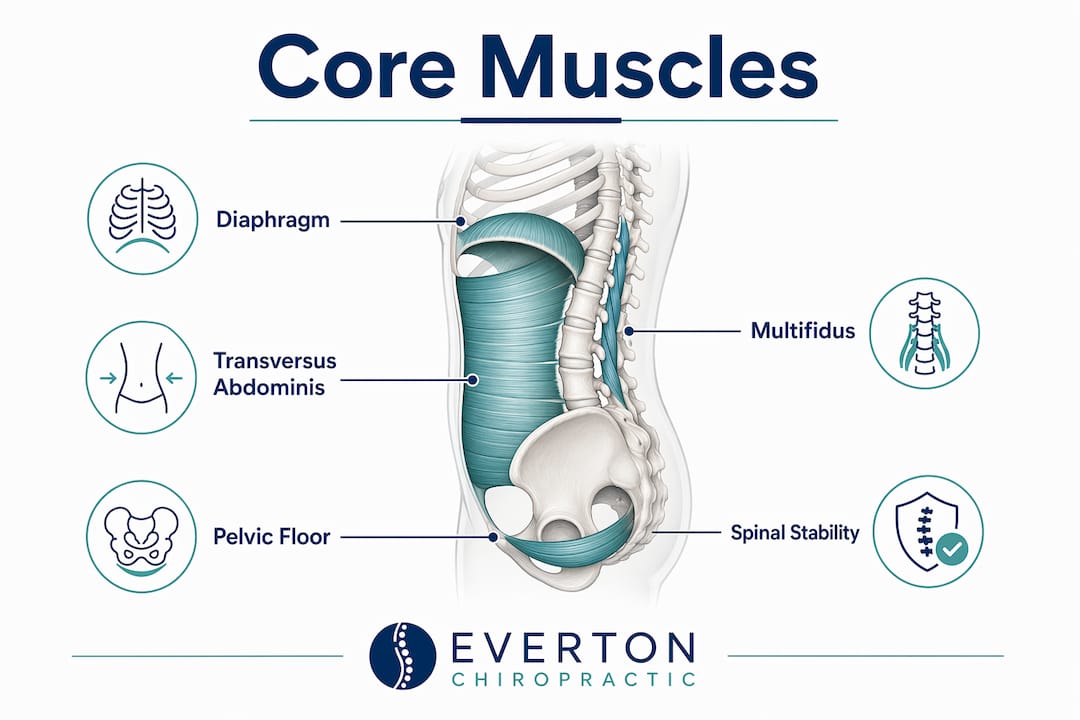
Core stability is the foundation of every movement your spine makes. Without it, the vertebrae absorb forces they were never designed to handle alone. The deep trunk muscles, specifically the transversus abdominis, multifidus, diaphragm, and pelvic floor, form a three-dimensional muscular cylinder around the lumbar spine. This cylinder contracts before your limbs even move, bracing the spine against load and shear forces.
Spine health importance becomes most visible when this system breaks down. Weak deep stabilizers shift load onto passive structures like discs, ligaments, and facet joints. Over time, that shift causes disc degeneration, joint inflammation, and the kind of chronic pain that limits daily life. Addressing core stability early prevents that cascade.
The functional payoff extends to ordinary tasks. Picking up groceries, sitting at a desk for eight hours, or climbing stairs all demand continuous spinal stabilization. When the core fires correctly, these activities feel effortless. When it does not, even minor movements can trigger pain.
Which core muscles support spine health and how do they function?
The core is not the six-pack you see in a mirror. Deep core muscles are the true stabilizers, and they operate below the surface where no amount of crunches can reach them directly.
The four key players work as a coordinated unit:
- Transversus abdominis: The deepest abdominal layer. It wraps around the trunk like a corset, generating intra-abdominal pressure that stiffens the lumbar spine before movement begins.
- Multifidus: A series of short muscles running along the vertebrae. They control segmental motion, preventing individual vertebrae from shifting out of alignment under load.
- Diaphragm: The top of the cylinder. Proper breathing mechanics allow the diaphragm to pressurize the abdominal cavity and contribute to spinal stiffness.
- Pelvic floor: The bottom of the cylinder. It co-contracts with the transversus abdominis and diaphragm to complete the pressure system.
When these muscles fail to fire in the right sequence, the spine loses its protective stiffness at the exact moment it needs it most. The result is increased shearing force across the discs and joints. Research confirms that spinal protection depends more on neuromuscular endurance and controlled bracing before movement than on raw muscle strength. That distinction changes how you should train.
Common weaknesses in this system include delayed transversus abdominis activation, multifidus atrophy after a first episode of back pain, and poor breathing mechanics that disconnect the diaphragm from the pressure system. Each weakness compounds the others.
What does current research reveal about core stability exercises and spine health benefits?
The evidence for core training is now substantial. A 2026 meta-analysis covering 1,757 patients showed that core stability training outperforms passive care for both pain and physical function in chronic non-specific low back pain. Sling exercise therapy and Pilates produced the strongest short-term effects within programs under eight weeks.
A separate 2026 systematic review found that extending training to eight weeks or more, combined with adjunctive therapies, produced better outcomes than short-term or single-modal programs. Longer programs allow the neuromuscular system to build the timing and endurance the spine actually needs.
The table below compares spinal compression forces and muscle activation across common core exercises, based on McGill’s research:
| Exercise | Spinal Compression | Muscle Activation | Spine Safety |
|---|---|---|---|
| Crunches | ~3,300N (high) | Moderate rectus abdominis | High risk for discs |
| Dead bug | Low | High deep stabilizers | Safe for most people |
| Bird dog | Low | High multifidus and glutes | Safe for most people |
| Side plank | Moderate | High obliques and quadratus | Safe with good form |
| Standard plank | Moderate | Moderate overall core | Safe, diminishing returns past 60 seconds |
Crunches generate spinal compression of 3,300N, which exceeds the threshold associated with disc microdamage. Safer alternatives like the dead bug and bird dog achieve equal or better deep muscle activation at a fraction of that compressive load.
Pro Tip: If you are recovering from a disc injury, replace crunches with the dead bug immediately. The dead bug trains the transversus abdominis and multifidus together without loading the spine into flexion.
How do core stability exercises differ from traditional strengthening methods?
Traditional trunk strengthening focuses on producing force. Core stability training focuses on controlling movement, timing muscle activation, and building endurance. That difference matters enormously for improving spinal alignment and reducing injury risk.
A structured comparative review found that core stabilization exercises produce superior short-term improvements in neuromuscular control, proprioception, and lumbopelvic stability compared to general strengthening. Long-term results tend to converge, but the early advantage of stability training means faster pain relief and a lower risk of re-injury during the recovery window.
The key distinctions between the two approaches:
- Anti-movement patterns: Core stability training uses anti-extension, anti-rotation, and anti-lateral-flexion exercises. These teach the spine to resist unwanted motion rather than produce it.
- Endurance over intensity: Holding a bird dog for ten seconds with perfect form beats grinding through a heavy set of sit-ups. The spine needs muscles that stay on, not muscles that peak and fatigue.
- Timing and coordination: The transversus abdominis should fire before your arm or leg moves. Traditional gym training rarely programs this feedforward activation.
The “six-pack” misconception is one of the most damaging ideas in fitness culture. The rectus abdominis, the muscle that creates visible abs, is a mobilizer, not a stabilizer. Training it in isolation through crunches does almost nothing to protect the spine and actively risks disc damage.
Pro Tip: During any core exercise, draw your lower abdomen gently toward your navel before the movement begins. Maintain normal breathing throughout. Holding your breath spikes intra-abdominal pressure in an uncontrolled way and defeats the purpose of the exercise.
How can you safely develop core stability to protect your spine?
A progressive, structured approach produces the best results. The McGill’s Big 3 protocol, comprising the dead bug, side plank, and bird dog, is the most evidence-supported starting point for building core strength and back pain resilience without spinal flexion risk.
Follow this six-week beginner progression:
- Weeks 1–2: Dead bug. Lie on your back, arms toward the ceiling, knees bent at 90 degrees. Lower one arm and the opposite leg toward the floor while keeping your lower back pressed down. Hold for five seconds. Complete three sets of five repetitions per side.
- Weeks 1–2: Bird dog. On all fours, extend one arm and the opposite leg simultaneously. Hold for eight seconds. Complete three sets of five repetitions per side.
- Weeks 1–2: Side plank. Support your body on one forearm and the side of your foot. Hold for ten seconds. Complete three sets per side.
- Weeks 3–4: Increase hold times. Progress dead bug and bird dog holds to eight seconds. Increase side plank holds to twenty seconds. Add one set to each exercise.
- Weeks 5–6: Add dynamic variations. Introduce hip dips on the side plank to break the static plateau. Static plank holds provide diminishing returns after about 60 seconds, so dynamic variations improve neuromuscular control more effectively at this stage.
- Throughout: Integrate into daily movement. Brace your core before lifting any object, even light ones. Practice the abdominal drawing-in maneuver while seated at your desk.
Quality of movement overrides quantity at every stage. One perfect bird dog repetition does more for your spine than ten sloppy ones. If you experience pain during any exercise, stop and consult a professional. People managing chronic pain or diagnosed spinal conditions should work with a qualified clinician to personalize this progression. A long-term spinal health routine built on these principles delivers compounding benefits over months and years.
Spine specialists consistently recommend low-impact aerobic and core training to maintain spine mobility and protect tissue, favoring this approach over surgical intervention for most chronic conditions. Core training is not a supplement to spine care. It is spine care.
Key Takeaways
Core stability training, built on deep muscle endurance and anti-movement patterns, is the most effective non-surgical method for protecting the spine and reducing chronic back pain.
| Point | Details |
|---|---|
| Deep muscles are the real stabilizers | Transversus abdominis and multifidus protect the spine; the six-pack does not. |
| Eight-plus weeks produces best results | Programs lasting eight weeks or more with combined therapies outperform short-term single-modal training. |
| Crunches risk disc damage | Crunches generate ~3,300N of spinal compression; dead bug and bird dog achieve better activation safely. |
| Endurance beats strength | The spine needs muscles that stay on during movement, not muscles that peak and fatigue. |
| Progressive training prevents re-injury | McGill’s Big 3 protocol offers a safe six-week progression for all fitness levels. |
What I’ve learned watching people train their core the wrong way
Most people who come in with chronic back pain have been doing core work for years. They just have been doing the wrong kind. They have done hundreds of crunches, maybe some sit-ups, and they wonder why their spine keeps failing them. The answer is always the same: they trained the mirror muscles and ignored the ones that actually hold the spine together.
What changed their outcomes was not more exercise. It was better exercise. Switching from crunches to bird dogs and dead bugs, learning to breathe properly during movement, and building holds over weeks rather than chasing heavier weights. The improvement in posture, pain levels, and confidence that follows is consistent and real.
The other thing I have noticed is that people underestimate how much the spine responds to consistency over intensity. A ten-minute daily practice of McGill’s Big 3 done correctly will outperform a forty-minute gym session done carelessly. The spine rewards precision. It punishes force applied without control.
Core stability training also complements chiropractic care in a way that nothing else does. Adjustments restore alignment. Core training holds that alignment between visits. The two work together, and the results are faster and more durable than either approach alone.
— Aman
How Evertonchiropractic supports your spine health goals
Core training builds the foundation. Professional care addresses what exercise alone cannot fix.
Evertonchiropractic, led by Dr. Richard, works with people managing chronic back pain, sciatica, and postural issues by combining spinal assessment with active rehabilitation strategies. If your core training has stalled, or if pain is limiting your ability to exercise at all, the underlying spinal alignment may be the missing piece. Evertonchiropractic’s approach to nerve pain relief targets the root cause rather than masking symptoms. For those dealing with persistent low back pain, the clinic’s lower back pain treatment program integrates core-focused rehabilitation with evidence-informed chiropractic care for lasting results.
FAQ
What muscles make up the core for spine stability?
The core stabilizers are the transversus abdominis, multifidus, diaphragm, and pelvic floor. These deep muscles form a pressure cylinder around the lumbar spine that activates before movement begins.
How long does core stability training take to reduce back pain?
A 2026 meta-analysis found significant pain and function improvements from core training programs, with the strongest short-term effects appearing within eight weeks when combined with adjunctive therapies.
Are crunches bad for your spine?
Crunches generate approximately 3,300N of spinal compression, which research links to disc microdamage. Exercises like the dead bug and bird dog produce equal or better deep muscle activation at far lower compression levels.
What are McGill’s Big 3 exercises?
McGill’s Big 3 are the dead bug, bird dog, and side plank. These anti-movement exercises build core endurance and spinal stability without the flexion risks associated with traditional crunches.
Can seniors safely do core stability exercises?
Yes. McGill’s Big 3 are low-impact and scalable, making them appropriate for seniors. Starting with shorter hold times and progressing gradually over six weeks builds stability without placing excessive load on aging spinal structures.