
Spinal health is a direct driver of work productivity, shaping how well you focus, move, and perform every hour of the workday. Musculoskeletal disorders, the clinical term for conditions affecting the spine, muscles, and joints, account for significant lost output across office and industrial workforces alike. Research shows that each additional painful region causes a 1.63-point drop in work productivity, explaining 12% of performance variance. The role of spinal health in work productivity extends well beyond physical discomfort. It shapes cognitive sharpness, emotional resilience, and your capacity to stay engaged through a full workday.
How does spinal health directly reduce work productivity?
Spinal pain does not just hurt. It physically limits what you can do and for how long you can do it. Fatigue sets in faster, task completion slows, and physical output drops in ways that are measurable and predictable.
The impact compounds when pain spreads across multiple body regions. A worker with lower back pain alone faces one level of impairment. Add neck tension or shoulder discomfort, and the productivity loss multiplies. Multisite musculoskeletal pain causes increased fatigue and reduced work endurance, with each new pain site adding another measurable hit to output.
Here is what that looks like in practice:
- Reduced physical endurance: Spinal pain shortens the time workers can sustain physical tasks before needing rest, cutting total output per shift.
- Slower task completion: Discomfort forces frequent position changes and micro-breaks, fragmenting workflow and extending task duration.
- Higher error rates: Fatigue from chronic pain degrades fine motor control and attention to detail, increasing mistakes on precision tasks.
- Increased absenteeism: Severe spinal conditions push workers toward sick days, removing them from the workforce entirely.
Pro Tip: Track your pain patterns over two weeks. If discomfort appears in more than one body region, address it before it compounds into a larger productivity problem.
Musculoskeletal pain also affects psychological engagement. Integrated health-promotion strategies are needed because spinal pain disrupts both physical and psychological domains simultaneously. Treating only the physical side leaves the fatigue and disengagement untouched.
What cognitive and emotional factors connect spinal pain to lost productivity?
The connection between spinal pain and reduced output is not purely physical. Cognitive beliefs and personality traits can predict productivity loss from back pain more accurately than pain intensity alone. A study of 2,223 employees found that how workers think about their pain shapes how much it costs them at work.
This matters because it changes the intervention strategy entirely. A worker who catastrophizes back pain will disengage from challenging tasks faster than a worker with the same pain level who views it as manageable. Cognitive fatigue from spinal discomfort also precedes physical disability. It reduces willingness to volunteer for demanding work, which quietly erodes workplace dynamism over time.
“Presenteeism costs can double absenteeism costs and impact focus, pace, and quality. Employees work below capacity for months, and the loss remains invisible on most performance dashboards.”
The concept of presenteeism captures this hidden cost precisely. MSD-related presenteeism means workers show up but operate at a fraction of their capacity. Output slows, errors increase, and collaboration suffers, all without a single sick day recorded. Addressing spinal health and cognitive function together produces better results than treating either in isolation.
Key cognitive and emotional effects of spinal pain at work include:
- Decision hesitancy: Chronic pain consumes mental bandwidth, leaving less capacity for complex choices.
- Reduced focus: Persistent discomfort acts as a background distraction that degrades sustained attention.
- Lower task ambition: Workers in pain self-select away from high-effort assignments, reducing their visible contribution.
- Emotional withdrawal: Pain-related irritability and low mood reduce collaboration quality and team cohesion.
What ergonomic strategies improve spinal health and work performance?
Ergonomics and workplace productivity are directly linked through workstation design. 40% of employees report back pain as their primary ergonomic issue. Yet only about half have adjusted their workstations, despite over 60% believing it would improve their productivity. That gap between belief and action is where most organizations lose ground.
Practical ergonomic adjustments that reduce spinal strain include:
- Adjust monitor height. Position the top of the screen at eye level to prevent forward head posture, which adds up to 60 pounds of load on the cervical spine.
- Set chair height correctly. Feet should rest flat on the floor, with knees at a 90-degree angle and the lower back supported by the chair’s lumbar curve.
- Reposition the keyboard and mouse. Keep both at elbow height to prevent shoulder elevation and wrist extension that radiates tension into the upper back.
- Use a document holder. Place reference materials at the same height as the monitor to eliminate repetitive neck rotation.
- Report discomfort early. More than half of employees never report ergonomic discomfort, which forces organizations to intervene proactively rather than waiting for problems to surface.
Pro Tip: Set a recurring calendar reminder every 45 minutes to check your posture. Small, frequent corrections prevent the gradual drift into harmful positions that accumulates over a full workday.
Reviewing your office posture habits alongside workstation changes produces faster results than either approach alone. Ergonomic design reduces the physical load. Posture awareness prevents the load from returning.

Which exercises strengthen the spine and protect work performance?
Exercise is the most underused tool in workplace spinal care. A 6-month program combining high-impact and resistance training increased spinal compressive strength by 4.58% and reduced strength variability by 24%. Greater spinal strength means the spine tolerates sustained sitting, lifting, and repetitive movement with less fatigue and pain.
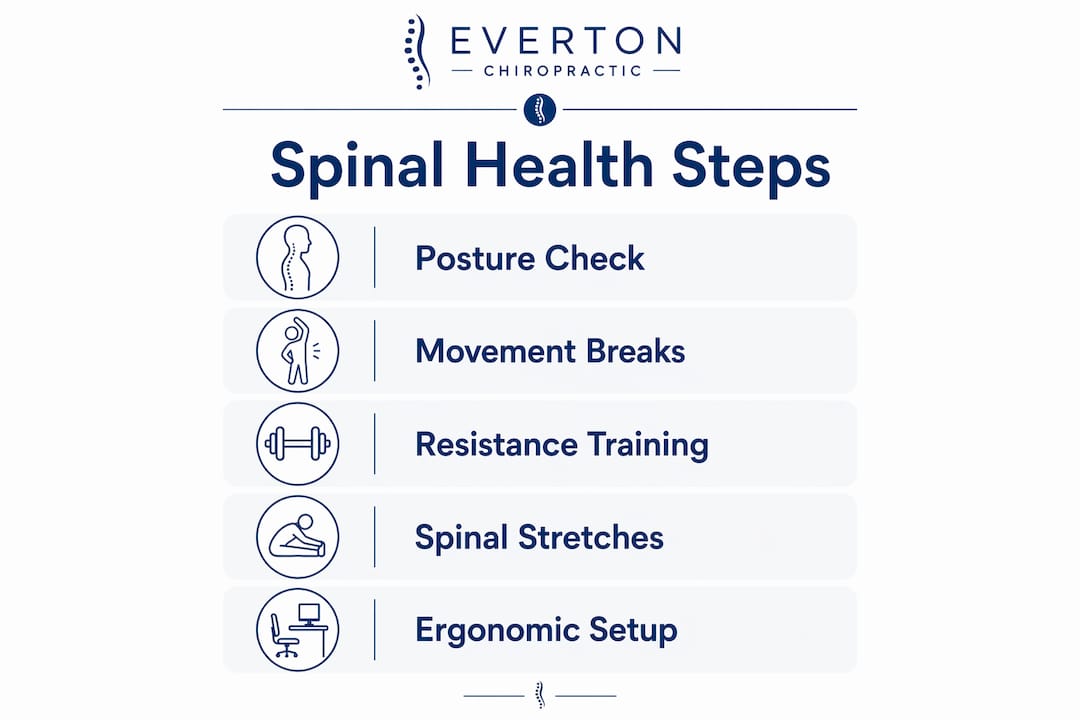
Movement breaks during the workday deliver immediate benefits. Short walks, standing intervals, and targeted stretches reduce spinal compression that builds during prolonged sitting. Evertonchiropractic recommends scheduled movement breaks as a first-line strategy for desk workers, because they cost nothing and produce measurable relief within days.
Pro Tip: Combine a 2-minute walk with three spinal extension stretches every hour. This combination addresses both the circulatory and structural effects of prolonged sitting.
Low-cost integrated approaches that combine cognitive, circulatory, and therapeutic exercises outperform ergonomic changes alone in reducing musculoskeletal pain and fatigue. The research is clear: movement plus mental engagement beats passive workstation fixes every time.
| Exercise type | Primary benefit | Frequency |
|---|---|---|
| Resistance training | Increases spinal compressive strength | 2–3 times per week |
| Stretching and mobility | Reduces stiffness and joint compression | Daily, multiple sessions |
| Aerobic movement breaks | Improves circulation and reduces fatigue | Every 45–60 minutes |
| Core stabilization | Supports lumbar spine during sustained sitting | Daily |
Non-surgical spinal care methods prioritize core strengthening, ergonomic optimization, and regular breaks as preferred first-line treatments. Surgery remains a last resort. The evidence consistently favors movement and load management over passive or invasive interventions.
Key Takeaways
Spinal health determines work productivity through physical endurance, cognitive clarity, and emotional engagement, making it one of the most measurable and addressable performance variables in any workplace.
| Point | Details |
|---|---|
| Multisite pain multiplies losses | Each additional pain region drops productivity by 1.63 points, compounding the total impact. |
| Cognitive factors matter as much as pain | Beliefs and personality traits predict productivity loss more accurately than pain intensity alone. |
| Presenteeism hides the real cost | Workers in pain attend but underperform for months, costing more than absenteeism in many cases. |
| Ergonomic gaps are behavioral, not informational | Over 60% of employees believe adjustments help, yet fewer than half actually make them. |
| Exercise outperforms passive fixes | Resistance and integrated movement programs produce stronger spines and less fatigue than ergonomic changes alone. |
Why I think most workplaces are solving spinal health backward
Most organizations treat spinal health as a reactive problem. Someone reports back pain, HR sends a checklist, and the workstation gets a minor adjustment. That sequence is backward, and the research confirms it.
The real issue is that 60% of employees never report ergonomic discomfort at all. By the time a formal complaint surfaces, the problem has already been costing the organization for months through presenteeism, slower output, and reduced collaboration. Waiting for disclosure is a losing strategy.
What I have seen work is organizational initiative. Regular workstation audits, movement break programs built into the workday, and access to spinal care before pain becomes chronic. These are not expensive interventions. They are cheap compared to the productivity losses they prevent.
The cognitive angle also gets ignored almost entirely. Addressing how workers think about their pain, not just the physical source of it, changes outcomes significantly. A worker who understands that movement reduces pain will move. A worker who fears movement will stay still and deteriorate. Education is part of the treatment.
Spinal health is not a wellness perk. It is a performance variable. Organizations that treat it that way will outperform those that do not.
— Aman
Spinal care for professionals at Evertonchiropractic
Chronic back pain and poor posture do not resolve on their own, especially for desk workers spending six or more hours a day in a chair. Evertonchiropractic, led by Dr. Richard, provides evidence-informed spinal adjustments for pain relief designed to restore function and reduce the discomfort that drains your focus and output at work.

The clinic’s approach goes beyond symptom relief. Treatment plans address posture correction, movement quality, and long-term spinal resilience, all tailored to your work demands and lifestyle. Whether you are dealing with lower back pain from prolonged sitting or neck tension from screen time, Evertonchiropractic builds a plan that fits your actual workday. Proactive spinal care is one of the most direct investments you can make in your professional performance.
FAQ
How does spinal health affect work productivity?
Spinal pain reduces physical endurance, increases fatigue, and impairs cognitive focus, all of which lower output and increase errors. Research shows each additional painful body region drops productivity by 1.63 points.
What is presenteeism and why does it matter for spinal health?
Presenteeism occurs when employees attend work but perform below capacity due to pain or discomfort. MSD-related presenteeism can cost more than absenteeism because the losses are invisible and sustained over months.
Which ergonomic changes reduce back pain at work?
Adjusting monitor height to eye level, setting chair height so feet rest flat on the floor, and repositioning the keyboard at elbow height are the three most effective starting points for reducing spinal strain.
Can exercise improve spinal health for desk workers?
A 6-month resistance and high-impact exercise program increased spinal compressive strength by 4.58% and reduced strength variability by 24%, showing that structured exercise produces measurable spinal improvements.
When should a professional seek chiropractic care for back pain?
Seek care when discomfort persists beyond two weeks, spreads to multiple body regions, or begins affecting your concentration and work output. Early intervention prevents acute pain from becoming a chronic productivity drain.