Vertebral alignment is defined as the precise positioning of each spinal vertebra that allows the nervous system to communicate efficiently and supports every major function in the body. When your spine sits in its correct position, nerve signals travel without interference, muscles work in balance, and joints absorb load the way they were designed to. The role of vertebral alignment in health extends far beyond back pain. It shapes your posture, your mobility, your digestion, and even your immune response. The American Chiropractic Association recognizes postural decline as a public health concern, and 2026 clinical research confirms that alignment correction produces measurable improvements in both physical and mental health outcomes.
How does vertebral alignment affect nervous system health?
The spine is the central communication highway for your nervous system. Every signal your brain sends to your organs, muscles, and glands travels through or near the spinal column. When vertebrae shift out of position, they create pressure on surrounding nerves and disrupt that signal flow.
Spinal misalignments disrupt nerve signals that regulate autonomic functions including heart rate, immune response, and digestion. That disruption also triggers chronic elevated cortisol and systemic inflammation, two conditions that accelerate tissue damage and fatigue over time.

The effects show up in places most people would not connect to their spine. Persistent headaches, sluggish digestion, poor sleep, and frequent illness can all trace back to nerve interference caused by misalignment. Proper spinal alignment reduces muscle tightness, eases nerve irritation, and supports digestive function by restoring clean nerve pathways.
The autonomic nervous system controls functions you never consciously manage. Heart rhythm, breathing rate, and gut motility all depend on uninterrupted nerve communication. Misalignment puts that system under constant low-grade stress, and the body pays for it in ways that look like unrelated health problems.
Pro Tip: If you experience recurring headaches, fatigue, or digestive issues without a clear cause, ask a chiropractor to assess your spinal alignment before assuming the problem is purely systemic.
What systemic symptoms signal nerve interference?
Nerve interference from spinal misalignment produces a recognizable pattern of symptoms:
- Chronic headaches or migraines that do not respond to standard treatment
- Irregular digestion, bloating, or constipation without dietary cause
- Disrupted sleep or difficulty staying asleep
- Reduced immune resilience, meaning frequent colds or slow recovery
- Unexplained fatigue or brain fog that worsens with prolonged sitting
Each of these symptoms reflects the autonomic nervous system working under strain. Correcting the underlying vertebral position often reduces or eliminates them without targeting the symptom directly.
What are the consequences of poor spinal alignment?
Poor spinal alignment produces consequences that compound over time. What begins as mild postural distortion can progress to chronic pain, restricted movement, and measurable loss of function within years.
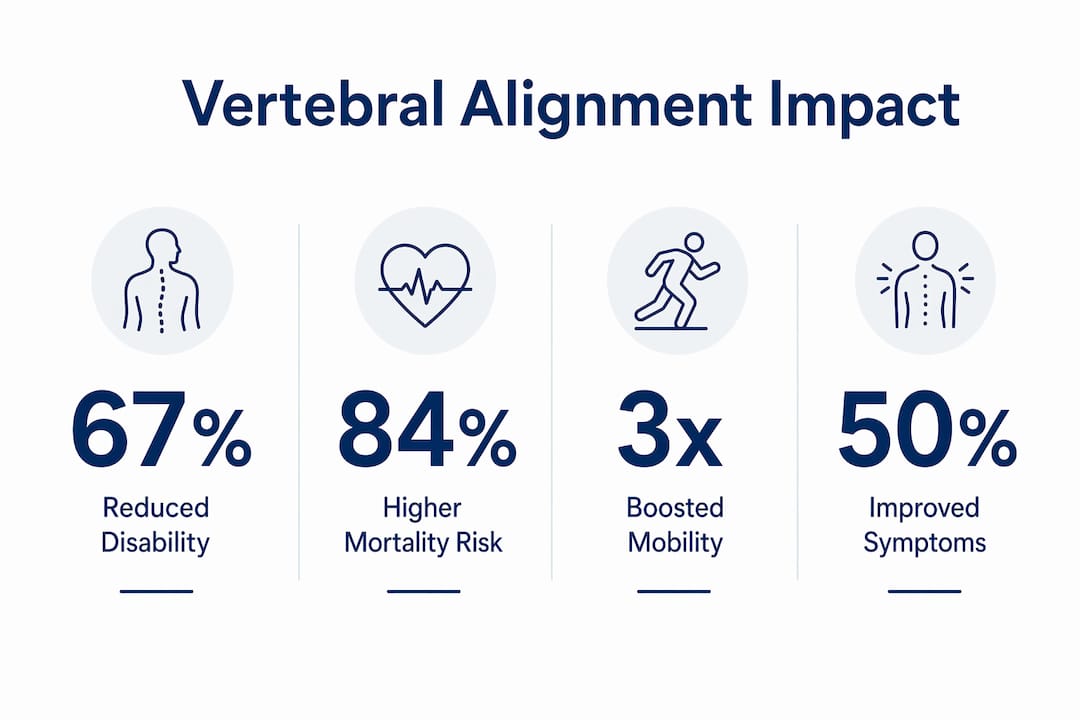
81% of young adults show postural distortion patterns, linking poor posture directly to neurologic health risks. That figure means misalignment is not a condition limited to older adults or people with injuries. It is widespread, and it starts early.
The consequences follow a predictable progression:
- Postural distortion begins with forward head posture, rounded shoulders, or anterior pelvic tilt. Each shift places uneven load on spinal discs and joints.
- Muscle imbalance develops as overworked muscles compensate for those that have switched off. This creates tightness on one side and weakness on the other.
- Joint degeneration accelerates when load is distributed unevenly. Discs compress asymmetrically, and cartilage wears faster than it should.
- Chronic pain sets in as inflamed joints and compressed nerves generate persistent signals. Conditions like lumbar spondylolisthesis, where one vertebra slips forward over another, become more likely.
- Mobility loss follows, reducing the range of motion needed for daily activities and increasing fall risk.
The mortality data is stark. Individuals unable to maintain a 10-second single-leg stance carry an 84% higher all-cause mortality risk. That single test reflects the combined effect of balance, muscle strength, and neurological coordination. All three depend on spinal alignment.
Sedentary lifestyles accelerate every stage of this progression. Prolonged sitting flattens the lumbar curve, weakens the deep stabilizing muscles, and trains the body into a slumped position. The signs of bad posture that seem cosmetic at first are early warnings of structural change happening underneath.
How does restoring proper vertebral alignment improve health?
Restoring alignment produces documented improvements across multiple health measures. A meta-analysis of 23 clinical studies confirmed that physiological sagittal alignment restoration after lumbar surgery reduces the odds of disability by 67% and lowers the risk of persistent pain by 61%. Those numbers reflect what happens when the spine returns to its correct position and stays there.
The benefits extend beyond the spine itself. A case series of 117 patients showed that structured rehabilitation improved both physical functioning and mental quality of life in people with lumbar misalignment. Pain reduction and better movement are expected outcomes. Improved mood, reduced anxiety, and better sleep are less expected but consistently reported.
| Health Outcome | Effect of Alignment Restoration |
|---|---|
| Disability risk | 67% reduced odds after lumbar alignment correction |
| Persistent pain | 61% lower risk following physiological alignment restoration |
| Physical function | Significant improvement in 117-patient rehabilitation case series |
| Mental quality of life | Enhanced scores linked to corrective spinal rehabilitation |
| Nerve irritation | Reduced muscle tightness and improved nerve flow |
Durable results require more than a single adjustment. Soft tissue adaptation happens when cumulative biomechanical forces are applied over time, allowing ligaments and connective tissue to remodel around the corrected position. Traction, targeted exercises, and spinal adjustments work together to create that lasting change. Manual adjustments alone produce temporary relief. The combination produces structural correction.
Pro Tip: Ask your chiropractor whether your treatment plan includes traction and corrective exercises alongside adjustments. If it only addresses symptoms, it may not produce lasting alignment change.
What practical steps can you take to maintain spinal alignment?
Maintaining spinal alignment requires consistent daily habits, not just periodic treatment. The spine responds to the positions you hold most often. If you sit for eight hours a day in a slumped position, no amount of weekend exercise fully undoes that load.
Start with a posture check. How to check your posture begins with standing against a wall. Your head, shoulder blades, and buttocks should all contact the wall. Your lower back should have a small gap. If your head sits forward or your lower back is flat against the wall, you have a postural pattern worth addressing.
Practical steps that support vertebral health and wellness include:
- Adjust your workstation. Your screen should sit at eye level. Your feet should rest flat on the floor. Your lower back should have support that preserves its natural curve.
- Move every 30 minutes. Prolonged static postures compress spinal discs and fatigue stabilizing muscles. A two-minute walk or standing stretch resets the load.
- Strengthen your core. Deep stabilizers like the transverse abdominis and multifidus hold the spine in position. Exercises like dead bugs, bird dogs, and planks train these muscles without loading the spine under flexion.
- Sleep on a supportive surface. A mattress that is too soft allows the spine to sag. Side sleepers benefit from a pillow between the knees to keep the pelvis level.
- Assess your lifestyle habits. The role of daily habits in spinal wellness covers how carrying heavy bags on one shoulder, wearing unsupportive footwear, and prolonged phone use all contribute to misalignment over time.
Seek professional care when pain persists beyond two weeks, when you notice visible postural changes, or when symptoms like numbness or tingling appear. Chiropractic care for spinal health works best as early intervention, not a last resort.
Key Takeaways
Vertebral alignment is the single most influential structural factor in nervous system function, posture, mobility, and long-term pain prevention.
| Point | Details |
|---|---|
| Alignment drives nerve health | Misaligned vertebrae disrupt autonomic nerve signals, causing systemic symptoms beyond back pain. |
| Poor posture carries serious risk | Individuals with postural decline face an 84% higher all-cause mortality risk in balance testing. |
| Correction produces measurable gains | Restoring alignment reduces disability odds by 67% and persistent pain risk by 61%. |
| Lasting change needs more than adjustments | Traction and corrective exercises allow soft tissue remodeling for durable alignment correction. |
| Daily habits determine alignment | Workstation setup, movement frequency, and core strength all directly shape spinal position. |
Why spinal alignment is about more than your back
Most people come to a chiropractor because something hurts. That is understandable. Pain is the loudest signal the body sends. But after years of working with patients on spinal alignment, I have found that the most significant changes are often the ones patients did not expect.
A person comes in for lower back pain and leaves reporting better sleep. Someone with chronic headaches finds they disappear after cervical alignment work. A patient who assumed their fatigue was stress-related discovers it was nerve interference from a thoracic misalignment they had carried for years. These outcomes are not coincidences. They reflect what happens when the nervous system stops working against structural interference.
The misconception I see most often is that spinal health is a reactive concern. People wait until pain becomes disabling before they act. By that point, postural distortion has usually been building for years, and soft tissue changes have already set in. Early assessment, even when you feel fine, gives you a baseline and catches patterns before they become problems.
The long-term value of spinal health is not just about avoiding pain. It is about preserving the quality of movement and function that makes an active life possible at 50, 60, and beyond. Physical decline is not inevitable. Structural neglect is what makes it feel that way.
— Aman
Evertonchiropractic’s approach to spinal alignment care
Evertonchiropractic, led by Dr. Richard, takes a structured, evidence-informed approach to spinal alignment correction. Treatment plans go beyond symptom relief. They address the underlying postural and structural patterns that drive pain and dysfunction in the first place.
Whether you are dealing with lower back pain, sciatica, or postural changes from years of desk work, Evertonchiropractic builds a plan around your specific goals and lifestyle. The clinic’s spinal alignment treatment combines chiropractic adjustments, corrective exercises, and traction where appropriate, giving your soft tissues the sustained input they need to remodel. For those dealing with persistent lower back pain, the lower back pain treatment program offers a path to lasting relief without relying on medication.
FAQ
What is vertebral alignment and why does it matter?
Vertebral alignment refers to the correct positioning of each spinal vertebra relative to the others. Proper alignment allows the nervous system to function without interference and supports balanced posture, efficient movement, and reduced pain.
How does spinal misalignment cause symptoms beyond back pain?
Misaligned vertebrae compress or irritate nerves that regulate autonomic functions including digestion, heart rate, and immune response. This nerve interference can produce headaches, fatigue, poor sleep, and digestive problems that appear unrelated to the spine.
Can spinal alignment be permanently corrected?
Lasting correction requires cumulative treatment over time, not a single adjustment. Traction, corrective exercises, and spinal adjustments applied consistently allow ligaments and soft tissues to remodel around the corrected position, producing durable results.
How do I know if my posture is affecting my spinal alignment?
Stand against a wall and check whether your head, shoulder blades, and buttocks all make contact. A forward head position or flat lower back signals a postural pattern that may be affecting your spinal alignment and worth assessing professionally.
When should I see a chiropractor for spinal alignment?
Seek chiropractic care for spinal health when pain persists beyond two weeks, when you notice visible postural changes, or when you experience numbness, tingling, or unexplained systemic symptoms like chronic headaches or digestive issues.