Chiropractic care restores post-injury movement by realigning joints, reducing mechanical inhibition, and improving nervous system function to rebuild mobility and reduce disability. The clinical term for this process is spinal and peripheral joint rehabilitation, and it sits at the center of modern conservative care pathways. Chiropractors deliver rehabilitation interventions across the full care continuum, targeting function and participation rather than pain alone. For anyone recovering from a back injury, neck strain, or musculoskeletal trauma, understanding how chiropractic helps movement is the first step toward a faster, more complete recovery. Evertonchiropractic, led by Dr. Richard, builds every treatment plan around this principle: restoring what you can do, not just reducing what hurts.
How chiropractic restores post-injury movement through joint and nerve function
Chiropractic adjustments work by correcting joint misalignments that restrict normal movement patterns. When a joint is displaced or stiff after injury, surrounding muscles compensate by tightening, which creates a cycle of restricted motion and increased pain. Chiropractic care improves joint mechanics and neuromuscular function by reducing that muscle tension and enabling smoother movement patterns. Breaking this cycle early is what separates a full recovery from a prolonged one.

The neurological effects of chiropractic care go beyond the joint itself. Spinal manipulation stimulates mechanoreceptors in the joint capsule, which sends signals to the nervous system that reduce pain sensitivity and normalize muscle tone. This is why patients often report feeling looser and less guarded after an adjustment, even before significant structural changes occur. The nervous system, not just the spine, is the target.
Clinicians measure these improvements using validated tools. Pain intensity, disability scales, and range of motion are the most frequently used outcome measures in manual therapy trials. Tools like the Oswestry Disability Index and the Roland-Morris Disability Questionnaire give both the patient and clinician a clear, objective picture of functional progress over time.
Key physiological effects of chiropractic adjustments on post-injury movement include:
- Increased joint range of motion through mobilization of restricted segments
- Reduced muscle guarding via nervous system modulation after spinal manipulation
- Improved movement efficiency as joint alignment reduces compensatory patterns
- Decreased pain sensitivity through stimulation of joint mechanoreceptors
- Better proprioception as restored joint position sense improves movement coordination
Pro Tip: Track your range of motion at each visit using a simple goniometer reading or a functional test like a seated forward bend. Objective numbers show progress even on days when pain levels feel unchanged.
What does the clinical evidence say about chiropractic injury recovery?
The strongest evidence for chiropractic care comes from chronic injury cases. The 2026 VA/DoD guideline recommends spinal mobilization and manipulation for chronic low back pain, while noting that evidence is insufficient to make a firm recommendation for acute cases. That distinction matters for patient selection and timing of care.
A Cochrane review synthesizing 76 studies confirmed that spinal manipulative therapy provides modest pain reductions and moderate functional improvements in chronic low back pain, with no serious adverse effects reported. Moderate functional improvement is clinically meaningful. It translates to getting back to work, lifting without fear, and sleeping through the night.
The PACBACK randomized clinical trial added an important layer to this picture. Combined chiropractic manipulation and self-management showed statistically significant disability improvements over one year in patients with acute and subacute low back pain at risk for becoming chronic. The short-term pain difference was not significant, but the functional outcome was. That finding reframes what success looks like in chiropractic injury recovery.
| Injury phase | Evidence strength | Guideline recommendation |
|---|---|---|
| Acute low back pain | Insufficient | No firm recommendation; use within conservative care |
| Chronic low back pain | Moderate to strong | Recommended by VA/DoD 2026 guidelines |
| Acute neck pain | Mixed | Cautious application with patient selection |
| Subacute at-risk patients | Moderate | Supported by PACBACK trial for disability outcomes |
“Patients often experience meaningful improvement through gradual restoration of movement patterns and reduction of disability rather than immediate pain alleviation.” — PACBACK Randomized Clinical Trial, JAMA
The VA HSR&D evidence brief on acute neck and lower back pain reinforces this nuance. Results across acute cases are inconsistent, which points to the importance of matching the right patient to the right timing of care. Chiropractic is not a one-size-fits-all intervention, and the evidence supports a thoughtful, staged approach.
How chiropractic fits into a full rehabilitation program
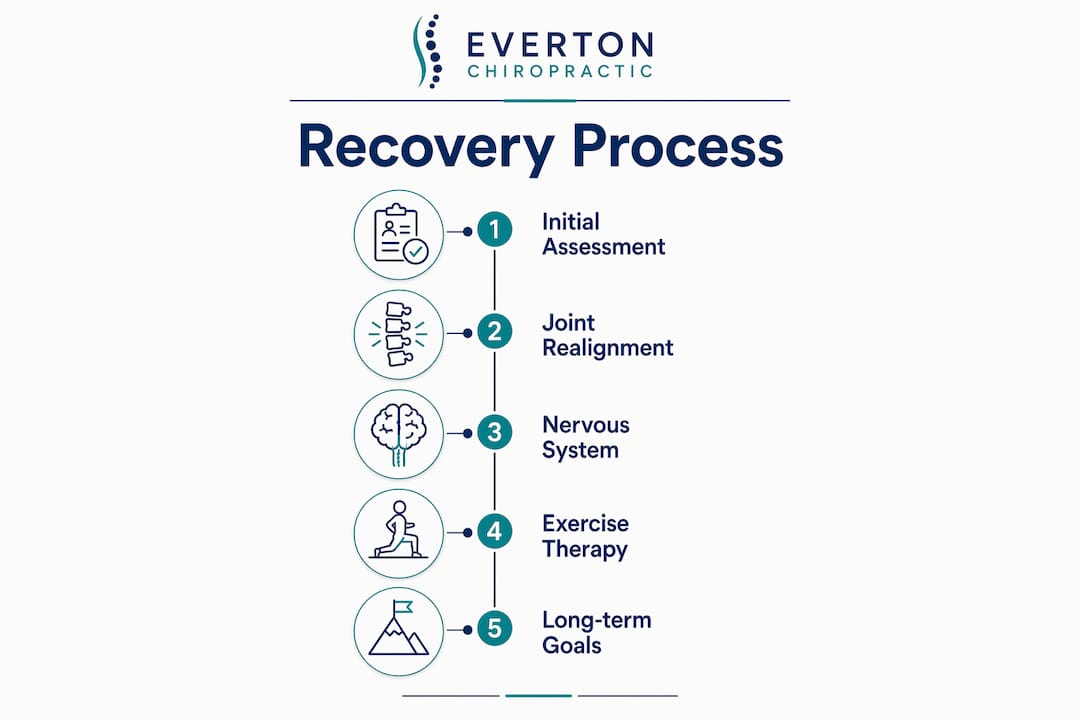
Chiropractic care produces the best outcomes when it is part of a broader rehabilitation plan, not a standalone treatment. Chiropractic’s role in multidisciplinary rehab settings focuses on patient-centered function and participation outcomes, which means the goal is always what you can do in daily life, not just what shows up on a scan. This is the framework that separates modern chiropractic from the outdated image of passive treatment.
A well-structured post-injury program typically moves through three stages:
- Reduce mechanical inhibition. The first priority is restoring safe, pain-free motion. Chiropractic adjustments and joint mobilization remove the physical barriers to movement so the body can begin healing without compensation patterns locking in.
- Restore mobility and movement quality. Once basic motion is available, the focus shifts to movement patterns. Targeted mobilization, soft tissue work, and guided movement drills rebuild the coordination between joints and muscles that injury disrupts.
- Build strength and stability. The final phase uses graded exercise to reinforce the movement gains from earlier stages. Chiropractic care continues here to maintain joint alignment as load increases, preventing regression.
Combining chiropractic with exercise therapy, patient education, and self-management strategies produces better long-term outcomes than any single approach alone. The PACBACK trial demonstrated this directly: the combination of spinal manipulation and clinician-supported self-management outperformed medical care alone for disability reduction over 12 months.
Pro Tip: Ask your chiropractor for a written phase-based plan at your first visit. Knowing which stage you are in and what the next milestone looks like keeps you engaged and gives you a way to measure real progress.
Long-term functional goals matter more than short-term pain scores. Patients who set specific targets, such as returning to a sport, carrying groceries without discomfort, or sitting through a workday, recover with more purpose and consistency than those focused only on pain reduction.
What to expect from chiropractic rehabilitation techniques
Chiropractic rehabilitation uses several distinct techniques, and knowing what each one does helps you engage with your treatment rather than just receive it. The core methods used in post-injury care include:
- Spinal manipulation (high-velocity, low-amplitude thrust): A controlled, precise force applied to a spinal segment to restore joint motion and reduce nerve irritation. The audible “pop” is gas releasing from the joint, not bones cracking.
- Joint mobilization: Slower, sustained movements applied to a restricted joint. Used when manipulation is not appropriate, such as in the early acute phase or with certain patient profiles.
- Soft tissue therapy: Techniques like myofascial release and trigger point work address muscle tightness that restricts movement. These are often combined with adjustments for faster functional gains.
- Therapeutic exercise: Prescribed movements that reinforce joint stability and movement quality between sessions. These are not generic stretches but targeted exercises matched to your specific deficits.
- Postural and movement education: Teaching patients how to load their spine and joints correctly during daily activities to prevent re-injury and support long-term mobility.
Most patients notice gradual improvement across multiple sessions rather than a single dramatic change. Functional recovery from disability tends to accumulate over weeks and months, which is why consistency matters more than the number of sessions in any given week. Setting realistic expectations from the start prevents frustration and dropout. Evertonchiropractic uses objective progress tracking at each visit to show patients exactly where they are improving, which keeps motivation high through the full recovery arc. You can learn more about the conditions chiropractic treats to understand whether your specific injury falls within this scope of care.
Key Takeaways
Chiropractic care restores post-injury movement by correcting joint alignment, improving nervous system function, and integrating with staged rehabilitation to rebuild mobility and reduce long-term disability.
| Point | Details |
|---|---|
| Joint alignment drives recovery | Correcting misalignments removes mechanical barriers that prevent normal movement patterns from returning. |
| Chronic cases have the strongest evidence | VA/DoD 2026 guidelines recommend spinal manipulation for chronic low back pain; acute cases require careful patient selection. |
| Function matters more than pain scores | The PACBACK trial showed significant disability improvement without significant short-term pain reduction. |
| Staged rehab produces the best outcomes | Moving through inhibition reduction, mobility restoration, and strength building maximizes functional recovery. |
| Objective tracking is non-negotiable | Tools like the Oswestry Disability Index and range of motion tests show real progress beyond how you feel on a given day. |
Why I think most patients underestimate what chiropractic can actually do
Most people walk into a chiropractic clinic expecting pain relief. That is understandable, but it is also the reason so many patients stop too soon. Pain is a lagging indicator. It often improves after function does, which means if you quit when the pain fades, you leave the most important gains on the table.
What I have seen consistently is that patients who stay engaged through the full rehabilitation arc, including the strength and stability phase, are the ones who do not come back with the same injury six months later. The ones who stop at “I feel better” are the ones who re-injure. The difference is not willpower. It is understanding that movement quality, not pain absence, is the real target.
The other misconception worth addressing is that chiropractic and physiotherapy are competing options. They are not. The best outcomes I have observed come from patients who use chiropractic to restore joint mechanics and nervous system function, then layer in exercise-based rehabilitation to build on that foundation. Choosing one over the other is a false dilemma. If you want to understand how these approaches compare, the chiropractic vs. physiotherapy breakdown is worth reading.
The final thing I would say is this: physical decline after injury is not inevitable. It is the result of incomplete rehabilitation. Chiropractic care, done right and done in full, is one of the most direct paths back to the movement you had before.
— Aman
Evertonchiropractic’s approach to restoring movement after injury
Evertonchiropractic, led by Dr. Richard, builds post-injury recovery programs around one principle: restore what you can do, not just reduce what hurts. Every treatment plan combines evidence-based chiropractic adjustments with exercise therapy, movement education, and objective progress tracking tailored to your specific injury and lifestyle goals.
Whether you are dealing with acute back pain, a lingering neck strain, or a musculoskeletal injury that has limited your daily life, Evertonchiropractic provides a structured path back to full function. The clinic’s approach to lasting lower back pain relief is a strong starting point for anyone ready to move beyond pain management and toward genuine recovery.
FAQ
How does chiropractic care improve movement after injury?
Chiropractic adjustments correct joint misalignments that restrict motion and stimulate the nervous system to reduce muscle tension, enabling more normal movement patterns to return. Functional improvements typically build over multiple sessions rather than appearing immediately.
Is chiropractic care safe for acute injuries?
Chiropractic care is generally safe, but evidence for spinal manipulation in acute cases is mixed. The VA/DoD 2026 guidelines recommend using it within a conservative care pathway and selecting patients carefully based on injury type and chronicity.
How many sessions does it take to restore movement?
There is no universal number. The PACBACK trial tracked meaningful disability improvements over 12 months, which reflects the reality that functional recovery is gradual. Your chiropractor should set phase-based milestones so you can track progress objectively.
Can chiropractic care be combined with other rehabilitation therapies?
Yes, and it should be. Clinical guidelines and trial evidence support combining chiropractic manipulation with exercise therapy, patient education, and self-management for better long-term outcomes than any single approach alone.
What is the difference between spinal manipulation and joint mobilization?
Spinal manipulation uses a fast, controlled thrust to restore joint motion, while joint mobilization uses slower, sustained movements. Mobilization is typically used in the acute phase or when manipulation is not appropriate for a specific patient.