
A long-term spinal health routine is a structured, repeatable plan that combines exercise, posture correction, lifestyle habits, and self-management to protect your spine from pain and decline. Physical therapists and chiropractors call this a spinal wellness plan, and the evidence behind it is clear: passive, episodic care does not produce lasting results. Building a sustainable routine is the only reliable path to long-term spine care that keeps you mobile, functional, and out of pain. The good news is that the core components are practical, well-researched, and accessible to anyone willing to be consistent.
What are the essential components of a long-term spinal health routine?
A spinal health routine works when it addresses the full picture: movement, posture, nutrition, and mindset. Focusing only on stretching or only on pain relief leaves critical gaps that lead to setbacks.
The physical foundation rests on these pillars:
- Structured exercise: Aerobic activity, core stabilization, and mobility work performed consistently. Exercises like the plank, bird-dog, and Pilates-based movements directly target the muscles that support your spine.
- Posture awareness: Maintaining natural spinal curves while seated and standing reduces gravitational load on your discs and joints. Head, shoulders, hips, knees, and ankles should align vertically.
- Movement breaks: Sitting for extended periods compresses spinal discs. Standing or walking for two to three minutes every 30–45 minutes offsets that compression.
- Nutrition: Calcium and vitamin D from dairy, fatty fish, and eggs maintain bone density and reduce osteoporosis risk. Hydration keeps intervertebral discs plump and shock-absorbent.
- Stress management: Chronic stress increases muscle tension and pain sensitivity. Mind-body practices like yoga, tai chi, and mindfulness reduce both.
- Clinician support: A chiropractor or physical therapist sets measurable goals, tracks progress, and adjusts your plan before small problems become injuries.
Pro Tip: Set a specific, measurable goal before you start, such as “walk 20 minutes daily for 12 weeks” rather than “exercise more.” Vague goals produce vague results.
How to design an effective exercise program for spine health

Exercise is the single most evidence-backed intervention for chronic back pain prevention. Clinician-directed supervised exercise is the first-line recommendation in the VA/DoD 2022 clinical guideline for chronic low back pain, ahead of medication and passive therapies. That recommendation exists because structured movement restores function in ways that rest and pain relief alone cannot.
The ideal exercise program for spine health follows a clear progression:
- Start with low-impact aerobic activity. Walking is the most accessible starting point. A spine surgeon at Northwell Health identifies walking as a foundational spine exercise because it loads the spine gently, supports weight management, and builds endurance without joint stress. Pool exercises offer the same benefit with even less load.
- Add core stabilization exercises. The plank and bird-dog train the deep muscles that hold your vertebrae in place. These are not about aesthetics. They are about giving your spine a stable base during every movement you make.
- Incorporate Pilates or yoga. Both combine flexibility, strength, and body awareness. Harvard Health recommends mind-body practices alongside physical therapy for building long-term resilience against back pain.
- Exercise 3–4 times weekly for at least 10–20 weeks. Hackensack Meridian Health reports that consistent activity over 10–20 weeks produces the most meaningful improvements in spinal wellbeing. Short bursts of effort followed by weeks of inactivity do not accumulate the same benefit.
- Progress intensity gradually. Increase duration before you increase difficulty. Add resistance or complexity only after your form is solid and your body has adapted.
- Work with a clinician. Clinician-guided routines produce better outcomes than self-directed, sporadic activity for people with chronic back pain. A professional catches compensatory movement patterns before they cause new injuries.
Pro Tip: If you miss a week, do not double your effort the following week. Return to your previous level and resume the progression from there.
Here is a quick comparison of common spine-friendly exercise types:
| Exercise type | Primary benefit | Best for |
|---|---|---|
| Walking | Low-impact aerobic loading | Daily movement, weight management |
| Plank / bird-dog | Core stabilization | Vertebral support, injury prevention |
| Pilates | Flexibility and controlled strength | Posture, disc health |
| Yoga / tai chi | Flexibility, stress reduction | Mind-body resilience, chronic pain |
| Pool exercises | Near-zero joint load | Acute flare-ups, seniors, post-injury |
What lifestyle habits support long-term spinal health and pain prevention?
Exercise alone does not protect your spine if the other 22 hours of your day work against it. Daily habits either reinforce or erode the gains you build in the gym or clinic.
The habits that matter most for chronic back pain prevention include:
- Ergonomic workspace setup: Your monitor should sit at eye level. Your chair should support your lumbar curve. Your feet should rest flat on the floor. Poor desk posture is one of the most common drivers of neck and upper back pain in office workers. Evertonchiropractic’s guide to workday spinal care covers this setup in detail.
- Sleep position: Sleeping on your side with a pillow between your knees keeps your spine neutral. Sleeping on your stomach forces your neck into rotation and increases lumbar strain.
- Healthy weight: Excess body weight shifts your center of gravity forward and increases compressive load on lumbar discs. Even modest weight reduction reduces that load significantly.
- Hydration: Intervertebral discs are roughly 80% water in young adults. Chronic dehydration accelerates disc degeneration. Drinking adequate water daily is one of the simplest spinal health tips available.
- Stress reduction: Psychological stress amplifies pain perception through the nervous system. Mindfulness, tai chi, and pain neuroscience education address the threat-avoidance behaviors that keep people stuck in pain cycles.
- Posture correction: Addressing forward head posture early prevents the spinal degeneration that follows years of misalignment. Evertonchiropractic’s resource on fixing forward head posture explains the mechanics and the corrective steps.
These habits do not require large time investments. They require awareness and repetition until they become automatic.
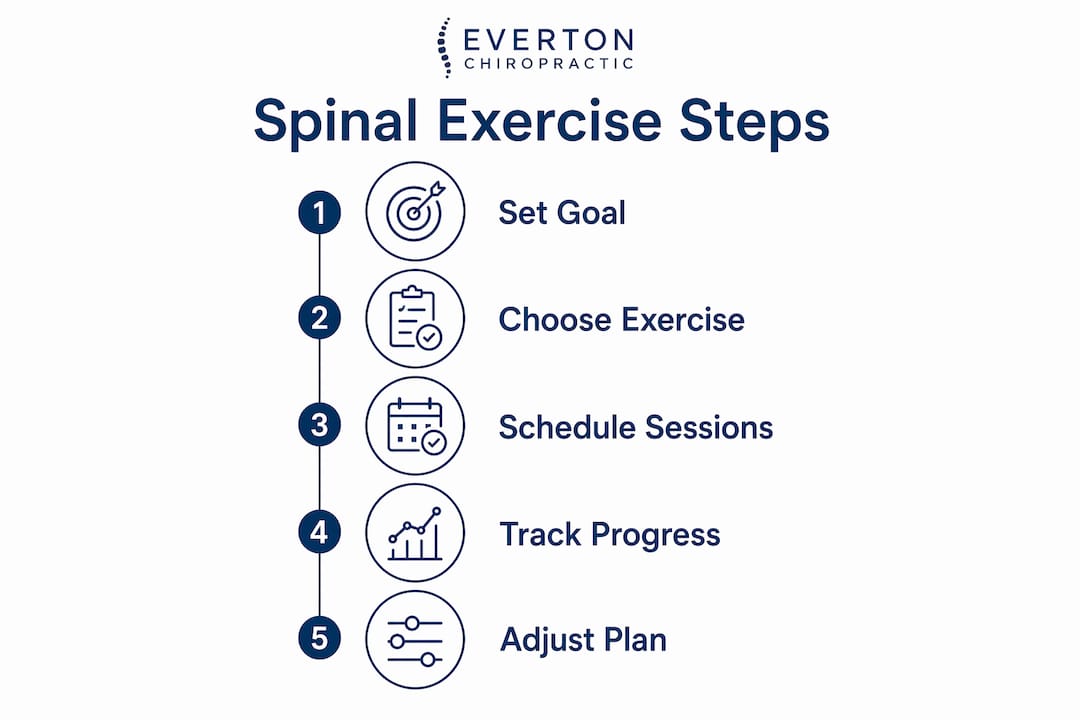
How to monitor progress and maintain motivation in your routine
The most common reason spinal health routines fail is not lack of effort. It is lack of structure around measuring results. Without clear benchmarks, people either quit too early or continue the wrong approach too long.
A structured monitoring process keeps your routine on track:
- Set functional goals, not just pain goals. The PACBACK trial published in JAMA found that clinician-supported self-management reduced disability over 12 months even when pain intensity remained similar between groups. Functional ability, such as how far you can walk or how long you can sit comfortably, is a more reliable progress marker than pain scores alone.
- Schedule reassessments every 4–6 weeks. The Journal of Spine Surgery recommends goal-directed, time-bound care with scheduled progress checks to prevent routine drift. A reassessment forces you to evaluate what is working and what needs adjustment.
- Use behavioral strategies. Cognitive behavioral therapy techniques, such as activity pacing and thought restructuring, help people stay engaged with their routine during flare-ups. These are not just for mental health. They are clinically validated tools for sustained spine pain management.
- Adjust based on data, not mood. If your walking distance has increased but your pain has not changed, that is progress. Do not abandon a working plan because pain persists temporarily.
- Continue after symptoms resolve. Harvard Health is explicit that sustaining benefits requires ongoing exercise and mind-body practices even after acute symptoms ease. Stopping when you feel better is the most common mistake in spinal care.
Key takeaways
A sustainable spinal wellness plan requires consistent, clinician-supported exercise, daily posture and lifestyle habits, and structured progress monitoring to produce lasting mobility and pain relief.
| Point | Details |
|---|---|
| Exercise frequency matters | Train 3–4 times weekly for at least 10–20 weeks to see meaningful spinal improvement. |
| Function beats pain as a goal | Track how far you walk and how long you sit, not just your pain score. |
| Lifestyle habits reinforce exercise | Ergonomics, hydration, sleep position, and stress management protect gains made in training. |
| Clinician guidance improves outcomes | Supervised routines outperform self-directed activity for chronic back pain. |
| Consistency beats intensity | Steady, moderate effort over months produces more lasting results than short, intense bursts. |
Why I think most people approach spinal health backwards
Most people treat their spine only when it hurts. They rest, take medication, and wait for the pain to pass. When it does, they return to the same habits that caused the problem. That cycle is not bad luck. It is a predictable outcome of treating symptoms instead of building capacity.
What I have seen work, both in clinical settings and in the research, is a complete reversal of that approach. You build the routine before the crisis, and you maintain it after the pain eases. Consistency over 10–20 weeks matters far more than any single exercise or treatment session. The people who maintain their spinal health long-term are not the ones who found the perfect stretch. They are the ones who showed up three times a week for months, adjusted when something stopped working, and kept going when they felt fine.
The other thing I would push back on is the idea that intensity signals progress. A 20-minute walk done daily beats a 90-minute gym session done twice a month, every time. Your spine responds to regular, moderate loading. It does not need to be punished into health.
If you are starting from scratch, get a clinician involved early. Not because you cannot do this alone, but because a professional catches the compensatory patterns and movement faults that you cannot see in yourself. That early investment saves months of setbacks later.
— Aman
Personalized spinal care at Evertonchiropractic
Evertonchiropractic, led by Dr. Richard, specializes in evidence-informed, non-drug spinal care designed to produce lasting results rather than temporary relief. The clinic builds individualized routines around each person’s lifestyle, goals, and physical capacity.
If you are dealing with lower back pain, poor posture, or recurring stiffness, Evertonchiropractic’s approach goes beyond adjustments. The team creates structured plans that combine spinal mobilization, corrective exercise, and posture work. For a detailed look at non-surgical, non-medication options, Evertonchiropractic’s guide to lasting lower back pain relief is a strong starting point. You can also explore long-term treatment options for back pain that address the root cause, not just the symptoms.
FAQ
How often should I exercise for spinal health?
Exercise 3–4 times weekly for a minimum of 10–20 continuous weeks. Hackensack Meridian Health identifies this frequency and duration as the window where spinal health improvements become meaningful and lasting.
What exercises are best for a spinal wellness plan?
Walking, core stabilization exercises like the plank and bird-dog, Pilates, and yoga are all well-supported choices. A spine surgeon at Northwell Health specifically recommends walking as a foundational movement for spinal support and weight management.
Can lifestyle habits really prevent chronic back pain?
Yes. Posture alignment, hydration, sleep position, ergonomic workspace setup, and stress management all directly affect spinal load and disc health. These habits reinforce the gains from exercise and reduce the risk of recurring pain.
Should I stop my routine once my back pain goes away?
No. Harvard Health is clear that sustaining spinal health benefits requires continued exercise and mind-body practices after acute symptoms resolve. Stopping when you feel better is the most common cause of relapse.
How do I know if my spinal health routine is working?
Track functional markers, not just pain. Measure how far you can walk, how long you can sit without discomfort, and how well you move through daily tasks. The PACBACK trial showed that reduced disability is a more reliable success indicator than pain intensity alone.
Recommended
- Why Spinal Health Matters Long Term for Your Wellness – Everton Chiropractic
- Lifestyle’s Role in Spinal Wellness: 2026 Guide – Everton Chiropractic
- Workday Spinal Care Best Practices for Office Workers – Everton Chiropractic
- Types of Preventive Spinal Care: Your Complete Guide – Everton Chiropractic