Overuse injury is the clinical term for tissue damage caused by repetitive mechanical stress that exceeds the body’s recovery capacity. Managing overuse injuries with chiropractic care means combining spinal manipulative therapy (SMT), soft tissue work, and progressive rehabilitation into a single, staged plan. This approach works because it addresses both the symptom and the root cause: restricted joint movement, faulty load distribution, and undertrained tissue. Dr. Richard at Evertonchiropractic uses exactly this model, building treatment plans around each patient’s movement patterns and long-term goals rather than just short-term pain relief.
How do chiropractic adjustments help relieve overuse injury symptoms?
Spinal manipulative therapy is the core tool chiropractors use to restore joint mobility and reduce pain signals from irritated tissue. A Cochrane 2026 review of 26 randomized controlled trials with 6,070 participants found SMT delivers statistically significant short-term pain relief and improved functional status for chronic low back pain. That finding matters because overuse injuries frequently involve the lumbar spine, hips, and surrounding musculature, all of which respond to joint mobilization.
Beyond pain relief, chiropractic adjustments restore proper joint alignment. Misaligned joints alter how load travels through the body, forcing tendons and muscles to absorb stress they were not designed to handle. Correcting that alignment reduces the mechanical irritation driving the overuse cycle.

Safety is a legitimate concern, and the evidence is reassuring. A 2026 matched retrospective study found no increased risk of serious neurologic events, including cauda equina syndrome, in patients receiving chiropractic SMT compared to those receiving physical therapist-led exercise for lumbar disc herniation or stenosis. A separate systematic review on older adults confirmed that adverse events from SMT are mostly mild to moderate, with injury rates lower than those seen in primary care visits.
Risk does vary by patient profile. Conditions like osteoporosis, active inflammatory arthritis, or anticoagulant use require modified techniques or referral. This is why thorough screening before any manual therapy is non-negotiable, not optional.
- SMT restores joint mobility and reduces referred pain from compressed or irritated nerves
- Gentle mobilization techniques work for patients who cannot tolerate high-velocity adjustments
- Soft tissue work alongside adjustments reduces muscle guarding around the injured area
- Screening for contraindications protects patients and improves treatment outcomes
- Short-term pain relief from adjustments creates a window to begin progressive rehabilitation
Pro Tip: Ask your chiropractor to explain which specific joints are being targeted and why. Understanding the mechanical reason behind each adjustment helps you connect the treatment to your recovery progress.
What does a multimodal chiropractic approach look like in practice?
Clinical guidelines from the Cleveland Clinic recommend multimodal conservative care as the standard for overuse and chronic musculoskeletal injuries. Multimodal means combining chiropractic manipulation with myofascial release, rehabilitative exercise, and progressive load management. No single technique resolves an overuse injury on its own.
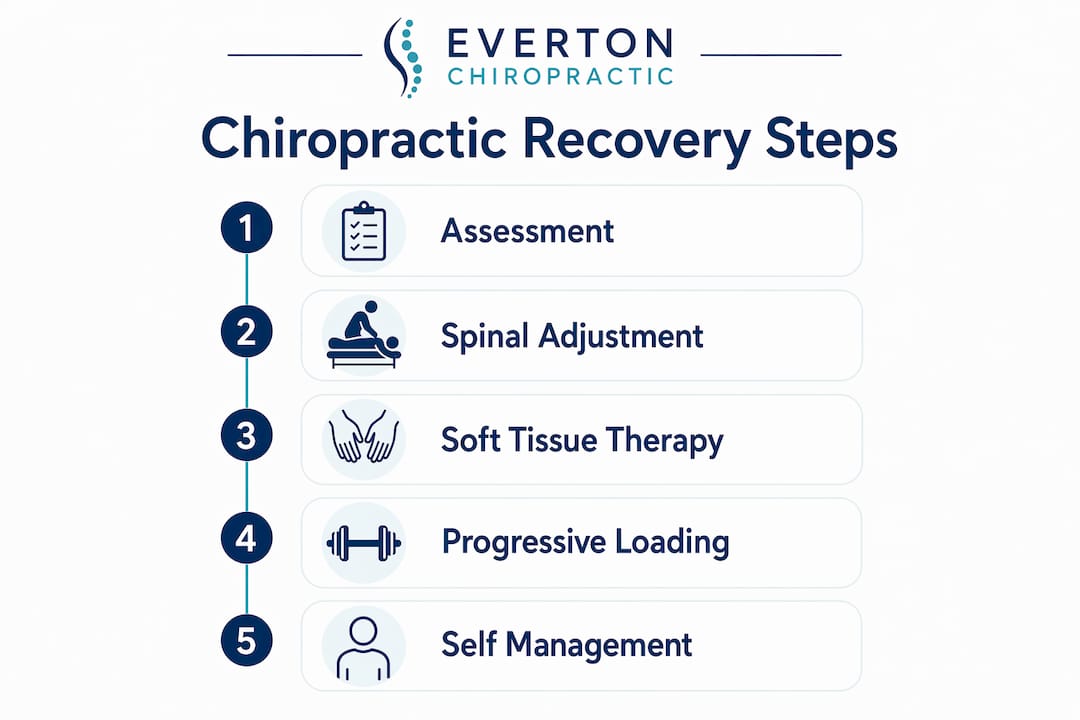
The staged structure of this approach is what separates it from generic treatment. Mayo Clinic clinicians describe a three-phase model: calm the irritability, restore mechanics, then rebuild load capacity. Each phase has a distinct goal, and moving too fast between phases is a primary reason overuse injuries become chronic.
Here is how a structured multimodal plan typically unfolds:
- Phase 1: Reduce irritability. Chiropractic adjustments, ice or heat, and activity modification lower pain and inflammation. The goal is not rest. The goal is controlled, pain-free movement.
- Phase 2: Restore mechanics. Myofascial release targets trigger points and adhesions in the affected tissue. Joint mobilization corrects movement patterns that created the overuse problem in the first place.
- Phase 3: Progressive loading. A 2026 review on tendon rehabilitation confirms that isometric, eccentric, and heavy slow resistance protocols improve pain, mechanical tissue properties, and function while reducing reinjury risk. Isometric holds are used first because they load the tendon without movement, which is tolerable even in the irritable phase.
- Phase 4: Sport or activity-specific training. Load is gradually reintroduced in patterns that mirror the patient’s actual activity demands, whether that is running, lifting, or desk-based posture under sustained load.
The critical insight from the tendon rehabilitation literature is that pain relief alone does not equal tissue recovery. A tendon can stop hurting while still being mechanically weak. Progressive loading is what builds the structural durability that prevents the injury from returning.
Chiropractors at clinics like Evertonchiropractic integrate shockwave therapy into this model for stubborn tendon cases. Shockwave stimulates tissue repair at the cellular level and pairs well with progressive loading protocols in the later phases of rehabilitation.
How can you self-manage and work with your chiropractor to prevent recurrence?
Self-management is not passive. The University of Maryland Medical System advises patients to monitor symptoms closely and avoid pushing through unusual pain, swelling, or aching. Ignoring early warning signs is the single most common reason overuse injuries escalate from minor irritation to months-long problems.
The practical framework for self-management centers on three variables: training volume, intensity, and technique. Modifying any one of these can reduce tissue load enough to allow healing without stopping activity entirely.
- Recognize early signals. Localized aching that appears during activity and lingers afterward is the body’s first warning. Act on it before it becomes constant pain.
- Apply the 10% rule. Avoid abrupt training increases; increase weekly volume or intensity by no more than 10% at a time. This principle applies to runners, gym athletes, and anyone in a physically demanding job.
- Warm up with movement, not static stretching. Dynamic warm-ups that mimic your activity pattern prepare tendons and joints better than static holds before exercise.
- Prioritize sleep and hydration. Tissue repair happens during sleep. Dehydration reduces tendon elasticity and increases injury risk.
- Use protective equipment correctly. Proper footwear, bracing, and ergonomic setups reduce repetitive mechanical stress at the source.
- Communicate with your chiropractor. Track your pain levels using a simple 0–10 scale before and after sessions. This data helps your chiropractor adjust loading progressions accurately.
Pro Tip: Keep a one-line training log noting your pain level, activity duration, and any technique changes. Bring it to each chiropractic session. Patterns in that log will tell your chiropractor more than memory alone.
The collaboration between patient and chiropractor is most effective when the patient understands the “why” behind each restriction or exercise. Evertonchiropractic’s approach, led by Dr. Richard, focuses on patient education as a core part of treatment. Patients who understand their injury recover faster and are less likely to reinjure.
Chiropractic vs. other rehabilitation options: which is right for you?
Chiropractic care and physical therapy share significant overlap in treating overuse injuries. Both use exercise prescription, manual therapy, and progressive loading. The distinction lies in emphasis: chiropractors prioritize joint alignment and spinal function, while physical therapists typically focus on neuromuscular retraining and movement pattern correction. For most overuse injuries, the two approaches are complementary rather than competing.
| Feature | Chiropractic care | Physical therapy |
|---|---|---|
| Primary focus | Joint alignment, spinal function, SMT | Neuromuscular retraining, movement patterns |
| Manual therapy | Spinal and peripheral joint manipulation | Soft tissue mobilization, joint mobilization |
| Exercise prescription | Progressive loading, rehabilitative exercise | Functional movement, strength and conditioning |
| Safety profile | Low risk; screening required for high-risk patients | Low risk; appropriate for most populations |
| Best for | Joint-driven overuse injuries, spinal involvement | Movement-pattern errors, post-surgical rehab |
| Integrative care | Works well alongside physical therapy and shockwave | Works well alongside chiropractic and massage |
The Cleveland Clinic’s collaborative care model positions chiropractors as coordinators within a broader musculoskeletal care team. When a patient’s overuse injury involves both spinal dysfunction and significant movement pattern errors, a referral between disciplines produces better outcomes than either profession working alone.
Screening for contraindications applies equally to both professions. Patients with complex comorbidities require individualized risk assessment before any manual therapy begins. This is not a barrier to care. It is the standard that makes care safe.
For patients comparing options, the chiropractic vs. physiotherapy breakdown at Evertonchiropractic provides a practical framework for making that decision based on your specific injury type.
Key Takeaways
Effective overuse injury recovery requires chiropractic adjustments, progressive loading, and patient-led self-management working together as a staged, evidence-based plan.
| Point | Details |
|---|---|
| SMT provides short-term relief | Cochrane evidence confirms modest but real pain reduction and functional gains from spinal manipulation. |
| Multimodal care outperforms single treatments | Combining SMT, myofascial release, and progressive loading produces better long-term outcomes than adjustments alone. |
| Progressive loading rebuilds tissue | Isometric, eccentric, and heavy slow resistance protocols restore tendon strength and reduce reinjury risk. |
| Self-management prevents recurrence | Monitoring symptoms early, applying the 10% rule, and tracking pain levels keeps recovery on course. |
| Safety requires individualized screening | Comorbidities like osteoporosis or anticoagulant use demand modified techniques, not avoidance of care. |
What I’ve learned about overuse injuries that most articles get wrong
Most content on overuse injuries treats pain relief as the finish line. That framing is the core problem. Pain can disappear while the underlying tissue remains structurally weak. I have seen this pattern repeatedly: a patient feels better after a few adjustments, returns to full training, and reinjures within weeks. The injury did not resolve. The irritability did. Those are not the same thing.
The staged rehabilitation model changes this. Calming irritability is Phase 1. Rebuilding mechanical capacity is the actual goal. Chiropractors who skip straight from adjustments to discharge are leaving patients exposed. The ones who integrate progressive loading protocols, monitor pain response, and educate patients on the 10% rule produce durable recoveries.
The other thing most articles miss is the role of movement pattern correction. An overuse injury is almost always a load distribution problem, not just a tissue problem. The tendon or joint that hurts is absorbing stress that should be shared across a wider kinetic chain. Fixing the painful site without addressing the movement driver is like patching a leak without fixing the pressure. Chiropractic care, when done well, addresses both. The role of chiropractic in injury prevention extends well beyond the treatment room when patients carry those movement corrections into their daily training.
— Aman
Evertonchiropractic’s approach to overuse injury recovery
Persistent overuse injuries do not resolve with rest alone. They need a structured plan that moves through irritability management, mechanical correction, and tissue loading in the right sequence.
Evertonchiropractic, led by Dr. Richard, builds exactly that kind of plan for each patient. Treatment combines chiropractic adjustments, rehabilitative exercise, and shockwave therapy where appropriate, all tailored to your specific injury and activity demands. If lower back pain is part of your overuse picture, the lasting lower back pain relief guide covers the full range of non-medication options available at the clinic. For tendon-driven overuse injuries, shockwave therapy accelerates tissue repair and pairs directly with progressive loading protocols. Book a consultation to get a clear assessment of your injury stage and a plan built around your goals.
FAQ
What is an overuse injury in chiropractic terms?
An overuse injury is tissue damage caused by repetitive mechanical stress that exceeds the body’s repair rate. Chiropractors address it by correcting joint alignment, reducing load on irritated tissue, and rebuilding capacity through progressive rehabilitation.
How many chiropractic sessions does it take to recover from an overuse injury?
Recovery timelines vary by injury severity, tissue type, and how long the problem has been present. Most patients see meaningful functional improvement within 6–12 sessions when chiropractic adjustments are combined with progressive loading exercises.
Is chiropractic care safe for tendon-based overuse injuries?
Yes. Chiropractic SMT and mobilization are appropriate for most tendon overuse injuries. Clinicians screen for contraindications first, and treatment is modified for patients with conditions like osteoporosis or inflammatory arthritis.
Can chiropractic care prevent overuse injuries from recurring?
Chiropractic care reduces recurrence risk by correcting the movement patterns and joint restrictions that created the overuse problem. Pairing adjustments with progressive loading and patient education produces the most durable results.
When should I see a chiropractor instead of waiting out an overuse injury?
See a chiropractor when localized pain or aching persists beyond a few days, worsens with activity, or returns after rest. Early intervention prevents the reactive tissue state from becoming a chronic, harder-to-treat condition.