The role of lifestyle in spinal wellness is the complete set of daily choices — exercise, nutrition, posture, sleep, and movement habits — that directly determine whether your spine stays strong or breaks down over time. Clinicians call this the “modifiable risk factor” model of spinal health, meaning the biggest threats to your back are largely within your control. Back pain affects 8 out of 10 people during their lifetime, making it one of the most common and costly health problems worldwide. The good news is that the same research pointing to that statistic also confirms that consistent lifestyle changes reduce your risk significantly.
What are the key lifestyle factors that influence spinal health?
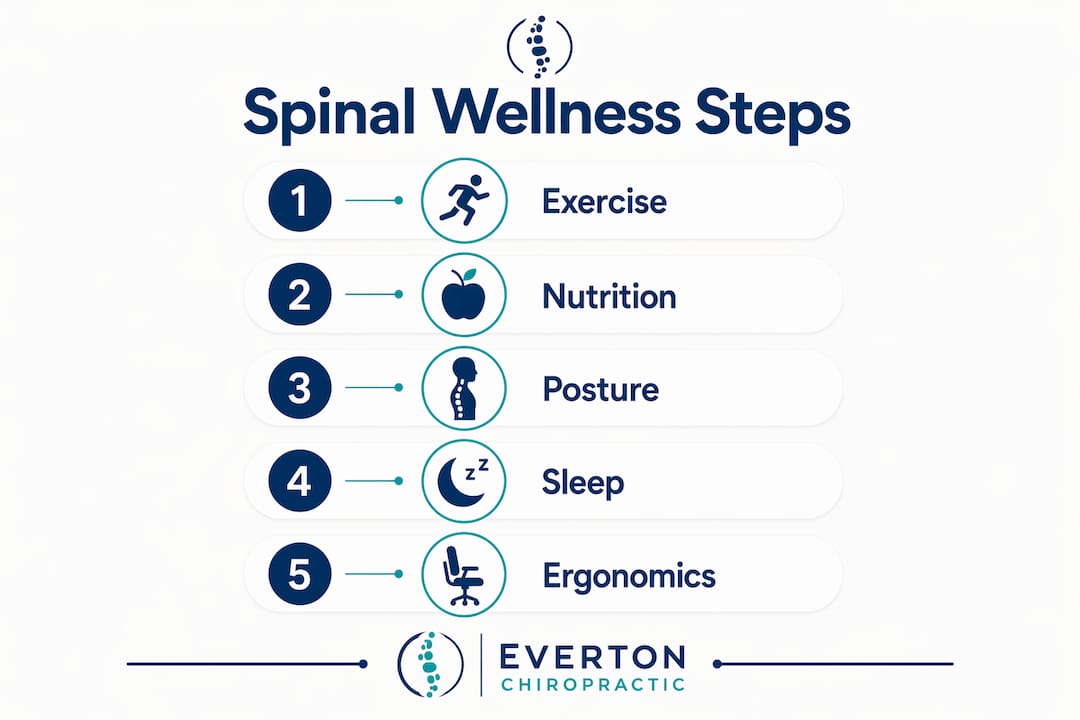
Spinal wellness depends on five lifestyle pillars working together: movement, nutrition, posture, sleep, and weight management. Each one affects your spine through a different mechanism, and neglecting any single pillar accelerates degeneration in the others.
-
Exercise frequency and type. Exercising 3–4 times weekly for 10–20 weeks produces measurable improvements in long-term spinal health. Low-impact activities like swimming combined with resistance training protect discs and prevent osteoporosis.
-
Nutrition and disc health. Specific dietary patterns causally protect or damage spinal discs. This is not a general correlation. Research published in Frontiers in Medicine confirms diet directly influences disc degeneration through both metabolic and biomechanical pathways.
-
Posture and ergonomics. Poor posture compresses spinal discs continuously. Over months and years, that compression accelerates degeneration in ways that are difficult to reverse.
-
Sleep and recovery. Spinal tissues repair themselves during rest, not during workouts. Cutting sleep short means your spine never fully recovers from the day’s load.
-
Weight management. Abdominal obesity is a stronger predictor of disc degeneration than general body mass index. Waist circumference matters more than the number on the scale.
Pro Tip: Think of your spine’s health as the product of 23 hours outside the gym, not the one hour inside it. What you do the rest of the day determines your long-term outcome.
How does exercise support spinal wellness and prevent injury?
Exercise is the most studied lifestyle factor for spinal health, but most people misunderstand what kind of exercise actually works. Heavy lifting alone is not the answer. Varied, low-level loads throughout the day build spinal resilience more effectively than gym sessions alone. Simple movements like glute bridges, step-ups, and carrying loads evenly across both sides of your body reduce injury risk in ways that a single weekly workout cannot replicate.
Here is a practical framework for exercise and spinal wellness:
-
Commit to 3–4 sessions per week. Research supports this frequency for measurable spinal improvement over a 10–20 week window. Consistency matters more than intensity.
-
Prioritize low-impact cardio. Swimming, walking, and cycling load the spine gently while building cardiovascular fitness. These activities improve disc nutrition by promoting fluid exchange in spinal tissues.
-
Build core strength with planks and Pilates. The “three Ps” framework, which includes planks, Pilates, and proper pillow support, is a clinically recognized approach to preventing back pain through structural support and postural awareness.
-
Add daily functional movements. Glute bridges, step-ups, and bodyweight squats distribute load across spinal structures throughout the day. These movements are not glamorous, but they are effective.
-
Protect recovery time. Spinal tissues strengthen during recovery, not during workouts. Skipping rest days does not accelerate progress. It increases the risk of fatigue-related injury.
For a deeper look at how evidence-based exercise frequency connects to overall spinal function, the health optimization framework at Healthmaxxing offers a practical breakdown of modalities and recovery cycles.
Pro Tip: Carry your groceries, bag, or backpack evenly on both sides whenever possible. Asymmetric loading is one of the most overlooked contributors to chronic spinal stress.
What nutritional habits promote a healthy spine?
Diet is the most underestimated lifestyle factor in spinal wellness. Most people focus on exercise and posture while ignoring the fact that what they eat directly shapes the health of their intervertebral discs.
Research from Frontiers in Medicine identifies specific foods with causal relationships to disc health. Apples, white fish, and cereal bars are associated with protective effects on spinal discs. Mushrooms and porridge, by contrast, are associated with increased disc degeneration risk. These are not minor associations. The study used Mendelian randomization, a method that establishes causation rather than correlation.
The mechanism behind diet’s impact on the spine runs through two pathways: systemic inflammation and metabolic load. A diet that promotes chronic inflammation degrades disc tissue over time. A diet that drives abdominal obesity increases mechanical pressure on lumbar discs, compressing them beyond their design tolerance.
| Dietary Factor | Effect on Spinal Discs |
|---|---|
| Apples | Protective; associated with reduced degeneration risk |
| White fish | Protective; anti-inflammatory omega-3 profile |
| Cereal bars | Protective in research findings |
| Mushrooms | Associated with increased degeneration risk |
| Abdominal fat | Increases mechanical load and systemic inflammation |
- Reduce processed foods that drive systemic inflammation, including refined sugars and trans fats.
- Prioritize anti-inflammatory proteins like white fish, sardines, and lean poultry.
- Maintain a healthy waist circumference. Abdominal obesity is a stronger predictor of disc degeneration than general BMI.
- Stay hydrated. Spinal discs are largely water-based structures that lose height and shock-absorbing capacity when dehydrated.
Metabolic health and spinal health are directly linked. Managing blood sugar, reducing visceral fat, and eating an anti-inflammatory diet are not just heart health strategies. They are spinal health strategies too.
How do daily habits, posture, and ergonomics affect your spine?
Your spine spends far more time responding to your daily habits than to your workouts. Posture, sitting duration, screen time, and sleep position all create cumulative mechanical forces on spinal structures. Those forces either protect or degrade your spine depending on how you manage them.

Prolonged sitting and poor posture compress spinal discs, worsening degeneration and pain over time. Regular movement breaks and ergonomic workstation setups reduce those compressive forces and improve long-term outcomes. This is not a minor adjustment. It is a structural intervention.
For office workers, the workday spinal care practices recommended by Evertonchiropractic address exactly this problem: how to set up your workspace and schedule movement breaks to protect your spine during the hours you spend seated.
The problem starts earlier than most people realize. Over 80% of adolescents worldwide do not meet WHO physical activity recommendations. Sedentary habits and digital device use exceeding 5–8 hours daily are already damaging young spines. That means spinal degeneration risk is being set in childhood, not just in middle age.
Practical daily habits that protect your spine:
- Set a timer to stand and move for two minutes every 30–45 minutes of sitting.
- Position screens at eye level to prevent forward head posture, which adds up to 60 pounds of force on the cervical spine at a 60-degree angle.
- Sleep on your side with a pillow between your knees, or on your back with a pillow under your knees, to maintain neutral spinal alignment overnight.
- Address bone density early. Screening for kyphosis is recommended for women at 65 and men at 70, or earlier if risk factors are present.
Pro Tip: Ergonomics should be addressed before you notice a problem, not after. By the time you see a visible spinal curve or feel persistent pain, the structural changes have already been building for years.
For a practical guide on using better posture to prevent injury, Evertonchiropractic has published a step-by-step resource covering core exercises and postural awareness techniques.
Key takeaways
Lifestyle choices are the primary driver of long-term spinal health, and the most effective approach combines daily movement, anti-inflammatory nutrition, consistent sleep, and postural awareness.
| Point | Details |
|---|---|
| Daily movement beats gym-only | Varied low-level loads throughout the day build more spinal resilience than isolated workouts. |
| Diet causally affects discs | Apples and white fish protect disc health; abdominal obesity accelerates degeneration through inflammation and mechanical load. |
| Recovery is non-negotiable | Spinal tissues repair during sleep and rest days, not during exercise sessions. |
| Posture damage is cumulative | Prolonged sitting and poor ergonomics compress discs daily, and the damage compounds over years. |
| Start early, screen proactively | Spinal degeneration risk begins in childhood; bone density screening and ergonomic habits should start well before symptoms appear. |
What i’ve learned about spinal wellness that most articles miss
Most spinal health content focuses on what to do in the gym. That is the wrong frame entirely. The spine is loaded every waking hour, and the quality of those loads across a full day determines your outcome far more than any single workout.
What I see consistently is that people who manage chronic back pain well are not necessarily the ones doing the most exercise. They are the ones who have built small, consistent habits into their daily routine: moving every 30 minutes, sleeping with proper support, eating in a way that keeps inflammation low, and managing stress so their nervous system is not in a constant state of tension.
The nutrition finding from Frontiers in Medicine is the one that surprises people most. The idea that eating apples and white fish has a causal protective effect on your intervertebral discs is not intuitive. But it reflects a deeper truth: your spine is a living tissue system, and it responds to everything you put into your body, not just the exercises you perform.
Sleep is the other factor people consistently underestimate. Spinal tissues do not strengthen during your workout. They strengthen during the hours afterward, when you are resting and your body is rebuilding. Cutting sleep to make time for more exercise is a trade that works against you.
The most sustainable approach is to build habits you actually enjoy. A 20-minute walk you take every day beats a 90-minute gym session you dread and skip. Find the movements, foods, and recovery practices that fit your life, and build from there.
— Aman
How Evertonchiropractic can support your spinal wellness goals
Lifestyle changes are more effective when you have professional guidance tailored to your specific spine, posture, and movement patterns. Evertonchiropractic, led by Dr. Richard, takes an evidence-informed approach that connects your daily habits directly to your spinal function and long-term mobility.
Whether you are dealing with persistent lower back pain or want to prevent it before it starts, Evertonchiropractic offers personalized assessments, ergonomic advice, and movement plans built around your lifestyle. Their lasting lower back pain relief guide is a strong starting point if you want to understand how clinical care and lifestyle work together. The clinic’s philosophy is straightforward: physical decline is not inevitable, and the right habits, supported by expert care, keep you moving fully at every age.
FAQ
What is the role of lifestyle in spinal wellness?
Lifestyle choices including exercise, nutrition, posture, and sleep are the primary modifiable factors that determine long-term spinal health. Research confirms that consistent daily habits reduce disc degeneration risk and back pain incidence more effectively than any single clinical intervention.
How often should you exercise for spinal health?
Exercising 3–4 times per week for 10–20 weeks produces significant improvements in spinal health. Combining low-impact cardio like swimming with resistance training and daily functional movements delivers the best results.
Does diet really affect spinal disc health?
Yes. Research using Mendelian randomization confirms that specific foods causally affect intervertebral disc health. Apples, white fish, and cereal bars are protective, while abdominal obesity driven by poor diet accelerates disc degeneration through mechanical overload and systemic inflammation.
How does sitting affect your spine?
Prolonged sitting compresses spinal discs and worsens degeneration over time. Taking a two-minute movement break every 30–45 minutes and using an ergonomic workstation setup significantly reduces those compressive forces.
When should you start screening for spinal degeneration?
Bone density screening to prevent kyphosis is recommended for women at age 65 and men at age 70, or earlier if risk factors like sedentary lifestyle, poor diet, or family history are present. Ergonomic habits should start well before any symptoms appear.
Recommended
- Why Spinal Health Matters Long Term for Your Wellness – Everton Chiropractic
- Why Spinal Adjustments Restore Function: 2026 Guide – Everton Chiropractic
- Workday Spinal Care Best Practices for Office Workers – Everton Chiropractic
- How Chiropractic Prevents Degeneration: 2026 Guide – Everton Chiropractic