Chiropractic care is defined as a structured clinical discipline that realigns the musculoskeletal system to reduce nerve interference, improve circulation, and accelerate the body’s natural healing process. Understanding how chiropractic speeds recovery time matters most when you are already dealing with an injury, post-surgical stiffness, or chronic pain that won’t quit. Research published in 2026 shows that patients who chose chiropractic as their first provider after a back injury had significantly lower disability rates than those who started with a primary care physician. That gap is not a coincidence. It reflects how spinal alignment, nerve function, and tissue repair are deeply connected.
How chiropractic speeds recovery time: what the research shows
The strongest evidence for chiropractic benefits for recovery comes from a 2026 cohort study of 1,219 workers with back injuries. Workers who started with chiropractic care had a 4.8% disability rate at one year, compared to 11.8% for those who started with a primary care physician. That adjusted odds ratio of 0.45 means chiropractic-first patients were more than twice as likely to return to full function. The practical implication is clear: provider choice at the start of recovery shapes the entire trajectory.
A separate randomized clinical trial, the PACBACK study, compared spinal manipulation combined with clinician-supported self-management against standard medical care for low back pain. The combined approach produced a 64% responder rate at 10–12 months, versus 55% for medical care alone. That 12% reduction in chronic pain interference in daily activities is clinically meaningful. It shows that chiropractic treatment for faster healing works best when paired with structured self-management, not as a standalone passive treatment.
Military clinical trials add another layer. Analysis published in april 2026 found that mechanical improvements in the first 6 weeks of chiropractic care set the foundation for longer-term gains like better sleep and energy over 52 weeks. Early progress is not just a good sign. It is the biological window that determines how well the rest of recovery unfolds.
| Study | Population | Key Outcome | Recovery Metric |
|---|---|---|---|
| 2026 Cohort Study | 1,219 workers with back injuries | Chiropractic-first vs. primary care | 4.8% vs. 11.8% disability at 1 year |
| PACBACK Clinical Trial | Adults with low back pain | Self-management + spinal manipulation | 64% vs. 55% responder rate at 10–12 months |
| Military LBP Trial | Active-duty US military personnel | Chiropractic care over 52 weeks | Improved pain, sleep, and energy metrics |
Which physiological mechanisms explain how chiropractic aids healing?
Chiropractic care speeds healing through three overlapping biological pathways: nerve regulation, blood flow, and joint mobility restoration. When the spine is misaligned, it compresses nerves and restricts the signals that coordinate tissue repair. Correcting that alignment removes the interference and lets the nervous system do its job. This is not a metaphor. It is measurable in reduced inflammation markers and improved motor function.

The second pathway is vascular. Chiropractic adjustments improve blood flow and lymphatic drainage, which clears metabolic waste from injured tissue and delivers the oxygen and nutrients needed for repair. This is why patients recovering from post-workout soreness or soft tissue injuries often report faster symptom resolution with regular adjustments. The body’s repair system runs on circulation, and chiropractic care keeps that system open.
The third pathway is biomechanical. Restricted joints force surrounding muscles and tendons to compensate, creating secondary strain patterns that outlast the original injury. Restoring joint mobility through spinal adjustments breaks that compensation cycle before it becomes permanent. Research on accident-related injuries confirms that functional recovery milestones like return to work occur weeks earlier in patients receiving chiropractic care versus standard medical treatment.
Key physiological benefits of chiropractic care during recovery:
- Nerve decompression: Realignment reduces pressure on spinal nerves, improving signal transmission to injured tissues.
- Reduced inflammation: Adjustments down-regulate the nervous system’s stress response, lowering inflammatory cytokine activity.
- Improved lymphatic drainage: Better fluid movement clears cellular debris from injury sites faster.
- Joint mobility restoration: Corrected movement mechanics prevent compensatory strain from becoming a secondary injury.
- Postural correction: Improved alignment reduces chronic load on healing structures, letting them repair without constant re-aggravation.
Pro Tip: Seek chiropractic evaluation within 24–72 hours of an injury. Early intervention prevents compensatory movement patterns from becoming neurologically fixed, which is one of the hardest recovery obstacles to reverse later.
Chiropractic vs. other recovery methods: how do they compare?
Chiropractic care is not a replacement for physiotherapy or medical care. It is a distinct first-line option with specific strengths in structural correction and nerve function. The comparison matters because choosing the wrong starting point can add weeks to your recovery.
Medical care excels at acute pain management and ruling out serious pathology. What it does not address is the underlying mechanical dysfunction that often drives ongoing pain. Physiotherapy focuses on strength and movement rehabilitation, which is critical in later recovery phases. Chiropractic care addresses the structural foundation that makes those later phases more effective. The chiropractic versus physiotherapy distinction matters most in the first weeks after injury, when the body is most responsive to structural correction.
The PACBACK trial data is instructive here. Spinal manipulation alone did not significantly outperform medical care in isolation. But combined with clinician-supported self-management, it produced meaningfully better outcomes. This tells you that chiropractic care works best as part of a coordinated plan, not as a single-modality treatment.
| Recovery Approach | Primary Strength | Limitation | Best Phase |
|---|---|---|---|
| Chiropractic Care | Structural alignment, nerve function | Requires multiple visits | Acute and corrective phases |
| Physiotherapy | Strength, mobility rehabilitation | Less focus on spinal alignment | Rehabilitation phase |
| Medical Care | Pain management, diagnostics | Does not address mechanical dysfunction | Acute phase only |
| Combined (Chiro + Self-Management) | Functional outcomes, chronic pain prevention | Requires patient commitment | All phases |
For sciatica and disc injuries specifically, the chiropractic approach to sciatica targets the nerve root compression directly, which physiotherapy alone cannot replicate. The right choice depends on your injury type, but for most musculoskeletal injuries, chiropractic care as a first provider produces the best long-term outcomes.
What are the typical recovery phases with chiropractic care?
Chiropractic recovery follows a structured progression. Expecting results in two visits sets you up for frustration. Understanding the phases sets you up for success.
Phase 1: Acute Care (Weeks 1–6)
This phase focuses on reducing inflammation, restoring basic mobility, and stabilizing the nervous system. Visits are typically more frequent, often two to three times per week. The mechanical improvements in this window are the foundation for everything that follows. Patients who skip or rush this phase often plateau in Phase 2.
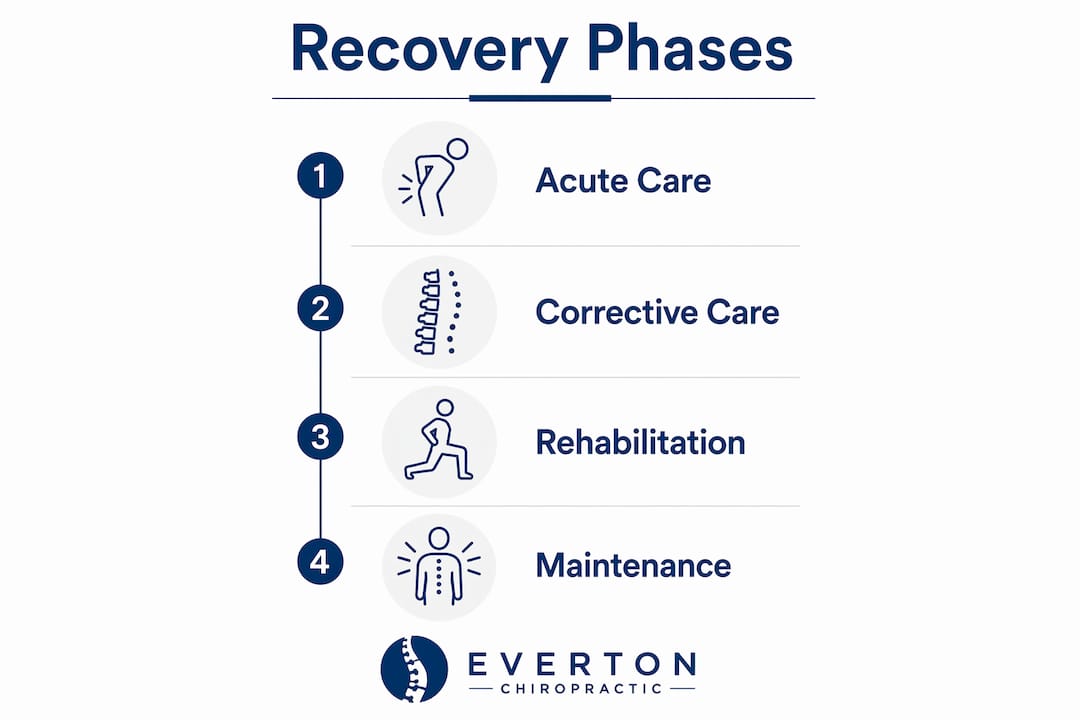
Phase 2: Corrective Care (Weeks 6–16)
Once acute inflammation is controlled, the focus shifts to correcting the underlying structural dysfunction. Spinal adjustments become more targeted. Rehabilitation exercises are introduced to reinforce alignment gains. Visit frequency typically drops to once or twice per week.
Phase 3: Rehabilitation and Strengthening (Months 4–6)
This phase rebuilds functional strength around the corrected structure. The goal is not just pain relief. It is restoring the movement capacity you need for work, sport, and daily life. Patients recovering from surgery often spend the most time here.
Phase 4: Maintenance Care (Ongoing)
Periodic adjustments maintain alignment and prevent regression. This phase is especially relevant for patients with physically demanding jobs or histories of recurring injury.
A full course of care typically spans 20 to 30 visits, reflecting the time required for genuine tissue healing rather than symptom suppression. That timeline is not arbitrary. Ligaments, discs, and joint capsules heal on biological schedules that cannot be compressed by willpower alone.
Pro Tip: Track your functional gains weekly, not just your pain levels. Patients who wait for pain to disappear before resuming activity often delay optimal recovery by weeks. Movement milestones are a more reliable recovery signal than pain scores.
Key takeaways
Chiropractic care speeds recovery by correcting structural alignment, reducing nerve interference, and improving circulation, with the greatest gains occurring in the first six weeks of care.
| Point | Details |
|---|---|
| Start chiropractic care early | Seeking care within 24–72 hours post-injury prevents compensatory patterns from becoming permanent. |
| Chiropractic-first reduces disability | Workers who chose chiropractic first had 4.8% disability at one year versus 11.8% with primary care. |
| Combine care with self-management | Spinal manipulation plus self-management produced a 64% responder rate versus 55% for medical care alone. |
| Recovery requires 20–30 visits | Full tissue healing follows a biological timeline that a structured visit plan supports, not shortcuts. |
| Track function, not just pain | Weekly functional movement monitoring guides rehabilitation better than waiting for pain to resolve. |
The part most patients get wrong about recovery speed
Most people come in expecting chiropractic care to work like a painkiller. They want the discomfort gone in two sessions, and when it isn’t, they assume the treatment isn’t working. That framing misses the entire point of what chiropractic care actually does.
What I’ve seen consistently is that the patients who recover fastest are not the ones who push hardest. They are the ones who show up consistently, follow the phased plan, and treat the process with the same discipline they’d apply to physical training. Recovery is a biological process. You can create the right conditions for it, but you cannot force it.
The research on biopsychosocial self-management reinforces this. The patients who integrate structured self-care with their chiropractic visits outperform those who rely on adjustments alone. That means sleep, movement, stress management, and nutrition all contribute to how fast your body heals. Chiropractic care optimizes the structural environment. What you do between visits determines how well that environment holds.
The other mistake I see is delayed evaluation. A patient waits three weeks after a car accident because the pain “wasn’t that bad.” By the time they come in, the compensatory movement patterns are already entrenched. Those patterns take twice as long to correct as the original injury would have. Mild stiffness after an injury is not something to wait out. It is a signal to act.
Speeding up recovery with chiropractic care is not about finding a shortcut. It is about removing the obstacles that slow healing down and giving your body the structural foundation it needs to repair properly.
— Aman
How Evertonchiropractic can support your recovery
Recovering from an injury or surgery is not a passive process, and the clinical team at Evertonchiropractic is built around that reality. Led by Dr. Richard, the clinic designs personalized recovery plans that address your specific injury, movement goals, and lifestyle, not a generic protocol.

Whether you’re dealing with lower back pain after a workplace injury, neck pain and headaches from an accident, or post-surgical stiffness that won’t resolve, Evertonchiropractic uses evidence-informed techniques to restore alignment and accelerate your return to full function. The clinic also offers shockwave therapy as an adjunctive option for patients who need additional support with muscle and soft tissue recovery. Book a consultation to start your structured recovery plan today.
FAQ
How quickly does chiropractic care show results?
Most patients notice measurable improvements in mobility and pain within the first 6 weeks of care. A 2026 military clinical trial confirmed that mechanical gains in this initial window set the foundation for longer-term recovery benefits over 52 weeks.
Is chiropractic care safe after surgery?
Chiropractic care is generally safe after surgery when the chiropractor is informed of your surgical history and adapts techniques accordingly. Dr. Richard at Evertonchiropractic tailors every treatment plan to individual health status and recovery stage.
Does chiropractic care work better than physiotherapy for injuries?
Chiropractic care and physiotherapy address different aspects of recovery. Chiropractic care corrects structural alignment and nerve function, while physiotherapy rebuilds strength. Combined approaches consistently produce better outcomes than either method alone.
How many chiropractic visits does recovery typically require?
A full recovery course typically spans 20 to 30 visits, structured across acute, corrective, and rehabilitation phases. The exact number depends on injury severity, patient commitment, and how early care begins.
Can chiropractic care help with accident-related injuries?
Yes. A systematic review of whiplash and accident-related injuries found that patients receiving chiropractic care returned to work and normal activities weeks earlier than those receiving standard medical treatment, with better pain and function outcomes.
Recommended
- Faster Recovery from Sports Injuries: A Guide for Singaporean Athletes – Everton Chiropractic
- Combining Red Light Therapy and Chiropractic Adjustments for Faster Healing – Everton Chiropractic
- Why Spinal Adjustments Restore Function: 2026 Guide – Everton Chiropractic
- Non-Surgical Slipped Disc Recovery: What a Chiropractor Can Do for You – Everton Chiropractic