
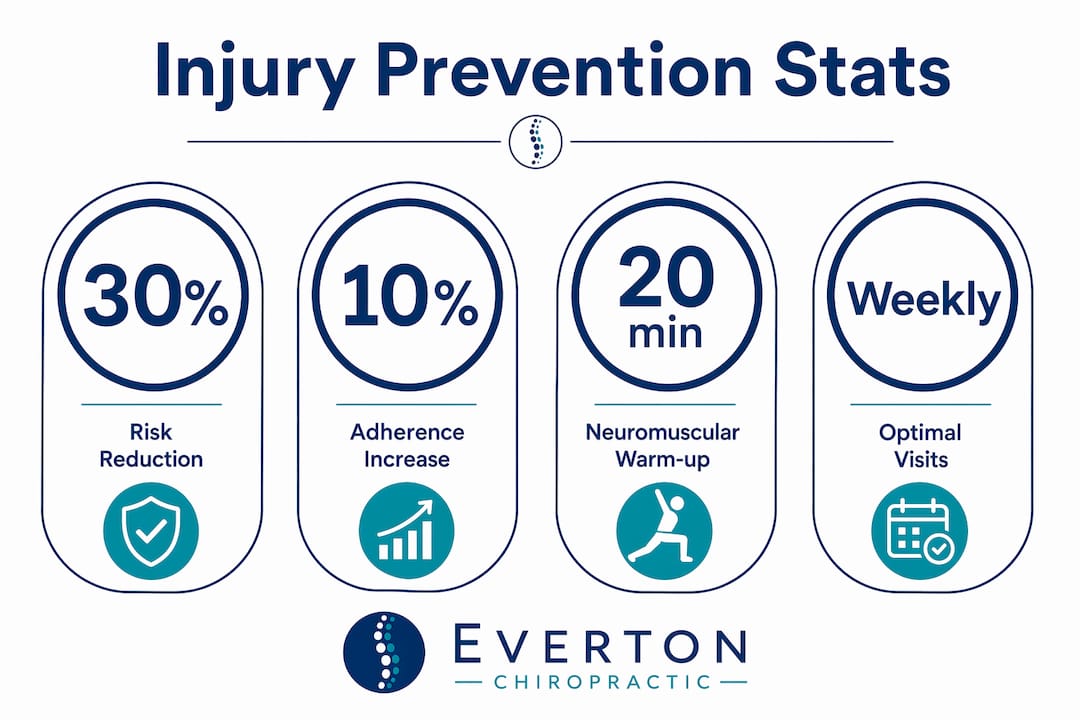
Chiropractic care for injury prevention is defined as a proactive clinical approach that uses spinal adjustments, neuromuscular training, and functional stability exercises to reduce injury risk before pain ever develops. Athletes who work with a chiropractor to prevent sports injuries with chiropractic methods gain measurable advantages in joint stability, movement efficiency, and biomechanical control. A 2026 meta-analysis confirms that functional stability training reduces lower-limb injury risk by approximately 30%. That figure represents a meaningful reduction in time lost to injury, not just a statistical footnote. Dr. Richard at Evertonchiropractic describes this approach as “prehabilitation,” a term that captures the shift from reactive pain treatment to proactive movement optimization.
How chiropractic techniques prevent sports injuries
Sports rehab chiropractic addresses movement imbalances and biomechanics rather than simply treating pain after it appears. The core toolkit includes spinal adjustments, corrective exercises, and mobility drills that target performance directly. Each of these components serves a specific mechanical purpose in the athlete’s body.
Spinal adjustments restore joint function and correct the compensatory movement patterns that lead to overuse injuries. Adjustments combined with exercises improve biomechanics and reduce the muscle compensation that quietly accumulates across a training season. When one joint moves poorly, surrounding muscles work harder to compensate, and that extra load is where injuries are born.

Neuromuscular training is the second pillar. Research shows that sessions of three or more times per week lasting 30 to 45 minutes over eight weeks maximizes injury prevention outcomes. This protocol incorporates strength, jump, balance, and agility training in combination, not as isolated drills. The integrated approach trains the nervous system to respond faster and more accurately under athletic load.
The specific components a chiropractor builds into a prevention program typically include:
- Proprioceptive training: Single-leg balance progressions and unstable surface work that sharpen the body’s position sense
- Eccentric strength loading: Slow, controlled lowering movements that build tendon and muscle resilience against sudden force
- Joint mobility drills: Hip, thoracic, and ankle mobility work that restores full range of motion and reduces compensatory strain
- Perturbation training: Unexpected balance challenges that train reactive stabilization in the knee, ankle, and hip
- Exercise-based warm-ups: Programs like FIFA 11+ that link neuromuscular activation directly to lower-extremity injury reduction
Pro Tip: Combine your chiropractic adjustment appointment with a 20-minute neuromuscular warm-up on the same day. The adjustment opens joint mobility, and the neuromuscular work locks in the new movement pattern before your nervous system reverts to old habits.
Does adherence to prevention programs actually reduce injury risk?
Consistency is the variable most athletes underestimate. A 2026 meta-analysis found that every 10% increase in adherence00129-5/abstract) to functional stability training correlates with a 10% reduction in injury risk. That is a direct, linear relationship. Athletes who show up 75% of the time or more capture the strongest protective effect, with a risk ratio of 0.70 compared to those with low participation.
Multicomponent programs outperform single-focus approaches by a significant margin. A program that combines balance, strength, and mobility training produces better outcomes than one that targets only strength or only flexibility. The body’s injury risk is multifactorial, and the prevention strategy must match that complexity.
Common adherence barriers and practical solutions:
- Time constraints: Schedule chiropractic and neuromuscular sessions as fixed calendar appointments, not optional add-ons. Athletes who block training time the way they block competition time maintain far higher participation rates.
- Perceived irrelevance when healthy: Track movement quality metrics like single-leg squat depth or shoulder rotation range so athletes see objective progress even without pain as a motivator.
- Program monotony: Rotate exercise variations every four weeks while keeping the core movement patterns consistent. The stimulus changes; the protective adaptation accumulates.
- Lack of professional accountability: Working with a chiropractor who monitors progress and adjusts the program creates external accountability that self-directed athletes rarely sustain alone.
The distinction between multicomponent and single-focus programs matters practically. An athlete who only stretches, or only lifts, leaves significant injury risk on the table. The chiropractic role in injury prevention is partly organizational: a skilled clinician builds the multicomponent structure that most athletes would not design for themselves.
When should athletes integrate chiropractic into their training cycle?
The right time to start chiropractic injury prevention is before the first injury, not after. This is the core distinction between prehabilitation and rehabilitation. Prehabilitation trains tissues proactively through slow eccentric loading, joint mobility drills, and perturbation training to strengthen joints before stress accumulates to injury threshold.
Chiropractors identify subclinical movement dysfunctions, limited range of motion, uneven gait patterns, and asymmetric loading, before these issues produce pain. Proactive movement assessment catches these problems at the stage where correction takes weeks, not months of rehabilitation. Most athletes do not notice these asymmetries until an overuse injury forces them off the field.
The table below outlines how chiropractic care maps onto a standard training cycle:
| Training phase | Chiropractic focus | Recommended visit frequency |
|---|---|---|
| Off-season | Baseline movement assessment, corrective exercise programming | Every 2 to 3 weeks |
| Pre-season | Neuromuscular training integration, joint mobility optimization | Weekly |
| In-season | Maintenance adjustments, load management, asymmetry monitoring | Every 1 to 2 weeks |
| Post-season | Recovery support, movement pattern reset, injury audit | Every 2 to 4 weeks |
Athletes who treat chiropractic as a seasonal resource rather than a year-round tool miss the compounding benefit. Movement quality built in the off-season protects the athlete during the high-load demands of competition. The posture and injury connection is particularly relevant here: postural compensations that develop during a long season become the injury risk factors of the next.
What injuries does chiropractic care prevent and how does it improve performance?
Chiropractic care targets the injury types most common in athletic populations: lower-limb injuries including hamstring strains, ACL stress, and ankle sprains; lower back pain from repetitive loading and rotational sport demands; and shoulder dysfunction from overhead movement patterns in swimming, tennis, and throwing sports. Spinal adjustments restore joint function and reduce the overuse injury risk in the lower back and shoulder by correcting the imbalances that drive repetitive strain.
The performance benefits extend well beyond injury reduction. Athletes who complete structured neuromuscular prevention programs show measurable improvements in sprint speed, jump height, and single-leg balance. These are not side effects of injury prevention. They are direct outcomes of training the neuromuscular system to operate more efficiently under load.
| Injury type | Chiropractic intervention | Performance benefit |
|---|---|---|
| Hamstring strain | Eccentric loading, lumbopelvic alignment | Improved sprint mechanics |
| Ankle sprain | Proprioceptive training, joint mobilization | Better reactive balance |
| Lower back pain | Spinal adjustment, core stability training | Reduced fatigue under load |
| Shoulder impingement | Thoracic mobility, rotator cuff activation | Greater overhead power |
| Knee overuse injury | Hip strengthening, gait correction | More efficient running economy |
Pro Tip: Ask your chiropractor to assess your gait pattern and single-leg squat symmetry at your first appointment. Asymmetries greater than 15% between sides are a reliable early warning sign for lower-limb overuse injury, and correcting them takes far less time than recovering from the injury they predict.
Early detection of movement asymmetries is where chiropractic care for athletes delivers its clearest return on investment. Shoulder dysfunction in overhead athletes, for example, often originates from thoracic spine stiffness rather than the shoulder itself. A chiropractor who assesses the full kinetic chain finds the source; a clinician who treats only the symptom location misses it entirely.
Key takeaways
Chiropractic injury prevention works because it combines spinal adjustments, neuromuscular training, and proactive movement assessment into a system that addresses injury risk before symptoms develop.
| Point | Details |
|---|---|
| Functional stability training cuts risk | A 2026 meta-analysis shows a 30% lower-limb injury risk reduction with proper functional stability training. |
| Adherence drives outcomes | Every 10% increase in program adherence reduces injury risk by another 10%, with strongest effects above 75%. |
| Prehab beats rehab | Proactive eccentric loading and mobility drills prevent injury; rehabilitation corrects it after far greater cost. |
| Multicomponent programs outperform | Combining balance, strength, and mobility training produces better results than any single-focus approach. |
| Timing matters across the season | Year-round chiropractic integration, from off-season assessment to in-season maintenance, compounds protective benefit. |
Why I think most athletes are still playing defense with their bodies
The cultural shift is real. Younger athletes increasingly prioritize recovery and preventive care over the old “play through pain” mentality, and that shift is one of the most significant changes I have seen in how active people think about their bodies. But I still see a gap between attitude and behavior. Athletes say they value prevention, then only book a chiropractic appointment when something hurts.
The athletes who stay healthy longest are not the ones with the best genetics or the most talent. They are the ones who treat movement quality as a training variable with the same discipline they apply to strength or endurance. Corrective adjustments combined with neuromuscular training are not a recovery tool. They are a performance input. The distinction changes how you schedule them, how seriously you take adherence, and how you measure their value.
The partner resource at HollyFit captures this well: training like an athlete and recovering like a scientist are not separate goals. They are the same goal approached from both ends. Chiropractic care sits at that intersection, and athletes who recognize that stop waiting for pain to justify the investment.
— Aman
How Evertonchiropractic helps athletes stay injury-free
Evertonchiropractic, led by Dr. Richard, builds personalized injury prevention programs that combine spinal adjustments with functional stability and neuromuscular training tailored to each athlete’s sport, training load, and movement profile.

The clinic’s approach starts with a full movement assessment to identify asymmetries and subclinical dysfunctions before they become injuries. Athletes dealing with recurring lower back strain can explore lasting lower back pain solutions as part of a broader prevention plan. For those managing neck tension or headaches from training load, Evertonchiropractic’s neck pain and headache care addresses the root cause rather than the symptom. Prevention is the goal. Performance is the outcome.
FAQ
How often should athletes see a chiropractor for injury prevention?
During pre-season and in-season phases, weekly to biweekly visits optimize injury prevention outcomes. Off-season visits every two to three weeks support movement assessment and corrective programming.
What is the difference between prehab and rehab in chiropractic care?
Prehabilitation trains tissues proactively through eccentric loading and mobility drills before injury occurs. Rehabilitation restores function after injury, which takes significantly more time and resources.
Can chiropractic care improve athletic performance, not just prevent injury?
Neuromuscular training programs integrated with chiropractic care produce measurable improvements in sprint speed, jump height, and balance. These outcomes result directly from training the nervous system to operate more efficiently under athletic load.
Which sports injuries does chiropractic care most effectively prevent?
Chiropractic care most effectively targets lower-limb injuries like hamstring strains and ankle sprains, lower back overuse injuries, and shoulder impingement from overhead sports. Spinal adjustments and corrective exercises address the biomechanical root causes of each.
Does adherence to a chiropractic prevention program really matter?
A 2026 meta-analysis confirms that every 10% increase in adherence to functional stability training reduces injury risk by 10%, with the strongest protective effect at 75% participation or above.
Recommended
- The Role of Chiropractic in Injury Prevention – Everton Chiropractic
- Faster Recovery from Sports Injuries: A Guide for Singaporean Athletes – Everton Chiropractic
- Prevent Injury Through Better Posture: a Practical Guide – Everton Chiropractic
- Why Your Company Needs a Corporate Chiropractic Wellness Program – Everton Chiropractic