Spinal health is defined as the structural integrity, alignment, and functional capacity of the vertebral column and the neural pathways it protects. Why spinal health matters long term comes down to one fact: your spine governs every movement you make, every nerve signal your brain sends, and your body’s ability to stay upright and pain-free as you age. Chronic spinal pain is a leading cause of disability worldwide, reducing activity levels and triggering a cascade of muscle weakness, joint stiffness, and increased fall risk. Addressing spinal health early, through posture correction, manual therapy, and structured care programs, is the most direct path to preserving mobility and quality of life for decades.
Why spinal health matters long term for mobility and daily function
The spine is the mechanical axis of your entire body. Every step, bend, and reach depends on the vertebral column maintaining proper alignment so that muscles, joints, and connective tissue can distribute load evenly. When that alignment breaks down, the consequences compound quickly.

Spinal degeneration reduces activity levels, and reduced activity accelerates the degeneration further. This feedback loop is one of the most underappreciated threats to long-term wellness. People assume stiffness and pain are inevitable parts of aging. They are not. They are the result of neglected mechanics.
The mobility impacts of poor spinal health include:
- Flexibility loss in the lumbar and thoracic regions, limiting the range of motion needed for daily tasks like bending to tie shoes or reaching overhead
- Balance and coordination decline caused by disrupted proprioceptive signals from spinal joints and surrounding muscles
- Muscle weakening in the core and paraspinal muscles, which reduces spinal stability and increases injury risk
- Elevated fall risk, particularly in adults over 50, where spinal pain and stiffness are directly linked to reduced confidence in movement
- Secondary joint stress in the hips, knees, and shoulders, as the body compensates for a compromised spinal column
Pro Tip: Start addressing spinal stiffness before it becomes pain. Morning mobility routines of 10 to 15 minutes, focused on thoracic rotation and hip flexor lengthening, preserve the range of motion that protects your spine over decades.
The importance of spinal health for daily function cannot be separated from its role in preventing the slow erosion of independence. A person who loses 20 degrees of lumbar flexion by age 60 faces a fundamentally different quality of life than one who maintains it.
How does the spine protect your nervous system?
The spinal cord sits inside the vertebral column, running from the brainstem to the lumbar region, and it is the primary highway for nerve signals between your brain and every organ, muscle, and limb in your body. Spinal cord disruptions cause pain, numbness, and weakness throughout the body, not just at the site of damage. This is why a herniated disc at L4-L5 can produce shooting pain down the leg, and why a cervical misalignment can trigger headaches or arm tingling.
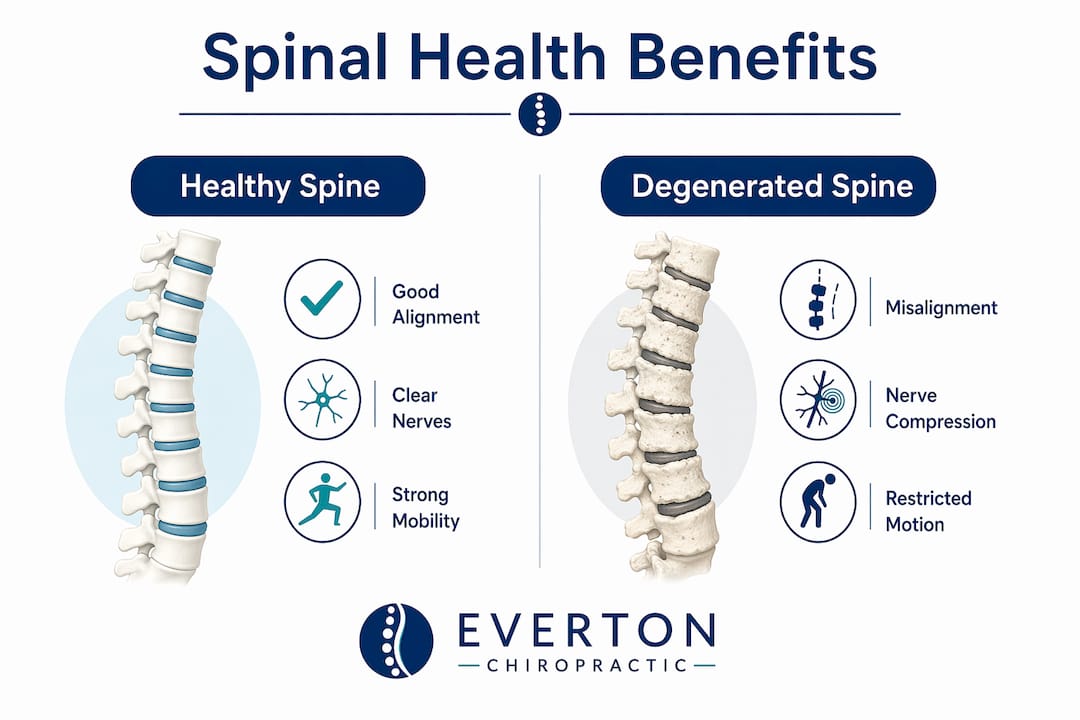
The table below shows the functional difference between a healthy spine and a degenerated one at the level of nerve communication:
| Function | Healthy spine | Degenerated spine |
|---|---|---|
| Nerve signal transmission | Clear, unobstructed pathways | Compressed or irritated nerve roots |
| Pain response | Localized, acute, resolves with healing | Chronic, widespread, radiating |
| Muscle activation | Coordinated, full strength | Inhibited, asymmetrical, weakened |
| Organ communication | Consistent autonomic signaling | Disrupted, contributing to systemic symptoms |
| Postural control | Active, responsive stabilization | Passive, fatigued, compensation-dependent |
Spinal misalignment does not just cause back pain. It disrupts the autonomic nervous system, which regulates heart rate, digestion, and immune response. Patients with chronic spinal compression often report digestive irregularities and fatigue that resolve after spinal alignment is restored. This is how spinal health and overall well-being are directly connected at a physiological level.
What are the most common degenerative spinal conditions?
Degenerative lumbar spinal stenosis, the narrowing of the spinal canal in the lower back, is one of the most prevalent long-term spinal conditions in adults over 50. It causes leg pain, numbness, and difficulty walking. Left unmanaged, it progresses to significant mobility loss.
Integrative medical programs combining manual therapy with standard care improve both pain and function in patients with degenerative lumbar spinal stenosis, with benefits persisting over 12 weeks and reducing the need for surgical intervention. This is a clinically significant finding because it confirms that structured, non-surgical care is not a passive alternative. It is an active treatment with measurable outcomes.
The comparison between surgical and non-surgical outcomes is more nuanced than most patients expect. Surgical decompression improves early function and pain relief in lumbar spinal stenosis, but non-surgical management outcomes converge with surgical outcomes over a five-year period. Surgery carries risks including infection, adjacent segment degeneration, and symptom recurrence. For many patients, a well-structured conservative care program produces equivalent long-term results without those risks.
Conservative care strategies for managing degenerative spinal conditions include:
- Manual therapy and chiropractic adjustments, which restore joint mobility and reduce nerve compression. Learn more about how adjustments restore function at Evertonchiropractic.
- Targeted exercise programs focused on core stabilization and spinal decompression movements
- Posture correction protocols, particularly for patients with forward head posture or lumbar lordosis loss
- Manual physical therapy techniques including joint mobilization and soft tissue work
- Pain neuroscience education, which changes how patients interpret and respond to pain signals
Pro Tip: Non-surgical spine care must be goal-directed and time-bound. Set specific functional targets, such as walking 30 minutes without pain, and schedule reassessments every 6 to 8 weeks. If progress stalls, the plan needs to change, not just continue.
What happens when you ignore spinal health and posture?
Poor posture increases disc pressure by up to 40%, accelerating degenerative disc disease and altering the mechanics of the sacroiliac joints. That pressure increase is not abstract. It means the cartilage and disc material in your lumbar spine wear down faster than your body can repair them.
Think of it this way: spinal wear mirrors a misaligned tire. A tire with uneven pressure wears through on one side in a fraction of the time it should last. Your spinal discs behave the same way under chronic postural load. The damage is slow, invisible, and cumulative until it is not.
The cascading effects of ignoring spinal health extend well beyond back pain:
- Osteoarthritis acceleration in the facet joints of the lumbar and cervical spine, caused by uneven mechanical loading
- Cardiovascular impact, as chronic pain elevates cortisol and inflammatory markers that stress the heart
- Digestive disruption, particularly when thoracic kyphosis compresses the abdominal cavity and reduces diaphragmatic movement
- Sleep degradation, since chronic spinal pain disrupts sleep quality and impairs the body’s overnight repair processes, worsening inflammation and pain perception the following day
- Psychological effects, including anxiety and depression linked to persistent pain and reduced physical capacity
Poor spinal alignment causes compensatory issues across the entire kinetic chain. Treating only the site of pain without addressing the underlying alignment problem leads to recurring symptoms. This is why people who treat lower back pain with rest and anti-inflammatories alone find themselves back in pain within months.
Practical strategies for maintaining spinal health long term
Long-term spine care is built on daily habits, not occasional interventions. The goal is to reduce cumulative mechanical stress while maintaining the strength and mobility that protect spinal structures.
| Habit or strategy | Impact on spinal health |
|---|---|
| Ergonomic workstation setup | Reduces lumbar disc pressure during prolonged sitting by maintaining neutral spine position |
| Movement variability throughout the day | Prevents sustained postural loading that accelerates disc degeneration |
| Core stabilization exercises | Strengthens the muscles that support the vertebral column and reduce joint stress |
| Regular chiropractic or manual therapy | Restores joint mobility, reduces nerve irritation, and corrects compensatory patterns |
| Posture correction training | Addresses forward head posture and lumbar lordosis loss before they become structural problems |
| Scheduled reassessment with a clinician | Catches early degeneration and adjusts care before symptoms escalate |
Structured conservative care improves function and reduces pain when managed adaptively, meaning the care plan evolves with the patient’s progress rather than staying static. This is the model Evertonchiropractic uses: personalized, goal-oriented, and reassessed regularly so that treatment stays effective rather than becoming routine.
Seek professional evaluation when you experience persistent pain lasting more than two weeks, numbness or tingling in the limbs, or a noticeable change in your posture or walking pattern. These are not signs to wait out. They are signals that the spine needs attention before the window for conservative care narrows. Physical therapy can prevent surgery when conservative care is applied early and consistently.
Key takeaways
Long-term spinal health requires consistent daily habits, early professional intervention, and goal-directed care that addresses alignment, nerve protection, and mobility together.
| Point | Details |
|---|---|
| Spine governs nerve function | Misalignment disrupts signals to muscles, organs, and limbs, causing widespread symptoms beyond back pain. |
| Degeneration is a feedback loop | Reduced mobility from spinal pain accelerates muscle weakness and joint stiffness, compounding decline. |
| Non-surgical care is clinically viable | Integrative programs match surgical outcomes over five years for many patients with degenerative conditions. |
| Poor posture accelerates disc wear | A 40% increase in disc pressure from poor posture speeds up degeneration and sacroiliac joint dysfunction. |
| Goal-directed care prevents stagnation | Structured reassessments every 6 to 8 weeks keep conservative treatment effective and prevent indefinite ineffective therapy. |
The case for treating your spine like a long-term investment
Most people I work with come in after years of ignoring signals their spine was sending. A little stiffness in the morning. Occasional aches after sitting too long. Mild neck tension that never quite goes away. They adapted around these symptoms instead of addressing them, and by the time they sought care, the degeneration was already significant.
The cultural assumption that physical decline is a normal part of aging is the most damaging idea in long-term health. It is not normal. It is common. Those are different things. Common means it happens to many people. Normal means it is supposed to happen. Your spine is not designed to fail in your 50s or 60s. It is designed to last a lifetime if you give it the mechanical inputs it needs.
What I have observed consistently is that patients who combine daily postural habits with periodic professional monitoring maintain function far longer than those who rely on reactive care. The spine responds well to consistency. Ten minutes of targeted mobility work every morning, an ergonomic setup at your desk, and a chiropractic check-in every few months is not a medical regimen. It is maintenance, the same way you service a car before it breaks down.
The other pattern I see is patients who pursue non-surgical care without clear goals. They come in, feel better, stop, regress, and repeat the cycle. Effective non-operative spine care requires specific, measurable targets and scheduled reassessments. Without those, care drifts and outcomes plateau. The patients who make lasting progress are the ones who treat their spine health as an ongoing commitment, not a problem to solve once.
— Aman
How Evertonchiropractic supports your long-term spinal health
Evertonchiropractic, led by Dr. Richard, takes a structured, evidence-informed approach to long-term spine care. The clinic focuses on posture correction, spinal alignment, and nerve protection through personalized treatment plans that evolve with each patient’s goals and progress.
Whether you are managing early stiffness, recovering from a degenerative condition, or simply want to stay mobile and active as you age, Evertonchiropractic offers spinal adjustment care designed to restore function and prevent decline. If lower back pain or sciatica is already affecting your daily life, the clinic’s lasting lower back pain relief program provides a non-surgical path to recovery. Book a consultation with Dr. Richard to get a clear picture of where your spine stands and what it needs to stay strong.
FAQ
What does spinal health actually mean?
Spinal health refers to the structural alignment, mobility, and functional integrity of the vertebral column and the spinal cord it protects. A healthy spine transmits nerve signals clearly, supports balanced movement, and resists degenerative change over time.
How does poor posture damage the spine long term?
Poor posture increases disc pressure by up to 40%, accelerating degenerative disc disease and altering sacroiliac joint mechanics. Over years, this uneven loading wears down cartilage and discs faster than the body can repair them.
Is surgery necessary for degenerative spinal conditions?
Not always. Research shows that non-surgical outcomes for conditions like lumbar spinal stenosis converge with surgical outcomes over a five-year period. Structured conservative care, including manual therapy, exercise, and posture correction, is a clinically viable alternative for many patients.
When should I see a chiropractor for spinal health?
Seek evaluation when pain persists beyond two weeks, when you notice numbness or tingling in the arms or legs, or when your posture or walking pattern changes noticeably. Early intervention keeps more treatment options open and prevents further degeneration.
Can spinal problems affect organs and overall health?
Yes. The spinal cord controls autonomic nerve signals that regulate digestion, heart rate, and immune function. Chronic spinal compression or misalignment can disrupt these pathways, contributing to systemic symptoms well beyond back or neck pain.